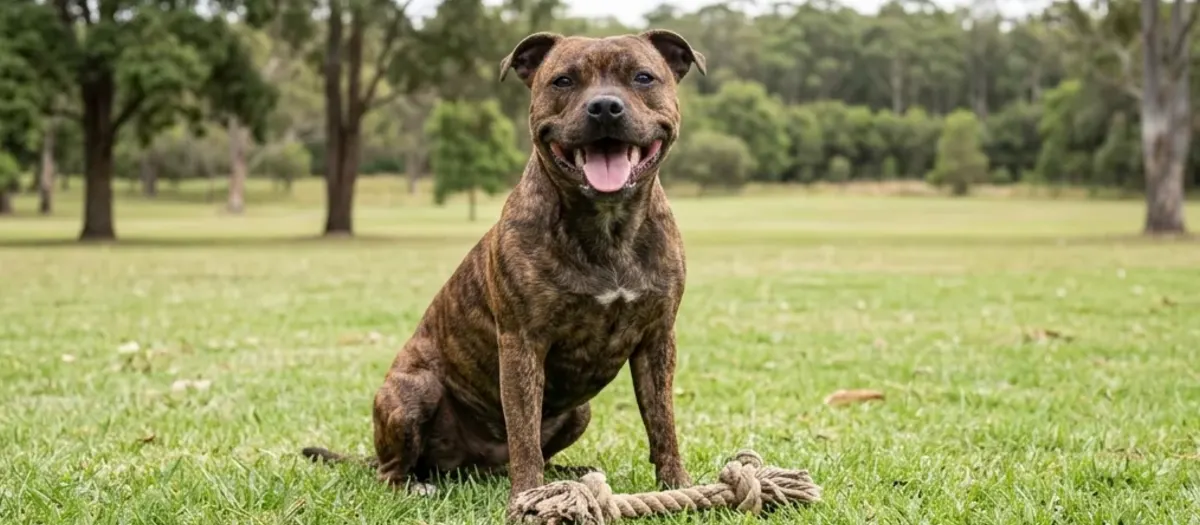
Quick answer: A staffy (Staffordshire bull terrier) is a compact, muscular, short-coated dog, usually about 36 to 41 cm tall and 11 to 17 kg. Breed standards describe them as courageous, bold and people-loving. They suit active owners who can offer daily exercise, training, tough toys and careful introductions to other dogs.
Staffies have a big fan base in Australia, and plenty of myths follow them around. This guide sticks to what breed standards and vet sources say, so you can decide whether a staffy fits your home and look after one well.
Staffy at a glance
| Staffordshire bull terrier | |
|---|---|
| Size category | Small to medium, stocky |
| Height | About 36 to 41 cm at the shoulder |
| Weight | Males 13 to 17 kg, females 11 to 15.4 kg (Dogs Australia standard) |
| Lifespan | Often 12 years or more (see below) |
| Coat and shedding | Short, smooth and close. Sheds |
| Colours | Red, fawn, white, black, blue, brindle, or any of these with white |
| Energy | Moderate to high, with bursts of enthusiasm |
| Kids and other pets | Often very fond of people, including children, but some can be pushy or selective with other dogs. Supervise and introduce slowly |
| Grooming needs | Low: a weekly brush and a bath when needed |
Individual dogs vary, and a staffy cross can differ from these numbers.
How big do staffies get?
The Dogs Australia breed standard describes a dog of 36 to 41 cm at the shoulder. The standard lists males at 13 to 17 kg and females at 11 to 15.4 kg. They look heavier than they are because they're so dense with muscle, so watch their waistline rather than the scales alone.
How long do staffies live?
The Royal Kennel Club breed profile gives a lifespan of over 12 years. Lifespan depends on genetics, weight, dental care and the health problems below, so treat any figure as an average, not a promise. Keeping your staffy lean is one of the most useful things you can do for their joints and heart.
What is a staffy's temperament like?
Breed standards describe the staffy as bold, fearless and highly affectionate, especially with people and children. Many are clowns who love contact and want to be wherever you are. That same enthusiasm can mean jumping up, pulling and mouthing if they aren't taught manners early.
Some staffies are excellent with other dogs, and some become less tolerant as they mature, particularly with dogs of the same sex. Early, calm socialisation and training help. Never leave any dog unsupervised with young children, whatever the breed.
If your staffy lunges or barks on lead, our reactive dog training guide is a good place to start. Struggling when left alone is also common in people-loving breeds, and our separation anxiety guide explains what to look for.
How much exercise does a staffy need?
Plan on roughly an hour a day, which matches the Royal Kennel Club profile's "up to 1 hour", split into a couple of walks plus play and brain games. Staffies are strong, so a sturdy lead and a well-fitted harness make walks easier. Fetch, tug and a flirt pole burn energy well, and sniffy walks and training tire their minds. Our guide to dog exercise covers how to judge if your dog is getting enough.
Bored staffies can turn to chewing and digging. Our guides on stopping dog chewing and stopping dog digging have practical fixes.
What toys can a staffy chew?
Staffies have powerful jaws, and many go through soft toys in minutes. Look for firm rubber or heavy-duty toys sized so they can't be swallowed, check them often, and bin anything that's cracking or coming apart. Use the thumbnail test on chews: if you can't make a dent with a thumbnail, it's too hard for teeth. Supervise all chewing.
Our heavy chewer toys guide compares options, and tug toys and puzzle toys give them something to work on.
How do you groom a staffy?
Staffies have short, smooth coats that need very little work. A weekly rub with a soft brush or grooming glove lifts loose hair and spreads skin oils. Bathe only when they're dirty or smelly, using a gentle dog shampoo, because over-washing can dry the skin. Our guide on how often to wash a dog has more detail.
Keep nails trimmed, check ears, and brush their teeth if you can. See our guides to dog nail clippers and cleaning a dog's teeth.
Common staffy health problems
Staffies are generally sturdy. The Royal Kennel Club's health testing list for the breed covers the inherited conditions below, and the other points are general things to watch in any strong, short-coated dog:
- Skin problems and allergies. Itching, red skin, ear problems and paw licking are common reasons dogs see a vet. See itchy skin in dogs and licking paws.
- Inherited eye conditions. Hereditary cataracts are linked to the breed. There is a DNA test for parent dogs, and eye testing can pick up other inherited eye problems.
- L-2-HGA. An inherited condition affecting the brain, for which a DNA test exists. Ask whether both parents were tested.
- Joint problems. Elbow dysplasia screening is on the Royal Kennel Club's list, and extra weight is hard on any dog's joints. Our arthritis in dogs guide explains the signs.
- Lumps. Skin lumps, including mast cell tumours, can occur in many breeds. Have any new lump checked.
- Heat stress. Any dog can overheat, and an excited staffy may keep playing past the point it should stop. Build in rests, shade and water.
Ask your vet about health testing, a sensible weight and regular checkups. This guide can't diagnose anything.
Is a staffy right for you?
A staffy may suit you if you:
- Want an affectionate, people-focused dog who enjoys cuddles and play
- Can offer daily exercise and training
- Have a secure fence, because many staffies can escape if bored
- Are happy to manage introductions to other dogs carefully
- Can handle a strong, enthusiastic dog on lead
A staffy may not suit you if you:
- Are away for long hours most days
- Want a dog who is relaxed about every other dog
- Don't have time for consistent training
Check local council rules, rental agreements and insurance conditions before you commit, because they differ across states and councils.
Caring for a staffy in Australian weather
A staffy's short coat gives little protection from sun or cold, so both ends of the weather need attention.
Summer. Keep walks to cooler parts of the day, never leave a dog in a parked car, and provide shade and cool water. See how to keep a dog cool in summer, and consider a cooling mat. Pale or white staffies can sunburn, particularly on the nose and ears, so a pet-safe dog sunscreen is worth a look.
Winter. The thin coat means many staffies feel the cold. A dog coat or raincoat helps on chilly walks, and a warm bed away from draughts is welcome.
Ticks and snakes. If you live in a paralysis tick area, read our paralysis ticks guide and check your dog daily in season. Know the signs of snake bite too.
Gear that fits a staffy
- Harness. Measure your dog's chest girth and compare it with the maker's size chart instead of guessing by weight, since staffies have deep, broad chests. Our dog harness guide and no-pull harness guide are good starting points.
- Lead and collar. Choose a strong, non-stretchy dog lead and a wide, comfortable dog collar. Never use prong, choke or shock collars.
- Toys. Go for firm, heavy-duty options from our toys for heavy chewers guide, and add a KONG-style stuffable toy for quieter time while you are home, as the brand advises supervision.
- Bed. Pick a hard-wearing, washable bed sized to your dog's length when stretched out. See washable dog beds and chew-resistant bed advice.
- Crate. A medium crate usually suits an adult staffy, but measure from nose to base of tail and shoulder height first. See our medium dog crate guide.
- Coat. Measure back length from the base of the neck to the base of the tail. Our how to measure a dog for clothes guide shows how.
- Brush. A soft dog brush or grooming glove is plenty for the short coat.
- Go straight away for trouble breathing, collapse, or signs of heat stress such as heavy panting, drooling and wobbliness. See keeping a dog cool in summer.
- Go straight away for a suspected snake bite or tick paralysis, or a seizure.
- Swallowing a toy, a chew or a piece of one, or repeated vomiting.
- A new or growing lump.
- Constant itching, sore skin, red ears or a bad smell.
- Bumping into things, or losing confidence in the dark.
- Tremors, unusual wobbling or behaviour changes.
- Limping or struggling to get up. See dog limping.
Frequently asked questions
Are staffies good family dogs?
Many staffies are affectionate and playful with children, and breed standards praise their love of people. Still, no dog should be left unsupervised with young kids. Teach children to respect the dog's space and train your staffy early, and individual dogs will vary.
Do staffies shed a lot?
Staffies do shed, and the short hairs can stick to fabric. A weekly brush and a good pet hair remover keep things manageable. Heavy shedding or bald patches deserve a vet check, because they may point to skin trouble.
Are staffies easy to train?
Many are eager to please and love treats, so reward-based training tends to work well. They can also be stubborn and easily excited. Keep sessions short and upbeat, and use training treats and a clicker. Our puppy training schedule is a good start.
Can staffies be left alone?
Staffies are people dogs, and many struggle with long absences. Build up alone time gradually and give them exercise and attention first. Keep chews and puzzle toys for times you are home to supervise. Read our guide to keeping a dog busy while you work.
What should I feed a staffy?
Choose a complete and balanced food suited to their age, size and activity, and keep an eye on their waistline, since extra weight is hard on joints. Your vet can advise on amounts. Our puppy food guide covers the basics for young dogs.
Do staffies get along with cats and other dogs?
It depends on the dog. Some live happily with other pets, while others have a strong chase drive or dislike other dogs. Introduce slowly, keep pets separated when unsupervised at first, and see our guide to introducing a dog to a cat.
Do staffies need a coat in winter?
Many do. A short, close coat gives little insulation, so some staffies feel the cold, especially when wet or older. If your dog shivers or curls up tight, add a coat and a warm bed.
Related guides
- Best staffy dog food
- Staffy toys
- Staffy harness
- Staffy collar
- Staffy bed
- Best toys for heavy chewers
- Dog harnesses
- Dog bed buying guide
- Labrador guide
- Border collie guide
- Dogs hub
Sources
- Dogs Australia, Staffordshire Bull Terrier breed standard: https://dogsaustralia.org.au/members/breeds/breed-standards/Staffordshire-Bull-Terrier (page read 25 November 2026)
- Royal Kennel Club (UK), Staffordshire Bull Terrier breed profile and health testing list: https://www.royalkennelclub.com/search/breeds-a-to-z/breeds/terrier/staffordshire-bull-terrier/ (page read 25 November 2026)
This guide provides general information and isn't a substitute for veterinary advice. If you're concerned about your dog's health, speak with your vet.