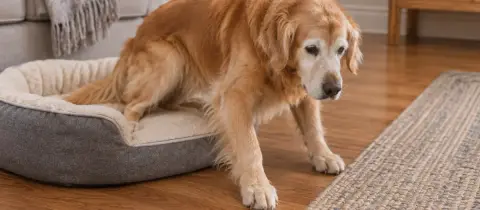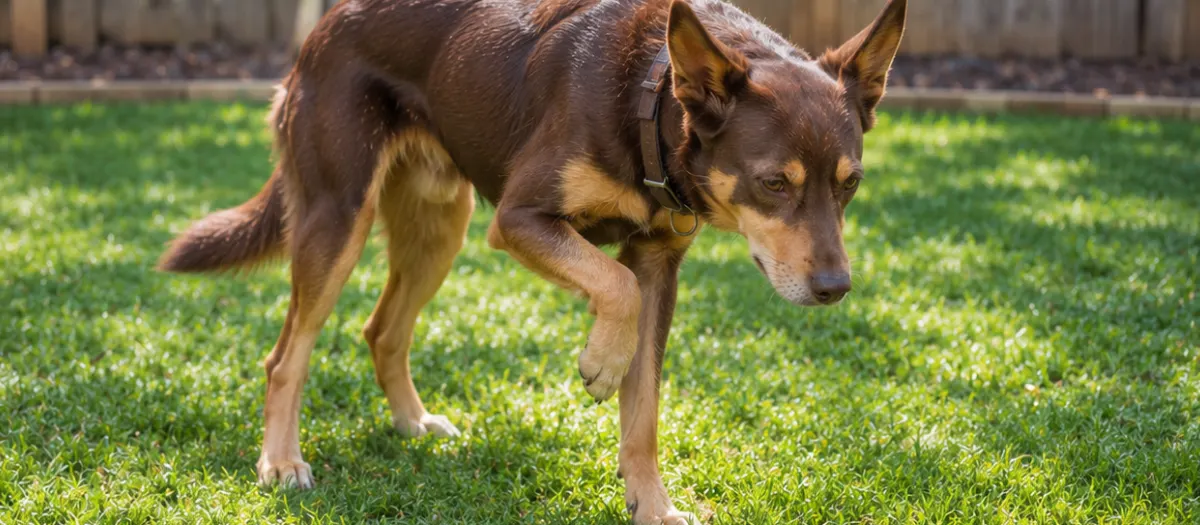
Quick answer: Dog limping almost always means something hurts. Causes range from a sore paw, torn nail or sprain to a joint problem. Check the paw gently and keep your dog quiet on a lead. See your vet straight away for severe pain or a leg your dog won't put down, and don't wait if a limp lasts more than a day or two.
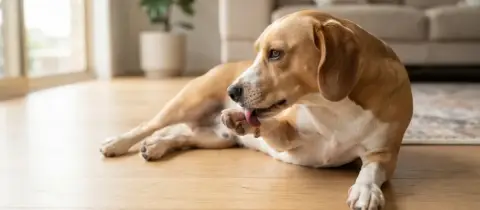
A limp is one of those signs where the pattern matters more than the limp itself: which leg, how it started, and whether it's getting better. This guide walks through the causes, a safe check at home, how to rest your dog and the signs that mean a vet visit. If your dog is mostly licking one paw, our dog licking paws guide covers that side of it.
Why is my dog limping?
Pain is the usual reason. A limp can come from an injury such as a sprain, cut or torn nail, or from a joint or growth condition, and some dogs have more than one problem at once. You can't tell which from the outside, so a vet needs to examine your dog.
Walkerville Vet in Adelaide says a limp is almost always caused by pain, even when a dog doesn't show it in any obvious way. PDSA lists sprains, wounds, claw injuries, something stuck in the foot (glass or a grass seed, for example), broken bones and dislocations, and adds that some dogs hide pain well, so even a minor-looking limp is worth a vet's opinion. Cornell's veterinary college adds that more than one problem can be present together.
Front leg or back leg: what can cause each?
Age and leg help a vet narrow things down. Back leg limps in young dogs are more often hip or knee problems, and in older dogs ligament or hip trouble. Front leg limps are more often elbow or shoulder problems. Paw and nail injuries can affect any leg at any age.
This table is our own summary of the lists in the Cornell, PDSA and Walkerville Vet pages. It's a guide to what a vet may be thinking about, not a way to diagnose your dog.
| Leg | Young dogs | Older dogs | Any age (injury and paw) |
|---|---|---|---|
| Back leg | Hip dysplasia (Cornell's most common cause here, especially in large breeds), panosteitis, luxating patella, tendon or muscle injury | Cruciate ligament tear (Cornell's most common cause here), hip arthritis, spinal disease, bone cancer, foot injuries | Sprain, cut pad, torn or split nail, grass seed, something stuck in the foot, skin problem between the toes |
| Front leg | Elbow dysplasia, panosteitis, osteochondrosis, shoulder problems | Elbow arthritis, shoulder conditions, neck or spinal problems, bone cancer | Sprain, cut pad, torn or split nail, grass seed, something stuck in the foot, skin problem between the toes |
Lists aren't complete, and more than one problem can exist together (Cornell). Weak, wobbly or dragging back legs aren't a normal limp, so call a vet straight away. A paralysis tick is one possible cause, and our paralysis tick guide shows what to look for.
Sudden or gradual: what does the pattern suggest?
A limp that starts suddenly during a walk or play is more consistent with an injury or a sore paw. One that builds over weeks is more consistent with a joint condition. How it started, and whether it's changing, is exactly what your vet will ask.
Cornell says vets ask whether the limp was sudden or gradual, whether it's improving, worsening or switching legs, and whether stairs, jumping or getting up make it worse. Jot down your answers before you go.
| Pattern you see | What it can be more consistent with | What to do |
|---|---|---|
| Sudden, during play or a walk | Injury, a sore paw or nail, a ligament problem (Cornell, PDSA, Walkerville Vet) | Check the paw gently (below), rest on lead, call your vet if it doesn't settle |
| Slowly getting worse over weeks | A joint condition such as arthritis or dysplasia (our reading; both are on Cornell's cause lists) | Book a vet check and read our arthritis in dogs guide |
| Worse after rest, easing once moving | A stiffness pattern (PDSA, Walkerville Vet). Easing doesn't mean healed | Book a vet check |
| One paw licked as well, in grass seed season | A grass seed (Walkerville Vet) | Look between the toes, never dig it out, see your vet |
| Switching from one leg to another | Needs a vet's opinion (Cornell asks about it) | Book a vet check |
| Won't put the leg down at all | Often a painful problem (PDSA) | See your vet immediately |
How do I check my dog's paw and leg safely at home?
Look first, touch lightly and stop if your dog flinches. Check the pads, nails and the skin between the toes for cuts, swelling, something stuck or a torn nail. Don't squeeze joints or dig anything out. Any sign of pain means a vet, not more prodding.
Here's a simple routine, drawn from the paw advice in Walkerville Vet's guides. It's our own practical order, not a vet protocol.
- Let your dog settle. Sit on the floor with calm, quiet company. A stressed dog is harder to read.
- Look at the standing leg. Notice any swelling or heat compared with the other side, and whether your dog holds the leg up or just favours it.
- Check the pads. Look for cuts, cracks, burns or something lodged.
- Check each nail. A torn, split or overlong nail can make walking painful.
- Part the toes gently. Look between them for redness, a small hole, a lump or a stuck seed.
Many dogs don't show pain in any obvious way (Walkerville Vet), so a calm response doesn't clear anything. Grass seeds are a real risk in southern Australia from about October to the end of the year (Walkerville Vet). Never dig one out yourself: the grass seed question below explains what to do.
Bindis and hot pavement are other summer paw hazards. See dog boots for bindis and burnt dog paws for how hot is too hot. A torn or overlong nail may need trimming by someone who knows where the quick is, and our dog nail clippers guide covers that.
When should I take a limping dog to the vet?
Go straight away for severe pain, a leg your dog won't put down, or a serious wound. Don't wait if a limp lasts more than a day or two or is sudden or getting worse. Book a check for mild limps that keep returning, or stiffness after rest.
The wording below follows PDSA and Cornell. The "swollen or hot" and "weak back legs" rows are our own advice, not from a source.
| Sign | How soon | Source |
|---|---|---|
| Severe pain, a leg your dog won't put down, a serious wound | Now | PDSA |
| A swollen, hot or misshapen leg, or crying out when touched | Promptly | Our advice |
| Weak or wobbly back legs, or your dog can't stand | Call now | Our advice |
| A limp lasting more than a day or two, or pain that's sudden or getting worse | Don't wait: book the soonest appointment | Cornell |
| A mild limp that keeps coming back, or stiffness after rest | Book a check | PDSA, Cornell |
If it's after hours and your dog is in pain, phone your nearest 24-hour emergency vet before you go.
How should I rest my dog while waiting to see the vet?
Keep your dog quiet and on a lead. Short toilet trips only, no running, ball games, jumping on and off furniture or rough play. Walkerville Vet says excited dogs forget their injury, so manage the environment rather than relying on your dog to take it easy.
Block off stairs with a dog gate, keep your dog on a rug rather than polished floors (our grip socks guide covers slipping), and put toys away. We can't give a rest period, because it depends on the cause and your vet will tell you how long.
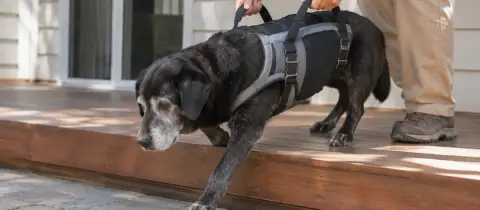
If your dog needs help standing or on steps, a purpose-made lift harness can support them while the vet's plan does the treating. Don't lift your dog by the legs.
What will the vet check?
A vet will ask about the history, watch your dog walk, feel each limb and may suggest x-rays or other tests. Cornell says that in many cases the vet can find the likely source of pain during the physical exam. A short video of the limp from home can be extremely helpful.
Cornell says the gait exam may use different surfaces and circles, and that dogs sometimes move normally in the clinic, which is why a home video helps. Film your dog trotting on a flat surface, from the front, the back and the side. Our FAQ below explains how to tell which leg is sore.
Could a limp be arthritis?
Possibly, particularly in an older dog, or when stiffness builds slowly and is worse after rest. A vet needs to confirm it, because other conditions can look similar. Arthritis can be managed, and our arthritis guide covers the signs and what helps.
Our arthritis in dogs guide has the early signs, home changes and treatment options. For a sudden limp, work through the steps on this page and call your vet.
Useful guides
No product fixes a limp, and the cause comes first. These guides cover gear that can help once your vet has weighed in.
- Dog lift harnesses: rear slings and full-body harnesses that help you support a weak dog on steps, into the car or after surgery, as the vet directs.
- Dog boots: for bindis and hot pavement.
- Dog nail clippers: for a long or split nail.
- Dog first aid kits: what to keep on hand for scrapes and cuts.
- Dog cones: if your vet wants licking or chewing stopped.
- Dog socks with grip: if slipping on floors is part of the problem.
When to see a vet
See your vet immediately if your dog has any of these. If it's after hours, call your nearest 24-hour emergency vet.
- Severe pain, or a leg your dog won't put down
- A serious wound, heavy bleeding or something deeply stuck in the foot
- A swollen, hot or misshapen leg, or crying out when touched
- Weak, wobbly or dragging back legs, or not being able to stand
A limp lasting more than a day or two, or pain that's severe, sudden or getting worse, shouldn't wait either (Cornell).
Never give your dog human pain medicine such as paracetamol, ibuprofen or aspirin. Some are dangerous for dogs, so ask your vet first. If your dog has swallowed any, call your vet or the Animal Poisons Helpline (1300 869 738, 24/7) now. For longer-term stiffness, see our arthritis in dogs guide.
Frequently asked questions
Why is my dog limping but doesn't seem to be in pain?
A limp nearly always means something hurts. Walkerville Vet says a limp is almost always caused by pain, even when a dog doesn't show it, and PDSA notes some dogs hide pain well. Your dog may still eat, play and wag as normal. Film the limp and book a vet check rather than assuming it's harmless.
Should I wait to see if my dog's limp goes away?
Not for long. Cornell says don't wait if a limp lasts more than a day or two, or if pain is severe, sudden or getting worse. A limp that eases once your dog warms up hasn't necessarily healed (Walkerville Vet). If you're unsure, phone your vet clinic and describe what you see.
Can I give my dog paracetamol or ibuprofen for a limp?
No. The MSD Veterinary Manual says human anti-inflammatories shouldn't be given to pets unless a vet directs it. Dogs have a narrow safety margin with ibuprofen, which can cause vomiting, diarrhoea and abdominal pain. Aspirin can cause stomach ulcers and paracetamol can damage the liver. Call your vet or the Animal Poisons Helpline if your dog swallowed any.
Why does my dog limp after sleeping or lying down?
Stiffness that is worse after rest and eases once your dog is moving is a pattern PDSA and Walkerville Vet both describe. It's more consistent with a sore joint than a one-off knock, and easing off doesn't mean it has healed. Book a vet check, and see our arthritis guide.
Why does my dog's limp come and go?
PDSA says stiffness often comes and goes and is usually worse after walks and rest. A limp that keeps returning, or moves from one leg to another, is worth a vet check, because Cornell says vets ask about exactly that. Note which days are worse and film a good and a bad day.
Can a grass seed make a dog limp?
Yes. Walkerville Vet says paws are the most common place for a grass seed, often between the toes. A seed caught soon after it attaches may come out with finger and thumb, but if only a small hole remains, a vet must remove it with sedation and pain relief. Look for a red bump, licking or swelling, and never dig one out.
How can I tell which leg my dog is limping on?
Try the trot test Walkerville Vet describes. Have someone trot your dog towards you from 10 to 20 metres away. We'd pick a flat, non-slip surface. The head tends to lift when the sore front leg lands, and a head drop is easier to see. Back legs are harder to read, so film it for your vet.
Can I walk my dog if they're limping?
Only short, lead-only toilet trips until your vet has seen your dog. Skip off-lead runs, stairs, jumping and fetch, even on a day when the limp looks better. Keep the pace slow on even ground. Ask your vet when normal walks can start again, because that depends on the cause.
Related guides
- Arthritis in dogs: early signs, home changes and vet treatment
- Dog lift harnesses
- Why does my dog keep licking their paws?
- Burnt dog paws
- Dog boots
- Dog nail clippers
- Dog first aid kits
- Paralysis ticks in dogs and cats
- Best joint supplements for dogs
Sources
- Cornell University College of Veterinary Medicine, "What to expect when taking your limping dog to the veterinarian", last updated 5 January 2026, page read 23 November 2026: https://www.vet.cornell.edu/departments-centers-and-institutes/riney-canine-health-center/canine-health-information/what-to-expect-when-taking-your-limping-dog-to-the-veterinarian
- PDSA, "Limping and stiffness in dogs", published July 2019, page read 23 November 2026: https://www.pdsa.org.uk/pet-help-and-advice/pet-health-hub/symptoms/limping-and-stiffness-in-dogs
- Walkerville Vet (Adelaide, SA), "Causes Of Limping On Front & Back Legs", updated 20 February 2024, page read 23 November 2026: https://www.walkervillevet.com.au/blog/dog-limp-front-leg-back-leg/
- Walkerville Vet (Adelaide, SA), "Help! My Dog Has A Grass Seed", updated 28 November 2020, page read 23 November 2026: https://www.walkervillevet.com.au/blog/dog-grass-seed/
- VCA Animal Hospitals, "Arthritis in Dogs", page read 23 November 2026: https://vcahospitals.com/know-your-pet/arthritis-in-dogs
- MSD Veterinary Manual (Australian edition), "Poisoning from human over-the-counter drugs", page read 23 November 2026: https://www.msdvetmanual.com/en-au/special-pet-topics/poisoning/poisoning-from-human-over-the-counter-drugs
This guide provides general information and isn't a substitute for veterinary advice. If you're concerned about your dog's limping, speak with your vet.