Quick answer: Reactive dog training helps a dog that barks, lunges or freezes at triggers such as other dogs feel safer. Start with a vet check, then work below your dog's threshold distance, rewarding calm looks at the trigger. Manage walks so your dog isn't overloaded. A vet behaviourist or qualified reward-based trainer can tailor the plan.
If your dog erupts at other dogs on walks, it's stressful for both of you, and you're far from alone. This guide explains what's going on, how distance and rewards change things, and who to call for help. If the barking happens at home, our guide to stopping dog barking covers windows and fences.
What is a reactive dog?
A reactive dog overreacts to everyday triggers, such as other dogs, strangers, bikes or noises, by barking, lunging or growling. Reactive doesn't mean aggressive. Cornell says reactive dogs are usually fearful, though they can escalate, and Dogs Trust describes reactivity as a sign your dog is struggling, not naughtiness.
Triggers vary. Some dogs react only on the lead, only at night or only in crowded places. Spotting your dog's pattern is the first useful step. If the trouble is guarding food or toys at home, see our food aggression guide instead. To read the quieter signals before the big reaction, see our dog body language guide.
Why do dogs lunge and bark on the lead?
Reactivity is usually fear, frustration or over-arousal, and pain can play a part. On a lead your dog can't flee or say hello, so barking and lunging may be its way of making something scary go away or reaching something it wants. Dogs Trust says that if the reaction works, your dog is likely to repeat it.
The table pairs each pattern with what it can look like. It's a guide to patterns, not a diagnosis, and a dog can show more than one.
| Type | What it can look like | What tends to help | Source |
|---|---|---|---|
| Fear | Barking or lunging when a trigger gets close, calming once it leaves | More distance, rewards for calm looks, a way to retreat | Dogs Trust, Cornell |
| Frustration | Pulling and whining towards a dog it wants to greet, worse on the lead | Distance, rewards for looking away, quiet routes | Dogs Trust |
| Over-arousal | Quick to wind up, hard to settle, may bounce between triggers | Calmer outings, enrichment, shorter walks | Dogs Trust |
| Pain-linked | A new reaction, or less tolerance than before, sometimes with stiffness or changes in appetite or toileting | A vet check first | Dogs Trust, VCA |
A vet check matters because pain and illness can lower a dog's tolerance, which is why vets rule them out before behaviour work. Dogs Trust says to get a check early, especially if the reactivity is new.
What is threshold distance?
Threshold distance is how close your dog can get to a trigger and still cope. VCA describes training that keeps your dog below the point where fear or stress shows. A simple check: can your dog still take a treat and glance back at you? If not, you're too close, so add distance.
Use the table at the distance where your dog is, not where you wish it were.
| Sign at this distance | What it suggests | What to do |
|---|---|---|
| Loose body, takes treats, looks back at you | Your dog is coping | Train here: reward calm looks at the trigger |
| Stiffer body, slow to take food, watching closely | Your dog may be close to its limit | Add some distance, or move on and try again further away |
| Staring, can't take food, pulling or lunging | Your dog is likely over threshold | Calmly leave, then try again much further away on another day |
Signs a dog is nearing its limit can include a stiff body, ears pinned back, a fixed stare or trying to move away. Your dog's own signs may differ, so learn them. Our dog body language guide can help.
How do you train a reactive dog?
Train at a distance where your dog stays calm, and pair the trigger with something wonderful. VCA calls this desensitisation (gradual, low-level exposure) combined with counter-conditioning (pairing the trigger with a very high-value reward). Progress only while your dog stays relaxed. Results vary, and some dogs need ongoing management.
Here's the shape of a session:
- Choose a quiet spot where you can see a trigger from far enough away that your dog still takes treats.
- Reward the moment your dog notices the trigger. Cornell says to reward as soon as the trigger appears, starting at a safe distance. Many trainers call this the "look at that" game: the instant your dog looks at the trigger calmly, say a marker word or click, then treat.
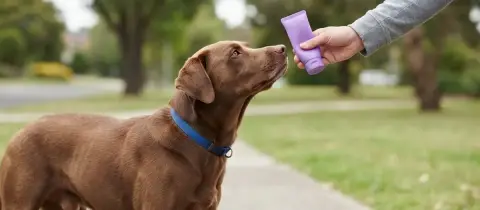
- Use the best rewards you have. VCA recommends very high-value treats in the trigger context. Small, soft pieces or a lick of wet food work well. A squeeze treat tube delivers a reward quickly with your hands clear of your dog's mouth.
- Move closer only when your dog is relaxed at the current distance, and one small step at a time. If your dog struggles, go back a step.
- Keep sessions short and finish while your dog is still coping.
Count training treats in your dog's daily allowance, and keep fillings dog-safe. Our frozen KONG recipes page has the full list of foods to never use. For pieces that suit this work, see our dog training treats guide, and carry them in a treat pouch.
Avoid flooding, which means walking your dog straight up to the trigger to "get used to it". It overwhelms rather than teaches. Cornell also advises avoiding triggers while you train, so the reaction doesn't become a habit.
How do you manage walks with a reactive dog?
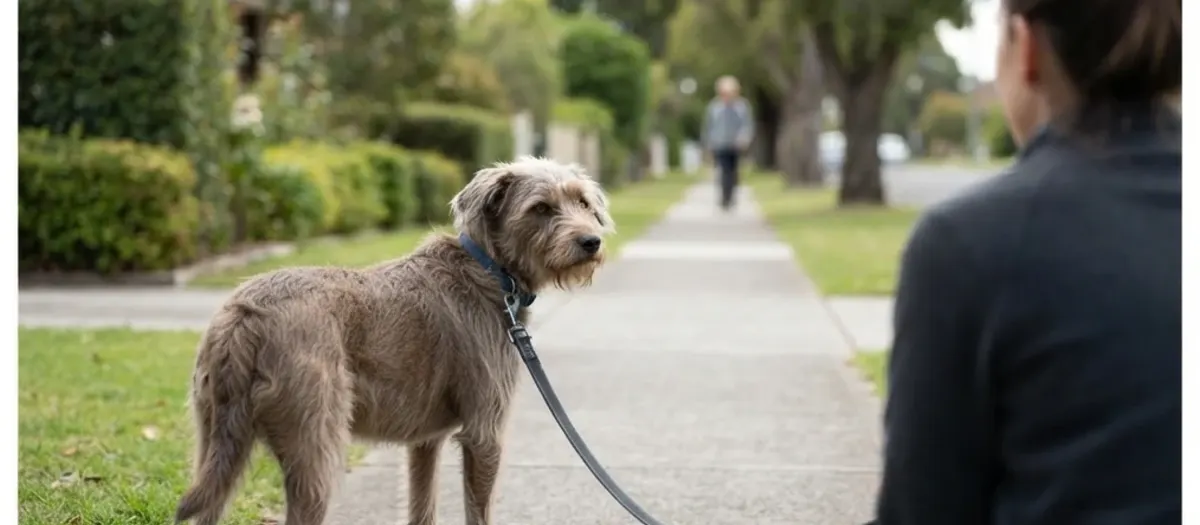
Walk at quiet times, on routes with good visibility and room to turn away, and act before your dog reacts. Dogs Trust suggests giving others a wide berth early, and using parked cars or trees to block the view. Keep the lead relaxed but secure, and keep outings short.
Management counts as progress. Every walk where your dog stays under threshold is a walk where the old habit doesn't get practised.
| Situation | What to do |
|---|---|
| A dog appears ahead | Turn around calmly or cross the road, scattering a few treats on the ground to keep your dog busy |
| A dog comes up behind you | Step off the path, guide your dog to face away, and let the other dog pass |
| An off-lead dog approaches | Call out that your dog needs space, and ask the owner to recall their dog; Dogs Trust suggests speaking up for your dog this way |
| A narrow path | Avoid it for now, or wait at a wide spot and let others pass |
| Strangers want to say hello | Say no thanks; Cornell says your dog doesn't need to be friends with everyone |
VCA suggests stepping off the path and standing still rather than pulling your dog along, and changing routes or times to avoid other dogs. RSPCA Australia says a reactive dog may suit quieter streets and parks without other dogs, and that you can ask owners to put their dogs on lead until you've passed (RSPCA Australia, 6 April 2021, page read 23 November 2026).
Why shouldn't you punish a reactive dog?
Punishment can make reactivity worse. VCA says it can raise arousal and teach dogs to skip their milder warnings. Dogs Trust says telling a dog off can suppress the growl, so a dog may go straight to lunging or biting. RSPCA Australia calls reward-based training the most humane and effective approach.
That means no lead pops, spray bottles, shaker cans, shouting or pain-based gear. Your dog isn't being stubborn or trying to dominate anyone. It's scared, frustrated or overexcited, and it needs help to feel differently. Our dog body language guide explains why a growl is a warning worth keeping.
What gear helps, and what to avoid?
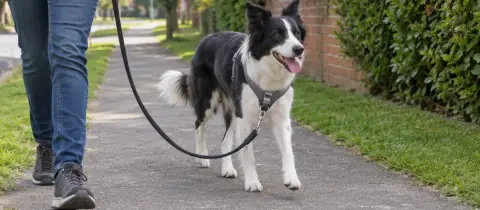
A well-fitted harness and a sturdy, secure lead give you safe control. VCA says walking gear should be secure, well fitted and sturdy, and suggests considering a basket muzzle if you worry your dog might bite another dog. Gear gives you control. Training is what changes how your dog feels.
Never use e-collars, prong, choke, slip or martingale collars, or lead corrections. They rely on pain or fear, which is the opposite of what a reactive dog needs. A basket muzzle is different: Dogs Trust says it improves safety and lets a dog pant, drink and take treats, but it doesn't change how your dog feels. Introduce it slowly with treats, never as a punishment, as our dog muzzle guide explains.
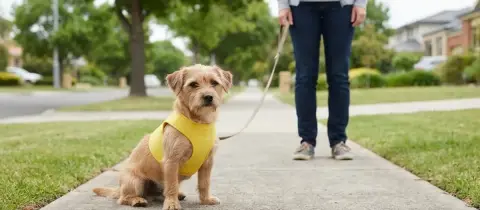
Yellow "give me space" gear is a polite signal to other people. It isn't a training tool, and some people won't notice it. If you use patches, stick to "Do Not Pet" or "needs space" wording. Our give me space vest guide has the details.
Useful guides
These guides compare gear that supports the plan. None of it replaces the training.
- Dog treat squeeze tubes: wet-food rewards delivered fast, at a distance
- Give me space dog vests and leads: a signal to people, not training
- Front clip dog harnesses: control for a dog that pulls
- Dog head collars: only after your dog is conditioned to wear one
- Dog muzzles: basket muzzles only, for safety
- Long dog leads: for quiet open spaces
- Dog treat pouches: treats ready on every walk
- Dog training treats: small, soft rewards
When should you see a vet or vet behaviourist?
See your vet first, then a qualified reward-based trainer or a veterinary behaviourist, which your vet can refer you to. Pain or illness can drive reactivity, so rule that out before behaviour work. Get help sooner if your dog has bitten, or if the reactions are getting stronger.
A veterinary behaviourist can assess both emotional and physical causes and build a plan. VCA says they may add medication alongside behaviour work, never instead of it. Ask any trainer about their methods, and avoid anyone who uses punishment or aversive gear.
When to see a vet
Book a vet visit before starting a training plan, and sooner if your dog's reactivity comes with any of these:
- a reaction that is new, or much stronger than before
- stiffness, limping, or flinching when touched
- changes in appetite, toileting or sleep
- a bite or near-bite, or reactions that are escalating
- a dog that seems unable to settle or relax at home
Ask your vet about referral to a veterinary behaviourist if progress stalls or safety is a worry. If a fight leaves a wound, see a vet the same day.
Frequently asked questions
Can a reactive dog be cured?
Many reactive dogs improve a lot with steady work, but "cured" isn't a promise anyone can make. Dogs Trust says both the feelings and the habits can change with training and support. Some dogs need management for life, and results vary. Counting calmer walks and quicker recoveries is a fair measure.
How long does it take to train a reactive dog?
There's no set timeline. Progress depends on your dog, how strong the trigger is, how often it gets rehearsed and how consistently you can keep your dog below threshold. VCA says to move on only when your dog is calm. Expect small steps and some setbacks rather than a quick fix, and results vary.
Should I take my reactive dog to the dog park?
Not while you're training. VCA advises that a dog who has been aggressive in a group setting, such as a dog park or daycare, stays out of group settings until treatment is finished, and Cornell says to avoid the dog park. A busy off-lead park gives your dog repeated chances to practise the reaction, so choose quiet streets and empty spaces instead. Dog park visits aren't socialisation for a reactive dog.
Is a reactive dog an aggressive dog?
No, though the two can overlap. Cornell says reactive dogs are usually fearful, while aggressive dogs intend to cause harm, and that any reactive dog can escalate. Treat reactivity seriously, keep a safe distance and your dog under control, and ask your vet or a behaviourist for help if your dog has bitten.
Does desexing help a reactive dog?
It isn't a reliable fix for fear-based reactivity. Reactions driven by fear, frustration or over-arousal are mostly changed by training, management and, where a vet advises, other support. Whether desexing makes sense for your dog is a conversation for your vet, who knows your dog's age, health and history.
What's the difference between a dog trainer and a vet behaviourist?
A reward-based trainer teaches you and your dog new skills and routines. A veterinary behaviourist is a vet who assesses emotional and physical causes and can add medication alongside behaviour work (VCA). Start with your own vet, who can refer you, and ask any trainer to explain their methods.
Do puppies grow out of reactivity?
Not reliably. Cornell warns that reactive behaviour can become an ingrained habit, so it's worth acting early rather than waiting. Puppies and young dogs are still learning, which can help, but reactivity that persists or builds deserves a vet check and a reward-based plan. Never punish a puppy for barking or lunging.
Related guides
- How to stop a dog barking at the window, the fence and when you're out
- Dog side eye and whale eye: how to read your dog's body language
- Food aggression in dogs: why dogs guard bowls, bones and toys
- Give me space dog vests and leads
- Squeeze treat tubes for dogs
- Dog muzzles
- Front clip dog harnesses
- Dog scared of fireworks or thunder?
- Dog separation anxiety
Sources
- Dogs Trust: Reactive dogs, why it happens and how to help, read 23 November 2026
- VCA Animal Hospitals: Reducing fear and stress with desensitization and counterconditioning, read 23 November 2026
- VCA Animal Hospitals: Treatment of aggression toward unfamiliar dogs, read 23 November 2026
- Cornell University College of Veterinary Medicine, Riney Canine Health Center: Managing reactive behavior, read 23 November 2026
- RSPCA Australia: Top tips for dog park etiquette, 6 April 2021, read 23 November 2026
- RSPCA Australia: The do's and don'ts of training your dog, 28 March 2019, read 23 November 2026
This guide provides general information and isn't a substitute for veterinary advice. If you're concerned about your dog's behaviour or health, speak with your vet.