Quick answer: Dog food aggression is when a dog growls, freezes or snaps to keep food, chews or toys, and it's usually fear of losing the item rather than dominance. Never take the bowl or test your dog. Feed it somewhere quiet, see your vet, and use trade-ups with professional help if there's any bite risk.
If your dog stiffens or growls when you walk past the bowl, you're not alone, and a calm, patient plan can help. This guide covers why dogs guard, how to read the warning signs, a safe plan and the rules for homes with children. For the body language side, see our dog body language guide.
What is food aggression in dogs?
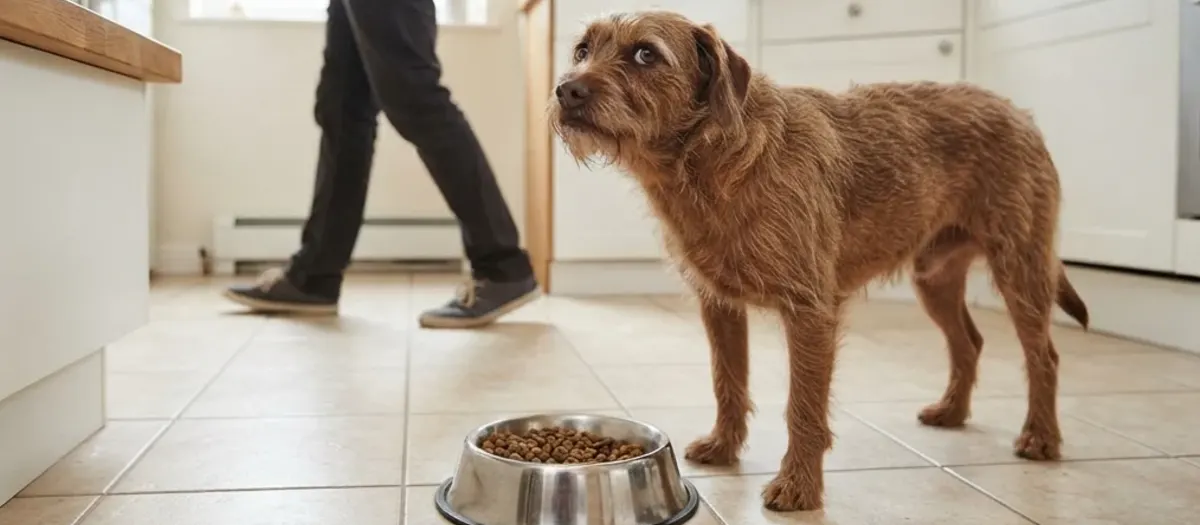
Food aggression, also called food bowl aggression or resource guarding, is when a dog growls, stiffens or snaps to keep food or another valued item when someone comes close. VCA Animal Hospitals says wanting to keep valued things is normal for dogs, and the trouble starts when the early warning signals are ignored.
It isn't limited to the bowl. VCA says the same behaviour can extend to chews, toys, favourite resting spots and even people. ASPCA describes a range from mild, such as running off with the item or growling, to biting or chasing people away. Some dogs guard only certain items, or only from certain people.
Why do dogs guard food, bones and toys?
Guarding is usually driven by fear of losing the item, not by dominance or spite. Dogs Trust lists competition, past success, stress, over-arousal, pain, illness and medicines that change hunger as contributors, and says taking things away or telling a dog off can make the worry worse.
Two points are easy to miss. A new food can seem more valuable to a dog (VCA), and a guarding response that has worked before is more likely to be repeated (Dogs Trust). That isn't a reason to stand your ground. Backing off keeps everyone safe, and the lasting fix is changing how your dog feels about people near its things, not winning the moment. Reactivity is usually fear, frustration or over-arousal, and pain can play a part. Our reactive dog training guide explains it, including the distance method this page borrows from.
What are the warning signs?
Warning signs usually start quietly: eating faster, pausing, going stiff or still, or staring at whoever approaches. Whale eye, lip licking and a body lowered over the item can follow, then growling, snapping and biting. Read the signs together and against your dog's normal, and treat a growl as useful information.
The table is a guide to patterns, not a diagnosis. It draws on VCA, Dogs Trust and ASPCA.
| Stage | What it can mean | What to do now |
|---|---|---|
| Eats faster or gulps | May be worried about losing the food | Give space and don't hover |
| Pauses, freezes or stiffens | May feel the item is under threat | Step away calmly, no reaching |
| Stares, shows whale eye, licks lips, lowers body over the item | Tension is rising | Back off and let your dog finish alone |
| Growls | A clear request for space and a useful warning | Stop, move away, never punish |
| Snaps or bites | The earlier signals didn't work | Stay safe, separate your dog from people, then call your vet and a behaviour professional |
What should you do when your dog growls over food?
Stay calm, stop what you're doing and quietly step away. VCA says not to scold, reach for the food or confront your dog, and not to test it by reaching toward the bowl. Never remove the bowl mid-meal. A growl is a request for space, and punishing it can remove the warning before a bite.
If you need to retrieve something harmful, call your dog away or create a distraction rather than grabbing. Our body language guide explains why growls are worth listening to.
How do you stop food aggression?
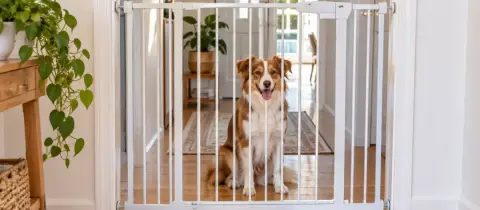
Start with management today, get a vet check, then train only if there's no bite risk. Management means a quiet feeding spot behind a gate or closed door, set meal times and picking up empty bowls. Training then uses trade-ups and staged approach-and-toss at a safe distance, and results vary from dog to dog.
Step 1: Manage the space
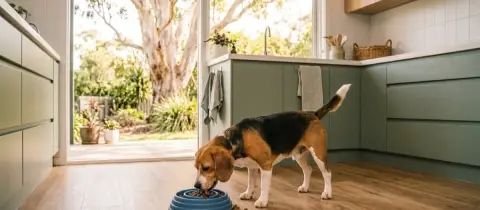
VCA suggests feeding at set times in a low-traffic area, using a crate, gate or closed door to separate your dog from people and other pets, and picking up empty bowls afterwards. Dogs Trust adds that long-lasting chews shouldn't be given in busy areas, and suggests counting the treats you give and checking they've all been eaten, because a hidden treat can be guarded later. Management doesn't change how your dog feels, and Dogs Trust warns it can give a false sense of security, so treat it as the first step, not the finish.
Step 2: Check with your vet
VCA recommends a vet visit before any training, to confirm a healthy weight and rule out illness that could raise hunger or irritability. Dogs Trust also links guarding with pain. Tell your vet if you notice a recent change, and ask about a referral if there's any bite history.
Step 3: Trade up, don't take
Dogs Trust suggests swapping for something of equal or higher value, tossing it away from the item so your dog chooses to leave it, rather than grabbing, chasing or cornering. Keep trades small and dog-safe. The table shows ideas that fit what VCA, ASPCA and Dogs Trust describe.
| Guarded item | Good trade | Notes |
|---|---|---|
| Food bowl | Small pieces of something better than the meal, tossed toward the bowl from a distance | Keep your hands out of the bowl. Count trades in the 10% treat allowance (VCA), as in our dog treats guide |
| A chew | A small, higher-value treat tossed away from the chew | Don't give long chews in busy areas. Cooked bones are never safe, and real bones fail our thumbnail test, so see our natural chews guide |
| A toy | A different toy, or a lick of dog-safe wet food from a squeeze tube | A squeeze treat tube lets you reward from a distance |
| A stolen sock or tissue | Call your dog away, then toss treats in the other direction | Don't chase. Phone your vet if it may have been swallowed |
Only dog-safe foods belong in trades. Our frozen KONG recipes guide has the full list of foods to never use.
Step 4: Approach and toss, only with no bite risk
ASPCA describes a staged method called approach and toss. You stand a short distance from the bowl (ASPCA says a few feet, roughly a metre) and toss a better treat toward it without approaching, then move one step closer on later days and drop a treat in the bowl as you pass. Move on only after your dog has eaten relaxed for 10 meals in a row. Stop at once if your dog stiffens, tenses, gulps, stares or growls.
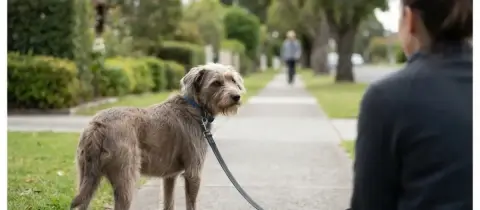
Our reactive dog training guide explains the same "stay below the level where your dog gets worried" idea. VCA and ASPCA both say to get professional guidance first if your dog already growls, snarls, snaps or has bitten. A basket muzzle may be introduced under professional guidance for safety, as our dog muzzle guide explains, but it never fixes the guarding.
How do you keep children safe around a dog that guards?
Keep children away from your dog while it eats, rests or has a chew or toy, and never let them run the training exercises. ASPCA says children are more likely to be bitten and less likely to spot warning signs, so adults handle feeding and the household rules do the protecting.
Here is a household checklist built from VCA, ASPCA and Dogs Trust:
- One adult feeds your dog, in the same place, at set times.
- Feed behind a gate, closed door or crate, and nobody goes in during the meal.
- Children never approach a dog that is eating, resting or holding a chew or toy.
- Adults supervise closely, and children never do the exercises (ASPCA says not under 18).
- Pick up bowls once they're empty, and check for dropped or hidden food.
- Give chews and toys only when your dog is separated from children.
- With visitors, take food off tables and counters or put your dog in another room, because dogs can guard food meant for people (ASPCA).
- Nobody reaches into the bowl, tests your dog or scolds it.
- Give your dog a quiet safe space children can't enter.
A dog gate is the simplest barrier for the feeding spot.
What about two dogs at feeding time?
Feed dogs in separate rooms or behind a gate, and pick up bowls, chews and toys before they come back together. Dogs Trust says dogs who live together can develop their own rules about resources, so separating dogs during feeding and enrichment, supervising, and giving each a safe space are the usual advice.
Dogs that are fine with people can still guard from each other. If a growl ever turns into a scuffle, stop offering high-value items when both dogs are present and ask a behaviour professional for a plan.
When should you see a vet or behaviour professional?
See your vet first, especially if the guarding is new or sudden, because pain, illness or medicines that change hunger can play a part. Then, if your dog already growls, snaps or has bitten, work with a qualified reward-based trainer or a veterinary behaviourist, which your vet can refer you to, before any exercises.
Look for someone with documented experience treating aggression who uses reward-based methods, and ask how they work. Bring videos, a diary or notes of what happens to the appointment, as Dogs Trust suggests.
Useful guides
Gear helps with management and rewards. It doesn't treat guarding, and none of it replaces the steps above.
- Dog gates: feed your dog behind a gate so nobody wanders in mid-meal.
- Slow feeder bowls: ASPCA says slow-feed bowls can help a dog that gulps, best used in the separate feeding spot.
- Lick mats: a calm way to serve a meal, used under supervision in the quiet spot and picked up when finished, since they can become guarded items too.
- Dog training treats: small, soft, high-value trades.
- Dog treat squeeze tubes: a squeeze of wet food is a handy trade when your hand can stay away from the bowl.
- Dog muzzles: basket muzzles only, introduced slowly with treats under professional guidance, as that page explains.
When to see a vet
Book a vet visit if your dog's guarding comes with any of these:
- guarding that is new, sudden or getting stronger
- a bite, a snap that made contact, or any history of biting
- eating very fast, gulping or swallowing non-food items
- a big change in appetite, weight or thirst
- starting a new medicine, or a new diet, at the same time
- guarding that is aimed at children in the home
If your dog may have swallowed a non-food item, especially with vomiting, see a vet straight away. If it may have swallowed something toxic, call your vet now and the Animal Poisons Helpline on 1300 869 738 (24/7). For the training side, see our reactive dog training guide.
Frequently asked questions
Is food aggression in dogs normal?
Guarding is normal dog behaviour, according to ASPCA and VCA, and many dogs do it to some degree. It becomes a problem when it's aimed at people, especially children, or escalates to snapping or biting. Normal doesn't mean safe to ignore, so manage the feeding space and get help if there's any bite risk.
Should I punish my dog for growling at its food bowl?
No. ASPCA warns that punishing or intimidating a guarding dog can make the guarding worse, and Dogs Trust says punishing a growl can remove the warning before a bite. Step away, manage the space and work on changing how your dog feels about people near its food.
Will my dog grow out of food aggression?
Don't count on it. Dogs Trust says guarding isn't something dogs grow out of without help, and VCA says repeatedly taking a puppy's food can teach it to guard. Leave puppies undisturbed while they eat. If guarding appears, ask your vet about a behaviour professional. There's no set timeline, and results vary.
Why has my dog suddenly started guarding its food?
A sudden change is a reason to see your vet. Dogs Trust links guarding with pain, illness and medicines that change hunger, and VCA says a new diet can seem more valuable. Think about what has changed, such as food, other pets or visitors, and tell your vet, ideally with notes or a short video.
How do I stop my dog guarding toys from my other dog?
Put toys away when you can't supervise, and hand them out one dog at a time in separate spaces. Watch for stiffening or staring, and call the dogs apart calmly rather than grabbing. Dogs Trust suggests separating dogs at feeding and enrichment times and giving each dog its own safe space. If tension keeps building, ask a behaviour professional.
Why does my dog guard things it has stolen, like socks?
Dogs Trust says guarding is usually driven by fear of losing the item, and chasing or grabbing adds to that worry. Call your dog away, toss treats in the other direction, then pick up the item. Keep guardable things out of reach, and phone your vet straight away if your dog may have swallowed one.
Can a dog that guards food live with children?
Sometimes, but only with strict management and professional guidance, never on hope. Keep children and your dog apart at meals and with chews, supervise closely and ask your vet for a referral. ASPCA says children shouldn't do the exercises. A behaviour professional can judge whether your household can keep everyone safe.
Does hand-feeding stop food aggression?
Not as a proven fix. VCA says there's no scientific evidence that hand-feeding, or making a dog wait through a series of cues before meals, prevents or treats food guarding, and waiting may add frustration. ASPCA suggests hand-feeding for a new dog, so treat it as optional, not a cure.
Related guides
- Reactive dog training: why dogs lunge on the lead, and a calm plan that helps
- Dog side eye and whale eye: how to read your dog's body language
- Give me space dog vests and leads
- Dog treat squeeze tubes
- Dog gates
- Slow feeder dog bowls
- Lick mats for dogs
- Dog muzzles
- Natural dog chews: which are safe
Sources
- VCA Animal Hospitals: Aggression in dogs, food-related, updated 27 June 2025, page read 23 November 2026
- ASPCA: Food guarding, page read 23 November 2026
- Dogs Trust: Resource guarding in dogs, how to keep everyone safe, page read 23 November 2026
This guide provides general information and isn't a substitute for veterinary advice. If you're concerned about your dog's guarding, eating or behaviour, speak with your vet.