Front clip dog harness: how it works, front vs back vs dual clip, and when it's the wrong choice
By Anish PuriUpdated 19 Nov 202619 min readResearched, not tested by us
Research guide. WhiskerFinds may earn a commission from links, at no extra cost to you.
Quick answer: A front clip dog harness has a lead ring on the chest, so when your dog surges ahead the lead turns them sideways and back towards you instead of letting them lean in. It helps manage pulling alongside reward-based training and doesn't fix it alone. Our top pick is the Eagloo No Pull Dog Harness, a dual clip with front and back rings.
Where the lead clips on changes what happens when your dog pulls. This guide explains how a front clip works, compares front, back and dual clips, and covers when a front ring is the wrong tool. It also shows where the ring should sit and why it can tangle small legs, and compares five harnesses by cm. For the wider "do no-pull harnesses work?" question and a different set of picks, see our no pull dog harness guide. To choose a harness type from scratch, start with our dog harness buying guide, and for putting one on, how to put on a dog harness.
Quick picks
Our top pickBest overall
Eagloo No Pull Dog Harness, Large
Dual clip with metal front and back rings, handle and a wide cm range
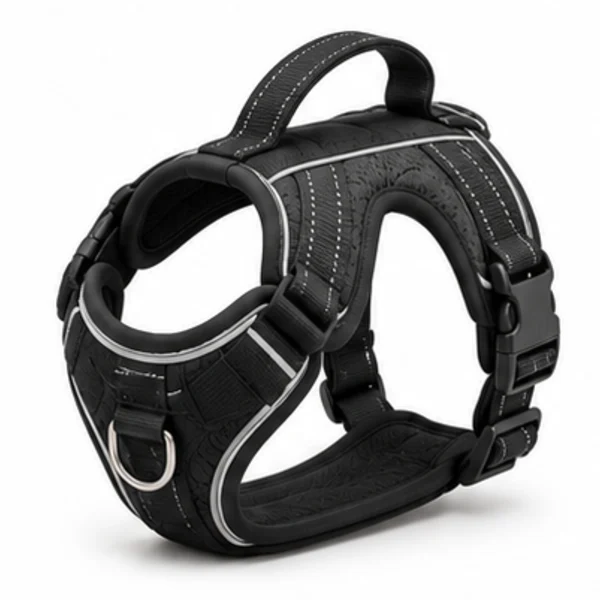
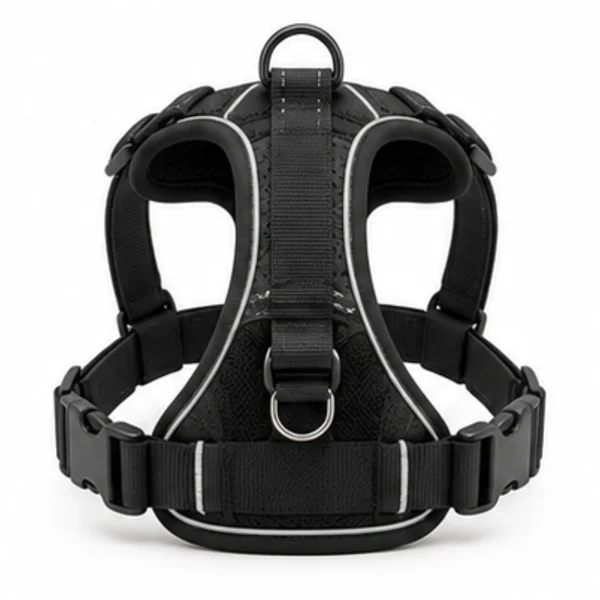
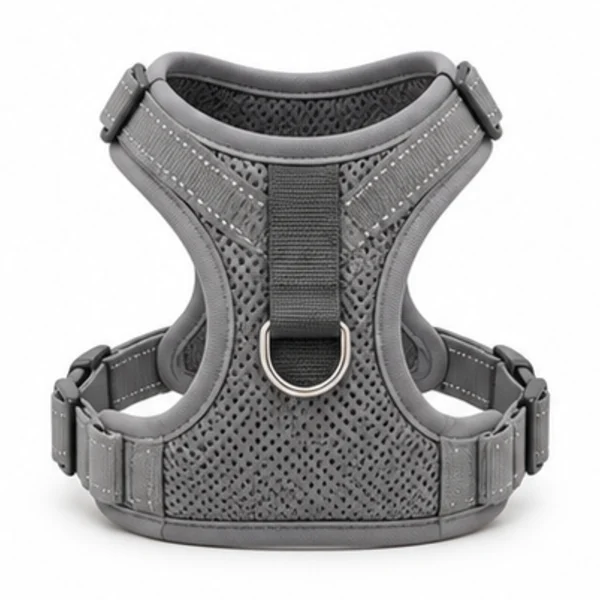
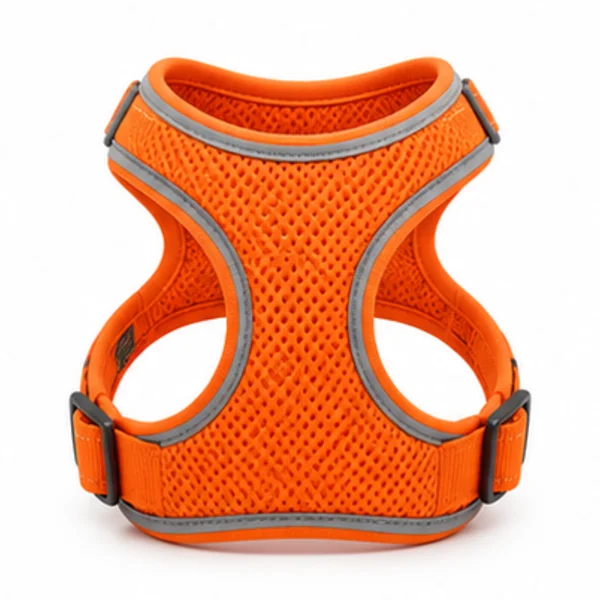
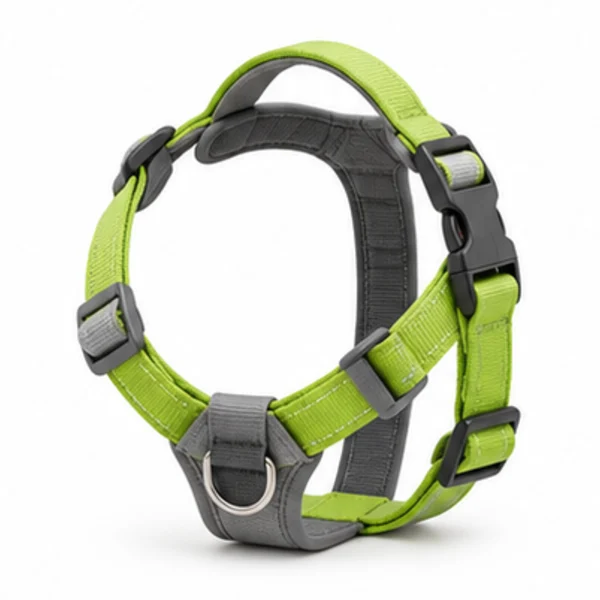
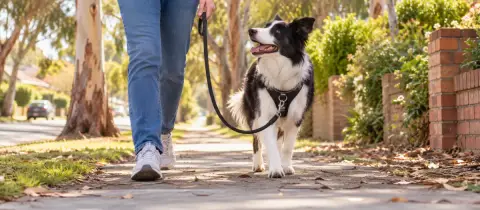
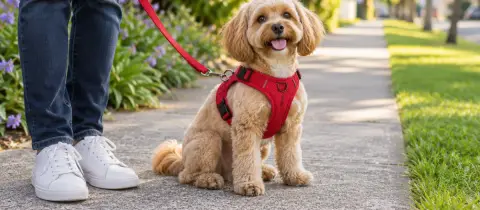
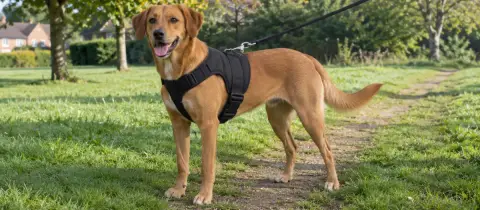
Pictures are illustrations, not the actual products.
How does a front clip dog harness work?
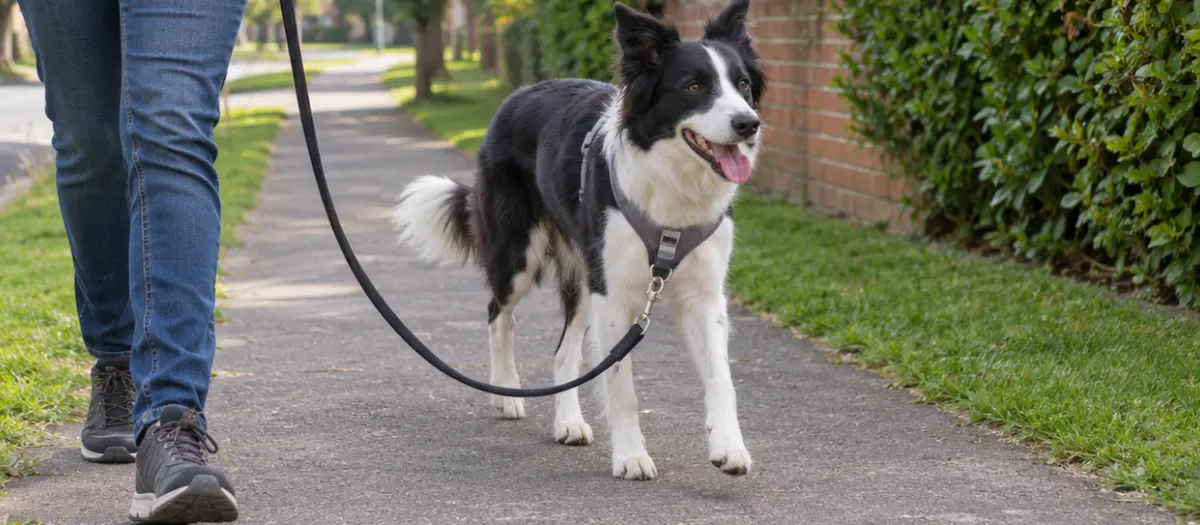
A front clip harness moves the lead attachment from your dog's back to the middle of the chest. When your dog pulls, the lead tugs the chest sideways, so they swing round towards you instead of charging on. RSPCA South Australia says that because a dog's centre of gravity sits at the chest, a front-attaching harness gently turns the dog towards you (RSPCA SA, "The best-ever walking harness for your dog", page read 19 November 2026).
A back ring does the opposite. Pulling against a ring between the shoulder blades lets your dog lean into the harness and tow, which is why RSPCA SA calls a back-attaching harness a next step for dogs that already walk on a loose lead. One study of 52 shelter dogs, covered in a 2025 review, found dogs pulled more in a back-clip harness than in a collar (Cavalli & Protopopova, Animals, 2025, page read 19 November 2026).
Front clip vs back clip vs dual clip: which is better?
A dual clip is the most flexible, because it has both rings. Use the front ring while your dog is learning, the back ring once they walk on a loose lead, or a double-ended lead on both. A front-only harness suits a dedicated puller. A back-only harness suits a dog that doesn't pull.
Swipe sideways to see every column
Clip
What happens when your dog pulls
Control
Tangle risk
Suits
What the research says
Front ring
Chest is turned sideways, towards you
Good
Higher, the lead sits between the front legs
Dogs that pull, in training
RSPCA: gentle training aid
Back ring
Dog can lean in and tow
Least
Low
Dogs that already walk on a loose lead; chest-strap or Y designs suit flat-faced dogs and non-pullers
One study in the 2025 review: more pulling than a collar
Dual clip
Depends which ring you use
Best of both
Front ring only
Most households
Non-tightening front clips balance comfort and less pulling
The same 2025 review says non-tightening front-clip harnesses "appear to offer the best balance between discomfort and reduction in pulling", and that "tightening harnesses, martingale collars, and head collars can pose greater discomfort and should be used with caution". That's why four of our five picks don't tighten. The Easy Walk below does.
On shoulders, the research is mixed. A small treadmill study of nine dogs found both harness types reduced shoulder extension against no harness, and the Y-shaped (non-restrictive) harness reduced it slightly more than the chest-strap one (Lafuente et al., Veterinary Record, 2019). No design is proven best, so focus on fit.
Our picks in detail
1. Eagloo No Pull Dog Harness, Large: best overall
A padded mesh vest with two metal D-rings, one on the back and one on the chest, and a handle on the back. It goes over the head, closes with quick-release buckles and adjusts in four places. The listing gives the Large as a chest girth of 38 to 90 cm and a neck of 40 to 63 cm, and says it's reflective, polyester and not chew-proof. Hand wash with mild soap and dry fully before use. The listing also says animals shouldn't be tied without supervision.
What sets it apart is a front and back ring, a handle and a wide cm range on one size. A non-tightening dual clip is the design the 2025 review favours.
Pros: non-tightening front ring; metal rings; handle; reflective; wide chest range
Cons: goes over the head; the listing's "choose a larger size" line is poor fit advice; not chew-proof; the wide range means careful adjusting
Best for: medium to large dogs that pull, and owners who want front and back rings
Skip it if: your dog hates things over the head (picks 2 or 3)
2. BARKBAY No Pull Dog Harness, 3 Buckles, Medium: best buckle-on (nothing over the head)
The title, bullets and directions describe a harness you open, fit around your dog's body and buckle up, so nothing goes over the head. One line in the description says it slips over the head and secures at the sides, which looks left over from the brand's older design, so check the listing's pictures before you rely on the buckle-on fit. The listing says it has a front O-ring for more control in training and a D-ring on the back, a handle, reflective stitching, an Oxford outer and a mesh lining with sponge padding, and four points of adjustment.
The catch is sizing. The title says the Medium fits a chest of 56 to 69 cm (22 to 27 in), but the description chart says Medium is a neck of 41 to 56 cm and a chest of 43 to 61 cm (16 to 22 in and 17 to 24 in). They don't agree. Measure your dog, compare with the size chart image on the listing and size up if between. The Small in pink is the same product in a smaller size.
Pros: nothing over the head; front O-ring and back D-ring; handle; reflective
Cons: the listing's two size statements disagree, and its description and directions disagree on whether it goes over the head; no washing instructions listed
Best for: wriggly dogs that dislike things over their head
Skip it if: you want a size chart you can trust at a glance (picks 1 or 3)
3. PHOEPET No Pull Dog Harness, Medium: best budget dual clip for small and medium dogs
A light vest with three buckles (a lockable one at the neck and two on the chest) so it doesn't go over the head, two metal rings and a soft handle on the back. The listing says reflective material and four adjustable clips, and gives a full chart from XS to XL (table on this page). The Medium is a neck of 36 to 51 cm and a chest of 41 to 71 cm. Our no pull harness guide features the Small.
Pros: buckles, no over-the-head; five sizes with a full cm chart; reflective; soft handle
Cons: the handle is soft, so it's for steadying rather than lifting; measure both neck and chest and check the strap lengths
Best for: small and medium dogs that dislike things over the head
Skip it if: your dog's chest is over 99 cm, the top of the PHOEPET XL, or you want the Eagloo's wider range on one size
4. BARKBAY Air no-pull mesh harness, Large: best mesh for hot days
A vest in air mesh that the listing says is breathable, with "no rip" nylon and anti-chafe padding (the brand's words). It has a front halt ring and a back D-ring, both metal, four adjustment points, reflective strips and an ID tag pocket. The listing says the fit should leave no more than one or two fingers, and that it isn't chew-proof or for tie-out. The listing doesn't give cm sizes, so check the size chart on the listing before you order.
Mesh keeps the coverage light, but it's no cure for summer heat. On hot days walk early or late and see how to keep your dog cool in summer. The same harness in another size is the top pick on our French bulldog harness guide.
Pros: breathable air mesh; front and back rings; ID tag pocket; reflective
Cons: no cm sizes in the listing text; no handle mentioned; not chew-proof
Best for: dogs that run hot and pull
Skip it if: you need a handle or a cm chart at a glance (picks 1 or 3)
5. PetSafe Easy Walk Dog Harness, Medium/Large: the original front clip, with a tightening loop
Not our first choice, but the one many owners already have in the cupboard. It rests across the chest rather than the throat, with a front chest ring, quick-snap shoulder and belly straps and a belly strap in a different colour so you can see where it goes. It has less coverage, so it's light and breathable, and the listing says it's nylon. The maker's Australian chart is in the size table on this page, but it lists Small, Medium, Large and Extra Large, while this listing sells a Medium/Large, so compare your measurements with the size chart on the listing itself before you order. PetSafe says to measure rather than go by weight and to size up if between sizes. The XL on the same line is a separate listing.
The limitation: the listing calls the loop a martingale loop, and says it tightens as your dog pulls, putting gradual pressure on the shoulders. That is a tightening design, which the 2025 review says to use with caution, and VCA warns that some no-pull styles press on the front of the shoulder. Our no pull harness guide leaves tightening designs out for that reason.
Pros: light and breathable; clear maker chart in cm; simple on and off
Cons: tightens when your dog pulls; no handle; no back ring, so no two-point lead method
Best for: an owner who already has one and has fitted it carefully
Skip it if: your dog pulls hard, is still growing, or you want a harness that does nothing when your dog pulls (picks 1 to 4)
Add-on: a double-ended lead
Halti Double-Ended Lead, Large, 2 m
The two-point method needs a lead with a clip at each end. This one is 2 m, the length RSPCA Australia suggests, with two trigger clips and a reflective stripe, and the listing says it has eight uses (the brand's claim). Clip one end to the back ring and the other to the chest, hold the back and use the front to turn. It also appears on our double dog lead guide, and it pairs with the harnesses in our Halti harness guide. A heavy clip is too much for a tiny dog.
Pros: two clips; 2 m; reflective stripe
Cons: takes practice to hold two points; heavy for tiny dogs
Pet shops and vet clinics also sell harnesses and leads, and a staff member can help with fitting. Ask them to check the chest ring sits centrally.
When is a front clip harness the wrong choice?
A front clip is the wrong choice when your dog doesn't pull, is flat-faced, is so small that the lead tangles its legs, has a neck or windpipe problem, or the strap sits across the front of the shoulder. VCA warns that some designs rest over the shoulder joints and restrict movement, and that some "no pull" styles can injure the front of the joint (VCA, "Collar and Harness Options for Dogs", page read 19 November 2026).
Dog that doesn't pull: a back ring is simpler. The review says back-clip harnesses suit flat-faced dogs and dogs that don't pull, especially chest-strap or Y designs. Our French bulldog harness guide covers that fit.
Tiny dog: a front ring on a short body puts the lead between very short legs. See "why does the lead tangle?" below, then our small dog harness guide.
Neck or windpipe problem: VCA describes a body harness with minimal neck pressure as an excellent choice for dogs with tracheal disease or neck pain. Ask your vet which design suits your dog. Pulling hard on the lead is also one of the listed triggers for reverse sneezing. A harness doesn't treat it, and our reverse sneezing guide covers the other triggers and when to see a vet.
Dog that backs out: a front ring doesn't stop that. Our escape proof harness guide covers extra straps, and no harness is escape proof.
Running or hiking: use the back ring. RSPCA Australia doesn't recommend extendable, retractable or bungee leads, so try our hands-free lead guide instead.
Strong pull and you can't hold your dog: a trainer can help before something goes wrong. Head collars are a different tool; see our dog head collar guide, where RSPCA Australia says to try a front-attach harness first.
Where should the chest ring sit, and why does the lead tangle?
The chest ring should sit on the breastbone, in front of your dog's chest and above the point of the shoulder. This is our own reading of the fit advice, and the ring isn't a precise mark, so watch your dog walk. A ring that sits too low swings between the front legs, and the lead can snag or lift a paw as your dog steps.
Swipe sideways to see every column
Ring position
What you see on the walk
Fix
Too low, near the belly strap
Lead catches between the front legs; your dog trips, hops or lifts a leg
Shorten the neck strap so the ring rides higher; if it still sits low, the shape doesn't suit your dog; use the back ring until it's fixed
Too high, at the throat
Collar-like pressure, coughing or the harness riding up
Loosen the neck strap and tighten the chest strap; try the next size
On the breastbone, centred
Lead hangs to one side, dog turns smoothly when they surge
Keep it
Ring off-centre
Harness twists to one side, your dog walks crooked
Re-centre and adjust both sides evenly
Small dogs tangle most because their legs are short and the lead is heavy. RSPCA Australia says heavy leads with large clips are too heavy for small dogs and can strain the neck and spine, and that the lead should be about 2 metres. A shorter lead helps too: the Eagloo listing's own tip is to shorten the lead if it tangles your dog's legs.
For fit, put two fingers under every strap, check behind the front legs for rubbing and watch the stride. RSPCA SA says a loose harness lets a dog slip an elbow through and back out, and the front legs should take full strides (RSPCA SA, "How to fit your dog's walking harness like a pro").
Front clip harnesses compared
Details from each Amazon Australia listing, checked on 19 Nov 2026. "Not stated" means the listing doesn't say.
Swipe sideways to see every column
Harness
Rings
Goes on
Adjustment points
Handle
Tightens?
Reflective
Chest range (cm) listed
Eagloo L
Metal D-rings, back and chest
Over the head
4
Yes
No
Yes
38 to 90
BARKBAY 3 Buckles M
O-ring front, D-ring back
Buckles around the body
4
Yes
No
Yes
Conflicting, see below
PHOEPET M
Two metal rings
Buckles, nothing over the head
4 clips
Soft
No
Yes
41 to 71
BARKBAY Air L
Front halt ring, back D-ring
Over the head
4
Not stated
No
Yes
Not stated
PetSafe Easy Walk M/L
Front chest ring
Quick-snap shoulder and belly straps
4 (maker)
Not stated
Yes, martingale loop
Not stated
Maker chart, below
What size front clip harness does my dog need?
Measure your dog's chest at the widest part of the ribcage behind the front legs, and the neck where a collar sits (AKC, "How to Measure Your Dog for Clothes and Gear"). Go by measurements, not breed or weight. If you're between sizes, size up and adjust the straps snug.
The Eagloo listing also says "for unsafe situations choose a larger size". We'd ignore that. A loose harness is easier to back out of, so size up only when between sizes, as AKC says, then adjust to two fingers.
Swipe sideways to see every column
Harness and size
Neck (cm)
Chest or girth (cm)
Eagloo L
40 to 63
38 to 90
PHOEPET XS
25 to 30
28 to 51
PHOEPET S
30 to 46
36 to 61
PHOEPET M
36 to 51
41 to 71
PHOEPET L
41 to 61
56 to 84
PHOEPET XL
56 to 84
71 to 99
BARKBAY 3 Buckles S (description chart)
33 to 46
33 to 46
BARKBAY 3 Buckles M (description chart)
41 to 56
43 to 61
BARKBAY 3 Buckles L (description chart)
46 to 64
58 to 76
BARKBAY 3 Buckles XL (description chart)
53 to 89
74 to 97
PetSafe Easy Walk S (maker, girth)
Not listed
38 to 53
PetSafe Easy Walk M
Not listed
55 to 81
PetSafe Easy Walk L
Not listed
68 to 101
PetSafe Easy Walk XL
Not listed
81 to 124
The listing sizes for PHOEPET and BARKBAY are given in inches, converted here. The PHOEPET back length for the Medium is 14 cm. The BARKBAY Air has no cm sizes in the listing text, so check the size chart on the listing. The Easy Walk listing we link is a Medium/Large, which isn't on the maker's chart, so check the chart on the listing.
Is the PetSafe Easy Walk a good front clip harness?
It's the original front clip, and the listing says it was created by a veterinary behaviourist, but we'd choose a non-tightening design first. The listing also says that the chest piece has a "patented martingale loop" that tightens, putting gradual pressure on your dog's shoulders when they pull (PetSafe Australia, page read 19 November 2026). The loop sits on the chest piece of a harness. It isn't a collar. In plain words, it tightens a little when your dog pulls.
That's the type the 2025 review says to use with caution, and that VCA's warning about pressure at the front of the shoulder bears on. If you already own one, fit it carefully and watch the stride. If you're buying for a strong puller, start with one of the first four.
Choose by situation
Your dog
Our suggestion
Mild puller, wants flexibility
Eagloo (pick 1), front ring to train, back ring once calm
Strong puller
Eagloo with a double-ended lead; get trainer help if you can't hold your dog
We searched Amazon Australia for front clip and dual clip dog harnesses and shortlisted those that met these checks:
Well rated: a strong average rating with plenty of buyer reviews.
No red flags: no pattern of poor reviews, safety complaints or listing problems.
Available on Amazon Australia when we checked.
A ring on the chest for steering, with a back ring too where possible.
Sizes in cm we could set against a measuring chart, or a clear note where the listing doesn't give them.
Tightening or not stated plainly, because of the 2025 review.
These are researched picks, not products we've personally tested. We compared specs from each Amazon Australia listing, checked on 19 Nov 2026, and no brand paid us or saw this page first. Availability and listings can change. The BARKBAY 3 Buckles and PetSafe Easy Walk are included with their limitations printed, and the Easy Walk isn't our first choice.
Left out this time: other colours and sizes of the same Eagloo (the dark green Large is the same harness in another colour; the Medium is the top pick in our dog harness buying guide); the BARKBAY and PHOEPET models that already feature on our no pull harness guide; and listings that didn't meet the checks above. We never include prong, choke or shock collars.
When to see a vet
See your vet if your dog:
limps, seems stiff or is reluctant to walk after wearing a harness
has redness, sores or hair loss behind the front legs or under the straps
coughs, gags or breathes noisily on walks
has a known neck, windpipe or shoulder problem, so your vet can say which design suits
Talk to a reward-based trainer if your dog lunges, barks or pulls hard at other dogs, people or traffic, or you can't hold them safely. See our dog head collar guide before using any head collar.
Frequently asked questions
Do front clip harnesses hurt a dog's shoulders?
They can if the strap sits across the front of the shoulder or fits badly. VCA warns some designs rest over the shoulder joints and restrict movement. Check that your dog takes full strides, check behind the front legs for rubbing, and ask your vet if your dog changes how they walk.
Can a puppy use a front clip harness?
Yes, with a light, well-fitted one. RSPCA Australia says puppies grow quickly, so check the fit at least a few times a week, and medium and large puppies may outgrow a first harness. We don't have a source for a minimum age, so ask your vet. See our puppy harness guide.
How do I use a double-ended lead with a dual clip harness?
Clip one end to the back ring and the other to the chest ring. Hold the lead from the back and use the front end to turn your dog if they surge. RSPCA Australia and RSPCA SA both describe this method. Aim for about 2 metres of lead, and reward your dog whenever it goes slack.
Is a front clip harness good for a small dog?
Sometimes. A light harness and a light lead help, because RSPCA Australia says heavy clips strain small necks and spines. But the front ring can tangle short legs, so many owners use the back ring on a small dog that doesn't pull. Our small dog harness guide covers fit.
Will a front clip harness stop pulling on its own?
No. It makes pulling easier to manage, but teaching loose-lead walking is what changes the habit. VCA says most dogs need several months of regular practice, and results vary. Reward your dog every few steps when the lead is loose, and stop when it goes tight.
Can I use a front clip harness for running or hiking?
Use the back ring for running and hiking, where you want freedom of movement and a steady pace, and keep the front ring for training walks. RSPCA Australia doesn't recommend retractable or bungee leads. After bush or long-grass walks, take the harness off and check for ticks, as in our paralysis tick guide.
Why does my dog walk sideways or crab in a front clip harness?
It can mean the chest ring is too low, the harness is twisting, or the lead is tight so it steers all the time. Re-centre the ring, loosen the lead and check the fit and stride. If it continues, try the back ring or ask a trainer. Some dogs simply dislike it.
Front clip harness or head collar for a strong dog?
RSPCA Australia suggests trying loose-lead training and a front-attach harness first, because a head collar can jerk the head sideways if used wrongly and many dogs don't tolerate one. RSPCA SA lists them as gear to avoid. Our dog head collar guide covers both views.
Product details and sizes from each linked Amazon Australia listing, checked on 19 Nov 2026.
This guide provides general information and isn't a substitute for veterinary advice. If you're concerned about your dog's walking, pulling or comfort in a harness, speak with your vet.