Best double dog leads: couplers for walking two dogs
By Anish PuriUpdated 2 Nov 202612 min readResearched, not tested by us
Research guide. WhiskerFinds may earn a commission from links, at no extra cost to you.
Quick answer: A double dog lead lets you walk two dogs from one handle, and it works best for two dogs who already walk calmly side by side. Our top pick is the Kelivi no-tangle coupler with a 360-degree swivel. The phrase also means a double-ended lead that clips to one dog in two places, like the Halti.
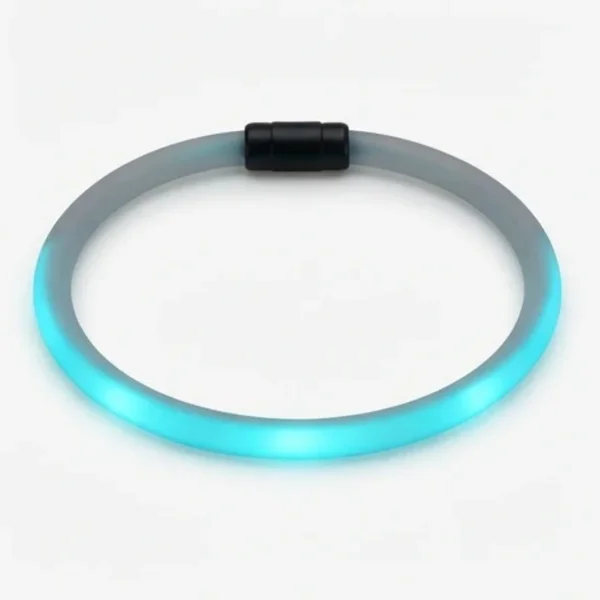
Illustration, not the actual product
Our top pickKelivi no-tangle double dog lead coupler
"Double dog lead" can mean two different things, so this guide covers both: couplers that split one lead into two, and double-ended leads that give one dog extra control. We compare three on Amazon Australia and explain when two separate leads are the better choice. If you're still choosing a basic lead, start with our dog lead guide.
Quick picks
Our top pickBest overall
Kelivi no-tangle double dog lead coupler
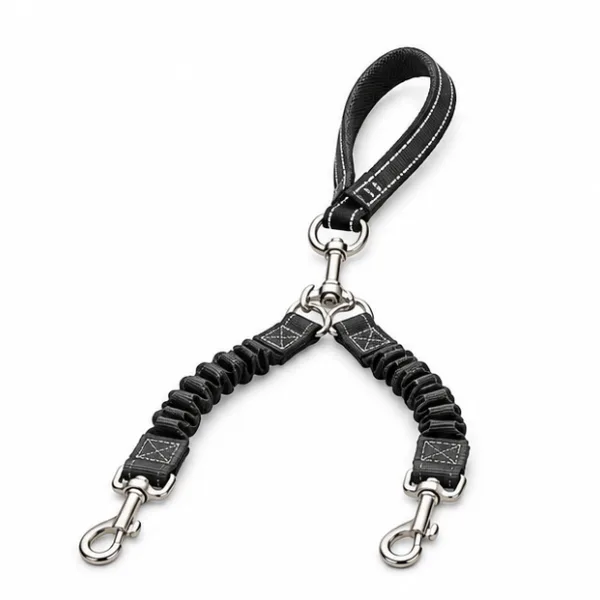
Two swivel snaps on bungee straps that adjust up to 60 cm, with reflective stitching
Pictures are illustrations, not the actual products.
The first and third picks walk two dogs. The Halti is mainly for one dog, though its listing says it can be used with two.
Are double dog leads a good idea?
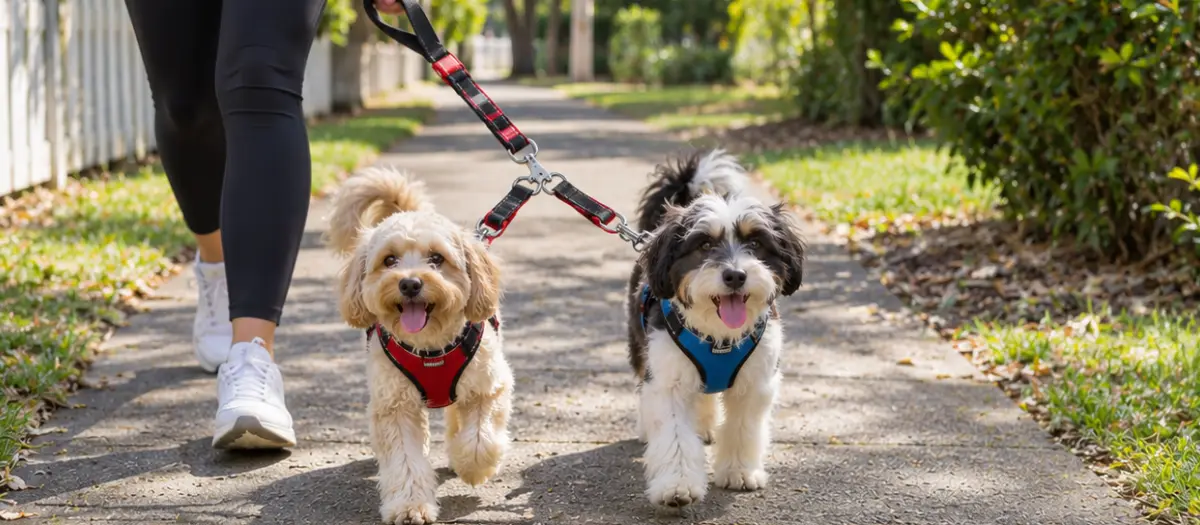
They can be, for two dogs who are calm, similar in pace and already walk well on their own leads. A coupler gives you one handle and one hand free. It is a poor fit for dogs who pull, lunge or don't get along, because two dogs can pull in different directions at once.
The RSPCA's walking advice leans on fit and control: a well-fitted harness, a fixed lead of around 2 metres, and reward-based loose-lead training (RSPCA Knowledgebase, page read 2 November 2026). It advises against extendable, retractable and bungee leads because they reduce control and can encourage pulling. That matters here, because many couplers use bungee, so a coupler works best as a convenience for two well-trained dogs, not a fix for pulling.
A good test: can you walk each dog alone on a normal lead without them pulling? If yes, a coupler is worth trying. If not, work on each dog separately first. Our no-pull harness guide helps with the pulling.
What is a double-ended lead?
A double-ended lead is one lead with a clip at each end, used on a single dog. You clip one end to the front of a harness and the other to the back or to a collar, which gives extra steering. It is not a two-dog lead, even though the name sounds like one.
The RSPCA suggests a front-attach harness with a double-ended lead as a way to manage pulling while you train (RSPCA Knowledgebase, page read 2 November 2026). The Halti's listing says it can be used in 8 different ways, including dual control for headcollars and harnesses, three adjustable lengths and hands-free wear. If you want to go hands free, see our hands-free dog lead guide.
Our picks in detail
1. Kelivi no-tangle double dog lead coupler: best overall
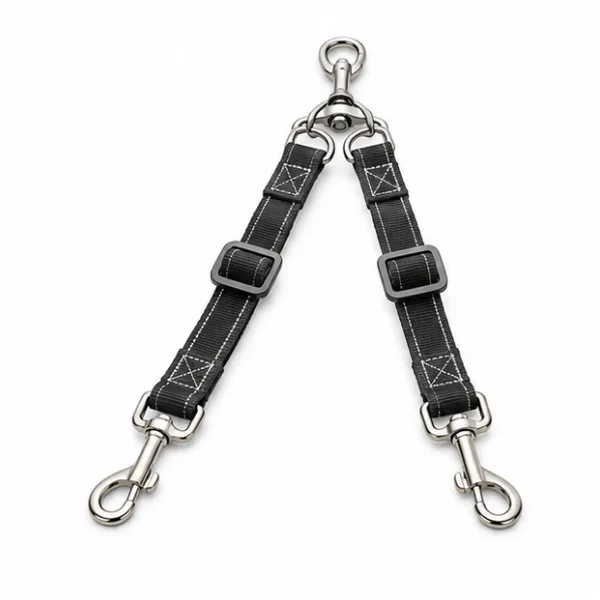
A coupler that splits one lead into two short bungee straps, each ending in an alloy swivel snap. The listing says the straps adjust up to 60 cm, the hardware is all metal, the straps are nylon, and the 360-degree swivel is there to prevent tangling. It also has reflective stitching for low light. You attach it to your own lead, and the listing says it can be used with a seat belt as well.
For car travel, we'd still follow our dog car restraint guide rather than rely on a coupler. The listing makes no crash-test claim.
Pros: metal swivel snaps; straps adjust; reflective stitching; works with a lead you already own
Cons: short at up to 60 cm, so the dogs stay close; bungee reduces control, which the RSPCA cautions about; listing wording on size is mixed (all sizes in the bullets, medium to large in the title)
Best for: two medium or large dogs of similar size who already walk calmly
Skip it if: your dogs pull hard, differ a lot in size, or you want long, loose spacing between them
2. Halti double-ended lead, large, 2 m: best double-ended lead
A 2 m lead in neoprene-padded nylon webbing with a clip at each end. The listing says it can be used in 8 ways, including dual control with a headcollar or harness, three lengths, hands free for walking or running, and with two dogs. It has a woven reflective stripe and reinforced trigger clips. It weighs 171 g. If you're pairing it with a head collar, our dog head collar guide covers fitting and introduction.
Treat it mainly as a one-dog training lead. The listing says it can be used with two dogs, but it has no swivel mentioned, so it won't tangle-proof a pair.
Pros: padded and adjustable; reflective stripe; reinforced trigger clips; useful with a front-attach harness
Cons: no swivel on the listing, so two dogs can still tangle; the size is large, so check fit for small dogs
Best for: one dog on a front-attach harness, or an owner who wants one lead for several set-ups
Skip it if: you want a true coupler for two dogs with anti-tangle swivels
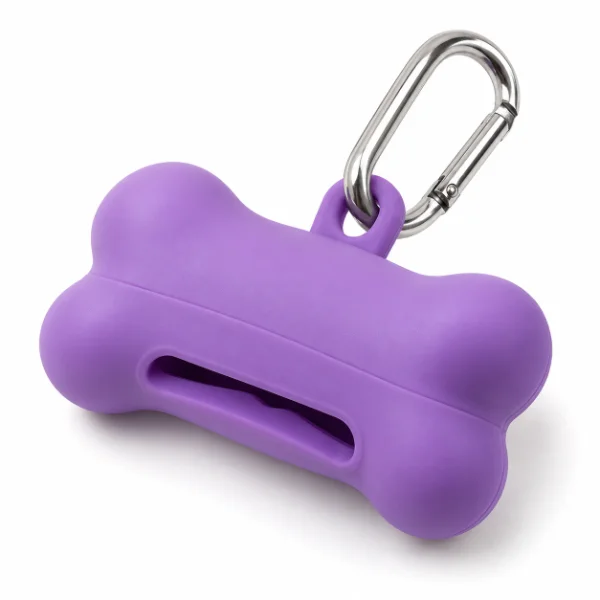
An extendable nylon double lead with a 360-degree rotation system, reflective seams and a padded handle. The listing says you can walk two dogs with one hand, that the carabiner lets you convert it to a single lead, and that there's a pocket dispenser. It also calls the material waterproof.
The listing is vague on size. The breed size says small, and it gives no length. Because it stretches, the RSPCA's caution about extendable and elastic leads applies, so keep it short near roads and don't rely on the stretch for control.
Pros: rotation system to reduce knots; padded handle; converts to a single lead; reflective seams
Cons: no length or weight limit on the listing; breed size says small, so it may not suit big dogs; extendable design gives less control
Best for: two small dogs who walk calmly, on quiet paths
Skip it if: you have large or strong dogs, or you walk near traffic
How do I stop two dogs tangling?
Pick a coupler with swivel clips, keep both dogs on the same side of you, and walk at a steady pace. Swivels let each dog turn without twisting the strap. Short, adjustable straps also help, because less slack means less to wrap around legs.
A few habits make a real difference:
Match each strap to its dog's size so neither is dragged or has loose slack.
Start in a quiet, familiar place before a busy street.
Stop and untangle straight away rather than walking on with a twist.
Clip to a well-fitted harness where you can, since two dogs pulling apart on collars puts pressure on both necks.
No coupler stops tangling completely, and dogs who weave or circle will still wrap the straps. If that sounds like yours, two separate leads are easier to sort out.
Can I walk two dogs of different sizes on a coupler?
Sometimes, but it takes care. A big dog's sudden move can jerk a small dog off balance, so size and pace need to be close. Adjustable straps help you match each dog's length, but they don't remove the difference in strength.
The Kelivi coupler's listing describes it as suitable for all sizes, with a maximum adjustable length of 60 cm, yet its title says medium to large. That short length keeps the dogs close together, which suits two similar dogs but gives a small dog little room next to a big one. For a big and small pair, a wider-set approach, such as two separate leads or one lead in each hand, is usually safer. Never use a coupler on dogs who might be a danger to each other.
Double dog leads compared
Details from each Amazon Australia listing, checked on 2 Nov 2026.
We searched Amazon Australia for double dog leads, couplers and double-ended leads, then shortlisted products that met all of these checks:
Well rated: a strong average rating with plenty of buyer reviews.
No red flags: no pattern of poor reviews, safety complaints or listing problems.
Available on Amazon Australia when we checked.
A swivel or tangle-reducing design where the lead walks two dogs.
A clear length on the listing, or a clear description of how it adjusts.
Secure clips, such as metal snaps or reinforced trigger clips.
Padding or comfort features per the listing, such as a padded handle or neoprene.
These are researched picks, not products we've personally tested. We compared the specifications and features shown on each Amazon Australia listing, checked on 2 Nov 2026. We didn't accept payment from any brand, and no brand saw this page before it was published.
Left out this time: couplers for dogs that pull or don't get along.
When should I use two separate leads instead?
Use two leads whenever control matters more than convenience: busy streets, dogs who pull, dogs who react to others, or dogs of very different size. Two leads let you manage each dog on its own, and let go of one without losing the other.
Two separate leads are also better while a dog is still learning to walk nicely, for puppies, and for any pair that doesn't get along. If one dog is a runner and the other a sniffer, a coupler can feel like a tug of war. Carry a spare single lead anyway, in case a clip fails or one dog needs to be walked alone. For dogs who need more room, a long dog lead used one dog at a time in a safe, open space is a better recall tool. Avoid retractable leads with two dogs, since the cord can wrap and burn.
Sizing and set-up
Fit the harness first. Each dog should wear a well-fitted harness, or a flat collar with ID if they walk well on one. The RSPCA's rule of thumb is two fingers under a collar (RSPCA Knowledgebase, page read 2 November 2026). Our dog collar guide covers ID and registration, which differ by state and council.
Then follow these steps:
Practise with each dog on its own lead first.
Clip the coupler to your lead, then to each dog.
Start in a quiet space with treats and short sessions.
Reward both dogs for staying beside you with a loose strap.
Never use slip, choke, prong or shock collars with a coupler. Dogs must be on a lead in public places unless you're in a signed off-lead area, and rules vary by state and council. Woollahra Council in NSW, for example, requires a lead at all times in public outside sign-posted off-leash areas (Woollahra Council, page read 2 November 2026).
Safety and care
Check clips and stitching before every walk and stop using anything frayed or bent. Don't wrap a lead or coupler around your hand or wrist, because two dogs bolting together can pull hard. Keep the lead short near roads and wildlife, and in the heat, take shorter walks and avoid hot pavement; see our guide to keeping dogs cool.
Rinse mud off nylon and let it dry fully. Wipe metal clips so they keep moving freely.
When to get help
See your vet if a dog coughs, gags or seems sore in the neck or shoulders after walks, or limps. Two dogs pulling at once can strain a neck, so stop using the coupler and have them checked.
If your dogs fight or lunge on lead, don't force them to walk together. Talk to your vet or a qualified, reward-based behaviour professional. The RSPCA says choke, slip and prong collars must not be used on any dog, and that a sudden jerk on the lead can damage the neck (RSPCA Knowledgebase, page read 2 November 2026).
Frequently asked questions
What is the best double dog lead?
For two calm dogs of similar size, our top pick is the Kelivi no-tangle coupler, which has metal swivel snaps and straps that adjust up to 60 cm. For one dog on a harness, the Halti double-ended lead is the better fit. Compare all three in the table above.
Do double dog leads stop tangling?
They reduce it, but they don't stop it. Swivel clips let each dog turn without twisting the strap, and short adjustable straps leave less slack to wrap. Dogs that weave or circle will still tangle, so walk at a steady pace and untangle straight away.
What is a double-ended dog lead used for?
A double-ended lead clips to one dog in two places, such as the front and back of a harness. It gives extra steering while you train loose-lead walking. The RSPCA suggests a front-attach harness with a double-ended lead for dogs who pull. Most aren't made for two dogs, though the Halti listing says it can be used that way.
Can you walk two dogs on one lead?
Yes, with a coupler, if both dogs walk calmly and are similar in size and pace. Practise with each dog alone first, use harnesses, and start in a quiet place. Dogs that pull, lunge or don't get along are better on two separate leads.
Are coupler leads safe for dogs?
They can be when used on well-trained dogs, but they aren't right for every pair. Bungee and extendable parts reduce control, which the RSPCA cautions about. Fit harnesses properly, check clips each walk, and stop if either dog gets sore or the dogs pull apart.
Can I use a double lead for a puppy?
Not at first. A puppy is still learning to walk beside you, and a coupler can pull a pup off balance. Teach each dog on a single lead first, then try a coupler with a calm adult. Keep early sessions short and quiet.
Should I clip a double lead to a collar or harness?
A well-fitted harness is usually the safer choice, because two dogs pulling apart on collars puts pressure on their necks. The RSPCA calls a harness ideal for walking and training. If a dog walks calmly on a flat collar, check it fits with two fingers under it.
Can I use a double dog lead in the car?
We wouldn't count on it. One listing says its coupler can be used with a seat belt, but it makes no crash-test claim. Use a proper restraint clipped to a harness, never a collar. See our dog car restraint guide for how.
Product details from each linked Amazon Australia listing, checked on 2 Nov 2026.
This guide provides general information and isn't a substitute for veterinary advice. If you're concerned about your dogs' walking or training, speak with your vet.