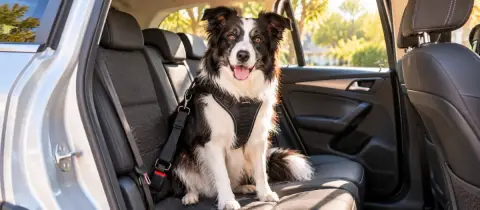
Quick answer: A dog car restraint isn't spelled out in every state's road rules, but driving with a dog on your lap is against them, and the wider rules vary by state and territory. RSPCA Australia describes a car harness attached as the maker directs on the back seat, or a secured crate. Never the front seat.
Wondering whether your dog can roam the car, sit up front or ride on the ute tray? This page pulls the answers together: the lap rule, the state-by-state table, the safest ways to restrain a dog and a chooser to match the option to your dog and car. If your dog gets queasy on the road, start with our dog car sickness guide.
Quick picks
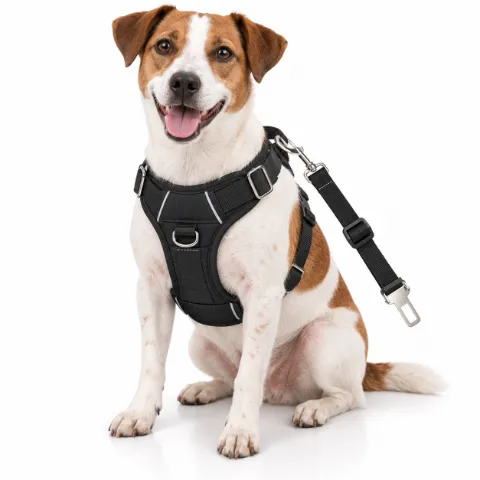
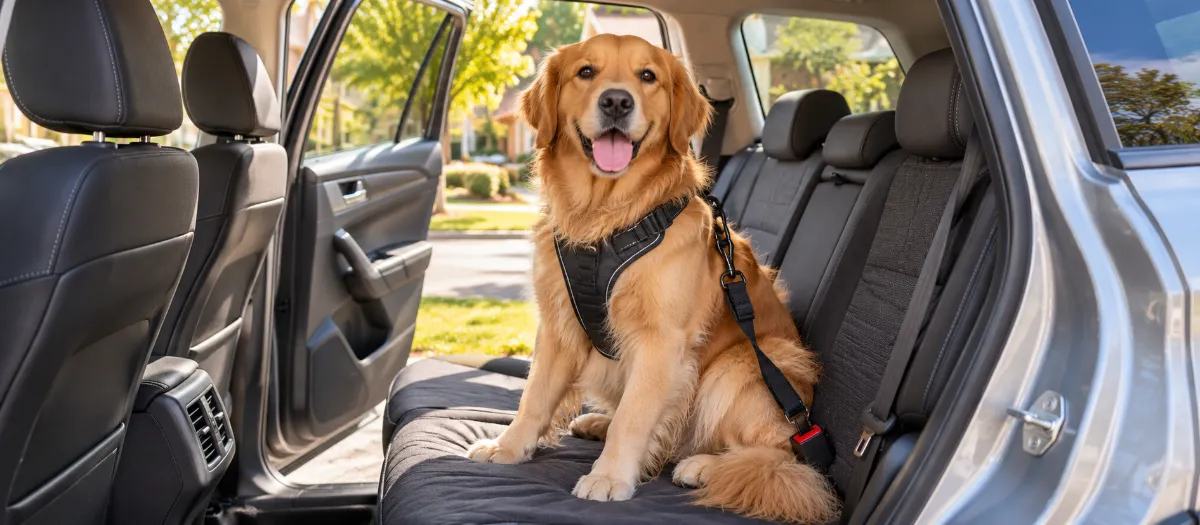
Kurgo Tru-Fit Enhanced Strength harness
An in-car harness that works with the seat belt; Kurgo makes a crash-test claim
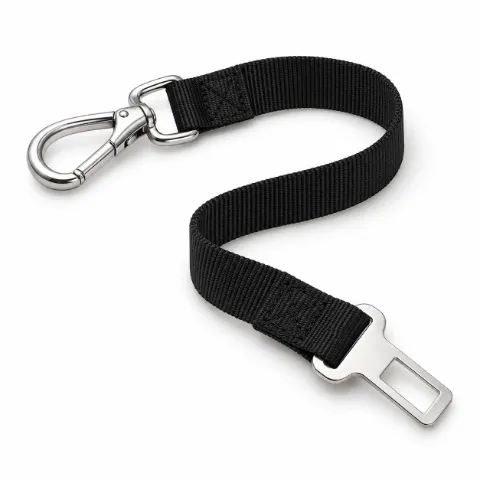
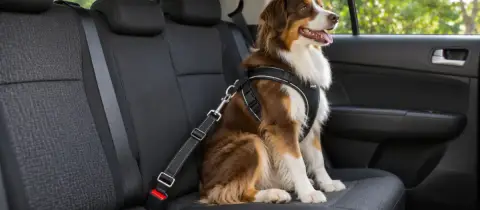
KONG seat belt tether, 56 cm
Clicks into the seat belt buckle and has a quick-release carabiner for a harness
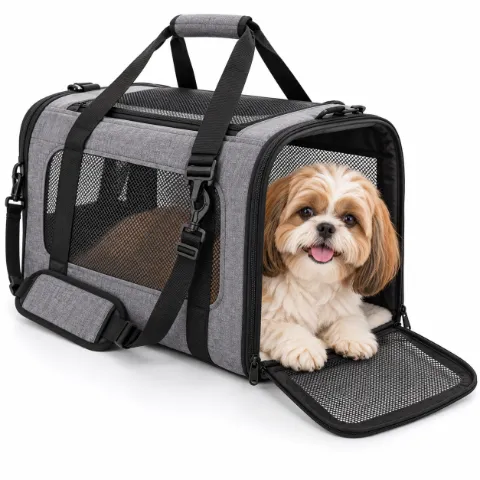
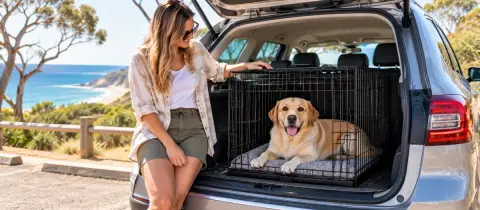
K&H Travel Safety Carrier
Straps to the headrest and seat belt; holds up to 20 lb (9 kg) per the listing
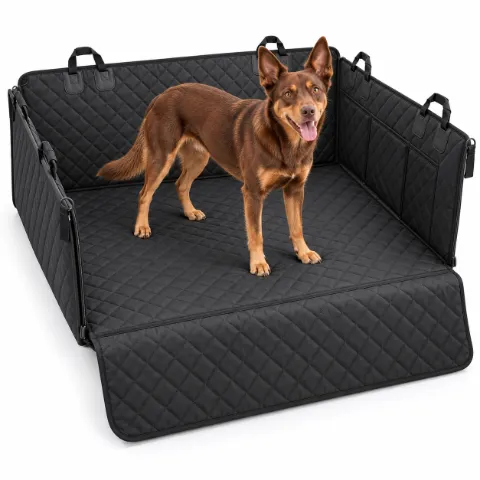
PETICON SUV cargo liner
Protects the boot, not the dog; fits large and full-size SUVs, per the listing
Pictures are illustrations, not the actual products.
Each one is covered in its full guide: car harnesses, car crates, car seats and seat covers. For tethers on their own, see our dog seat belt guide. A boot barrier keeps a dog in the cargo area but isn't a restraint, and a car ramp can help older dogs get in and out.
Is it illegal to have a dog unrestrained in a car in Australia?
Not in every state, but you can't drive with a dog on your lap, and you must keep proper control of the vehicle. Beyond that, the rules for dogs in and on vehicles vary between states and territories, so check your state road authority and animal welfare laws (RSPCA Australia, updated 30 September 2025).
The lap rule is the clearest one. Australian road rules say a driver must not drive with a person or an animal in their lap (rule 297(1A); see, for example, Queensland's road rules). The penalty is a fine and demerit points. In Victoria, VicRoads says the same (as reported by RACV), and RACV adds that no Victorian road rule specifically requires you to secure a dog in the car (RACV, September 2026). RSPCA Queensland notes that a dog on a lap or in the driver's area can stop the driver being fully in control, and police can issue a fine and demerit points (RSPCA Queensland, March 2026).
Animal welfare laws sit on top of the road rules. Most apply to dogs on utes and trailers, covered below. The RSPCA also says its page isn't legal advice, so for your own situation ask the relevant authority. Those welfare laws also cover a dog left in a parked car on a warm day: see is it illegal to leave a dog in a car in Australia?
Dog car restraint laws by state
The table shows what the RSPCA and state pages we read say. Fines change and differ between states, so we haven't listed amounts. Where we couldn't confirm a state's road rule, we say so and point you to the road authority.
| State or territory | Key rule | Where to check |
|---|---|---|
| NSW | Lap rule applies (Australian road rules, rule 297(1A)). Dogs on utes and trailers must be secured (Prevention of Cruelty to Animals Act 1979, s 7, per RSPCA Australia) | Transport for NSW and RSPCA Australia |
| Victoria | Lap rule applies. No road rule requires securing a dog inside the car. It is illegal to put a dog in the boot of a sedan, and a dog on a tray or trailer must be tethered or caged (Prevention of Cruelty to Animals Act 1986, s 15A) | Agriculture Victoria |
| Queensland | Lap rule applies, and a dog in the driver's area can mean the driver isn't in control. A dog on a vehicle tray must be secured (Animal Care and Protection Act 2001, s 33) | Business Queensland |
| Western Australia | Lap rule: check the road authority. For open vehicles, state welfare standards say a dog must be crated or tethered | WA Department of Transport |
| South Australia | Lap rule: check the road authority. A dog in an open tray must be enclosed or restrained (Dog and Cat Management Act 1995, s 45) | MyLicence SA |
| Tasmania | Lap rule: check the road authority. The person in charge must restrict the dog enough to stop it leaving the vehicle (Dog Control Act 2000, s 16(3)) | Transport Tasmania |
| ACT | Lap rule: check the road authority. A dog must be restrained or enclosed to prevent falling, jumping or injury (Animal Welfare Act 1992, s 15A) | Access Canberra |
| Northern Territory | Lap rule: check the road authority. The RSPCA table says a dog on a public street must be inside the passenger compartment and secured (Animal Protection Act 2018, s 34) | NT Government driving |
The welfare-law rows come from the RSPCA Australia table on dogs in open vehicles, updated 29 October 2025, with state details current as of 27 March 2025 (RSPCA Australia). Most states exempt dogs working livestock. Laws change, so check the link for your state before a trip.
Do dogs on utes have to be tied up?
Yes, in practice. A dog on a ute tray or trailer has to be secured or enclosed in every state and territory, with exemptions for dogs working livestock in most states. The NT is stricter and asks for the dog to be in the passenger compartment (RSPCA Australia, October 2025).
The RSPCA says a cabin restraint is generally safer than the tray. If the tray is the sole choice, it suggests a well-ventilated crate fixed behind the cabin, or a tether clipped to a harness made for car use, not a collar. The tether should let the dog stand, sit and lie down but be too short for the dog to reach the sides of the vehicle. It also suggests a swivel at each end, non-slip flooring and avoiding thin rope.
Heat matters on a tray. The RSPCA warns that metal trays can get hot enough to burn paws. Agriculture Victoria says that in Victoria, at 28°C or hotter, a dog secured on a metal ute or trailer tray must have insulating material under it (Agriculture Victoria). RSPCA Queensland suggests avoiding the tray in extreme heat, dust or bad weather (RSPCA Queensland).
Why restrain your dog in the car?
A restrained dog is less likely to distract the driver, less likely to be thrown forward in a crash or hard braking, and can't jump out of a window. That's the RSPCA's reasoning (RSPCA Australia), and it applies to the shortest trip too.
In a sudden stop a loose dog keeps moving at the speed the car was going, which can hurt the dog and the people in the car. A tethered dog on the back seat also can't climb into your lap, lean on the gear stick or step on the pedals.
What is the best and safest dog car restraint?
For most dogs, a car harness on a short tether on the back seat, or a secured crate of the right size. There's no single safest option, because the evidence is limited, and the RSPCA says more research is needed to find the safest methods (RSPCA Australia). A cargo barrier comes third.
A word on crash-test claims. RSPCA Australia says there's no formally recognised Australian standard for crash testing dog car restraints or carriers, and that many products on the market haven't passed any safety or crash testing. Some brands are certified by independent groups such as the Center for Pet Safety, others cite their own tests, so check the claim. We repeat a brand's claim as the brand's claim. Some listings make no crash-test claim at all, and the K&H carrier below is one of them.
How do I secure a dog in a car?
Put your dog on the back seat, or in the cargo area behind a barrier, and attach them with gear made for cars.
1. Car harness and short tether, back seat. RSPCA Australia says dogs can be restrained on the back seat with a vehicle harness that has passed safety or crash tests, attached to the car as the maker directs. Most clip into or loop through the seat belt. A car harness may differ from a walking harness. Clip the tether to the back of the harness, never a collar, and keep it short enough that your dog can't reach the front seats or fall off the seat. See our car harness guide and dog seat belt guide.
2. Secured crate or carrier. It should be fastened in the car, ventilated and big enough for your dog to stand with their head upright, turn around and lie down comfortably. See our car crate guide.
3. Cargo area behind a barrier. This suits dogs who ride comfortably in the back of a wagon or hatchback. RSPCA Australia says a barrier may protect the people from a flying dog but may not protect the dog from serious injury, so a harness restraint can be added. RACV also suggests a grille between the cargo area and the back seat in an SUV to keep a dog from moving around the cabin. See our boot barrier guide.
Booster seats. For small dogs, a booster can give a better view and a contained spot, and many have a short leash that clips to a harness. Treat them as containment, not crash protection. See our dog car seat guide.
Seat covers. These protect your car from mud, hair and scratches. They don't restrain your dog, so use a harness on top. See our seat cover guide.
Can dogs sit in the front seat of a car in Australia?
It isn't illegal in Victoria, but it's not advised. RACV calls it unsafe because airbag deployment could seriously injure a dog, and recommends the back seat with a seat belt or restraining device (RACV, September 2026, page read 3 November 2026). RSPCA Australia's advice is for the back seat too. Check your own state's rules, and never put a dog on a lap.
Our rule is simple: back seat or the boot area, never the front seat and never on a lap. With one adult in the car, the back seat with a short tether is still the better spot.
Which dog car restraint suits your dog and car?
Match the option to your dog's size, temperament and your car. This table uses the facts above and the listing specs on this page.
| Option | Pick this if | Trade-offs | Our guide |
|---|---|---|---|
| Car harness and tether | Your dog rides on a back seat, from small to large | Needs the maker's sizing; attach to the harness, not a collar; a walking harness isn't a car harness | Car harnesses, seat belt tethers |
| Secured crate or carrier | Your dog is small, or already likes a crate | Must be fastened in, ventilated and roomy enough to stand, turn and lie down; the K&H listing says up to 9 kg | Car crates |
| Cargo area with barrier | You have a wagon, hatch or SUV with a proper boot | A barrier may not protect the dog, so a harness can be added | Boot barriers |
| Booster seat | Your dog is small and likes a view | Containment, not crash protection; clip to a harness | Car seats |
If your dog needs a harness and a tether, our KONG tether pick pairs with a harness you already own, or see the Kurgo harness for a full car harness.
Our picks in brief
These are researched picks. We compared the specs on each Amazon Australia listing on 22 Oct 2026.
Kurgo Tru-Fit Enhanced Strength harness. It comes in sizes XS to XL. The listing describes an in-car harness for all breeds with a nesting buckle system that attaches to standard seat belts, and it doubles as an adjustable everyday harness. Kurgo makes a crash-test claim, so treat that as the brand's claim.
KONG seat belt tether, 56 cm. Nylon webbing clicks into a standard seat belt buckle, and the quick-release carabiner clips to a harness. The length is fixed at 56 cm, so it won't suit every car or every dog. Use it with a harness.
K&H Travel Safety Carrier, medium. The listing gives the size as 61 x 48 x 43 cm and says it holds up to 20 lb (9 kg). It straps around the headrest, and straps for the seat belt hold the carrier in place. The listing makes no crash-test claim.
PETICON SUV cargo liner. The listing says it fits large and full-size SUVs, not compact crossovers, minivans, sedans or small and mid SUVs, so measure your boot first. It protects the car, not the dog, so a harness restraint is still worth adding.
Tips for safe car trips
- Start short and happy. Build up from short drives that end somewhere fun, with treats. If your dog drools, whines or vomits, see our dog car sickness guide.
- Get used to the gear first. Introduce the harness or crate at home before the car.
- Stop for breaks. A drink, a toilet break and a walk on long drives.
- Never leave your dog in a parked car. Dogs can suffer fatal heat stress quickly, even in mild weather (RSPCA Australia). In Victoria it's also illegal to leave an animal unattended in a car for more than 10 minutes when it's 28°C or hotter outside (Agriculture Victoria). See our guide to keeping your dog cool in summer.
- Keep heads inside. RACV notes that dirt and debris can injure a dog hanging out of a window, and Animal Welfare Victoria advises against it (RACV). In Queensland, a dog's head may be out of the window but not more (RSPCA Queensland).
- Planning a trip away? See our holiday guide for the care options.
When to see your vet
If your dog has been in a crash or a hard stop and is limping, breathing fast, in pain or acting differently, see a vet straight away, even if they seem fine, because some injuries aren't obvious.
Heavy panting, drooling, weakness or collapse can be signs of heat stress. Move your dog to shade, call a vet and see our guide to keeping your dog cool.
Talk to your vet if car sickness or panic doesn't improve with practice. Our car sickness guide explains what can help.
Frequently asked questions
Can a dog sit on my lap while I drive?
No. Australian road rules (rule 297(1A)) bar driving with an animal in your lap, VicRoads says the same, and RSPCA Queensland says it can stop the driver being in control. A fine and demerit points can apply. Put your dog on the back seat with a harness and short tether.
Do dogs have to be restrained in cars in South Australia?
We couldn't confirm a South Australian road rule that requires restraint inside the car, so check the state road authority. The lap rule still applies: don't drive with a dog in your lap. For a dog in an open ute tray, the Dog and Cat Management Act 1995 (s 45), as summarised by the RSPCA, requires it to be enclosed or restrained.
Is a dog seat belt enough on its own?
No. A seat belt tether should clip to a car harness, not a collar, which RSPCA Australia says can choke a dog (RSPCA Australia). The RSPCA also says restraints should attach as the maker directs. Our car harness guide compares options.
What car restraint should I use for a puppy?
The same types apply: a car harness on the back seat or a secured crate. Puppies grow fast, so check the maker's sizing and smallest size, and recheck the fit as your puppy grows. Introduce the gear at home first, and keep early trips short.
Related guides
- Best dog car beds (comfort, not a restraint)
- Best dog goggles and sunglasses
- Best dog car harnesses
- Best dog seat belts and tethers
- Best dog car crates and carriers
- Best dog car seats and boosters
- Best dog car barriers
- Best dog car seat covers
- Dog car sickness: signs, tips and what helps
- Going on holiday? Your dog care options
- How to keep your dog cool in summer
- Is it illegal to leave a dog in a car in Australia?
Sources
- RSPCA Australia Knowledgebase: Do I need to restrain my dog when travelling in my car? (updated 30 September 2025, read 3 November 2026)
- RSPCA Australia Knowledgebase: Is it legal to have unrestrained dogs on ute trays or other open vehicles? (updated 29 October 2025)
- RACV: Driving with dogs, laws in Victoria (September 2026)
- RACV: Driving with dogs, car restraints and accessories (September 2026, read 3 November 2026)
- RSPCA Queensland: Travelling with pets, do you know the law (24 March 2026)
- Queensland legislation: Transport Operations (Road Use Management, Road Rules) Regulation 2009, rule 297
- Agriculture Victoria: Travelling with dogs
- Queensland Government: Transporting dogs in vehicles
- Product details from each linked Amazon Australia listing, checked on 22 Oct 2026.
This guide provides general information and isn't a substitute for veterinary advice. If you're concerned about your dog's safety in the car, speak with your vet.