Best dog goggles and sunglasses: UV, fit and sizing
By Anish PuriUpdated 19 Nov 202615 min readResearched, not tested by us
Research guide. WhiskerFinds may earn a commission from links, at no extra cost to you.
Quick answer: The best dog goggles for most small dogs are the Enjoying Dog Goggles, with UV400 lenses per the listing and head and chin strap ranges you can check against your dog. Medium dogs suit the PETLESO, large dogs the NVTED or NAMSAN. Goggles are extra protection, not a treatment, and some dogs never accept them.
This guide compares five pairs on Amazon Australia by strap range, frame size and minimum weight, explains who benefits, shows how to measure, and sets out how to get a dog used to wearing them. Dog sunglasses and goggles are the same product here. For the rest of your dog's sun protection, see our dog sunscreen guide. For shade rather than UV lenses, see our dog hats guide.
Quick picks
Our top pickBest overall for small dogs
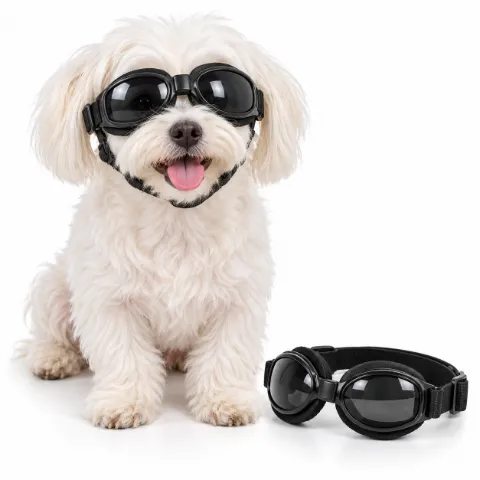
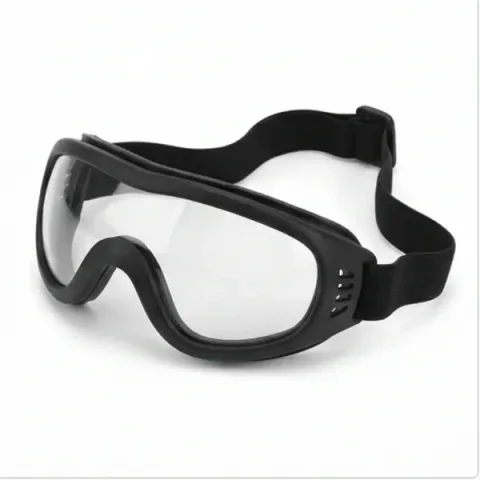
Enjoying Dog Goggles, small, black
UV400 lenses per the listing, foam padding, head strap 33 to 43 cm and chin strap 18 to 25 cm
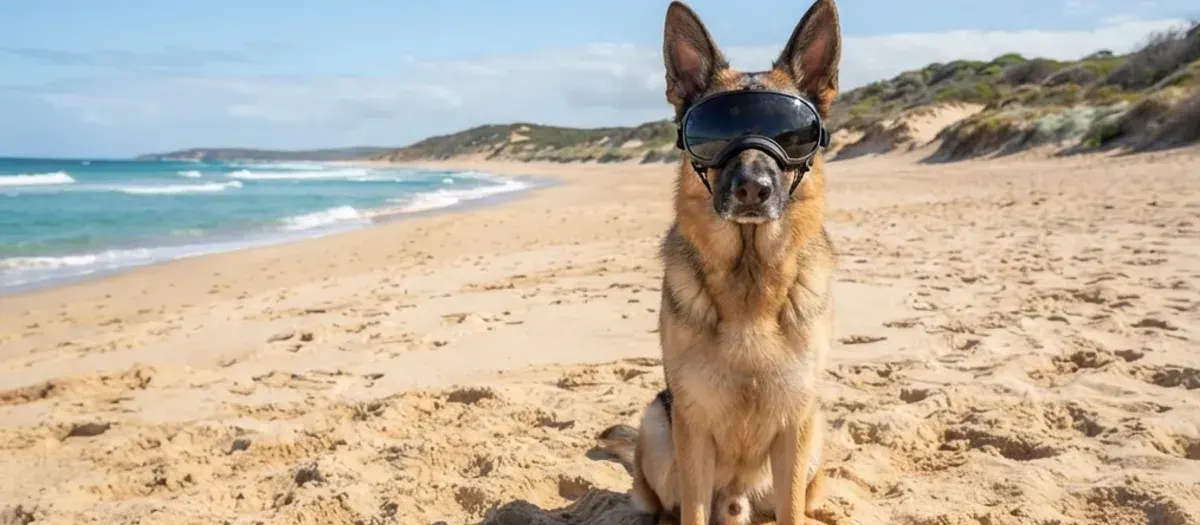
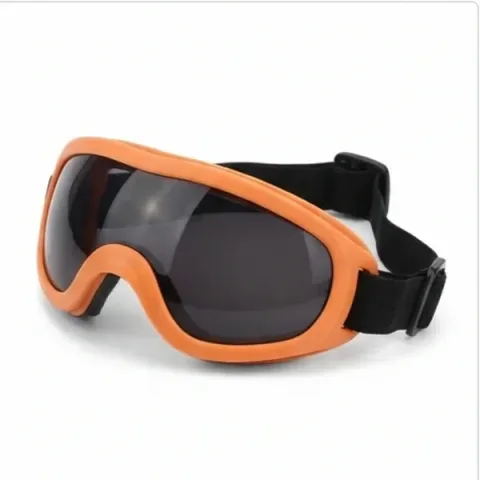
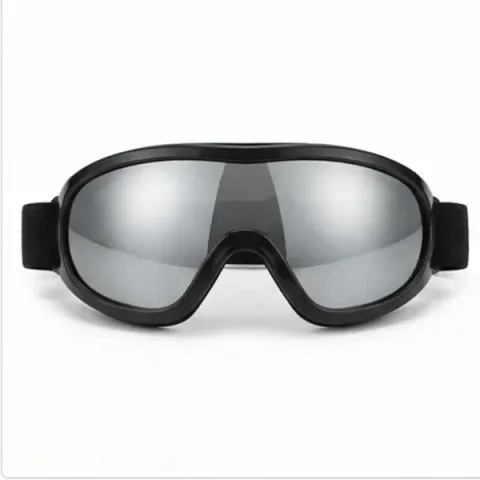
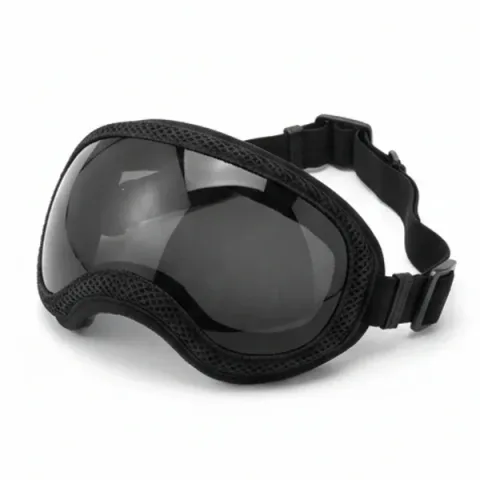
Pictures are illustrations, not the actual products.
Which dogs benefit from goggles?
Most dogs don't need them. Goggles can help dogs that spend long hours in strong sun, wind or dust, dogs that ride in cars or on bikes, working dogs, and dogs with certain eye conditions that a vet has diagnosed. They are extra protection, not a treatment.
The American Kennel Club (AKC) lists dogs prone to eye injuries, dogs working in harsh conditions and dogs with glaucoma, cataracts, pannus or uveitis as ones that can benefit, with tinted lenses to cut light (AKC, updated 3 March 2026, page read 12 November 2026). PetMD adds that flat-faced breeds such as Pugs and Boston Terriers have prominent eyes that scratch easily, so eyewear may help them outdoors, and it says to check with your vet first (PetMD, page read 12 November 2026).
What the UV claims mean, and what they don't
A UV claim is only as good as the lens behind it. We can't measure UV ourselves, so every UV claim below is what the Amazon Australia listing says, not our finding. The AKC advises looking for a product that offers 100% UV protection, and says human or children's goggles generally don't fit a dog. PetMD says dogs rarely live long enough for UV to cause cataracts, so keep UV in proportion.
Our picks in detail
1. Enjoying Dog Goggles, small: best overall for small dogs
The listing says the lenses are UV400 in an ABS frame, with foam padding and deep eyecups. It's for dogs over about 2.3 kg, such as Shih Tzus, Toy Poodles, Maltese and Yorkies, but not tiny heads. It weighs 32 g.
The listing says to adjust both straps so the goggles don't slide down the snout and touch the eyes. We rank it first because it's the smallest fit here with strap ranges you can check against a tape measure. UV400 is the listing's claim.
Pros: stated strap ranges in the listing; foam padding; light at 32 g; UV400 per the listing
Cons: not for toy breeds with very small heads; no vents mentioned; the listing mixes inches and centimetres, so measure before you order
Best for: a small dog that rides in the car or walks in strong sun
Skip it if: your dog is tiny or has a very small head, or your dog's head measures bigger than the strap range
2. PETLESO Dog Goggles, medium: best for medium dogs
The only medium-size pick with full strap ranges and a vented frame. The listing gives both strap ranges (see the table) for dogs from about 4.5 kg. The soft rubber frame has comb-shaped vents that the listing says stop mist on the lens. The lens is polycarbonate, and the listing names Corgis, Shiba Inus, medium Poodles and Boston Terriers.
It weighs 60 g, so it's heavier than the small pair but light enough for walks. The strap check matters here: a Boston Terrier's wide, short face may sit differently in the frame, so measure first.
Pros: both strap ranges stated; vented soft frame; polycarbonate lens; orange is easy to spot
Cons: the orange camouflage style isn't for everyone; the listing gives no UV rating, only that the lens filters UV, infrared and visible light
Best for: a medium dog on car rides, windy hikes or beach walks
Skip it if: your dog is a giant or a toy breed, or you want a UV rating stated
3. NVTED Dog Sunglasses, medium or large: best UV-claim goggles for large dogs
The listing says the lens is polycarbonate and the frame is PVC with nylon elastic, with adjustable head and chin straps. It says "100% UV protection", which is the listing's claim. It's for medium to large dogs from about 6.8 kg and weighs 82 g.
The listing doesn't give strap lengths in centimetres, so measure your dog's head against the medium picks above and check the chin strap sits snugly before you go out.
Pros: polycarbonate lens with a UV claim; adjustable head and chin straps; light enough for walks
Cons: no strap lengths in centimetres; no frame size stated; the listing says "high light transmission" but doesn't say the lens is tinted, so check the photos if glare is your concern; the listing mentions swimming and calls the lens waterproof, but no goggles here are swim goggles (see the lens section)
Best for: a medium to large dog in bright sun
Skip it if: you walk at dusk, or want measurements before buying
4. NAMSAN Dog Goggles, clear: best clear lens for wind, dust and dusk
The listing says the clear lenses are "UV-resistant and anti-glare" and that the soft PVC frame has vents to disperse fog. It's for medium to large dogs such as German Shepherds, Labradors and Huskies, and the listing says it's not recommended for oversize breeds such as Great Danes.
The clear lens suits early-morning or dusk walks where a tint would cut your dog's vision. The listing says not to wear them for swimming, so keep them for dry-land use.
The listing says the lens is spherical and shatterproof polycarbonate, designed against larger objects and fine particles, with breathable mesh to cut fogging and let water escape, and a fully adjustable strap system. It weighs 272 g. Rex Specs' own chart gives the XL for heads of 44.5 to 58.4 cm and muzzles of 29 to 35.6 cm. A smaller size is a separate Rex Specs listing, for heads of 26.7 to 30.5 cm.
The XL bullets say one clear lens comes in the box, while the description says one clear and one smoke lens, so check which lenses are included before you order. Rex Specs says water escapes through the mesh, but these aren't waterproof goggles.
Pros: shatterproof lens per the listing; fully adjustable straps; wide field of view per the listing; suits larger heads
Cons: the Amazon Australia listing isn't run by Rex Specs itself, so check the seller details and which lenses are included before you order; premium price band; sizing is in inches on the maker's chart; 272 g is heavy for small dogs
Best for: a working or large dog on rough ground, or a giant breed
Skip it if: you want a cheap pair for occasional car rides
Measuring your dog: head, muzzle and straps
Measure your dog's head and muzzle with a soft tape, then compare with the maker's chart, not the weight label alone. Rex Specs says to wrap the tape around the head about 2.5 cm behind the eyes, and around the muzzle where the goggle will rest, usually towards the back of the mouth. Goggles must never touch the eye itself, the AKC says.
Rex Specs' own chart, converted to centimetres, is a handy yardstick even if you buy another brand (Rex Specs, "Sizing Your Dog", page read 12 November 2026). Other brands size differently, so use each listing's strap range too.
Swipe sideways to see every column
Rex Specs size
Head (cm)
Muzzle (cm)
Extra small
21.6 to 26.7
10.2 to 15.2
Small
26.7 to 30.5
15.2 to 20.3
Medium
30.5 to 35.6
20.3 to 22.9
Large
35.6 to 44.5
22.9 to 29.2
Extra large
44.5 to 58.4
29.2 to 35.6
Small-wide (short noses)
30.5 to 38.1
15.2 to 22.9
Short-nosed breeds get a separate small-wide size at Rex Specs. Many budget goggles are cut for longer muzzles, so check the frame width and nose area before you buy.
Dog goggles compared by size and strap
Details come from each Amazon Australia listing, checked on 19 Nov 2026. Strap lengths were given in inches on the listings and are converted to centimetres. "Not stated" means the listing doesn't say.
Swipe sideways to see every column
Goggles
Head strap (cm)
Chin strap (cm)
Frame (cm)
Minimum weight
Listing names or excludes
Enjoying small
33 to 43
18 to 25
Lens 11.4 x 3.3
About 2.3 kg
Shih Tzu, Toy Poodle, Maltese, Yorkie; not tiny heads
PETLESO medium
34 to 46
15 to 23
12.7 x 5
About 4.5 kg
Corgi, Shiba Inu, medium Poodle, Boston Terrier
NVTED medium or large
Not stated
Not stated
Not stated
About 6.8 kg
Medium to large dogs
NAMSAN clear
Up to 35.6
Up to 22.9
15.2 x 6
Not stated
German Shepherd, Labrador, Husky; not giant breeds
Rex Specs V2 XL
Fully adjustable
Fully adjustable
Not stated
Not stated
Large breeds (head 44.5 to 58.4 cm per Rex Specs)
Lenses, frames and straps compared
Swipe sideways to see every column
Goggles
Lens
Frame
Vents
Weight
Enjoying small
Dark, UV400 per the listing
ABS with foam padding
Not stated
32 g
PETLESO medium
Polycarbonate; listing says it reduces visible light
Soft rubber
Comb-shaped vents
60 g
NVTED
Polycarbonate, "high light transmission", "100% UV protection" per the listing
PVC, nylon elastic
Not stated
82 g
NAMSAN clear
Clear, "UV-resistant and anti-glare" per the listing
Soft PVC
Frame vents
68 g
Rex Specs V2 XL
Spherical polycarbonate, shatterproof per the listing
Breathable mesh
Mesh lets moisture escape
272 g
Which lens is better: clear or tinted?
Tinted lenses suit bright sun, glare and snow. Clear lenses suit wind, dust, grass seed and low light, because a tint makes things darker. The AKC says tinted lenses are a poor choice for evening walks or in the dark, and that dogs can't see underwater through them.
Neither type is a swimming goggle. The AKC says clear goggles aren't watertight because a dog's hair stops a tight seal, and the NAMSAN listing says it wouldn't suggest wearing them for swimming.
Getting your dog used to goggles
Go slowly and let your dog decide. The AKC's routine is to let your dog sniff and explore the goggles, then put them on briefly with treats and praise, and stop if your dog is distressed and try again later. Some dogs adapt quickly and others take longer, so results vary.
Our own additions: short sessions, then build up while doing something your dog enjoys, such as a walk. Keep training treats handy. Never force goggles on, which the AKC says can lead to a dog pulling them off or knocking them out of place, and never leave them on overnight. PetMD quotes a vet saying some dogs never accept goggles. That's fine, and shade and timing do more for those dogs.
Cars and utes: restraint first, goggles second
Restraint comes first, goggles second. Goggles may keep grit out of your dog's eyes, but they don't make an unrestrained dog safe. RSPCA Australia says all states and territories prohibit carrying dogs unrestrained on utes, and prefers a restrained dog in the cabin. On a tray, tether to a harness made for car restraint, never a collar (RSPCA Australia, updated 29 October 2025, page read 12 November 2026).
UV claim, secure fit (the NVTED listing doesn't say the lens is tinted)
NVTED
Dawn, dusk or wind and dust
Clear lens
NAMSAN clear
Pannus-prone breed (ask your vet)
UV claim, secure fit, vet's advice first
NVTED or NAMSAN for a Shepherd-sized dog; Enjoying small for a small breed
Working dog, rough ground
Shatterproof lens, secure strap system
Rex Specs V2
Toy breed with a tiny head
A head strap minimum below 33 cm
None here: the Enjoying listing excludes tiny heads
Giant breed
A large head strap range, no "not for giants" note
Rex Specs V2 XL
How we chose
We searched Amazon Australia for dog goggles and sunglasses, then shortlisted pairs that met all of these checks:
Well rated: a strong average rating with plenty of buyer reviews.
No red flags: no pattern of poor reviews, safety complaints or listing problems.
Available on Amazon Australia when we checked.
Size information is clear, with strap ranges, frame size or a minimum weight where the listing gives them.
Lens claim stated, whether UV protection or impact resistance, and printed here only as the listing's claim.
Fit is adjustable, with both a head strap and a chin strap.
Not sold as a toy or photo prop.
These are researched picks, not products we've personally tried. We compared the specifications and features on each Amazon Australia listing, checked on 19 Nov 2026. We didn't accept payment from any brand.
Left out this time: repeat listings of the same small goggle from the same brand, a two-pack novelty set with no measurements in centimetres, heart-shaped pairs sold as photo props, and a second Rex Specs size (the small is covered in the Rex Specs write-up below).
Pannus, eye surgery and other eye conditions
The stronger case for UV protection is a condition like pannus, which VCA Animal Hospitals says is immune-mediated, most common in German Shepherds, Belgian Tervurens and Border Collies (it can occur in any breed), and can be made worse by UV and altitude. Treatment is lifelong and VCA says it halts the progression but doesn't cure it. Sunglasses are something a vet may suggest for extra protection (VCA Animal Hospitals, page read 12 November 2026). Goggles don't treat or prevent pannus. If you suspect an eye problem, see your vet first.
Goggles don't replace a cone after surgery. The AKC says vets recommend a cone first, and goggles are only an option if a dog won't tolerate one, because a dog can pull goggles off and cause more damage. Our dog cone guide and dog recovery suit guide cover the alternatives. Always ask your vet before using goggles on a dog with an eye problem, as PetMD advises.
Where else can you buy dog goggles?
Pet shops and some vet clinics also sell dog goggles, and trying the fit in person can help with a hard-to-fit face. This page doesn't cover helmets.
When to see a vet
Eye signs need a vet, not goggles. Squinting, redness, discharge, cloudiness, a swollen eye, pawing at the face or a change in how your dog sees can be more consistent with an eye problem that needs examining, including pannus. Goggles can't treat these.
After eye surgery or an injury, follow your vet's advice on a cone and ask before using goggles.
If your dog is distressed in goggles, rubs the skin raw, or the frame leaves marks, take them off and ask your vet.
Frequently asked questions
Should dogs wear goggles?
Most don't need them. Goggles can help dogs that work or play in strong sun, wind or dust, dogs that ride in cars, and dogs with eye conditions diagnosed by a vet. PetMD says to check with your vet first, and that some dogs never accept goggles.
Do dog goggles really block UV?
Some lenses are made to, but we can't verify it, so we only report what each listing claims. The Enjoying listing says UV400 and the NVTED listing says 100% UV protection. The AKC advises looking for 100% UV protection.
How do I measure my dog for goggles?
Wrap a soft tape around your dog's head about 2.5 cm behind the eyes, then around the muzzle where the goggle will rest, as Rex Specs advises. Compare with the maker's chart and the listing's strap range. The goggle shouldn't touch the eye, and short-nosed dogs may need a wider fit.
How do I get my dog to wear goggles?
Let your dog sniff the goggles first, then put them on briefly and reward with treats and praise. Stop if your dog is distressed and try again another day. The AKC says some dogs adapt quickly and others take longer. Never force them on, and never leave them on overnight.
Are there swimming goggles for dogs?
Not among our picks. The AKC says tinted lenses block a dog's view underwater and clear goggles aren't watertight, because fur stops a seal. The NAMSAN listing says not to swim in them, and Rex Specs' mesh only lets water escape. A dog life jacket is the better swimming gear.
Can my dog wear goggles with its head out the car window?
Goggles may keep grit out, but they don't make it safe. RSPCA Australia says dogs on utes must be restrained, and prefers the cabin. A dog in a car is safer in a harness-based restraint than with its head out of the window. See our dog car restraint guide for options.
What are Rex Specs used for?
Rex Specs are impact-resistant goggles, and their own chart runs from extra small to extra large. The listing says the polycarbonate lens is shatterproof and designed to protect against larger objects and fine particles. They suit working and very active dogs, and larger heads. They aren't waterproof.
Can goggles help a dog with pannus or after eye surgery?
They're extra protection, not treatment. VCA says a vet may suggest sunglasses for pannus, because UV can make it worse, but treatment is lifelong medication. After eye surgery the AKC says a cone comes first, and goggles are only an alternative. Always ask your vet before using goggles.