Best dog pools (2026): foldable, plastic and heavy duty picks by dog size
By Anish PuriUpdated 19 Nov 202613 min readResearched, not tested by us
Research guide. WhiskerFinds may earn a commission from links, at no extra cost to you.
Quick answer: The best dog pool is a foldable one with firm sides, a non-slip floor and a drain: our pick is the Jasonwell, in 81, 122 and 160 cm sizes. For big dogs or two dogs, the heavy duty VISTOP goes up to 170 cm. No pool is chew-proof, so trim nails, supervise every swim and empty it after use.
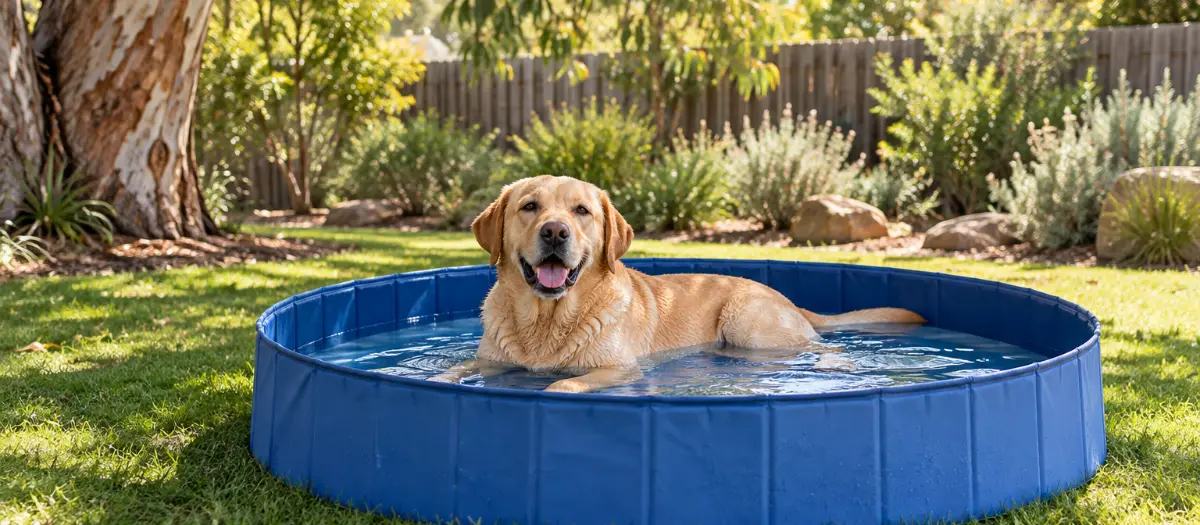
Illustration, not the actual product
Our top pickJasonwell Foldable Dog Pool (Large, 122 cm)
A dog pool is an easy way to help a water-loving dog cool off on a hot day. This guide compares dog pools on their actual measurements, helps you pick the right size, and covers the safety rules that apply to portable pools in Australia.
Quick picks
Our top pickBest overall
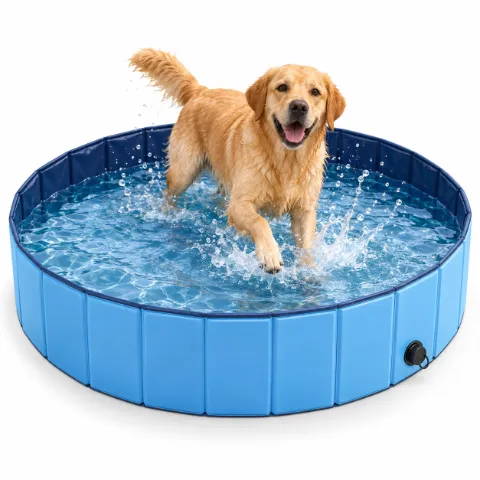
Jasonwell Foldable Dog Pool (Large, 122 cm)
Three sizes, including a low-walled small pool; drain and hose connector
A foldable pool with rigid side panels that stand up on their own, so there's nothing to inflate. The listing says the walls are three layers of laminated vinyl with polyester mesh, which it calls puncture resistant, and the floor is embossed for grip. You can drain it from the bottom or side, and the hose connector lets you run the water away from the lawn.
This link is the Large (122 × 30 cm). It also comes as a Small (81 × 20 cm), whose lower wall is easier for puppies, small dogs and older dogs to step over, and an XX-Large (160 × 30 cm) for bigger dogs. Wall heights are from the manufacturer's own listing, because the Australian listing doesn't state them.
Pros: three sizes, including the only 20 cm wall here; folds flat; drain and hose connector
Cons: "puncture resistant" isn't claw-proof, and the listing itself says to trim nails first; the listing gives a 50 lb (about 23 kg) maximum weight while also saying it suits large dogs, so treat the large sizes with care for heavy dogs who climb on the rim; the 30 cm sizes can hold close to 30 cm of water, which matters for fencing rules (see below)
Best for: most dogs, choosing the size by your dog's measurements
Skip it if: your dog chews or digs at everything, or you have nowhere flat and shady to leave a full pool
2. VISTOP Foldable Dog Pool: best for big dogs or two dogs
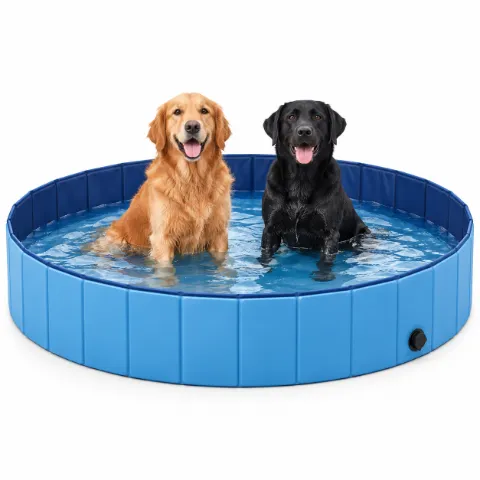
A heavier-duty foldable pool. The listing says it uses 0.55 mm PVC with plastic support boards so the walls don't collapse, heat-welded seams to stop leaks, and an anti-slip floor. It has a large side drain and a hose connector, and comes with three repair patches. This link is the XXL (170 × 30 cm).
VISTOP also sells larger sizes with 40 cm walls. We haven't linked them: a pool that can hold more than 30 cm of water clearly falls under pool fencing laws in most states.
Pros: big enough for a large dog to lie down and turn, or for two dogs; thicker material and welded seams; repair patches included
Cons: premium price; Imported, so check the delivery details on Amazon before you order; a full 170 cm pool holds over 500 litres, so it's heavy and slow to drain; not chew-proof
Best for: Labradors, Golden Retrievers, German Shepherds and other large dogs, or two dogs who share
Skip it if: you have a small yard or a small dog
3. PETMAKER Pet Pool with Carry Bag: best for travel and bath time
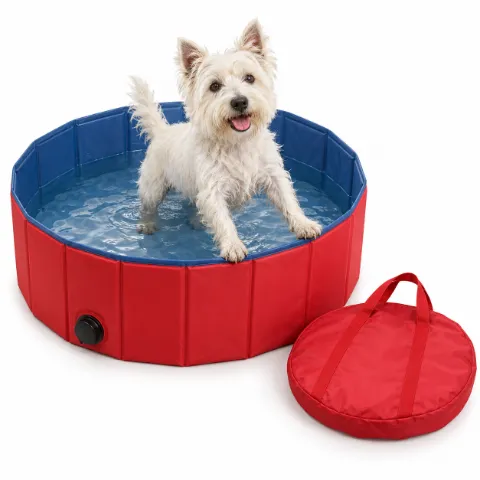
A small foldable pool that packs into its own carry bag with handles, so it's easy to take on holidays, to the park or to a friend's place. The listing recommends it for pets up to 40 lb (about 18 kg), says the PVC is designed to resist nails, and still advises trimming them. A wide-mouth drain with a twist-off cap empties it quickly, which makes it handy as a bath tub too.
Pros: carry bag; wide drain; works as a pool or a bath tub
Cons: costs more than the Jasonwell Small; the 30.5 cm wall is a high step for small, short-legged or older dogs; Imported, so check the delivery details on Amazon before you order
Best for: small to medium dogs up to about 18 kg, travel and bath time
Skip it if: your dog is small and struggles to step over a 30 cm wall (the Jasonwell Small has a 20 cm wall)
What size dog pool do I need?
Go by your dog's measurements, not just their breed.
Length: measure from the tip of the nose to the base of the tail. Choose a pool wider than that, so your dog can lie down and turn around.
Leg height: measure from the floor to your dog's elbow. Your dog needs to step over the wall comfortably, so for puppies, small dogs and older or stiff dogs, a lower wall (or a non-slip step beside the pool) makes getting in and out easier.
Water depth: emergency vets suggest a few inches (about 5 to 10 cm) of water in a kids' paddling pool for dogs who can't come inside on a hot day (Animal Referral & Emergency Network). Never fill it deeper than your dog can stand in with their head well clear of the water.
Swipe sideways to see every column
Your dog's length (nose to base of tail)
Pool diameter to look for
Our options
Up to about 70 cm (puppies, toy and small breeds)
About 80 cm
Jasonwell Small (81 × 20 cm) or PETMAKER (77.5 × 30.5 cm, up to about 18 kg)
About 70 to 110 cm (medium dogs)
About 120 cm
Jasonwell Large (122 × 30 cm)
About 110 to 140 cm (large dogs)
About 145 to 160 cm
Jasonwell XX-Large (160 × 30 cm)
Over 140 cm, or two dogs who share
About 170 cm
VISTOP XXL (170 × 30 cm)
This is a rough guide: a pool wider than your dog is long, with room to turn.
Dog pools for large dogs and huge dogs
Big dogs need a wide pool more than a deep one. Choose 145 cm or more so they can lie down and turn without climbing on the rim, which is what bends and wears foldable walls. Remember how heavy water is: a 122 cm pool filled to 25 cm holds about 290 litres (about 290 kg), and a 160 cm pool about 500 litres. Set it up where it will stay, on flat ground in the shade, and expect it to flatten the grass underneath.
Which type of dog pool should you buy?
A foldable pool with rigid panels suits most dogs: nothing to inflate, a drain, and walls that cope with claws better than a blow-up ring. Heavy duty foldable pools use thicker PVC and welded seams for big dogs. One-piece hard plastic pools are the toughest but bulky. Inflatable pools puncture fastest. Splash pads suit sprinkler-chasers.
Swipe sideways to see every column
Type
What it is
Claws and chewing
Storage
On this page
Foldable (plastic panels in PVC)
Rigid side panels inside a PVC skin, folds flat
Listing says puncture resistant, not claw-proof; trim nails
Folds flat
Jasonwell, 81 to 160 cm
Heavy duty foldable
0.55 mm PVC, support boards, heat-welded seams, repair patches
The thickest PVC here, still not chew-proof
Folds flat, heavy when full
VISTOP, 170 cm
Foldable with carry bag
PVC pool that packs into its own bag
Listing says it resists nails; trim them anyway
Carry bag
PETMAKER, 77.5 cm
Hard plastic, one piece
Moulded plastic shell, no seams
Toughest against claws
Bulky, doesn't fold
Not linked; sold by tank and pool makers and hardware stores, see the checklist below
No dog pool is chew-proof, and no listing on this page claims to be. The closest are the VISTOP, whose listing gives 0.55 mm PVC with heat-welded seams and repair patches, and one-piece hard plastic pools, which have no seams to work at. The Jasonwell listing says to trim nails first. A dog who chews the rim needs supervision, then the pool emptied and put away.
Portable pool safety and the law in Australia
Dog pools look like toys, but under Australian consumer law a foldable or inflatable pool is a portable swimming pool. Children can drown in very little water.
The mandatory standard covers dog pools. Australia's mandatory safety standard applies to inflatable and soft-sided portable pools of any depth, and to rigid-sided ones up to 300 mm deep. It doesn't make an exception for pools sold for pets. The ACCC has recalled several foldable dog pools because they didn't carry the required warnings (ACCC: vidaXL dog pool recall, ACCC: assorted pet pools recall).
Check for the warning label. Each pool and its packaging must carry a permanent warning about children drowning and the need for active adult supervision, with a blue-and-white safety sign. Pools under 300 mm deep must also tell you to empty and store them after use; pools that can hold 300 mm or more must say pool fencing laws apply (ACCC: portable pools mandatory standard). We couldn't see this label in the Amazon photos for our picks, which doesn't mean it isn't there. Check your pool when it arrives, and return it if the label is missing.
Empty it after every use. The ACCC advises emptying smaller pools whenever they're not in use, storing them away from young children, and never relying on older children to supervise younger ones (ACCC: portable and inflatable pools guide). Royal Life Saving says 27 children aged 0 to 4 drowned in portable pools in Australia over 20 years (Royal Life Saving Australia).
Fencing. In most states, a pool that can hold more than about 30 cm of water, including a portable one, needs a compliant safety barrier (Royal Life Saving Australia; see also Victoria, Queensland, WA and SA). A dog pool with 30 cm walls sits right on that line. The laws define pools by their use for swimming, wading or paddling, and we found no official guidance on pools used only by dogs, so check with your council. The simplest safe habit is to fill it only as deep as your dog needs and empty it straight after use.
Keeping your dog safe in the water
Supervise every swim. The Australian Veterinary Association says not to let a dog swim in a pool unsupervised, so you can help if they tire or can't get out (Australian Veterinary Association).
Know which dogs struggle. The AVA says Pugs and French and British Bulldogs are a real drowning risk, and that short-legged breeds such as Corgis, Basset Hounds and Dachshunds, Greyhounds, older dogs and very young dogs can also struggle (Australian Veterinary Association).
Shade, fresh water and breaks. Shallow water in full sun warms up quickly, so keep the pool in the shade, offer fresh drinking water and give your dog regular rest breaks.
Watch out for gulping water. Dogs who swallow lots of water while swimming, diving for toys or biting at a hose can, rarely, develop water intoxication. The American Kennel Club suggests rest breaks, and a flatter toy such as a flying disc instead of a ball for dogs who fetch (American Kennel Club).
Hot paws. Pavers and pool edges can get very hot. RSPCA Queensland advises against walking dogs on hot surfaces such as asphalt, sand and concrete (RSPCA Queensland).
Dry the ears. Water left in the ear canal can lead to ear infections, so dry your dog's ears after every swim (VCA Animal Hospitals).
Backyard swimming pools: chlorine, salt and getting out
Chlorinated pool water: small amounts of properly chlorinated pool water are generally safe, but drinking a lot can cause vomiting, diarrhoea or a poor appetite. Chlorine tablets and concentrated pool chemicals are far more dangerous, so store them out of reach (PetMD). Rinse your dog with fresh water after a swim, as pool water can leave some dogs with dry, red skin (PetMD).
Salt water pools: salt chlorinator pools usually run at about 2,500 to 6,000 ppm of salt, depending on the model (an Australian pool supplier's guide), while seawater is around 35,000 ppm. So they're far less salty than the sea, but still salty and chlorinated: offer fresh water instead of letting your dog drink from the pool.
At the beach: swallowing a lot of seawater can cause saltwater poisoning, with signs such as vomiting, diarrhoea, weakness and seizures (American Kennel Club).
Getting out: the AVA's advice to supervise is so you can help a dog who can't get out. Show your dog where the steps are, consider a ramp, and keep the pool gate shut whenever your dog is outside. Our guide to teaching a dog to swim shows how to teach the exit step by step.
Pool accessories: splash pad, ramp and life jacket
These aren't dog pools, but they solve related problems.
Jasonwell Splash Pad (150 cm)
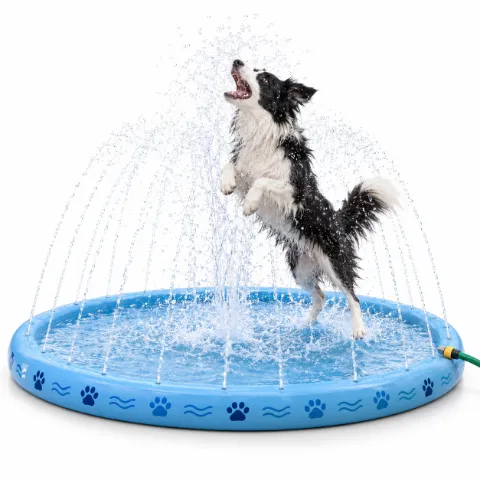
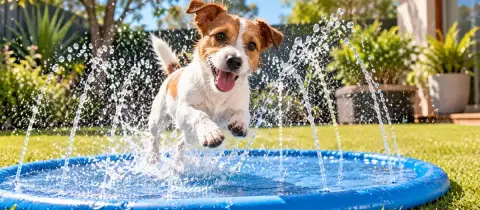
A splash pad that connects to the garden hose and sprays water up from the centre; you turn the tap to change the spray height. It suits dogs who'd rather chase a sprinkler than sit in water. The listing calls it an inflatable splash pad and says it has a non-slip surface. It's sold for kids, so treat it like a paddling pool: check for the warning label, supervise, and empty it after use. It also comes in 170 and 190 cm sizes.
Pros: fun for dogs who don't like sitting in water; folds away small
Cons: vinyl, so claws and teeth can puncture it; the hose needs to run while it's used; not for lying in water
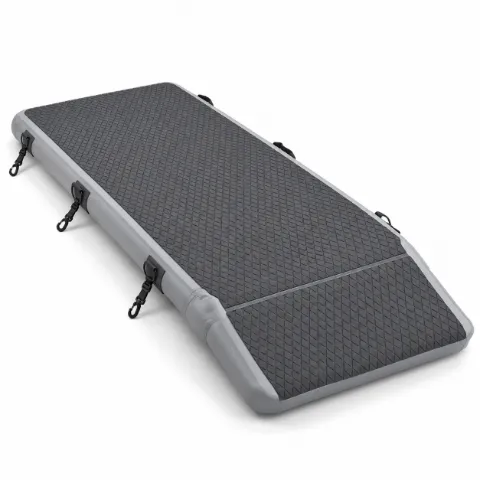
A floating ramp for a swimming pool, dock or boat, with a submerged slope and an EVA foam deck for grip, so a dog can walk out of the water. The listing says it suits dogs up to 210 lb (about 95 kg) and measures about 183 × 102 cm.
Pros: gives a dog a way out of a deep pool; grippy foam deck; suits big dogs
Cons: premium price; large to store; Imported, so check the delivery details on Amazon before you order; not a replacement for supervision or a pool fence
Skip it if: your pool already has wide, shallow steps your dog uses confidently
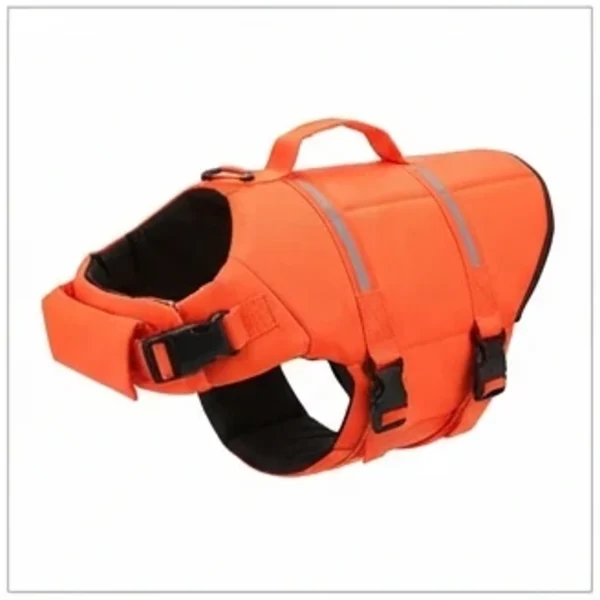
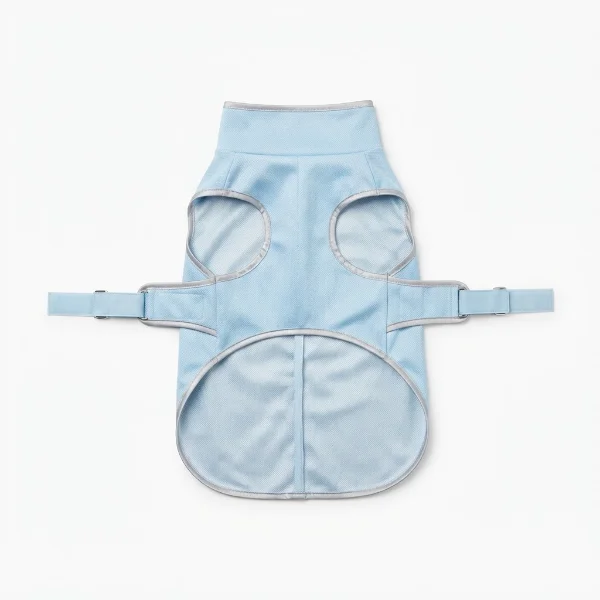
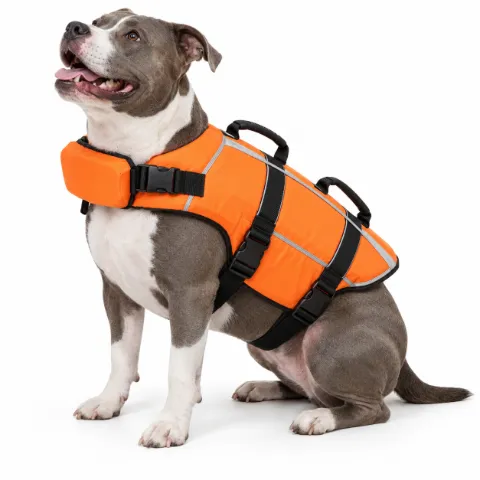
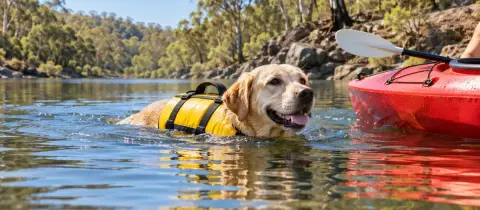
An orange dog life jacket sized by chest girth, with a float at the front of the neck, reflective trim and two grab handles for lifting your dog out of the water. Outward Hound says it's a flotation aid for a conscious dog in calm water, that the rescue handle is for emergencies only, and that you should never leave your dog unattended in it. The AVA advises a life jacket for dogs on boats, kayaks and paddleboards, even strong swimmers (Australian Veterinary Association). In a deep backyard pool, a jacket can also help dogs who tire quickly or struggle to swim, but it doesn't replace supervision. For more options by dog size and breed, see our dog life jackets guide.
Pros: neck float and two handles; easy to see in the water; adjustable straps
Cons: measure your dog's girth to get the size right; check the seams and stitching before every swim; it helps a dog float, but you still need to watch
Skip it if: your dog only paddles in a shallow dog pool where they can stand
Hard plastic dog pools from hardware stores: what to check
Store-brand dog pools can work well. Before you buy, check:
Warning label: the drowning warning and blue-and-white safety sign on the pool and its packaging.
Sides: rigid, foldable or one-piece sides last longer than blow-up rings.
Floor: a thick, non-slip base so paws don't slide.
Drain: a plug or drain makes emptying after every use much easier.
Size: wider than your dog is long, with a wall your dog can step over.
How we chose
We searched Amazon Australia for dog pools, then shortlisted pools that met all of these checks:
Well rated: a strong average rating with plenty of buyer reviews.
No red flags: no pattern of poor reviews or safety complaints.
Available on Amazon Australia when we checked.
Built for dogs: firm sides that don't need inflating, and a non-slip floor.
Clear measurements and a drain: a stated diameter and wall height, and an easy way to empty it.
No recalls: we found no recall for any brand on this page when we searched Product Safety Australia and the US Consumer Product Safety Commission on 17 Oct 2026. That isn't proof a product meets the Australian standard, so check for the warning label yourself.
These are researched picks, not products we've personally tested. We compared the specifications and features shown on each Amazon Australia listing, checked on 19 Nov 2026. Availability and prices can change. We didn't accept payment from any brand, and no brand saw this page before it was published.
Left out this time: inflatable kids' pools, which claws puncture quickly; many new dog pool listings with too little buyer feedback to judge; a few pools that didn't pass our "No red flags" check; and pools with walls deeper than 30 cm.
When to see your vet
Go to your vet or emergency vet now (call ahead on the way) if your dog:
has had a near-drowning or breathed in water, even if they seem fine, because problems can develop hours later (PetMD), or has any trouble breathing after a swim
vomits, bloats, staggers, drools, or has pale gums, dilated pupils or glazed eyes after swimming or hose play, which may be water intoxication (American Kennel Club)
may have eaten or chewed pool chlorine or tablets
shows signs of heatstroke, such as heavy panting, bright red gums, weakness, vomiting, staggering or collapse (start cooling them with tap water while you call)
has a seizure or collapses after swallowing seawater
Call your vet for advice if your dog has vomiting or diarrhoea that keeps coming back, or stops eating, after drinking pool or salt water; red, dry or itchy skin that doesn't settle; or head shaking, scratching, redness, smell or discharge from the ears after swimming.
Frequently asked questions
Can dogs drink pool water?
Small amounts of properly chlorinated pool water are generally safe, but drinking a lot can upset your dog's stomach. Keep a bowl of fresh water nearby, and store pool chemicals where your dog can't reach them.
Is a salt water pool safe for dogs?
Swimming in one is usually fine. Salt water pools are far less salty than the sea, but they're still salty and chlorinated, so don't let your dog drink from the pool. Offer fresh water and rinse your dog after a swim.
Can dogs drown in a backyard pool?
Yes. Some dogs can paddle but can't find a way out, and some breeds struggle to swim at all. Supervise every swim, keep the pool gate shut, show your dog the steps or add a ramp, and consider a life jacket for weak swimmers.
How often should I change the water in a dog pool?
After every use. Emptying the pool straight away keeps the water clean and removes a drowning risk for young children. Rinse it and refill with fresh water next time.
Can my kids and my dog use the same pool?
Many families share one, but children can drown in very little water, so an adult needs to actively supervise within arm's reach the whole time. Rinse and refill the pool between dog and kid sessions, and empty it afterwards.
Do I need a pool fence for a dog pool?
In most states, a portable pool that can hold more than about 30 cm of water needs a safety barrier. Many dog pools have 30 cm walls, so they sit right on that line, and there's no official guidance on dog-only pools. Check with your council, and empty the pool after every use.
Does my dog need a life jacket in a pool?
In a shallow dog pool, no. In a deep backyard pool, a life jacket can help dogs who tire quickly or struggle to swim, such as flat-faced, short-legged, older or very young dogs. It doesn't replace supervision.
Can I use a kids' paddling pool as a dog pool?
A hard plastic kids' pool can work, and emergency vets suggest about 5 to 10 cm of water in a paddling pool for hot days. Inflatable kids' pools puncture fast. Whatever you use, check for the mandatory drowning warning label, keep the water shallow enough for your dog to stand, and empty it after every use.
Product details and sizes from each linked Amazon Australia listing (Jasonwell wall heights from the manufacturer's own listing), checked on 19 Nov 2026.
This guide provides general information and isn't a substitute for veterinary advice. If you're concerned about your dog's health or safety around water, speak with your vet.