Quick answer: To teach a dog to swim, start in calm, shallow water on a warm day, fit a snug life jacket, let your dog come to you by choice, and teach the way out before any deeper swims. Never throw a dog in, keep sessions short, and stay within reach the whole time.
Plenty of dogs love the water, but being keen isn't the same as being safe. This guide covers dog swimming from the first wet paws to the pool exit, plus the risks owners often miss. If you're heading to the coast instead, read our beach tips for dogs.
Can all dogs swim?
No. Don't assume your dog can swim, because ability depends on build, breed, age and confidence. Some breeds and builds find it much harder than others (see below). The Australian Veterinary Association (AVA) says to watch a swimming dog as you would a child, so you can help if they tire or can't get out (Australian Veterinary Association, page read 23 November 2026).
Even a confident swimmer needs a way out of the water and someone watching. Swimming is hard work, so VCA also advises giving your dog breaks before they tire.
Which dogs struggle to swim?
The AVA names flat-faced breeds such as British and French Bulldogs and Pugs, short-legged breeds such as Corgis, Basset Hounds and Dachshunds, Greyhounds, and older and very young dogs. The American Kennel Club (AKC) adds that some builds carry their weight in a way that makes swimming hard without a life vest.
| Dog | Why the water is harder | What helps |
|---|---|---|
| Flat-faced breeds (Bulldogs, Pugs) | Named by the AVA as a real drowning risk | A fitted life jacket every time they go in, as VCA advises for stocky breeds, and close supervision |
| Short legs and long bodies (Corgis, Basset Hounds, Dachshunds) | The AVA lists them as breeds that may struggle; the AKC says short-legged or long-bodied dogs can have trouble | A life jacket that keeps the back level, shallow water, short sessions |
| Greyhounds and other lean dogs | The AVA lists Greyhounds as a breed that may struggle | A life jacket and calm, shallow water to start |
| Puppies | The AVA says very young dogs may have trouble swimming | Short, shallow, supervised sessions on warm days |
| Older or arthritic dogs | The AVA says older dogs may have trouble swimming | Ask your vet before starting, then keep it gentle and brief |
| Dogs with a heart, breathing, seizure or joint condition | Swimming is hard work for any dog | Check with your vet first |
This is a pattern, not a prediction. An individual dog can be better or worse than their breed suggests, so judge the dog in front of you. Our dog life jackets guide covers fit and sizing.
How do I teach my dog to swim, step by step?
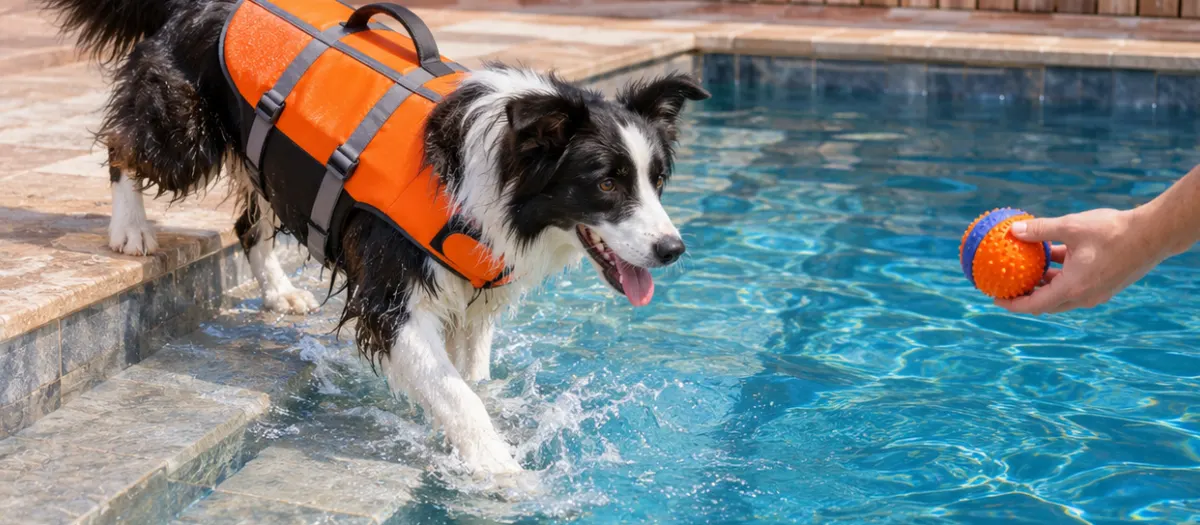
Go slowly and let your dog choose. The AKC's steps are a life vest on first, shallow water, a toy to coax your dog in, then gradual depth with praise. Pause or go back to shallower water if your dog seems overwhelmed. Never pull a dog in, and never throw one in (American Kennel Club).
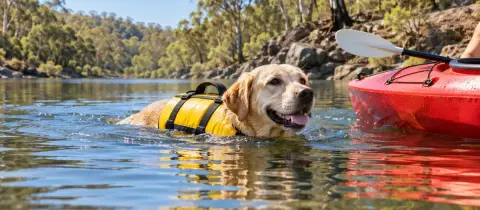
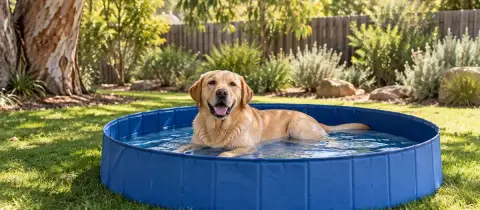
Put the life jacket on at home first, so the strap and fit are familiar before water is involved. The AKC says a vest also keeps the back level, so all four legs paddle. A paddling pool is a fine place for the very first lesson (see our dog pools guide). Results vary, so treat the table as an order of steps, not a timetable.
| Stage | What your dog does | Move on when | Stop if |
|---|---|---|---|
| 1. Wet paws | Stands or walks in the shallows or a paddling pool | Relaxed, coming in by choice, tail and body loose | Backs away, stiffens or refuses |
| 2. Chest depth | Walks in with the life jacket on, with you beside them holding the jacket handle | Moves calmly and takes treats or a toy | Trembling, frantic pulling or scrabbling at you |
| 3. First strokes | Paddles a few strokes towards you, near the steps | Keeps level, with head up and a relaxed face | Splashing with the head low and the mouth open |
| 4. Turn and exit | Turns back to the exit and climbs out | Finds the exit again from a few spots | Misses the exit or can't climb out |
| 5. Short swims | Swims short laps with breaks | Calm, with plenty of energy afterwards | Shivering, tiring, slowing down |
The AKC adds that watching a confident dog swim can help a nervous one.
How do I teach my dog to get out of the pool?
Make the exit its own lesson. Stand near the steps or ramp, point your dog towards them and repeat from different spots, so your dog learns where the way out is. VCA says to teach dogs to climb out of a pool, boat or dock without help, and that ramps or steps may be needed (VCA Animal Hospitals).
A pool wall or ladder is a trap for a dog who can't find the steps. Mark them with a bright toy or cone so they're easy to spot, and practise from the deep end with you close. The AKC says to stay near the exit if you're not in the water. Once your dog heads for the exit on their own, you've got the most important skill sorted.
For floating ramps, see our dog pools guide, which also covers getting out.
How long should a dog swim for?
Keep swimming sessions short. The AKC passes on one expert's advice of 10 minutes at most, to lower the risk of water intoxication, which happens when a dog swallows too much water. That's one expert's guideline, not an official limit, so watch your dog and stop earlier if they tire. Offer shade and fresh drinking water.
Water intoxication isn't often talked about, but it is serious, and the AKC says it can be mistaken for tiredness or chill. The AKC says it can follow swimming, diving, retrieving in water or biting at a hose or sprinkler. Small and high-drive dogs, and dogs who splash with their mouths open, are at greater risk.
Signs can include lethargy, bloating, vomiting, stumbling, restlessness, drooling, pale gums, dilated pupils and glazed eyes. Later signs include difficulty breathing and seizures. The AKC says to go to a vet or emergency clinic immediately (American Kennel Club). Tell the vet your dog has been swimming. To lower the risk:
- Give rest breaks and let your dog toilet between swims.
- Use a flat toy such as a flying disc instead of a tennis ball, so your dog can close their mouth round it (see our water toys guide).
- Don't allow diving for objects or biting at hose or sprinkler streams.
Is pool chlorine bad for dogs?
Small amounts are usually harmless, but drinking a lot can irritate your dog and cause vomiting. The AKC says pool water can be a problem if chlorine levels are too high or too low, that dogs should stay away during a chemical shock treatment until the balance is safe, and that chlorine tablets are the biggest toxic risk, so store them where your dog can't reach (American Kennel Club).
VCA says chlorine, sea salt and debris can irritate skin, so rinse your dog with fresh water after a swim. Dry the ears too, using a drying ear cleaner, because VCA says this helps prevent infections. A portable dog shower is handy if there's no tap near the pool.
How do I make a backyard pool safer for my dog?
Treat the pool like a hazard that needs layers: a closed gate, an adult watching, and a dog who knows the exit. VCA says never to leave a dog alone near water and to fence off and cover the pool. The AVA says not to let dogs swim unsupervised.
Pool fencing law in Australia exists to protect children, and we found nothing that covers dogs. The NSW Government says pool gates must self-close and self-latch, swing outward, and be kept shut, never propped open (NSW Government). That same closed gate also keeps your dog out when you're not watching.
| Check | Why it matters |
|---|---|
| Fence in good order and the self-closing gate shut, never propped | A dog can't swim alone if they can't get in (NSW Government) |
| Cover the pool when it's not in use | VCA advises fencing off and covering the pool |
| Steps marked and the exit taught | A dog who can't find the way out can tire quickly |
| Chlorine tablets and pool chemicals locked away | The AKC says tablets are the biggest toxic risk |
| Fresh water bowl beside the pool | VCA says to stop dogs swallowing pool water and offer fresh water |
| Dog out of the water during a chemical shock treatment | The AKC says to keep dogs away until the water balance is safe |
| Life jacket on weak swimmers | It helps a dog float, but it never replaces watching them |
What if my dog gets into trouble in the water?
Don't go in after your dog. An Australian study found eight adults drowned while trying to rescue animals between 2002 and 2016, and seven of those cases involved a pet dog. The researchers recommend non-contact rescue (Pearn, Peden and Franklin): call your dog, guide them to an exit, throw something that floats, or get help.
The AVA suggests learning dog CPR and what to do after a near-drowning. A vet or a pet first aid course can teach you the steps in person, and our dog first aid kit guide covers what to keep on hand. Any near-drowning needs a vet, even if your dog seems fine (see the box below).
Useful guides
Links to our buying guides, with no products to buy on this page:
- Dog life jackets: fit one on dry land first, then use it from the very first lesson.
- Dog pools: a paddling pool for first lessons, plus a floating ramp pick for the exit.
- Water toys for dogs: flat floating toys that are easier on your dog's mouth than a ball.
- Dog towels: to dry your dog quickly after a swim.
- Dog ear cleaners: for drying the ears after swimming.
- Portable dog showers: a fresh water rinse away from a tap.
- Dog sleeping bags: if swimming is part of a camping trip, dry your dog before bed.
When to see a vet
Go to your vet or emergency vet now (call ahead on the way) if your dog:
- has had a near-drowning or breathed in water, even if they seem fine, because problems can develop hours later (PetMD)
- coughs, struggles to breathe or collapses after a swim
- shows signs of water intoxication, such as vomiting, bloating, stumbling, drooling, pale gums or glazed eyes (American Kennel Club)
- has swallowed pool chemicals or chewed a chlorine tablet: phone the Animal Poisons Helpline on 1300 869 738 (24/7) as well as your vet
Call your vet for advice if your dog has red, itchy skin after swimming, or shakes their head, scratches at their ears or has ear discharge. Ask your vet before starting swimming if your dog is older or has a heart, breathing, seizure or joint problem.
Frequently asked questions
At what age can a puppy start learning to swim?
None of our sources gives a fixed age. The AVA says very young dogs may have trouble swimming, so keep sessions short, shallow and supervised on warm days. Check the life jacket fit as your puppy grows, and ask your vet when to start. Our life jackets guide covers fit.
My dog is scared of water: should I make them swim?
No. Never force a dog into water, and never throw one in. The AKC says doing so can damage a dog's confidence. Go back to wet paws in a paddling pool, use treats and toys, and let a confident dog show the way. If fear stays strong, ask your vet about a trainer.
Why does my dog bite at the water while swimming?
Many dogs snap at splashes, hose streams and waves, and it can mean they swallow lots of water. The AKC links this to water intoxication, along with swimming with the mouth open. Keep sessions short, give rest breaks, swap balls for a flat floating toy, and don't let your dog bite at hose or sprinkler streams. Go to a vet straight away if your dog vomits, bloats or stumbles after water play.
Should I clean my dog's ears after swimming?
Yes, dry them. VCA says to clean the ears after swimming with a drying-agent cleaner, because water left in the canal can lead to infections. Use a cleaner made for dogs and follow its label. If your dog shakes their head or the ears smell, call your vet. See our dog ear cleaner guide.
Is it safe for my dog to swim in a dam, river or lake?
It depends on the water. VCA says to avoid strong currents and dangerously cold water. Victoria's Department of Health says toxic blue-green algae can poison pets and kill them, so keep animals out of affected water, rinse them with fresh water if they touch it, and see a vet. In northern Australia, see our beach tips for crocodile advice.
Do dogs need swimming lessons?
Not always, but VCA says to consider lessons if your dog doesn't readily jump into the water. A dog who is scared, a breed that struggles or a family with a backyard pool may all benefit. If your dog has a health condition, a hydrotherapy pool is something to ask your vet about.
Can my dog use the pool steps or do they need a ramp?
Many dogs manage wide, shallow steps once they've learned where they are, so mark them with a toy or cone and practise. VCA says ramps or steps may be needed. A vertical pool ladder isn't a dog-friendly exit, so don't rely on one. Ramp options are on our dog pools guide.
Related guides
- Dog-friendly beaches in Australia
- Taking your dog to the beach
- Best portable dog showers
- Best dog sleeping bags
- Best dog life jackets by size and breed
- Best dog pools
- How to keep your dog cool in summer
- Best dog first aid kits
Sources
- American Kennel Club: Can all dogs swim? How to teach a dog to swim, page read 23 November 2026
- VCA Animal Hospitals: The dos and don'ts of dog water safety, page read 23 November 2026
- Australian Veterinary Association (Vet Voice): Water safety for dogs, page read 23 November 2026
- American Kennel Club: Can dogs drink too much water? Water intoxication, page read 23 November 2026
- American Kennel Club: Dogs drinking pool water, dangers of chlorine, page read 23 November 2026
- NSW Government: Owning a pool or spa, your obligations, page read 23 November 2026
- Victorian Department of Health: Health effects of blue-green algae, page read 23 November 2026
- Pearn, Peden and Franklin (2020): Drowning of pet owners during attempted animal rescues, page read 23 November 2026
- PetMD: Drowning in dogs, page read 23 November 2026
This guide provides general information and isn't a substitute for veterinary advice. If you're concerned about your dog's health or safety around water, speak with your vet.