Quick answer: Hiking with a dog starts with the rules, because dogs are banned from most national parks. Look for council reserves, some regional parks and state forests, keep your dog on a lead, build distance up slowly, carry more water than you think you'll need, and skip hot days. Check for ticks afterwards.
Before you lace up, sort three questions: is the track open to dogs, can your dog manage the distance in today's weather, and have you packed water and a lead you trust. This guide answers each one. If you're heading overnight, our camping with a dog guide picks up from here.
Where can I take my dog hiking?
Dogs are not allowed in most national parks. Your best bets are council bushland reserves, some regional parks, state forests and private land that welcomes dogs. Rules differ by state, park and even track, so check the managing agency's page and the signs at the start of the track before you go.
NSW National Parks and Wildlife Service says dogs and other pets are not permitted in most NSW national parks and reserves. Some regional parks allow them under effective control, and dogs are welcome in all NSW state forests (NSW National Parks and Wildlife Service, page read 2 November 2026). Parks Victoria says dogs are not allowed in most Victorian national parks, including national park beaches, with a handful of on-lead exceptions on listed roads and trails. It gives the reason that dogs can scare, injure or kill native wildlife (Parks Victoria, page read 2 November 2026).
Other states and councils have their own rules, so look up the park or council page for your track. The same applies to off-lead areas: dogs belong on a lead in public places unless a sign says the area is off-lead. Never let a dog off lead near wildlife or roads.
Can I take my dog hiking in a national park?
Usually no. In NSW and Victoria, dogs are banned from most national parks, with a few listed exceptions. Even where dogs are allowed, they must be on a lead or under effective control. Check the park's own page, because a dog-friendly track in one park can sit beside a no-dogs track in the next.
If a national park is the hike you really want, consider leaving your dog with a sitter and see leaving your dog on holiday. Parks Victoria says fines can apply, and the bans exist partly to protect wildlife, so it's not worth the risk.
How far can my dog hike?
There's no single distance that suits every dog. Age, breed, fitness, coat and the weather all matter. The safe approach is to start with short, easy walks, build up gradually, and turn back early if your dog tires. A fit kelpie and an older pug need very different hikes. Everyday amounts by age and breed are in how much exercise a dog needs.
None of the vet sources we opened gives a set distance. The vet-written Preventive Vet guide says to condition flat-faced breeds slowly to longer hikes, and to hike them in the cooler part of the day. It also says frequent stopping, heavy panting or lying down can be early signs of tiredness or heat (Preventive Vet, page read 2 November 2026). Puppies and senior dogs need gentler routes, so ask your vet what suits yours.
How much water does my dog need on a hike?
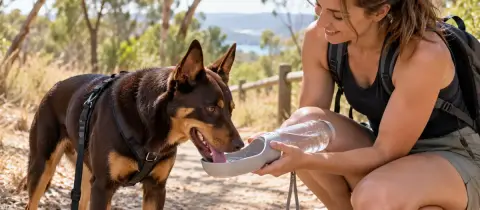
A dog's daily needs depend on size, weather and effort. One vet-written guide puts it at roughly 50 to 90 ml per kilo of body weight a day, and says that can nearly double on a strenuous, warm hike. Pack more than you think you'll need, and offer fresh water at every stop.
Bring all of it from home rather than letting your dog drink from puddles or ponds, which the same guide advises against (Preventive Vet, page read 2 November 2026). A bottle with a built-in bowl or a folding bowl makes drink breaks easy. See our dog water bottle guide and collapsible dog bowl guide.
Is it too hot to hike with my dog?
Often, yes, in summer. Dogs cool down mainly by panting, which works poorly on hot or humid days. Walk early or late, pick shaded tracks, test the ground with the back of your hand, and skip the hike if you're unsure. Never leave a dog in a parked car, because a car can heat quickly even on mild days.
Our keeping your dog cool in summer guide has the full detail. RSPCA Australia lists heavy panting that gets worse, drooling, agitation, very red or pale gums, vomiting, weakness and tremors as heatstroke signs (RSPCA Australia, 20 January 2021, page read 2 November 2026). If you see them, see the vet box below.
What should I pack for hiking with my dog?
Pack water and a bowl, poo bags, a well-fitted lead, a harness, ID, treats and a basic pet first aid kit. Add a towel, a few unscented dog wipes for muddy paws and a tick check routine for the end of the day. Small dogs that tire may suit a carrier for part of the walk.
Here's the short checklist, with our guides for each item.
Gear worth packing
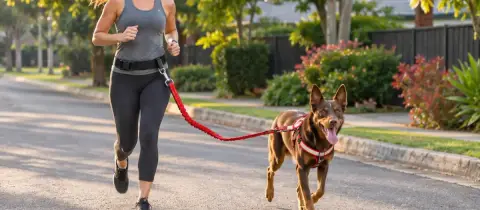
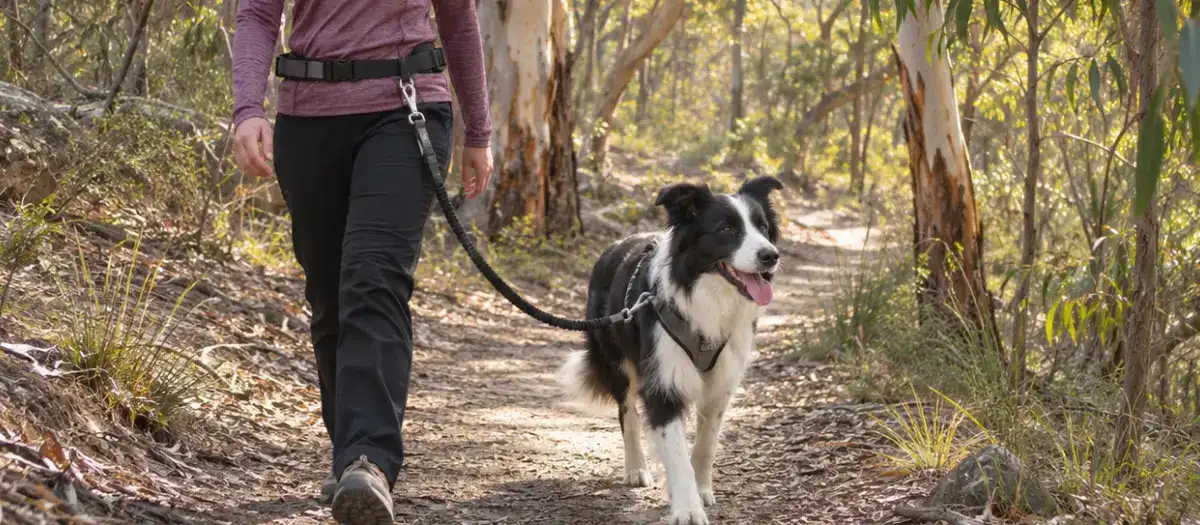
- Lead: a hands-free dog lead keeps both hands free on uneven ground. A long dog lead is for recall practice in safe, open, signed areas, not busy tracks. Clip to a harness, keep the lead short near other walkers, and step off the track to let cyclists, runners and horses pass while your dog sits and waits.
- Harness and ID: a well-fitted harness spreads the pull, see no-pull dog harness, or choose a type in our dog harness buying guide. Keep ID on a flat collar, and see our dog collar guide for tag and registration basics.
- Water: a dog water bottle and a collapsible dog bowl.
- Carrying your things: a dog walking bag holds treats, bags and a towel.
- A pack for your dog: a fit, healthy adult dog can carry a little of its own gear in a dog hiking backpack; keep the load light and ask your vet first.
- Poo bags: pack more poop bags than you think you'll need, and a poop bag holder keeps them handy. Pick up after your dog and take the bag out with you.
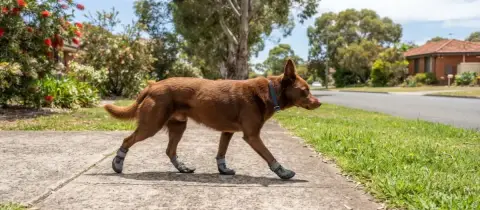
- Paw protection: dog boots can help on rough or hot ground, but need a slow introduction.
- Cold or wet weather: on cold, wet tracks a waterproof dog coat suits short-coated dogs.
- Small dogs: a dog backpack carrier for tired legs or rough sections. Not for hot days.
- First aid kit: a pet first aid kit with saline for rinsing and dressings for bandaging. Ask your vet what to include, and see our dog first aid kits guide for what to add for ticks, snakes and stings.
For overnight trips, add a dog camping bed, and see dog tie outs for camp safety. An outdoor dog bed suits trips to the beach or a picnic.
How do I protect my dog's paws on rocky tracks?
Build your dog's paws up with regular walks, check them at every rest stop, and skip sharp, rocky or hot ground when you can. Boots can help, but they won't suit every dog. If a pad is bleeding or cut, stop and head back.
The Preventive Vet guide says boots or gradual conditioning can help, but no paw is fully protected from sharp rocks, hot surfaces or glass, and an open, bleeding paw means stopping and returning to the car (Preventive Vet, page read 2 November 2026). Hot sand and bitumen can burn pads, see burnt dog paws. If you want boots, read our dog boots guide for fit and how to introduce them.
What about ticks and snakes?
Check your dog for ticks after every walk, especially the head, neck and ears, and talk to your vet about prevention if you hike along the east coast. Keep your dog on a lead and out of long grass and rocky spots, where snakes shelter. Both are emergencies if something goes wrong.
Our paralysis ticks guide covers where they live, the signs and what to do. Signs can include a change in bark, gagging, wobbly back legs and laboured breathing.
What do I do if my dog is bitten by a snake?
Treat it as an emergency and get to a vet immediately, even if your dog seems fine. Call ahead if you can, keep your dog calm and still, and don't try to catch or handle the snake. Signs can be delayed, so don't wait to see what happens. Our snake bite guide has the signs and first aid steps.
Lort Smith says to watch closely for at least 25 hours, since signs can appear up to 25 hours after a bite, and that early collapse or vomiting followed by apparent recovery still needs veterinary attention. For a bite on a limb it suggests a firm crepe bandage and a splint to slow the spread of venom (Lort Smith Animal Hospital, page read 2 November 2026). First aid advice differs between vets, so follow your own vet's guidance, and plan ahead by saving the number of the nearest 24-hour emergency vet.
When to see a vet
Go to a vet straight away, even after hours, if your dog:
- is bitten, or may have been bitten, by a snake
- has a tick on them, or shows a changed bark, gagging, wobbly back legs or laboured breathing (see our paralysis ticks guide)
- has a cut, bleeding or badly worn paw pad, or is limping and won't put weight on a paw
- seems unwell after the hike, vomits, or has swollen or painful joints
Heat emergency: if your dog collapses, pants harder and harder, drools, vomits, or has very red or pale gums, move them into shade and wet their coat with cool (not ice-cold) water while you call a vet. RSPCA Australia lists these among the heatstroke signs and says to get to a vet as soon as possible, even if you just suspect heatstroke (RSPCA Australia, page read 2 November 2026).
Frequently asked questions
Where can I find dog-friendly hiking tracks near me?
Start with your local council's website for bushland reserves, then check state forest and regional park pages. NSW National Parks says dogs are welcome in all NSW state forests. Read the signs at the start of the track too, because rules can change from one track to the next.
How long should I hike with my puppy?
Keep puppy walks short and easy, and build up slowly. Puppies tire quickly and their joints are still developing, so there's no set distance to aim for. Ask your vet how far suits your puppy's age and breed, and turn back at the first sign of tiredness.
Do dogs need boots for hiking?
Not always. Many dogs manage with paws conditioned through regular walks. Boots can help on sharp rock or hot ground, but need a gradual introduction and a good fit. Check paws at every rest stop either way. See our dog boots guide.
Can my dog hike off lead?
In signed off-lead areas, and nowhere else. Dogs belong on a lead in public places, and Parks Victoria says fines may apply for off-lead dogs in dog-friendly parks. Wildlife, snakes, other walkers and cyclists are all good reasons to keep a lead on, and never go off lead near roads.
What should I do with dog poo on a hike?
Pick it up and take it out with you, bagged. Don't leave bags on the track or hanging on branches. A clip-on holder keeps spare bags handy, and a sealed pocket in your pack stops smells. See our poop bag holder guide.
Can my dog drink from creeks and puddles on a hike?
Better not. The vet-written Preventive Vet guide says ponds, streams and puddles can carry parasites and bacteria such as giardia and leptospirosis, and that a dog without fresh water may find them itself. Carry water from home and offer it at every stop, using a bottle with a bowl or a folding bowl.
Related guides
- How much exercise does a dog need?
- Best dog hiking backpacks
- Best dog first aid kits
- Dog stung by a bee
- Camping with a dog
- Best dog camping beds
- Dog sleeping bags
- Best dog tie outs
- Best outdoor dog beds
- Best hands-free dog leads
- Best dog water bottles
- Best dog boots
- Paralysis ticks in dogs and cats
- Keeping your dog cool in summer
Sources
- NSW National Parks and Wildlife Service, Pets in national parks, page read 2 November 2026 (https://www.nationalparks.nsw.gov.au/conservation-and-heritage/pets-in-national-parks)
- Parks Victoria, Dog friendly parks, page read 2 November 2026 (https://www.parks.vic.gov.au/things-to-do/dog-friendly-parks)
- Preventive Vet, Hiking with dogs: trail safety tips from a veterinarian, page read 2 November 2026 (https://www.preventivevet.com/dogs/hiking-with-dogs-trail-safety-tips-from-a-veterinarian)
- RSPCA Australia, Keeping your pet safe during heat, page read 2 November 2026 (https://rspca.org.au/blog/2021/keeping-your-pet-safe-during-heat)
- Lort Smith Animal Hospital, Snake bites: dogs, page read 2 November 2026 (https://lortsmith.com/need-help-now/dog/bites-stings/snake-bite/)
This guide provides general information and isn't a substitute for veterinary advice. If you're concerned about your dog's health on the trail, speak with your vet.