Research guide. WhiskerFinds may earn a commission from links, at no extra cost to you.
Quick answer: A dog tie out cable can work at camp when someone is watching the dog. Our top pick is the XiaZ overhead trolley line, because your dog roams along a line instead of circling a stake. Clip it to a harness, keep it clear of tents and fires, and never leave a dog tied up alone.
A tie out is a short-term tool for a dog at a campsite, picnic or caravan park, not a way to leave your dog on its own. This guide compares four options on Amazon Australia and covers set-up and safety. For the bigger trip plan, start with camping with a dog, and for exercise on the move see our long dog lead guide.
Quick picks
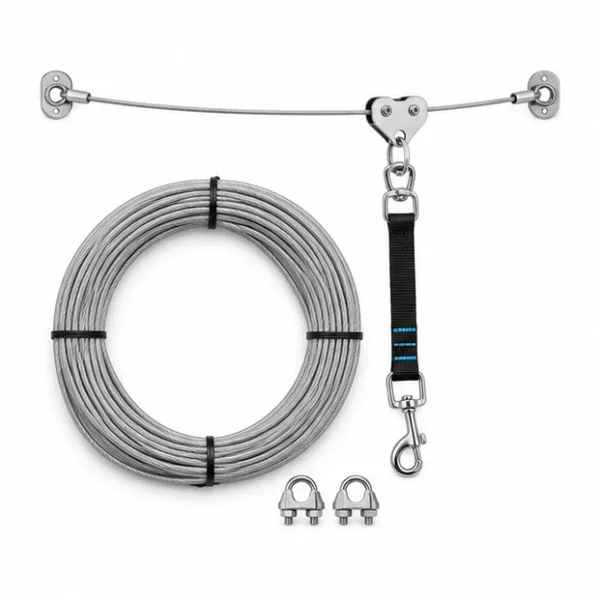
XiaZ overhead trolley tie out
A 50 ft (about 15 m) line strung between two anchor points, with a sliding trolley and a swivel clip
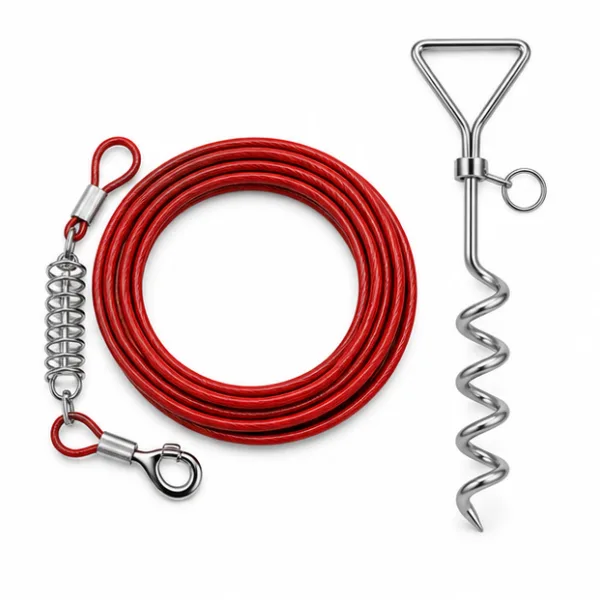
Supet tie out cable and stake
Vinyl coated wire rope with a 16 inch spiral stake and a 360 degree swivel
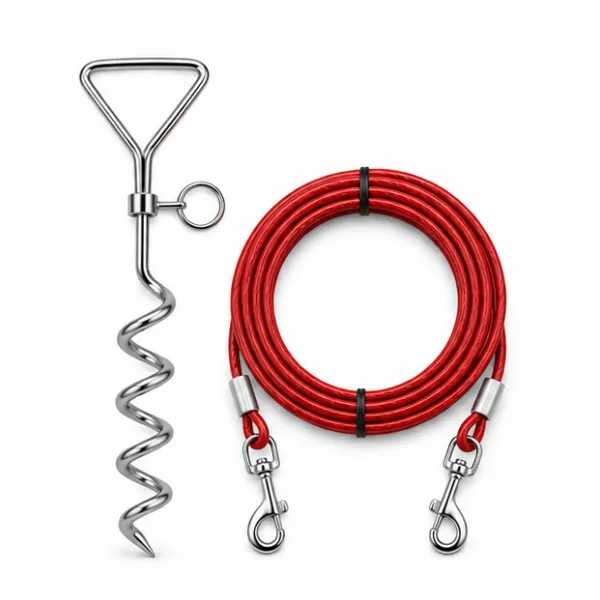
ShawFly spiral steel stake and cable
A 16 inch spiral stake with a rubber coated steel cable in 3 m, 5 m or 10 m
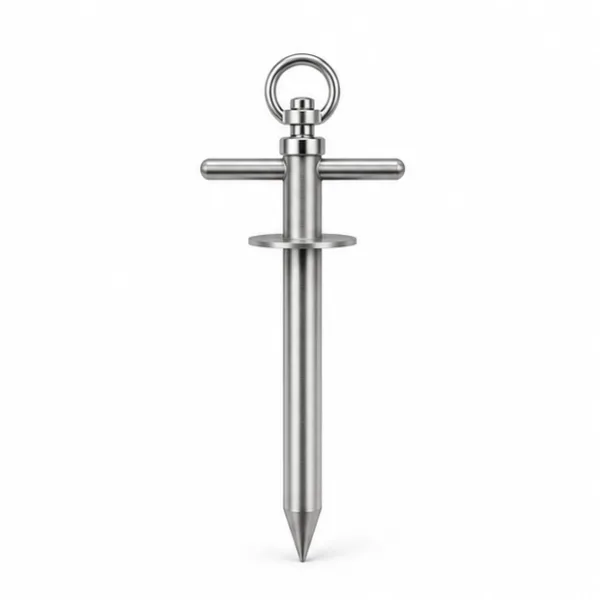
TOPKNOT 360 degree swivel stake
A bolt-down swivel anchor with no cable, for rock or hard ground
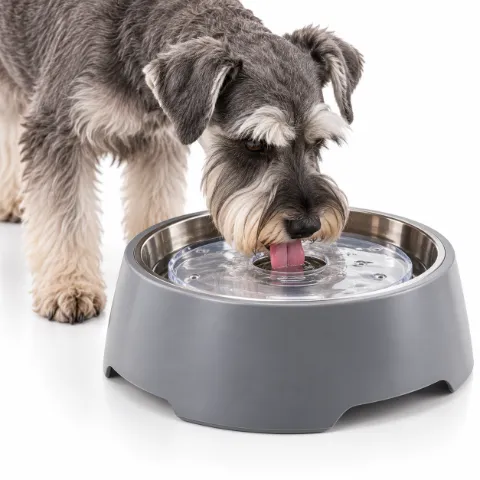
Decflow 3 L no-spill dog water bowl
A steady bowl that is harder to knock over, so water stays within reach.
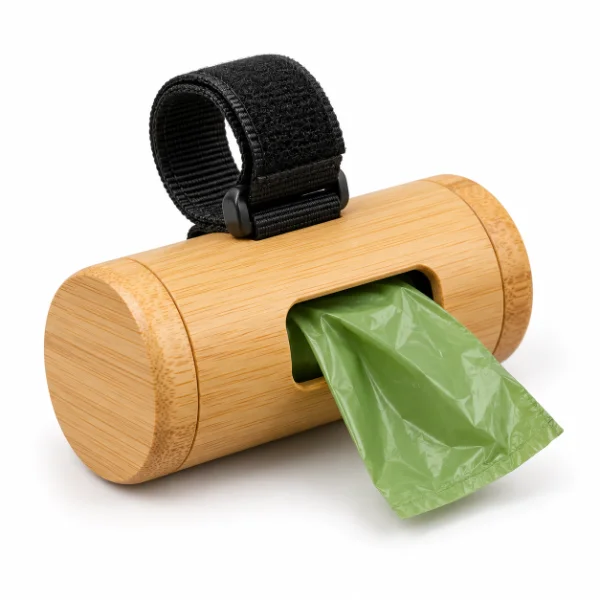
Tuff Pets bamboo poop bag holder
Keeps bags at hand for cleaning up when you pack up camp.
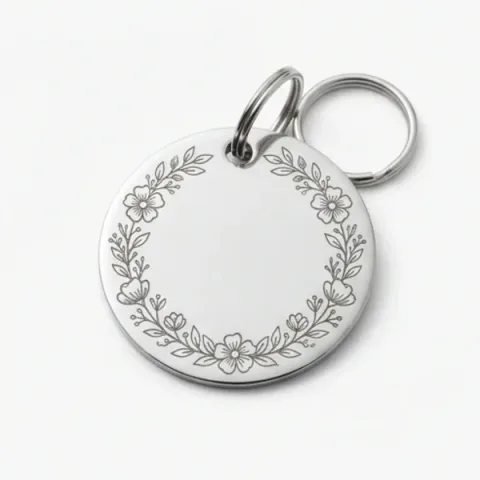
Meow the Woof stainless steel ID tag
A tag with your contact details gives a lost dog the best chance of getting home.
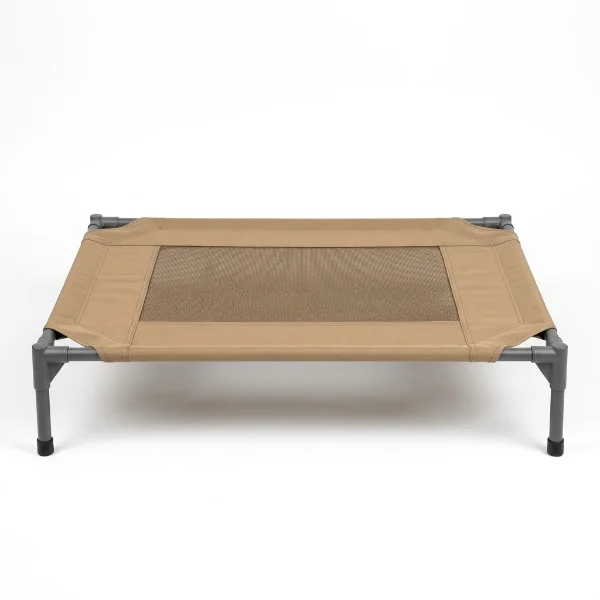
K&H outdoor elevated dog cot
A raised bed that keeps your dog off hot or damp ground.
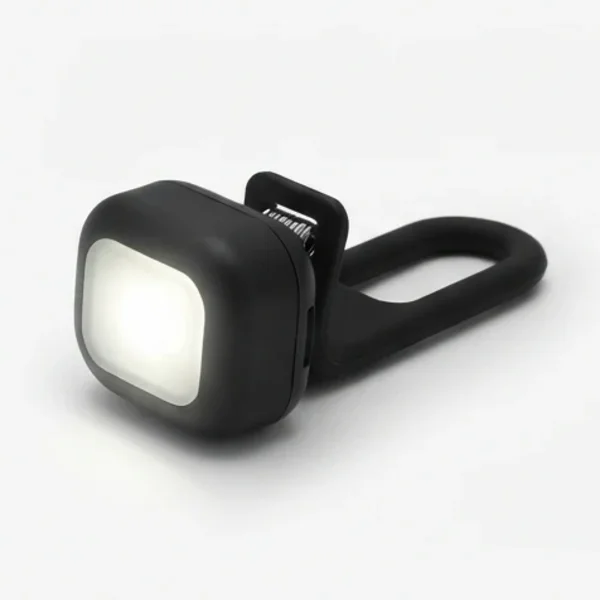
PAJ MINI clip-on light
A small light that clips on so you can see your dog at dusk.
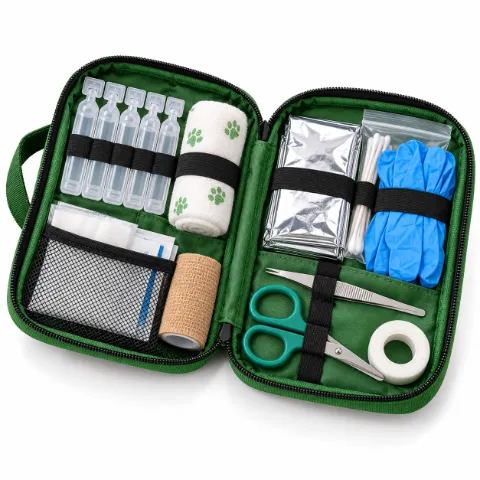
Reliance Medical pet first aid kit
Handy for scrapes and trips away from the vet.
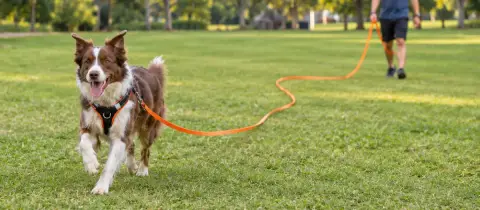
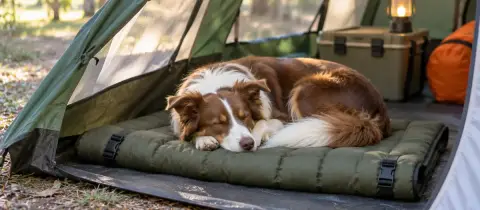
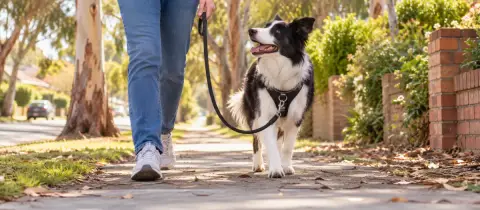
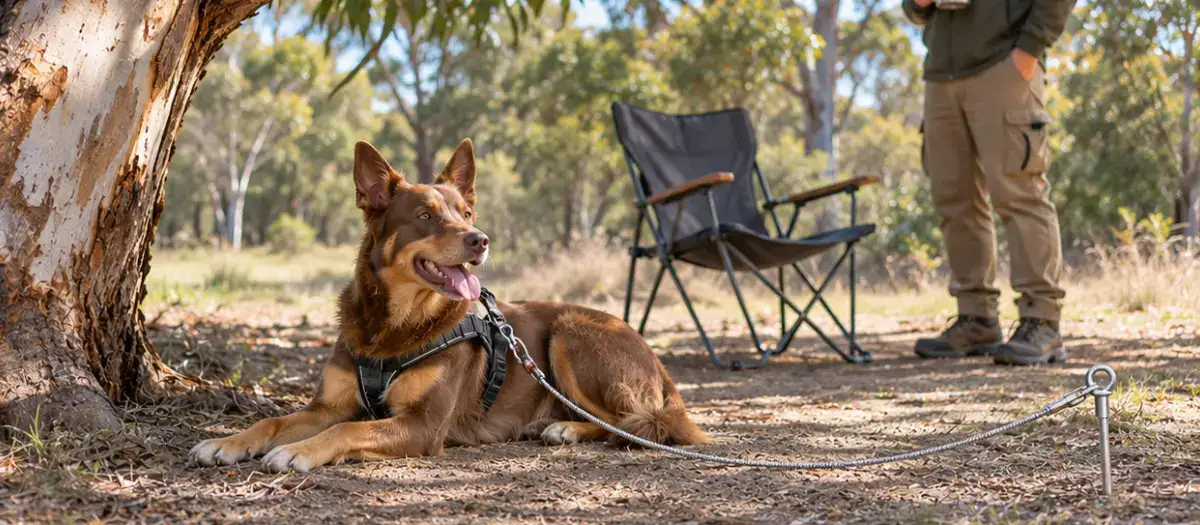
Pictures are illustrations, not the actual products.
Pick the one that matches your campsite. Tree or post to tree: the overhead line. Soft grass: a spiral stake. Rock: the bolt-down anchor.
Is it safe to tie a dog out at camp?
It can be, for a short time, with you close by. RSPCA Australia says tethered dogs shouldn't be left unsupervised, and that tethering should be kept to a minimum. A tie out suits a calm dog that is used to it, in shade, with water within reach.
The RSPCA also says tangled tethers can choke a dog, and that a dog can be hung if it jumps over or off something while tied (RSPCA Australia knowledgebase, page read 2 November 2026). Rules on tethering differ by state and territory, so check yours. Many camps also require dogs to be on a lead or under control at all times, so check the camp's rules before you go.
Some dogs shouldn't be tied out at all. A dog that panics when restrained, lunges at passers-by, or is likely to bolt after wildlife is better kept on a short lead beside you, or settled in a dog crate set up in deep shade beside you, with water inside. Never leave a dog in a parked car, even in the shade.
Stake or overhead line: which tie out is better?
An overhead line usually gives more control. The dog moves along a cable strung between two anchor points, so there is less chance of the line wrapping around a stake or a chair leg. A stake is simpler and works anywhere you have a good patch of soil.
Overhead lines need two solid anchors, such as two trees, and a clear gap between them. Check that the trees are healthy and the line sits well above head height for people walking past. A stake suits open ground, but your dog can circle it and shorten the cable. A swivel helps, though it won't fix a bad site.
Neither type suits a strong, lunging dog. Any anchor can fail if a big dog hits the end of the line at speed, so match the product's stated weight limit to your dog, with room to spare. For a dog that pulls on walks, a well-fitted no-pull harness is the right clip point, as covered below.
Our picks in detail
1. XiaZ overhead trolley tie out: best overall
A 50 ft line you string between two anchor points, such as two trees, so your dog can move along it. The listing says set-up takes about 5 minutes, and that this kind of trolley system lowers the chance of a dog getting wrapped around trees or picnic tables. It says the cable is reflective kernmantle rope with a glow-in-the-dark finish, which is handy at night. The listing says it weighs 1.3 lb (about 0.6 kg) and comes with a carry bag, 2 steel buckles and a 360 degree tangle-free clip.
- Pros: the dog roams along a line instead of around a stake; light and quick to pack; reflective for night visibility; a swivel clip is included
- Cons: you need two sturdy anchor points; the cable is rope, so check it for fraying and chewing; the listing says the lead pictured on the dog isn't included, so you need your own lead and a harness
- Best for: a calm dog at a camp with two good trees, with you nearby
- Skip it if: you camp in open ground with nothing to anchor to, or your dog chews rope
2. Supet tie out cable and stake: best cable and stake set
A cable and stake combo. The listing says the cable is wire rope with a smooth vinyl coating, crimp-covered ends and a 360 degree swivel ring. The 16 inch stake is stainless steel with a spiral shape, a plastic handle and a rotating top. It's listed for medium to large dogs up to 125 lb (about 57 kg), with a combined weight of about 0.6 kg.
- Pros: coated cable; spiral stake screws into the ground by hand; stainless steel stake; 360 degree swivel
- Cons: the listing is unclear on cable length: the title says 32 ft, but the details say 10 feet and the text mentions several sizes, so confirm the length before you buy; the listing also mentions a number of stakes in the package, so check what is included
- Best for: medium to large dogs at camps with soil you can screw a stake into
- Skip it if: the ground is hard rock or very loose sand, or your dog is heavier than the stated 125 lb (about 57 kg) limit
3. ShawFly spiral steel stake and cable: best spiral stake
A spiral stake and cable set in 3 m, 5 m or 10 m. The listing says the stake is 16 inches (about 40 cm) with a spiral root that is hard for a dog to pull out. The cable is 5 mm steel wire with a rubber coating and a plastic layer, and the listing says it has a 360 degree rotating ring. It says it suits small and medium dogs, and the stake and cable together weigh about half a kilo in the 5 m size.
- Pros: a choice of three cable lengths; the shorter 3 m cable keeps a small dog from wandering; light to carry
- Cons: the listing gives no weight limit; it says it's for small and medium dogs; the listing says to fix the collar to the chain, which we advise against, so clip to a harness
- Best for: small and medium dogs on soft ground, with someone watching
- Skip it if: your dog is large or strong, or you want a stated weight limit
4. TOPKNOT 360 degree swivel stake: best swivel stake
A stake with no cable. The listing says it's made from aluminium alloy and 304 stainless steel, with six 10 inch bolt anchors, a 360 degree rotating ring and a detachable chain buckle. It says to use a hammer to fix the anchors into rock or hard ground, and that the system resists 1500 pounds (about 680 kg) of pull.
- Pros: a swivel base; strong materials per the listing; you can add your own cable; designed for hard ground where spiral stakes struggle
- Cons: the listing describes bolting into rock or hard ground, so it isn't designed for sand or soft ground; the weight limit is unclear, with the title saying 200 lb (about 91 kg) and the colour option 150 lb (about 68 kg); a cable isn't included
- Best for: a fixed spot on rock or hard ground, with your own cable
- Skip it if: you camp on sand or soft soil, or your dog is large and lunges
How long should a dog tie out cable be?
Short is safer. A cable of about 3 m to 5 m gives a medium dog room to stand, turn and lie down in one spot. Longer cables, like the 9.75 m and 15 m options here, give more room but also more chance of tangling and of a dog reaching tents, guy ropes or a neighbour's site.
Choose a length by where you will camp. Measure the space between your camp chair, the tent and the nearest track. The dog should be able to reach shade and water, but not the tent, the fire, the road, other dogs or the next camp's gear. If the cable reaches somewhere it shouldn't, shorten it.
Cable length also changes the force on the anchor. A dog that gets a long run-up can hit the end of the line harder. Small and medium dogs do well on 3 m to 5 m, and big strong dogs need a sturdier set-up and close supervision.
Should a tie out clip to a collar or a harness?
Use a harness. A sudden stop on a collar puts the whole force on your dog's neck, and a tangle around the neck is far worse than around a body strap. Clip the swivel to the back ring of a well-fitted harness, not the front chest ring, and keep a flat collar with ID tags on as usual.
Never use a prong, choke, slip or shock collar, on a tie out or anywhere else. Check that the harness fits snugly with no rubbing, and that the clip can't slip out of the ring. Our dog collar guide covers ID tags, microchip and council registration, which differ by state and council.
Note that the ShawFly listing talks about fixing the collar to the chain. We would still clip a tie out to a harness instead.
How do I stop my dog tangling?
Pick a swivel, a clear site and a sensible length. A 360 degree swivel at the dog end lets the cable turn, so it doesn't twist around itself. Clear the area of chairs, bowls, tent pegs, trees and rocks the cable can catch on, and check the line often.
An overhead line helps, because the cable sits above the ground. Even so, check it every few minutes at first. Dogs find ways to circle trees and chair legs, and some will chew a cable. If yours chews, a tie out isn't the right tool, and a chew-resistant toy with a lead beside you may work better.
Keep the cable and the swivel clean and free of sand and grit, which can jam a swivel. If the swivel stops turning freely, stop using it.
Can I leave my dog on a tie out while I go out?
No. A tie out is for times when you can see the dog. RSPCA Australia says tethered dogs shouldn't be left unsupervised, and notes that dogs need protection from heat, sun, cold, wind and rain, plus enough water. Walk away from camp and you can't offer any of that.
Dogs have also died tethered on hot days without enough shade, according to the same RSPCA page. If you need to head out, take the dog with you, leave it with a trusted person, or arrange care. A tie out also doesn't treat anxiety, and a dog that struggles when left needs help from a vet or behaviour professional. See is my dog bored? for how to tell bored from distressed.
Dog tie outs compared
Details from each Amazon Australia listing, checked on 2 Nov 2026.
| Product | Type | Length per listing | Weight limit per listing | Best for |
|---|---|---|---|---|
| XiaZ overhead trolley | Overhead line | 50 ft (about 15 m) | Up to 200 lb (about 91 kg) | Camps with two trees |
| Supet cable and stake | Cable and spiral stake | 32 ft in the title (about 9.75 m) | Up to 125 lb (about 57 kg) | Medium to large dogs on soil |
| ShawFly spiral stake and cable | Cable and spiral stake | 3 m, 5 m or 10 m options | Not stated | Small to medium dogs |
| TOPKNOT swivel stake | Bolt-down stake, no cable | None, add your own | 150 lb or 200 lb (about 68 kg or 91 kg), see below | Rock or hard ground |
How we chose
We searched Amazon Australia for dog tie outs, stakes and overhead lines, then shortlisted ones that met all of these checks:
- Well rated: a strong average rating with plenty of buyer reviews.
- No red flags: no pattern of poor reviews, safety complaints or listing problems.
- Available on Amazon Australia when we checked.
- Length stated clearly, with a choice of sizes where possible.
- Cable coating that protects the wire and your dog's mouth, or a rope designed for outdoor use.
- Weight limit on the listing where one is given, so you can match it to your dog; where a listing gives none, we say so.
- Stake type: a spiral or bolt-down anchor rather than a flat peg.
- A swivel on the listing, to reduce twisting.
These are researched picks, not products we've personally used. We compared the specifications and features shown on each Amazon Australia listing, checked on 2 Nov 2026. We didn't accept payment from any brand, and no brand saw this page before it was published.
Left out this time: chains and uncoated wire, and tie outs sold as a way to leave a dog alone.
How to set up a tie out at camp
Take a few minutes to get the site right before the dog goes on the line.
- Walk the site. Look for rocks, roots, tent pegs, chairs, stumps and anything that could catch the cable.
- Pick shade. Dogs need shade all day, and the shade moves. Never tie a dog out in the heat or sun. Our keep your dog cool in summer guide has the signs of heat stress.
- Keep clear of hazards. Stay away from tents, guy ropes, fires, roads, other dogs and food.
- Check the anchor. Pull hard on the stake or line yourself before you trust it.
- Clip to a harness. Not a collar.
- Put water and a bed in reach. A collapsible dog bowl and a dog camping bed help. An outdoor dog bed keeps your dog off hot or damp ground.
- Stay in sight. Keep checking the cable for tangles.
Introduce the tie out gradually on a short lead at home first, with treats, so it's not new on the day. Pick up and bin dog poo when you leave.
Camp rules, parks and wildlife
Most national parks don't allow dogs. NSW National Parks and Wildlife Service says dogs and other pets aren't permitted in most NSW national parks and reserves, with some regional parks and all state forests the exceptions (NSW National Parks, page read 2 November 2026). Other states differ, so check the park's own page before you book. Our camping with a dog guide has more on this.
On the east coast, paralysis ticks are a risk, so check your dog daily and see our paralysis tick guide. Keep your dog out of long grass, and if you hike to the camp, see hiking with a dog.
Caring for your tie out
Rinse sand and mud off the cable and swivel after each trip, dry it, and store it loosely coiled. Check for kinks, frayed rope, cracked coating, bent stakes and a stiff swivel. Retire anything damaged. A cable with a broken coating can have sharp wire ends.
When to get help
Get to a vet straight away if your dog is tangled and struggling to breathe, has a swollen or cut neck or leg, or shows signs of heat stress such as heavy panting, drooling, weakness or collapse. Move the dog into shade and untangle it calmly, then call a vet.
A snake bite is an emergency: keep the dog still and go to the nearest vet immediately (RSPCA Knowledgebase, page read 2 November 2026). If your dog is anxious or distressed on a tie out, talk to your vet or a qualified, reward-based behaviour professional.
Frequently asked questions
Can I use a tie out in the backyard every day?
It's not a good long-term set-up. RSPCA Australia says tethering should be avoided for ongoing confinement and that a fenced yard or enclosure is better, with tethering kept as short as possible. If your yard isn't secure, a tie out for a few supervised minutes is a stopgap while you fix the fence.
Is rope or coated cable better for a tie out?
Coated steel cable is harder to chew through than rope, and RSPCA Australia suggests metal tethers and swivels on fixed runners over rope, which can fray or tangle. The XiaZ overhead line is kernmantle rope, so check it for wear each trip. Whatever the material, inspect clips and swivels before every use.
Which is better, a tie out stake or an overhead line?
An overhead line gives smoother movement and less wrapping, but needs two solid anchors like trees. A stake suits open ground with soil you can screw it into. A spiral stake won't hold in very loose sand or hard rock, so match the type to your site.
Can a tie out go on my dog's collar if the harness is wet?
No, wait for the harness to dry or use a short lead beside you. A collar puts any sudden pull on your dog's neck, and a tangle there is dangerous. Clip to the harness ring, keep a flat collar with ID on, and never use a prong, choke, slip or shock collar.
Why does my dog keep getting wrapped around things on a tie out?
Dogs circle whatever the cable can reach. Use a swivel, clear the area of chairs, bowls, pegs and trees, and keep the cable at a sensible length. An overhead line keeps the cable off the ground. Check it often, because dogs can still circle objects and twist a cable.
Is it OK to pop to the shop with my dog on a tie out?
No, not even for a few minutes. RSPCA Australia says tethered dogs shouldn't be left unsupervised, and they need shade, shelter and water. A tie out is for when you can see your dog. If you need to leave camp, take the dog with you or leave it with someone trusted.
Do tie outs work for big or strong dogs?
Sometimes, with care. Check the weight limit on the listing and leave a margin, and expect strong lunging dogs to test any anchor. If your dog hits the end of the line hard, a tie out may not suit it, so use a short lead beside you instead.
Are dogs allowed on a tie out in national parks?
Dogs aren't allowed in most Australian national parks, so a tie out won't come into it there. State forests, some regional parks and many caravan parks may allow dogs on a lead, each with their own rules on tethering. Check with the park or camp before you book, and ask whether tie outs are permitted.
Related guides
- Portable dog fences
- Camping with a dog: what to pack and what to know
- Best dog camping bed
- Hiking with a dog
- Best outdoor dog bed
- Best long dog lead
- Best collapsible dog bowl
- Best no-pull dog harness
Sources
- RSPCA Australia knowledgebase: Can dogs be safely confined by tethering?, read 2 November 2026
- NSW National Parks and Wildlife Service: Pets and animals in national parks, read 2 November 2026
- RSPCA Knowledgebase: My pet has been bitten by a snake, what should I do?, read 2 November 2026
- Product details from each linked Amazon Australia listing, checked on 2 Nov 2026.
This guide provides general information and isn't a substitute for veterinary advice. If you're concerned about your dog's safety at camp, speak with your vet.