Best dog car harnesses: crash tested or not? (2026)
By Anish PuriUpdated 22 Oct 202612 min readResearched, not tested by us
Research guide. WhiskerFinds may earn a commission from links, at no extra cost to you.
Quick answer: A dog car harness is a strap-on restraint that clips your dog to the seat belt in the back seat, and our pick is the Kurgo Tru-Fit Enhanced Strength Harness, which comes in sizes XS to XL and includes a tether. Australia has no formal crash-test standard for these, so treat every "crash tested" label as the brand's claim.
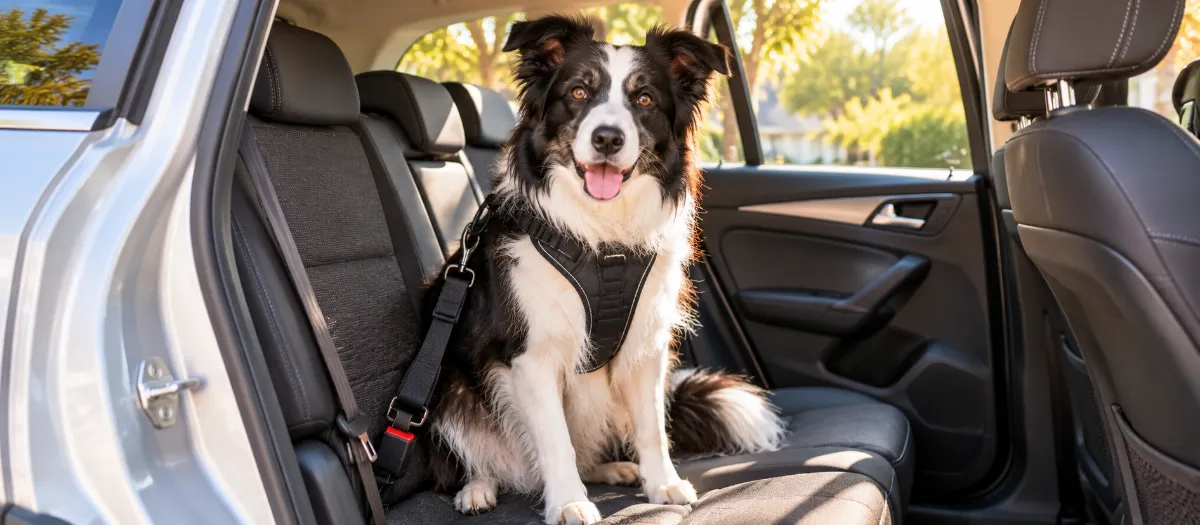
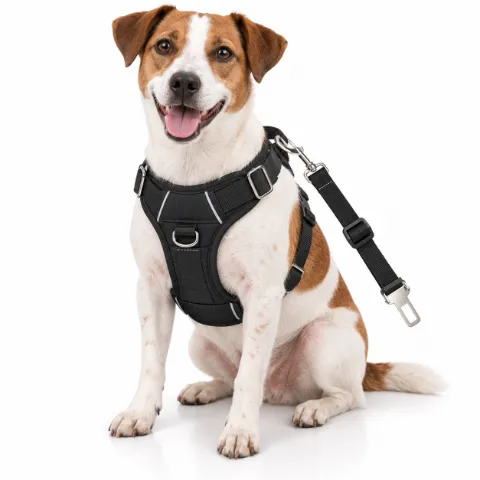
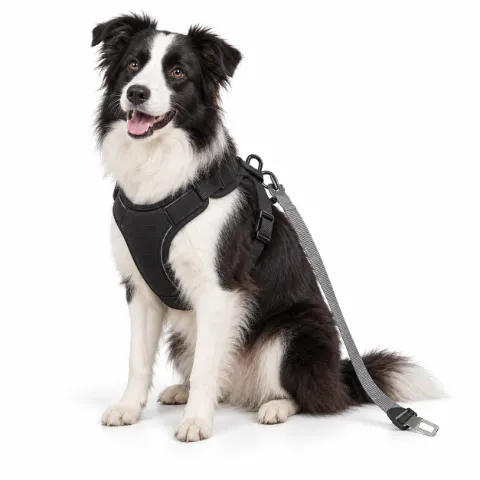
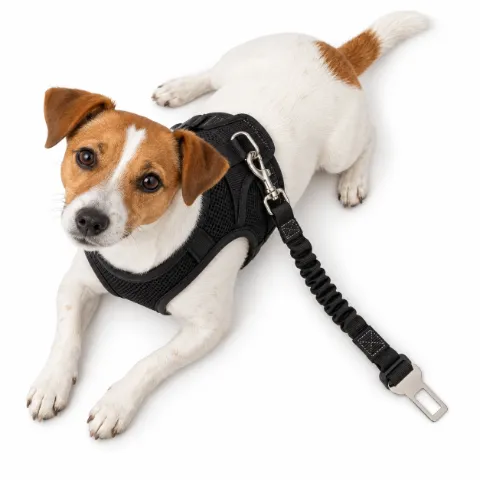
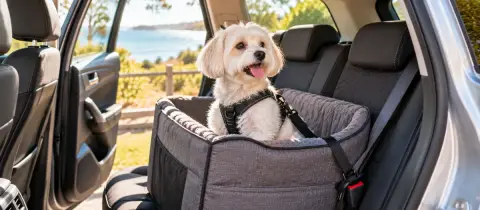
Illustration, not the actual product
Our top pickKurgo Tru-Fit Enhanced Strength Dog Harness
Here we compare four car harness and tether options on Amazon Australia, explain what "crash tested" can and can't tell you, and cover fitting and tether length. For the bigger picture, including the law, start with our guide to restraining your dog in the car.
Pictures are illustrations, not the actual products.
Tap "Check price on Amazon" for today's price. Prices change often, so we don't print them.
If your dog already has a harness and you only need the tether, our dog seat belt guide compares more of them.
What is a dog car harness?
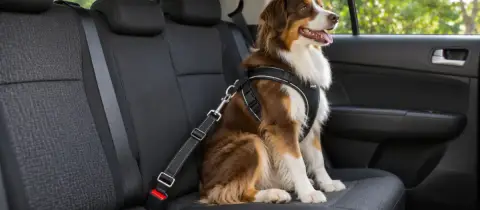
A dog car harness is a harness built to hold your dog in the seat while the car moves, usually by connecting to a seat belt or a tether that clicks into the buckle. A walking harness is made for walks and may not be built for car loads. RSPCA Australia says to use a harness that is safe for restraint in vehicles, which may be different from the harness you use for walks (RSPCA Australia Knowledgebase, updated 30 September 2025).
The same page gives the reasons to restrain a dog at all. A restrained dog is less likely to distract the driver, less likely to be thrown forward in a crash or hard braking, and can't jump out of a window.
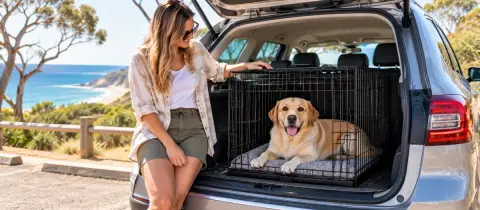
A harness is one of a few set-ups. A secured crate suits some dogs better (see our dog car crate guide), and small dogs can use a booster (see our dog car seat guide). Whichever you choose, the back seat is the place for your dog, never the front seat or your lap. A seat cover protects the upholstery but doesn't restrain anything, so pair it with a harness; our dog car seat cover guide covers those.
Does a crash-tested dog harness really matter?
It matters for knowing what you're buying. There is no formally recognised Australian standard for crash testing dog car restraints or carriers. Some brands have products tested by groups such as the Center for Pet Safety, and others say they ran their own tests, so check the claim (RSPCA Australia Knowledgebase).
In practice, that means a "crash tested" label on a listing tells you what the brand says, not what an Australian authority has confirmed. Here's how we handle it in this guide:
Kurgo's listing says the Tru-Fit harness is crash tested. We haven't seen a test report.
EzyDog says it tested the Drive harness to ECE R21, FMVSS 213 and ADR 42/04. Those are vehicle standards, so ask the brand what the test involved and what size and weight of dog it used.
SlowTon and KONG make no crash-test claim on their listings. The SlowTon set is a restraint for everyday trips, and the KONG is a tether only.
RSPCA Australia lists restraint as a way to reduce the risks of an unrestrained dog, but no harness can promise your dog will be unharmed in a crash. Ask each brand for its test details before you rely on a claim.
Our picks in detail
1. Kurgo Tru-Fit Enhanced Strength Dog Harness: best overall
An in-car harness in sizes XS to XL. The listing describes a nesting buckle system, an adjustable fit and an over-the-head design. It attaches to standard vehicle seat belts and to a zipline, and a seat belt tether is included. Kurgo says the harness is crash tested; the listing title also says "no pull", thanks to a front clip. Because it also works as an everyday harness, one piece of gear covers the car and the walk. It's the harness we already mention in our dog car sickness guide.
Pros: five sizes; tether included; works as an everyday harness
Cons: the crash-test claim is Kurgo's own, with no Australian standard behind it; check the size chart for very small dogs
Best for: most dogs, and owners who want one harness for car and walks
Skip it if: you want a mesh vest style, or a harness that uses the car's own seat belt directly
Instead of a separate tether, the car's own seat belt feeds through two webbing handles on top of the harness, with a one-time setup using numbered adjusters. The listing shows size S, which fits a girth of 28 to 64 cm, and other sizes are on the listing. It has a padded chest plate, seat belt webbing, aluminium tri-glides and two stainless D-rings, so you can clip a lead on to walk your dog to and from the car. EzyDog says it tested the harness to ECE R21, FMVSS 213 and ADR 42/04, which are vehicle standards, so ask the brand for the test details. EzyDog's other harnesses, and every EzyDog size chart in cm, are in our EzyDog harness guide.
Pros: an Australian brand; no separate tether to buy; padded chest plate; D-rings for the walk to the car
Cons: the crash-test claim is EzyDog's own; the S size covers a wide girth range, so measure before you order; the seat belt has to be set up for your car
Best for: owners who like the idea of the car's own seat belt doing the holding
Skip it if: you want a tether-and-clip set-up you can move quickly between cars
3. SlowTon Dog Car Harness Seatbelt Set: best budget set
A double mesh vest harness with four adjustment buckles, plus an elastic tether that the listing says adjusts from about 53 to 74 cm and clicks into the seat belt buckle. It's made for small and medium dogs. A set means you buy one thing, and the listing describes a double mesh vest rather than webbing straps.
Pros: harness and tether in one set; four adjustment points; length-adjustable tether; budget end of this guide
Cons: no crash-test claim on the listing; the tether is elastic, so it gives more than a fixed tether in a sudden stop; keep it at the shortest setting; check the clip suits your car's seat belt buckle before relying on it; small and medium dogs only
Best for: small and medium dogs on everyday trips
Skip it if: your dog is large, you want a brand that states how its harness was tested, or you want a fixed-length, non-stretch tether
4. KONG Dog Travel Seat Belt Tether, 56 cm: best tether for a harness you already own
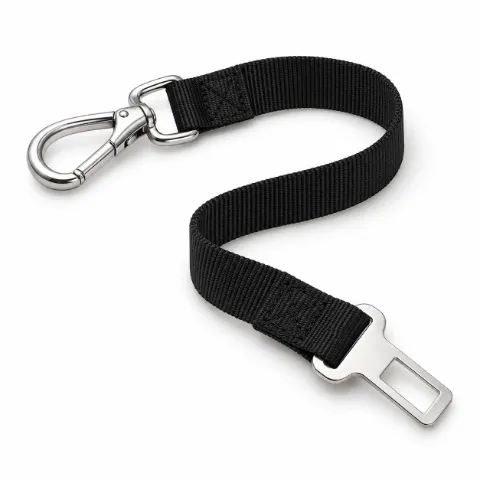
It's nylon webbing with a quick-release carabiner that clips to a harness and a connector that clicks into a standard seat belt buckle. The length is fixed at 56 cm, which makes it simple to set up and hard to get wrong. It's a tether only, so it needs a harness.
Pros: fixed length; quick-release carabiner; clicks into a standard seat belt buckle
Cons: tether only, so you need a harness; a walking harness may not be built for car loads, so check what the harness maker says; no crash-test claim on the listing
Best for: owners who already have a sturdy harness and want a short tether
Skip it if: you only have a walking harness, or want a harness and tether in one box
How do I fit a car harness?
Fit it snug but not tight: you should be able to slide about two fingers between the strap and your dog's skin, so it doesn't shift or rub. Measure your dog's girth just behind the front legs, around the ribcage, and match that to the size chart (PetSafe support page on fitting a harness).
That page covers a walking harness, but the snug-fit idea carries over. For a car harness, follow the maker's own instructions first, because buckles and chest plates differ.
A few fitting tips:
Measure the dog, not the old harness. Use a soft tape with your dog standing, and keep treats handy.
Check the size range. The EzyDog listing, for example, gives a girth range of 28 to 64 cm for size S, so look at the chart for your dog's measurement rather than guessing from breed.
Between sizes? Check which size the brand's chart points to, and re-check the fit once the dog is standing and sitting.
Re-check after a haircut or a growth spurt. Coats and puppies change shape.
How long should the tether be?
Short enough that your dog can sit, stand and lie down but can't reach the front seats or fall off the seat. Clip the tether to the back of a harness, never a collar. RSPCA Australia says restraints should attach the way the maker directs, using a harness (RSPCA Australia Knowledgebase).
The KONG tether is a fixed 56 cm. The SlowTon tether adjusts from about 53 to 74 cm and is elastic, so it can stretch further than its set length in a hard stop; use it at the shortest setting that lets your dog sit and lie down. If you have an adjustable tether, start at the short end and lengthen it only if your dog can't get comfortable. We left out separate bungee tethers and retractable tethers because they let a dog move further than we'd like.
Dog car harnesses compared
Details from each Amazon Australia listing, checked on 22 Oct 2026.
We searched Amazon Australia for dog car harnesses and seat belt tethers, then shortlisted products that met all of these checks:
Well rated: a strong average rating with plenty of buyer reviews.
No red flags: no pattern of poor reviews, safety complaints or listing problems.
Available on Amazon Australia when we checked.
Clips to a harness, not a collar.
Fitting or size guide on the listing.
What the brand says about crash testing, recorded word for word in our notes.
These are researched picks, not products we've personally tested. We compared the specifications and features shown on each Amazon Australia listing, checked on 22 Oct 2026. We didn't accept payment from any brand, and no brand saw this page before it was published.
Left out this time: imported harnesses, stand-alone bungee tethers and retractable tethers (they let a dog move further than we'd like in the car), and headrest straps that didn't pass our red flags check.
Using a car harness
Back seat only. Your dog rides in the back seat or the boot area, never the front seat or on a lap.
Practise at home. Put the harness on, give treats, take it off. Then try a short, calm drive and reward your dog at the end. Go slowly, with treats and praise only.
Clip to the harness, never a collar. See the tether section above.
Check the straps for wear. Look over stitching, webbing and buckles from time to time, and replace anything frayed.
After a crash, follow the brand's advice about whether to keep using the harness.
Rules vary between states and territories, so check your state road authority and animal welfare laws. Australian road rules say a driver must not drive with a person or an animal in their lap (rule 297(1A); see, for example, Queensland's road rules). The penalty is a fine and demerit points. Our dog car restraint guide has the state-by-state detail.
When to see your vet
See a vet straight away after a crash or hard stop, even if your dog seems fine. Limping, pain, fast breathing or behaving differently can be signs of injury.
Book a vet check if a harness causes rubbing, sores or hair loss, and stop using it until it fits properly.
Talk to your vet about car sickness or panic. Heavy drooling, vomiting or distress in the car can have several causes, and a harness won't treat them. See our dog car sickness guide.
Frequently asked questions
Are dog car harnesses crash tested?
Some brands say so, but there is no formally recognised Australian standard for crash testing dog car restraints or carriers. Some have products tested by groups such as the Center for Pet Safety, and others say they ran their own tests. Check the claim and ask the brand how the test was done.
Is a dog seat belt safe to clip to a collar?
No. Clip a car tether to the back of a harness. RSPCA Australia says to attach a tether to a properly fitted harness made for car restraint, not a collar, which can choke a dog (RSPCA Australia Knowledgebase on dogs in open vehicles). If you're pairing a tether with a harness you own, the KONG tether in this guide is built for that.
Can I use my dog's walking harness in the car?
RSPCA Australia says to use a harness that is safe for restraint in vehicles, which may be different from the harness you use for walks. A walking harness may not be built for car loads. Check what the maker says before pairing one with a tether, or choose a harness made for cars. Our dog harness buying guide covers walking harness types; none of them is a car restraint. A dog car bed gives a tether point and a soft spot, but the harness and tether do the restraining.
What is the safest dog car harness in Australia?
We can't name one as safest. There's no Australian crash-test standard, and the claims in this guide come from the brands. Choose a harness that fits your dog's measurements, check what the brand says about testing, and use it in the back seat.
How tight should a dog car harness be?
Snug but not tight, with about two fingers' room between the strap and your dog's skin, so the harness can't shift or rub. Check the fit with your dog standing and sitting, re-check after a haircut or growth spurt, and follow the maker's instructions for your model.
Where should a dog sit in the car?
In the back seat with a harness and tether, in a secured crate, or in the cargo area behind a cargo barrier. Never the front seat, and never on a lap. Our dog car seat guide covers boosters for small dogs.
Do I need a harness if my dog is in a crate?
Not usually. A crate that's secured in the car, ventilated and big enough for your dog to stand with their head up, turn around and lie down is a different set-up, and the dog isn't tethered inside it. Put a harness on for the walk to and from the car. See our dog car crate guide.
Product details from each linked Amazon Australia listing, checked on 22 Oct 2026.
This guide provides general information and isn't a substitute for veterinary advice. If you're concerned about your dog's safety in the car, speak with your vet.