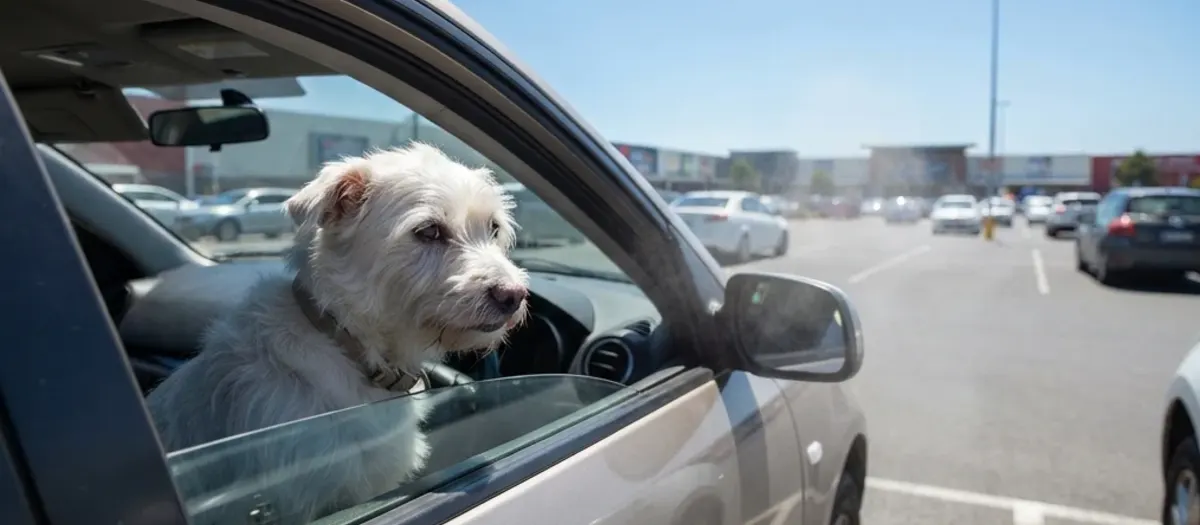
Quick answer: It isn't automatically illegal to leave a dog in a car in Australia, because no state has a blanket ban, but leaving a dog to suffer in a hot car can be prosecuted under animal welfare law in every state and territory. Cars heat fast: RSPCA Australia says it can take just six minutes for an animal to die.
This guide covers what each state's law says, how hot a parked car really gets, and what to do if you see a dog in trouble. For safe ways to carry your dog while driving, see our dog car restraint guide.
Is it illegal to leave a dog in a car in Australia?
There's no national law, because animal welfare is handled by each state and territory. Every one has cruelty or duty-of-care offences, and leaving a dog to suffer in the heat can fall under them. Some, like Queensland, name hot vehicles directly. The rules differ, but the danger to your dog is the same everywhere.
In most places the offence isn't "a dog was in a car". It's that the dog suffered, or was likely to, because of how it was confined. That means a short trip can still be a problem on a warm day.
Queensland spells it out. The Animal Care and Protection Act 2001 lists confining an animal in a vehicle in a way that causes heat stress as an example of cruelty, and the Queensland Government says the cruelty offence covers leaving an animal in a hot car. The ACT debated a specific hot car offence in 2019. Details are in the table below.
What does each state's law say?
Each state and territory has its own Animal Welfare or Animal Care Act, and none bans a parked dog outright. Instead they make it an offence to cause or allow suffering, or to fail to provide shelter and care. This table shows only what we could read from official sources, with the date we read them.
| State or territory | Law | What it says about heat and vehicles | Maximum penalty, as the source states | Report to |
|---|---|---|---|---|
| Queensland | Animal Care and Protection Act 2001, ss 17 and 18 | Duty of care covers confinement and transport. Cruelty includes confining an animal in a vehicle in a way that causes heat stress | Duty of care breach: 300 penalty units or 1 year (2,000 penalty units or 3 years if it causes death, serious disability or prolonged suffering). Cruelty: 2,000 penalty units or 3 years | RSPCA Queensland 1300 264 625, or 000 |
| Tasmania | Animal Welfare Act 1993, ss 6, 7 and 8 | Cruelty includes an act or omission that causes or is likely to cause unreasonable and unjustifiable pain or suffering, and carrying an animal in circumstances that cause it | Cruelty: 100 penalty units or 12 months, or both. Management of animals: 200 penalty units or 6 months, or both | 000 or your state RSPCA |
| Victoria | Prevention of Cruelty to Animals Act 1986 | The Victorian Government said in 2017 that an owner whose pet suffers from being left in a car can face fines or up to two years in prison. Police can break into a vehicle to rescue an animal suffering from heat exposure | See the Act. The 2017 release gave a fine and up to two years in prison | 000 |
| ACT | Animal Welfare Act 1992, ss 9(4) and 109A | A person in charge of an animal commits an offence if they confine it in or on a vehicle and the confinement causes, or is likely to cause, injury, pain, stress or death. Section 109A protects a person who forcibly enters a locked vehicle to release an animal that appears at risk of serious injury or death, if they act honestly, have no other reasonable option (such as calling police or Access Canberra) and aren't impaired | s 9(4): up to 20 penalty units | 000, Access Canberra or RSPCA ACT |
| New South Wales | Prevention of Cruelty to Animals Act 1979 | General cruelty and failure to provide shelter offences apply; see the Act. A specific hot car offence has been proposed in NSW but was not law when we checked | See the Act | 000 or your state RSPCA |
| South Australia | Animal Welfare Act 1985 | General ill-treatment offences apply; see the Act. The Animal Welfare Act 2025 had not come into operation when we checked | See the Act | RSPCA SA 1300 477 722 |
| Western Australia | Animal Welfare Act 2002 | General cruelty offences apply; see the Act. RSPCA WA says leaving a dog in a hot car could be charged as cruelty | RSPCA WA says up to five years in prison and a fine. Check the Act | RSPCA WA 1300 278 358, or WA Police 131 444 |
| Northern Territory | Animal Protection Act 2018 | General duty-of-care and cruelty offences apply; see the Act | See the Act | 000 or your state RSPCA |
Penalty unit values change each year, so check the current figure before relying on a dollar amount. The Queensland Act, the Queensland Government cruelty page and the Tasmanian Act were read in full for these sections. For Victoria, the ACT, SA, WA and the NT we've linked the official register in Sources; for NSW we could only read what RSPCA and parliamentary pages said. We printed only what an official or RSPCA page said. Laws change, so check the Act itself for your state.
How hot does a parked car get, and how fast?
A parked car heats far faster than most people expect, and the inside can pass twice the outside temperature on a mild day. RSPCA Australia says a car can reach more than double the outside temperature, and that it can take just six minutes for an animal to die. These figures come from the animal welfare groups named, and the conditions differ, so treat them as examples, not a chart you can plan around.
| Source | What it reported |
|---|---|
| RSPCA Australia | Car temperatures can be more than double the outside temperature, even on mild days. It can take just six minutes for an animal to die |
| Australian Veterinary Association (AVA) | Even around 22°C outside, with windows partly down, can cause hyperthermia in a dog |
| RSPCA WA | At 22°C outside, the inside of a car can rise to over 47°C in minutes |
| RSPCA South Australia | A ute cabin reached 48°C at 20°C outside, with windows slightly open |
| RSPCA Queensland | A car can reach up to 73°C on a hot summer's day |
There's no safe number of minutes. Shade, tinted windows and a cracked window don't fix it either: RSPCA WA says they give little or no relief, and RSPCA Australia says open windows and shade don't really help. Flat-faced breeds, puppies, older dogs and overweight dogs are at higher risk (RSPCA Australia; PDSA, "Heatstroke in dogs", September 2023, page read 15 November 2026). For everyday cooling, see how to keep your dog cool in summer.
What should I do if I see a dog in a hot car?
Act quickly and stay safe. Note the car's registration and location, check how the dog looks, and call for help: 000 if the dog is collapsed or distressed, or your state's RSPCA or police line. Ask centre management to page the owner. You're a witness, not a rescuer, so leave the rescue to those with the power to do it.
Here's a step list based on RSPCA WA, RSPCA Australia and the AVA:
- Note the details. Write down the registration, the car's make and colour, the exact location and the time. Photos help, with the time and date showing.
- Look at the dog. Panting hard, drooling, restless, lying down or not responding all matter. Tell the call-taker what you see.
- Call for help. If the dog is collapsed, unresponsive or clearly in distress, call 000. Otherwise call the RSPCA or police: Queensland 1300 264 625, Western Australia 1300 278 358 or WA Police 131 444, South Australia 1300 477 722, Victoria 000. In other states, call 000 or your state RSPCA. The AVA says police, animal welfare officers or firefighters can all help.
- Ask the centre to page the owner. If the car is at a shopping centre or event, tell security or management with the registration. The owner may be back in minutes.
- Stay nearby, at a distance. RSPCA WA suggests watching the dog from a distance until help arrives, so you don't agitate it and can tell the call-taker if it gets worse.
We don't advise breaking a window yourself. Victoria's Government says police have the power to break in, and RSPCA WA and RSPCA SA say to call. Whether a member of the public is protected differs by state, so let the person on the phone tell you what to do. Broken glass is also a risk to you and the dog.
What is heatstroke in dogs, and what is the first aid?
Heatstroke is when a dog's body temperature climbs too high to control, and it's a life-threatening emergency. RSPCA Australia lists heavy panting, drooling, very red or pale gums, vomiting, confusion, weakness, collapse and seizures. Cool your dog with cool tap water and fan them, then get to a vet, even if they seem better.
If the owner gets back and the dog is struggling, the same steps apply:
- Move the dog into shade or an air conditioned space.
- Pour or hose cool tap water over the body, keeping it away from the nose and mouth, and keep air moving with a fan. The RSPCA says to use cool or tepid water, not ice or ice-cold water.
- Offer small drinks of water if the dog is alert, but don't force it.
- Don't drape a wet towel over the dog and leave it there, because it can trap heat.
- Call your vet or nearest emergency vet while you cool, then go straight there with the air conditioning on.
For the full list of signs and more on cooling, see our heatstroke section in the summer guide.
When to see a vet
Heatstroke is an emergency. Cool first, then go to the vet. Get your dog to a vet straight away if you see any of these, even if they seem to recover:
- heavy panting that won't settle, or drooling
- very red or pale gums, or a bright red tongue
- vomiting or diarrhoea
- confusion, staggering or weakness
- collapse, tremors or seizures
Heatstroke can damage the body in ways that aren't visible straight away, and a vet can check for that. Some human medicines are dangerous for dogs, so ask a vet before giving anything. See RSPCA Australia and the AVA for signs and advice.
How do I travel with my dog safely in summer?
The safest plan is to leave your dog at home in the cool, or take them only when you can stay with them. On any drive, keep the car cool, stop for water and short breaks, and never leave your dog in the car at a stop, not even for a quick shop.
- Plan stops where your dog can come too. Choose dog-friendly cafes with outdoor seating, parks and drive-through options, and shop alone when you can't take them in.
- Take someone with you. One person can stay with your dog in the shade while the other shops.
- Don't use the ute tray. RSPCA Australia says dogs can overheat on the back of a ute and burn their feet or body on the tray (RSPCA Australia, 7 December 2022). See burnt dog paws for the footpath check, and our dog car restraint guide for the rules on restraint.
- Pack water and a bowl. A dog water bottle is handy on road trips.
Useful guides
These guides cover keeping your dog cool and comfortable on hot days. None of them make it safe to leave a dog in a parked car.
- Dog cooling mats and beds: for cooling at home after a hot day.
- Dog cooling vests: for early walks and beach trips.
- Dog water bottles for walks: so your dog can drink on outings.
- Dog first aid kits: what to carry for emergencies.
Frequently asked questions
Is it illegal to leave a dog in a car in Queensland?
It can be. Queensland's Animal Care and Protection Act 2001 gives confining an animal in a vehicle in a way that causes heat stress as an example of cruelty, and the Queensland Government says the offence covers leaving an animal in a hot car. Duty of care in section 17 also applies (Queensland Government).
Is it illegal to leave a dog in a car in NSW?
General cruelty and failure-to-provide-shelter offences in the Prevention of Cruelty to Animals Act 1979 can apply if a dog suffers. A specific hot car offence has been proposed in NSW but was not law when we checked on 15 November 2026, so check the NSW Parliament website for its progress.
Is it illegal to leave a dog in a car in Victoria?
Cruelty offences in the Prevention of Cruelty to Animals Act 1986 can apply. The Victorian Government said in 2017 that an owner whose pet suffers can face fines or up to two years in prison, and that police can break into a vehicle to rescue an animal. Call 000 (Premier of Victoria).
How long can a dog stay in a parked car?
There's no safe time. RSPCA Australia says it can take just six minutes for an animal to die in a hot car, and the AVA says even around 22°C with windows partly down can cause hyperthermia. If you can't take your dog in with you, leave them at home (RSPCA Australia).
Can I break a car window to save a dog?
We don't advise it. RSPCA WA and RSPCA SA say to call, and Victoria's Government says police have the power to break in. The ACT's Animal Welfare Act (s 109A) protects someone who forces entry only if they act honestly, have no other reasonable option and aren't impaired. Elsewhere it varies, so call 000 or your state RSPCA first and follow their advice while you stay with the dog.
Does parking in the shade or cracking a window make it safe?
No. RSPCA WA says tinting, shade or a cracked window give little or no relief, and RSPCA Australia says shade and open windows don't really help. The inside of a car can still climb far above the outside temperature within minutes (RSPCA WA).
Can my dog ride on the ute tray in summer?
It's best not to. RSPCA Australia says dogs can overheat on the back of a ute and burn their feet or other body parts on the tray. Our dog car restraint guide covers the rules on carrying dogs, and burnt dog paws explains hot surfaces (RSPCA Australia).
What should I say when I report a dog in a hot car?
Give the registration, the car's make and colour, the exact location, the time you noticed and how long the dog has been there. Describe how the dog looks, such as panting hard, drooling or lying still, and mention photos. RSPCA WA suggests staying with the dog and asking centre management to page the owner (RSPCA WA).
Related guides
- How to keep your dog cool in summer (+ heatstroke signs)
- Dog car restraint: Australian laws and the safest options
- Burnt dog paws: how hot is too hot for pavement?
- Do dog cooling mats work?
- Best dog cooling mats in Australia
- Hiking with a dog: gear, water and track rules
- Camping with a dog
- Dog car sickness: signs, fixes and when to see a vet
Sources
- ACT Legislation Register: Animal Welfare Act 1992 (current), ss 9 and 109A, read 15 November 2026
Pages read 15 November 2026, unless a different date is shown.
- Animal Care and Protection Act 2001 (Qld), in force version 27 April 2026
- Queensland Government: Cruelty, duty of care and abandoning animals, updated 1 July 2026
- Animal Welfare Act 1993 (Tas), authorised version 19 September 2025
- Premier of Victoria: Pets in hot cars are not cool, 7 January 2017
- ACT Legislative Assembly Hansard, 26 September 2019
- South Australian legislation: Animal Welfare Act 1985
- South Australian legislation: Animal Welfare Act 2025 (not yet in operation)
- Western Australian legislation: Animal Welfare Act 2002
- Victorian legislation: Prevention of Cruelty to Animals Act 1986, version 097 in force from 22 October 2025 (register page; section text not read)
- ACT legislation: Animal Welfare Act 1992, republication R36, 6 December 2025 (register page; section text not read)
- Northern Territory legislation: Animal Protection Act 2018 (register page; section text not read)
- PDSA: Heatstroke in dogs, published September 2023
- RSPCA Australia: 4 ways to keep your dog cool this summer, 7 December 2022
- RSPCA WA: High temps prompt dogs in hot cars warning, 11 January 2024
- RSPCA South Australia: Dogs left in heat, 17 December 2019
- RSPCA Queensland: Hot cars, hot dogs, 24 March 2026
- RSPCA Australia: Keeping your pet safe during the heat, 20 January 2021
- RSPCA Australia: Warm weather worries, protect pets from heatstroke, 15 November 2017
- Australian Veterinary Association: Don't let your dog go barking mad, 12 January 2018
This guide provides general information and isn't a substitute for veterinary advice. If you're concerned about your dog's health in the heat, speak with your vet.