Quick answer: The kelpie is an Australian working dog: a medium-sized, lithe, very energetic breed with a short double coat. Dogs Australia's standard puts males at 46 to 51 cm and females at 43 to 48 cm. Sources describe an intelligent, loyal dog that suits active owners who can offer a job and company.
Kelpies were bred to work sheep, and that history still shapes how they behave in the backyard and on the lead. This guide covers size, energy, training, health, popular kelpie crosses and gear that suits an active dog.
Kelpie at a glance
| Kelpie (breed standard) | Working kelpie | |
|---|---|---|
| Size category | Medium (Dogs NSW lists 11 to 27 kg for the breed) | Medium |
| Height at the withers | Dogs 46 to 51 cm, bitches 43 to 48 cm | The standard doesn't separate working lines |
| Weight | The standard gives no weight. The AKC weight chart lists 35 to 50 lb (about 16 to 23 kg) | The AKC chart lists 28 to 60 lb (about 13 to 27 kg) |
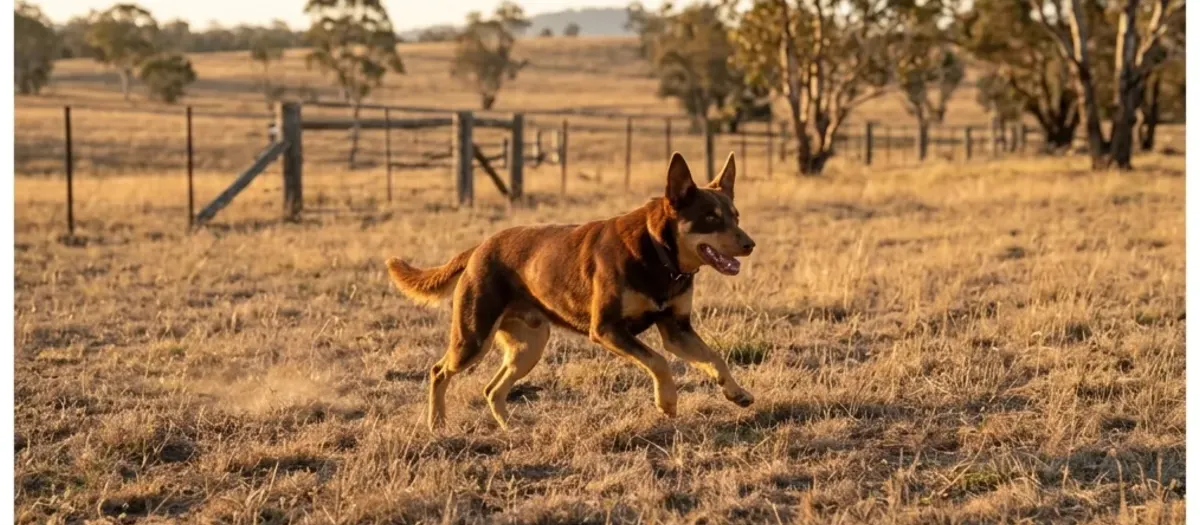
| Coat | Double coat, short dense undercoat, close, hard, rain-resisting outer coat | Same coat described |
| Colours | Black, black and tan, red, red and tan, fawn, chocolate, smoke blue | Same |
| Energy | "Almost inexhaustible energy" (standard) | Same description applies to the breed |
| Grooming | Weekly (Dogs NSW) | Weekly |
| Family life | Dogs NSW: suits families and singles who make the dog part of the family | Same |
Weights vary between sources and lines, so treat the ranges as a guide only. A cross has no breed standard at all.
How big do kelpies get?
Kelpies are a medium breed. The Dogs Australia standard gives height only: dogs 46 to 51 cm and bitches 43 to 48 cm at the withers, with a body slightly longer than tall (10 to 9). For weight, Dogs NSW lists a wide medium class of 11 to 27 kg, and the AKC chart lists about 16 to 23 kg for the Australian kelpie and about 13 to 27 kg for working kelpies.
What is a kelpie's temperament like?
The breed standard describes a kelpie as extremely alert, eager and highly intelligent, with a "mild, tractable disposition", almost inexhaustible energy, and marked loyalty. Dogs NSW adds that they are affectionate but independent, often "velcro dogs" that follow their people, and can be reserved with strangers. They tend to get into mischief if left to their own devices. Individual dogs vary.
How much exercise does a kelpie need?
Dogs NSW lists around 40 minutes a day as a baseline and says the breed doesn't necessarily need hours and miles. Both the standard and the AKC, though, describe very high energy, so many kelpies also need real mental work on top: training, scent games and puzzles. Ask your vet how much exercise suits a growing puppy. Our guide on how much exercise a dog needs covers the basics.
Ideas that suit an energetic working breed:
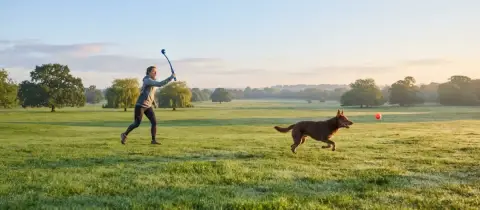
- Ball games with a ball launcher
- A flirt pole for short, controlled bursts of chasing
- Agility equipment in the backyard
- A herding ball for dogs who like to chase and push
- Rainy-day games when the weather keeps you in
Are kelpies easy to train?
Intelligent, eager dogs tend to pick things up quickly, and that includes habits you didn't plan. Short, varied, reward-based sessions work well. Start early with recall, settling on a mat and calm greetings. Our puppy training schedule is a good starting point, and a training clicker can help.
What are kelpie crosses like?
A kelpie cross is a mixed-breed dog, so there is no breed standard. Size, coat and temperament depend on the other parent and on which traits each puppy inherits, so puppies in one litter can differ. The sources we read don't give figures for kelpie crosses, so the best guide is the breed standard and profile of each parent. If a kelpie is one parent, it is sensible to plan for a dog with real energy and a need for something to do.
Staffy kelpie cross
Look up the Staffordshire bull terrier profile alongside the kelpie one. Size, build and energy can fall anywhere between the two, so meet the parents if you can.
Border collie kelpie cross
Both parents are working and herding breeds, so expect a dog that may need plenty of training and mental activity. Check each parent's breed profile for details.
Labrador kelpie cross
Size depends heavily on the labrador side and on the individual puppy. A vet can help you judge a healthy weight as your dog grows.
Kelpie German shepherd cross
Adult size can be larger than a pure kelpie, depending on the parents. Early socialisation and steady training are sensible with any larger, active dog.
Kelpie heeler cross
This cross combines two Australian working breeds. Expect an active dog that benefits from a regular job, training and exercise.
Do kelpies shed and how do you groom them?
A double coat means you can expect some shedding. Dogs NSW lists weekly grooming, which suits a short, hard, rain-resisting coat. A deshedding brush or slicker brush works well, and a dog shampoo helps after a muddy day. Our guide on how often to wash a dog has more.
Common kelpie health problems
Dogs NSW describes the kelpie as a relatively healthy breed with few hereditary problems, and says hip dysplasia, progressive retinal atrophy (PRA) and cerebellar abiotrophy (CA) are said to exist in the breed.
- Cerebellar abiotrophy: A genetics study describes CA in working kelpies as a recessive inherited disease. Signs include unsteady movement, head tremor and a wide-based, high-stepping gait. The paper describes an early form that shows from about 4 to 10 weeks of age and a later form that shows after about 4 months. The authors describe it as uncommon, affecting less than one percent of dogs, and discuss DNA tests, which a breeder or vet can explain.
- Hip dysplasia: A Swedish screening study of dogs aged 12 to 24 months found hip dysplasia of any grade, mild to severe, in 9.2% of 839 Australian kelpies and 17.2% of 256 working kelpies. Moderate to severe grades were much rarer, at 0.8% and 4.7%. The study was in Sweden, so figures may differ elsewhere. Elbow changes were found in 1.5% of 667 kelpies.
- PRA: An inherited eye condition that Dogs NSW lists for the breed. Ask your vet about eye checks.
If you are choosing a puppy, ask about health testing of both parents, and keep your dog lean. Our guides on arthritis in dogs and dog limping may help later in life.
Is a kelpie right for you?
A kelpie may suit you if you:
- Enjoy training and active days with your dog
- Have a house with a secure garden (Dogs NSW lists "house with garden")
- Can include the dog in family life, since "kelpies do not like to be left out"
- Are around enough to provide company, as Dogs NSW lists "alone with support"
A kelpie may not suit you if you:
- Are away for long hours and can't offer exercise or enrichment
- Want a low-key companion with little need for activity or training
- Have no outdoor space and can't commit to daily outings
Boredom often shows up as chewing, digging, barking and escaping. Our guides on dog boredom, stopping digging and separation anxiety are worth reading before you commit.
Caring for a kelpie in Australian weather
Whatever the breed, hot days call for early or late exercise, shade and fresh water. See keeping your dog cool in summer and dogs in hot cars. Hot pavement and sand can burn paws, so see burnt dog paws.
Active dogs in bushland or long grass may meet ticks and snakes in some regions. Read our paralysis ticks guide and snake bite in dogs page. The coat is short and hard, so some dogs may like a dog coat on cold, wet days.
Gear that fits a kelpie
- Harness: Weights vary from 11 to 27 kg, so measure your dog's chest girth and follow the maker's size chart for a dog harness. A no-pull harness can help with strong pullers.
- Escape-proof option: A clever, athletic dog can slip a loose harness, so consider an escape-proof harness.
- Lead: A sturdy dog lead plus a long lead for recall practice.
- Bed and crate: Pick a dog bed by your dog's adult weight, and a medium dog crate or large dog crate where your dog can stand and turn.
- Cooling: A cooling mat or cooling vest for hot days.
- Brain games: Puzzle toys and treat dispensing toys, used with supervision.
- Identification: A dog ID tag and a GPS tracker for a dog that likes to roam.
When to see a vet
See your vet if your kelpie:
- Is limping, stiff or reluctant to jump or run. See our guide on dog limping.
- Seems unsteady, shakes its head or has an odd gait, especially a young puppy
- Bumps into things or seems to see poorly, especially in low light
- Shows heat stress, such as heavy panting, drooling or collapse (this is an emergency, go straight away)
- May have been bitten by a snake, or has sudden weakness that could be a paralysis tick. Both are emergencies, so go to the nearest vet straight away and see our snake bite guide
- Is vomiting, has diarrhoea that doesn't settle, or has stopped eating
Frequently asked questions
Are kelpies good family dogs?
Dogs NSW says kelpies suit families and singles who are willing to make the dog part of the family. Many bond closely with their people. Supervise interactions with young children, and remember individual dogs vary.
Are kelpies aggressive?
The standard describes a mild, tractable disposition, and Dogs NSW says kelpies can be reserved and timid with strangers. Fear, boredom and poor socialisation can affect any dog. See our guide on reactive dog training.
Do kelpies bark a lot?
Dogs NSW rates barking as moderate and says kelpies make good watchdogs. Boredom can add to it. Our guide on how to stop dog barking has tips.
Can a kelpie live in a unit or apartment?
Dogs NSW lists a house with a garden as the living situation. A unit is likely to be harder, because you would need to cover exercise, company and enrichment away from home. Talk to a trainer or vet first.
Can kelpies be left alone?
Dogs NSW lists "alone with support", and notes that kelpies don't like to be left out. Build up absences gradually. See our guide to keeping your dog busy while you work.
What colours do kelpies come in?
The breed standard lists black, black and tan, red, red and tan, fawn, chocolate and smoke blue.
What is the difference between working and show kelpies?
The AKC weight chart lists the Australian kelpie and the working kelpie separately, with a wider weight range for working lines. The Dogs Australia standard doesn't split them. Ask any breeder or rescue about a dog's lines and energy.
Is a kelpie good for first-time owners?
It can work for an active first-timer who commits to training and exercise, but the intelligence and energy described in the sources mean there is a lot to learn. Puppy classes help. See our new puppy checklist.
Related guides
- Dog DNA tests for kelpie crosses
- How much exercise does a dog need?
- Keep your dog cool in summer
- Paralysis ticks guide
- Is my dog bored?
- Border collie guide
- Staffy guide
- Cavoodle guide
- Groodle guide
Sources
- Australian Kelpie breed standard, Dogs Australia (ANKC standard, last updated 1994): https://dogsaustralia.org.au/members/breeds/breed-standards/Australian-Kelpie (page read 24 November 2026)
- Australian Kelpie, Dogs NSW: https://www.dogsnsw.org.au/breeds/browse-all-breeds/australian-kelpie/ (page read 24 November 2026)
- Breed Weight Chart, American Kennel Club: https://www.akc.org/expert-advice/nutrition/breed-weight-chart/ (page read 24 November 2026)
- Cerebellar Abiotrophy in Australian Working Kelpies Is Associated with Two Major Risk Loci, PMC: https://pmc.ncbi.nlm.nih.gov/articles/PMC9602046/ (page read 24 November 2026)
- Prevalence of hip and elbow dysplasia in young adult dogs in Sweden, PMC: https://pmc.ncbi.nlm.nih.gov/articles/PMC13261803/ (page read 24 November 2026)
- Australian Kelpie, American Kennel Club: https://www.akc.org/dog-breeds/australian-kelpie/ (page read 24 November 2026)
This guide provides general information and isn't a substitute for veterinary advice. If you're concerned about your dog's health, speak with your vet.