Quick answer: A new puppy checklist starts with a safe sleeping spot, a collar with an ID tag, food and water bowls, chew toys, a toilet-training plan and an early vet visit. Microchipping is required in nearly every state and territory, and each state sets its own council registration rules and deadlines, so check your own council's page before pickup day.
Bringing a puppy home is exciting, and a bit chaotic. This page walks through what to buy first, what to sort out with your vet and council, and how to set up the first week. For what to teach once they've settled, see our puppy training schedule.
What do you need before you bring a puppy home?
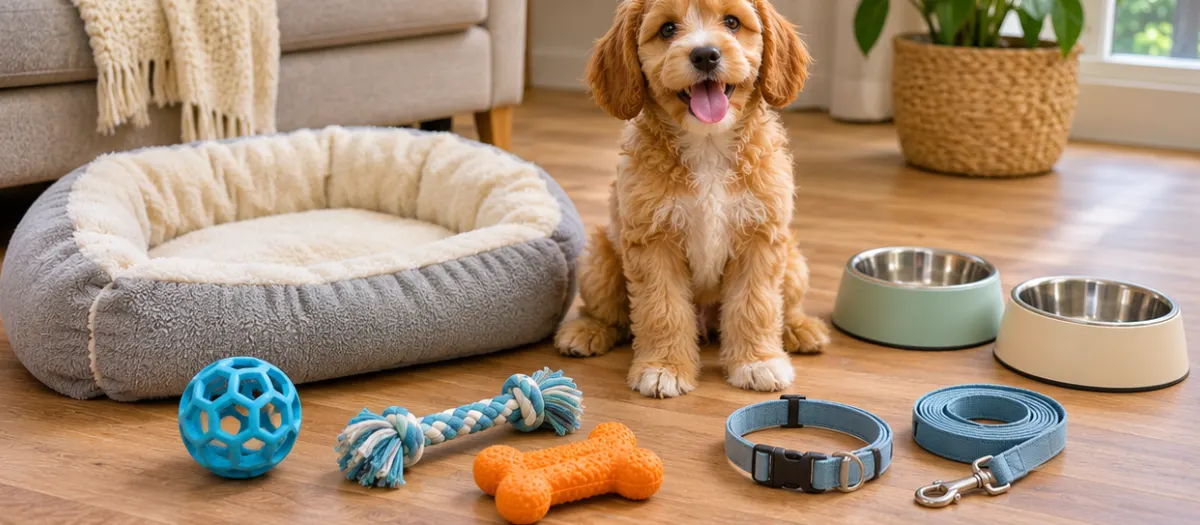
You need a safe, quiet place to sleep, a collar with an ID tag, a lead, bowls, a few chew toys, soft treats and something to clean up accidents. Add a toilet-training plan and a vet booking. You can buy extras like grooming gear later, once you know your puppy's size and coat.
RSPCA Australia suggests setting up a safe living area with a cosy sleeping spot, and checking the home for hazards such as certain foods, plants and chemicals (RSPCA Australia, 4 November 2021). Here's the whole list at a glance, with our guide for each item.
New puppy checklist: item by item
| Item | Why you need it | Our guide |
|---|---|---|
| Bed | A quiet, comfortable spot that's theirs | Best puppy beds |
| Crate and cover | A calm den, if introduced gently | Best puppy crates, crate covers |
| Collar and ID tag | Carries your contact details | Best puppy collars |
| Harness | Comfortable lead walking later on | Best no-pull harnesses or which harness type |
| Lead | For the yard first, then outings | Best dog leads or a collar and lead set |
| Food | A complete puppy food labelled for your pup's adult size band; start on the breeder's food, then change over about 7 to 10 days unless your vet says otherwise | Best puppy food |
| Bowls | Food and fresh water, always | Dog water bowls, slow feeder bowls |
| Chew toys | Safe outlets for teething | Puppy teething toys, puppy toys |
| Training treats and pouch | Rewards within reach | Training treats, treat pouch |
| Puppy pads | A back-up for times you can't get outside | Puppy pads |
| Enzyme cleaner | Removes the smell so it doesn't draw them back | Enzyme cleaner |
| Dog gate | Keeps them out of unsafe rooms | Best dog gates |
| Puppy shampoo | A gentle wash when they need one | Puppy shampoo |
| Toothbrush | Starts a dental habit early | Dog toothbrushes |
Not everything is needed on day one. The first week really needs the bed, collar and tag, bowls, a few chew toys, treats, cleaner and a gate or pen. A harness, shampoo and toothbrush can wait a little.
Once your puppy is past the tiny stage, our best dog collar guide covers everyday collars, budget picks and the two-finger fit check.
Do you have to microchip and register a puppy in Australia?
In most of Australia, yes. Microchipping is required for dogs in nearly every state and territory, and registration with your council is set by state rules. The deadline differs, from before sale or transfer to a set age, so check your own council's page before you collect your puppy.
RSPCA Australia lists the puppy deadlines by state: New South Wales and the ACT by 12 weeks of age and before sale or transfer, Queensland before 12 weeks, South Australia before sale or transfer and before 12 weeks, Western Australia by three months, Tasmania by six months, and in Victoria as a condition of registration, which is compulsory from three months. It says the Northern Territory has no statewide rule, though the City of Darwin requires it (RSPCA Australia knowledgebase, updated 24 January 2024, page read 6 November 2026). Rules change, and it isn't legal advice, so confirm with your council.
In NSW, for example, a puppy must be registered on the NSW Pet Registry by 12 weeks of age or on transfer to a new owner, whichever comes first, and the registration is one-off for life (City of Ryde Council). Other states differ, so use your own council or state government page. A collar and tag still helps, because anyone can read it without a scanner. See our puppy collar guide.
What should you do at the first vet visit?
Book a vet visit soon after your puppy comes home. Your vet can check their general health, plan the vaccination course and talk about flea, tick and worming prevention. Ask when your puppy can start outings and classes, because that depends on their vaccinations. Our puppy vaccination schedule explains the C3 and C5 timeline, and our puppy flea treatment guide lists each label's minimum age and weight. When your vet sets the plan, our guides to dog wormers and flea treatment for dogs explain the age and weight limits on each product.
RSPCA Australia says puppies are vulnerable to serious infectious diseases and need their full vaccination course, and that your vet can advise on vaccinations, flea treatment, worming and other essentials (RSPCA Australia, 4 November 2021). Bring any paperwork from the breeder or rescue, and write down your questions beforehand. If you live in tick country, ask about prevention early; see our paralysis ticks guide.
How do you puppy-proof your home?
Look at your home from puppy height. Move cables, shoes, medications, cleaning products and small objects out of reach, block off rooms you can't supervise, and know which foods are toxic. A baby gate or pen makes this far easier, and a closed bin lid helps too.
RSPCA Australia highlights foods, plants and chemicals as common hazards at home (RSPCA Australia, 4 November 2021). Our toxic foods list is the one to keep handy. Use a dog gate or playpen for rooms you can't watch, and keep the Christmas ham and its bones away too (can dogs eat ham?). Our dog poisoning guide lists the common household poisons, and our guides to cabinet locks, cord protectors and dog proof bins cover the hardware.
What should the first week at home look like?
Keep it calm and predictable. Give your puppy a quiet spot to settle, take them to the same toilet spot often, reward success, handle them gently and let them sleep a lot. Introduce visitors and new places slowly, and don't punish accidents or biting.
RSPCA Australia says to give the puppy a safe base to settle in, then start reward-based toilet training, and to begin socialising early, ideally between 3 and 17 weeks of age (RSPCA Australia, 4 November 2021). Socialising means gentle, positive new experiences, so ask your vet which outings are safe for now. Our guides cover toilet training a puppy, crate training and puppy biting.
Where should the puppy sleep?
A bed or crate in a quiet spot, near you at first, is a good start. Puppies often find the first nights unsettling, so keep the area calm, and make sure the bed is safe if they chew. If you use a crate, introduce it gently as a comfortable den. A crate doesn't treat separation anxiety.
If you'd like a keepsake of those tiny paws, a paw print kit can take a clay or ink print.
Choose by situation
| Your situation | Start with | Then add |
|---|---|---|
| Pickup is this weekend | Bed, collar and tag, bowls, treats, cleaner, gate | Chew toys, lead |
| Small flat or unit | Puppy pads, gate, enzyme cleaner | Crate, slow feeder |
| House with a yard | Gate, lead, collar and tag | Harness, treat pouch |
| Working from home | Crate or pen, chew toys, treats | Cover, puppy pads |
| Puppy is teething | Puppy teething toys | Cold fillings from our frozen KONG recipes, more variety |
| Adopting from a rescue | Check what is already done (vaccines, chip) | Vet visit for a plan |
How this checklist was put together
Every item links to one of our buying guides, where the picks were researched (not tested) against Amazon Australia listings. Rules and registration details come from the sources below, which you should confirm with your council. Size the collar and harness to your puppy as they grow, with a two-finger fit check, and take the harness off when your puppy is unsupervised, so straps can't catch or be chewed.
When to see a vet
Book a vet visit soon after your puppy comes home, and sooner if they have:
- vomiting or diarrhoea, or they aren't eating or drinking
- a cough, sneezing or runny eyes or nose
- blood in their urine, or they strain or cry when they toilet
- fear or aggression that stops them coping with everyday life
See a vet straight away if a young puppy is lethargic, weak, collapses or may have eaten something toxic. Small puppies can get sick quickly. In Australia you can call the Animal Poisons Helpline on 1300 869 738, 24 hours a day. Learn more from RSPCA Australia on caring for a new puppy.
Frequently asked questions
What should I do the first night with a new puppy?
Settle them in a quiet, warm spot with their bed, take them to the toilet before sleep, and expect a few unsettled hours. Keep the bed near you at first if you can. Don't punish whining or accidents. If they seem unwell, call your vet.
When should a puppy be microchipped in Australia?
It depends on your state. RSPCA Australia lists deadlines such as 12 weeks in NSW, the ACT and Queensland, and three months in Western Australia, with Tasmania at six months. Victoria ties it to registration from three months. Check your local council before pickup.
Do I have to register my puppy with the council?
Registration rules are set by each state and enforced by councils, so the answer depends on where you live. In NSW, for example, a puppy must be registered on the NSW Pet Registry by 12 weeks of age or on transfer to a new owner. Check your own council's page for the deadline and process.
When can a puppy go for walks?
Ask your vet, because it depends on their vaccinations. RSPCA Australia notes puppies need their full vaccination course because of diseases like parvovirus. Until your vet says it's safe, practise lead walking indoors and in a safe, clean yard, and carry your puppy for short outings if your vet agrees.
When should I start socialising my puppy?
Early, but safely. RSPCA Australia calls 3 to 17 weeks the critical socialisation period and recommends starting training and socialisation during it, while also stressing the full vaccination course because of diseases like parvovirus. So begin at home with gentle handling, sounds and visitors, and ask your vet which outings and classes are safe for now.
Do puppies need a crate?
No, but many owners find one helpful as a calm den and for toilet training. Introduce it gently with treats and never as punishment. A pen and gate are alternatives. A crate is a tool, not a treatment for separation anxiety. See crate training a puppy.
Can I use puppy pads?
Yes, as a short-term back-up when you can't get outside quickly or supervise. Taking your puppy to the same outdoor spot teaches the final habit more directly, so phase pads out as bladder control grows. See our puppy pads guide.
Related guides
- Paw print kits
- Puppy vaccination schedule in Australia
- Best puppy crates
- Best puppy toys
- Best puppy beds
- Puppy flea treatment
- Best dog collar and lead sets
- Best puppy food in Australia
- Whelping box guide (for breeders and first litters)
- Puppy training schedule: what to teach and when
- How to toilet train a puppy
- Crate training a puppy
- How to stop puppy biting
- Best puppy teething toys
- Best puppy collars
- Best dog gates
- Best dog wormer
- Best flea treatment for dogs
Sources
- RSPCA Australia: How do I care for my new dog or puppy? (4 November 2021)
- RSPCA Australia knowledgebase: Is microchipping mandatory for cats and dogs? (updated 24 January 2024, page read 6 November 2026)
- City of Ryde Council: Registration and microchipping
This guide provides general information and isn't a substitute for veterinary advice. If you're concerned about your puppy's health or behaviour, speak with your vet.