Quick answer: Can dogs eat ham? It's best skipped. Ham is very salty and fatty, and fatty scraps can trigger vomiting, diarrhoea or pancreatitis. Never give ham bones or any cooked bones, which can splinter, choke or block the gut. Call a vet if your dog eats a lot, or seems unwell afterwards.
Christmas lunch puts a lot of tempting food at nose height, and plenty of it is rich, salty or on the toxic list. This guide walks through the Australian Christmas table, from the ham to the pudding, so you know what to skip, what's safe in small amounts and what to do if something goes wrong. Our full list of toxic foods lives in the frozen KONG and lick mat recipes guide, and we use the same items here.
Can dogs eat ham?
It's best to skip it. Ham is very salty and fatty, and fatty trimmings and offcuts can upset a dog's stomach or trigger pancreatitis, a painful inflammation of the pancreas. If your dog has eaten a lot, call your vet.
The University of Sydney's vet school says fatty ham such as offcuts and trimmings can trigger pancreatitis and fatty stools, and that ham is tasty enough to encourage overeating, which raises the risk of a twisted stomach (University of Sydney, 6 December 2017). Our pancreatitis in dogs guide explains the signs to watch for. RSPCA NSW lists pork and ham, marinades and gravy among the foods to keep away from pets over Christmas (RSPCA NSW, 24 December 2021). The ASPCA also lists salt as a risk for dogs, with excess salt linked to heavy thirst, vomiting and diarrhoea (ASPCA, page read 31 October 2026).
We couldn't find an Australian vet source that recommends a bit of lean ham as a treat, so we don't. If you want your dog to join in, the safer options are further down this page.
Why does fat matter so much? The American Kennel Club says a high-fat diet is one of the most common triggers of pancreatitis, that a single large serving of fatty food can set it off in some dogs, and that emergency clinics often see more cases after holidays (AKC, updated 20 October 2026). Signs can include repeated vomiting, a hunched back, a sore or swollen tummy, diarrhoea, loss of appetite and tiredness. The AKC says vomiting can come on and off over several days, so keep watching after the meal.
What about ham bones and other cooked bones?
Don't give them. Cooked bones, including ham, chicken and turkey bones, can splinter, and the pieces can choke a dog, damage the throat or gut, or cause a blockage that may need surgery. A ham bone isn't a Christmas treat, however much your dog wants it, so it goes in a lidded bin.
RSPCA NSW lists cooked bones among the foods to avoid at Christmas (RSPCA NSW, 24 December 2021). UQ VETS Small Animal Hospital says chicken or ham bones can splinter and cause choking or internal injuries (UQ VETS Small Animal Hospital, 23 December 2025). The ASPCA says swallowed bones can injure or block the digestive tract, sometimes needing surgery (ASPCA, page read 31 October 2026). The University of Sydney piece adds that bones, kebab sticks and toothpicks can cause an obstruction or a tear in the gut (University of Sydney, 6 December 2017).
Skewers from the barbecue, ham-glaze toothpicks and the bones in the bin all count. Our chew guides follow the same rule, and none of our picks are bones, antlers or hooves. If your dog needs something to gnaw on while the family eats, see our guide to toys for heavy chewers.
Which Christmas foods are toxic to dogs?
Chocolate, grapes, raisins and sultanas (so Christmas pudding, fruit cake and mince pies), onion and garlic (stuffing and gravy), macadamia nuts, xylitol, alcohol and raw bread dough are all on our list. Others we list are avocado, nutmeg and mouldy food. Treat any of them as a reason to ring your vet.
Here is how that list shows up on a typical Australian Christmas table:
- Xylitol: a sweetener in some sugar-free lollies, gum and baking. The ASPCA says it can cause low blood sugar and liver damage in dogs (ASPCA, page read 31 October 2026).
- Chocolate: chocolate gifts, advent calendars, rum balls and truffles. Dark and baking chocolate are the most dangerous, according to the ASPCA. Our chocolate guide covers the signs and what to do.
- Grapes, raisins and sultanas: hidden in Christmas pudding, fruit cake, mince pies and fruit mince. The ASPCA says they can cause kidney damage. RSPCA NSW lists Christmas pudding, fruit cake and grapes, currants and raisins to avoid.
- Onion and garlic: stuffing, gravy, marinades and garlic butter. The ASPCA says they can irritate the stomach and damage red blood cells.
- Macadamia nuts: nut platters, biscuits and white chocolate cookies. The ASPCA lists weakness, vomiting, tremors and overheating.
- Alcohol: rum balls, trifle, brandy butter and drinks left at dog height. RSPCA NSW lists alcohol to avoid.
- Raw bread dough: the ASPCA says yeast dough can swell in the stomach and cause bloating and alcohol poisoning.
- Avocado, nutmeg and mouldy food: also on our full list. Bin leftovers securely, because a warm summer day grows mould fast.
Our full toxic foods list has the detail. Sugar-free desserts and "diet" products are worth a label check for xylitol before you leave them anywhere your dog can reach.
Christmas foods dogs can eat
A few plain, unseasoned foods are fine in small amounts, as long as they count towards your dog's daily food. Plain cooked green beans are the easiest. Skip anything with salt, butter, gravy, stuffing, skin or bones, and check with your vet first if your dog has health conditions.
The AKC says plain green beans are generally safe for dogs in moderation, served fresh or plainly steamed or boiled, without butter, garlic or salt, and notes that canned ones are often high in salt (AKC, updated 9 September 2026).
Other ideas that keep things simple:
- Your dog's usual treats. Bite-size training treats are easy to count. See our dog training treats guide.
- A frozen filling, not a plate of leftovers. Our frozen KONG and lick mat recipes use dog-safe ingredients, and our treat-dispensing toys guide covers KONG-style toys.
- A day of small treats. If you'd like something to open each morning in the lead-up, our dog advent calendar guide has safe picks and DIY ideas.
Whatever you offer, keep portions small. A big extra meal is the problem, not just the ingredient list.
How do I keep my dog safe at Christmas lunch?
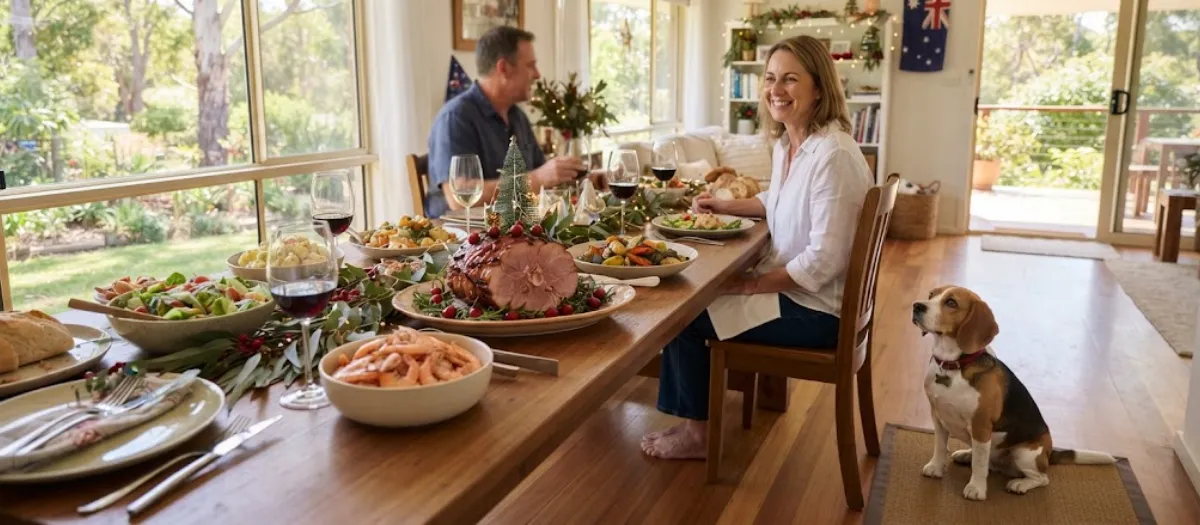
Brief your guests, keep bins lidded, clear plates quickly and give your dog a job in another room. A stuffed KONG, lick mat or snuffle mat keeps them busy and away from the table. Christmas is mid-summer here, so keep water and shade handy too.
A plan that works for most households:
- Tell the guests. Ask them not to slip scraps under the table, and explain why. Children can be given a bowl of dog-safe treats to hand out instead. A few pieces of plain, air-popped popcorn are fine too, but not the buttered or caramel kind; see can dogs eat popcorn?.
- Use a quiet room. Give your dog a spot away from the crowd, with their bed and water. RSPCA NSW also suggests long-lasting chews and exercise and play before guests arrive (RSPCA NSW, 24 December 2021). Pick a chew that passes the thumbnail test (if you can't dent it with a thumbnail, it's too hard for teeth), never a bone, antler or nylon bone; our toys for heavy chewers guide has options.
- Bins with lids, and take them out. Ham netting, bones, prawn shells, pudding scraps and wrapping all end up in the kitchen bin. The AKC lists getting into the rubbish as a pancreatitis risk (AKC, updated 20 October 2026). Our dog proof bin guide compares a bin with a lid lock, heavy steel bins and cupboard bins.
- Give them something to do. Try a KONG or treat-dispensing toy, a lick mat or a snuffle mat. The brands advise supervision with all three, so they're for when you're home, not for leaving your dog alone.
- Watch the heat. Hot days with a house full of people make dogs tired and thirsty. Our keep your dog cool in summer guide has the details.
- Clear away wrapping. String, ribbon, tinsel, gift wrap and toy packaging should never be left where a dog can get it.
- Plan for New Year's Eve. Fireworks are the next stress point. Our guide to dogs scared of storms and fireworks explains how to set up a quiet space.
If you're gifting your dog something that isn't food, our Christmas gifts for dogs guide covers food puzzles and toys sized for the dog. Have a cat at home too? Our Christmas gifts for cats guide covers their hazards, such as tinsel and lilies. And if the gift is for a person, see our gifts for dog lovers guide.
What should I do if my dog eats ham or something toxic?
Call your vet or an after-hours emergency vet straight away if your dog eats a bone, chocolate, grapes or raisins, xylitol or anything toxic, and don't wait for signs. For a few slices of ham, watch closely and phone your vet for advice if you're worried.
Have the following ready when you call: your dog's weight, what they ate, roughly how much and when, and the packaging if there is any. Don't try to make your dog vomit unless a vet tells you to. Offer water, keep them calm and follow the vet's directions.
After a fatty feed, watch for repeated vomiting, diarrhoea, a hunched back, a sore tummy, less interest in food or unusual tiredness over the next few days. These can be more consistent with pancreatitis or other tummy trouble, but only a vet can say. The AKC says a dog with several of these signs should see a vet as soon as possible, and that dehydration can quickly become an emergency (AKC, updated 20 October 2026).
Find out where your nearest after-hours vet is before the holidays, since many clinics close or change their hours.
When to get help
Suspected poisoning or swallowing something is an emergency. If your dog may have eaten chocolate, grapes or raisins, xylitol, cooked bones, ribbon or tinsel, or medicines, call your vet or an after-hours emergency vet straight away, and don't wait for signs. Know where your nearest after-hours vet is before the holidays, as many clinics close or change hours.
See a vet promptly for repeated vomiting, a sore swollen tummy, collapse, or straining with nothing coming out. Signs can come and go over several days after a fatty meal, so keep watching after the party. The American Kennel Club lists repeated vomiting, a hunched back, abdominal pain or swelling, diarrhoea, lethargy and dehydration.
Frequently asked questions
Can dogs eat ham off the bone?
Ham off the bone avoids the splinter risk, but it's still very salty and fatty, so we'd skip it. Fatty trimmings and offcuts are the cuts the University of Sydney links to pancreatitis, and a glazed slice is no leaner. See Can dogs eat ham? above for the detail.
Is a little ham okay for dogs?
We couldn't find an Australian vet source that recommends it, so we say skip it. One small piece is unlikely to cause a crisis in a healthy dog, but ham is salty and fatty, and treats are easy to find that aren't. Call your vet if your dog eats more than a nibble. For plain cooked pork, bacon and crackling, see our pork guide.
Can dogs eat prawns?
A plain prawn that's fully cooked and peeled, with the head, shell, tail and vein removed, can be a small treat for many healthy dogs, according to US vet guidance. Christmas prawns are another story: garlic butter, sauces, batter and a bin full of shells are where dogs get into trouble. Our can dogs eat prawns guide covers how much and what to do if your dog raids the platter.
Can dogs eat pavlova?
It's not worth the risk. Pavlova is mostly sugar and cream, and toppings can include chocolate, grapes or sugar-free sweeteners with xylitol. Rich, sweet food can also upset a dog's stomach. Check our toxic foods list before sharing any dessert, and keep the plates out of reach once lunch is over.
Can dogs have turkey or chicken skin?
Better not. Skin is fatty, and the sources above link fatty festive scraps to pancreatitis. Cooked turkey and chicken bones can also splinter. If you do share meat, keep it plain, boneless and tiny, and count it in the day's food.
Can dogs eat Christmas pudding?
No. Christmas pudding, fruit cake and mince pies contain raisins and sultanas (dried grapes), which the ASPCA links to kidney damage in dogs, and they often contain alcohol too. RSPCA NSW lists pudding, fruit cake and grapes, currants and raisins among the foods to avoid. Call your vet if your dog eats some.
What Christmas food can dogs eat?
Plain, unseasoned foods in small amounts, such as steamed green beans, are the safest bet. Skip salt, butter, gravy, stuffing, skin and bones. Your dog's usual treats or a frozen KONG filling are easier than sorting table scraps. See Christmas foods dogs can eat.
Related guides
- Dog poisoning symptoms: what to do in the first hour
- Can dogs eat pork?
- Can dogs eat corn?
- Can dogs eat grapes?
- Can dogs eat macadamia nuts?
- Can dogs eat cherries?
- What fruits can dogs eat?
- Dog advent calendar: safe picks and DIY
- Christmas gifts for dogs
- Christmas gifts for cats
- Gifts for dog lovers
- Can dogs eat watermelon?
- Can dogs eat mango?
- Can dogs eat ice cream?
- Frozen KONG and lick mat recipes (full toxic foods list)
- Best treat-dispensing toys
- Best lick mats
- How to keep your dog cool in summer
- All our dog guides
Sources
- UQ VETS Small Animal Hospital, University of Queensland, Christmas cheer without tears: keeping pets safe through the festive season, 23 December 2025 (https://news.uq.edu.au/2025-12-christmas-cheer-without-tears-keeping-pets-safe-through-festive-season)
- University of Sydney, Three reasons you shouldn't feed Christmas ham to your dog, 6 December 2017 (https://sydney.edu.au/news-opinion/news/2017/12/06/three-reasons-you-shouldn-t-feed-christmas-ham-to-your-dog.html)
- RSPCA NSW, Leave the feasting to non-furry friends and family this Christmas, 24 December 2021 (https://www.rspcansw.org.au/animal-care-information/leave-the-feasting-to-non-furry-friends-and-family-this-christmas/)
- ASPCA, People foods to avoid feeding your pets, page read 31 October 2026 (https://www.aspca.org/pet-care/animal-poison-control/people-foods-avoid-feeding-your-pets)
- American Kennel Club, Pancreatitis in dogs, updated 20 October 2026 (https://www.akc.org/expert-advice/health/pancreatitis-in-dogs/)
- American Kennel Club, Can dogs have green beans?, updated 9 September 2026 (https://www.akc.org/expert-advice/nutrition/natural-foods/can-dogs-have-green-beans/)
This guide provides general information and isn't a substitute for veterinary advice. If you're concerned about your dog's diet or anything they've eaten, speak with your vet.