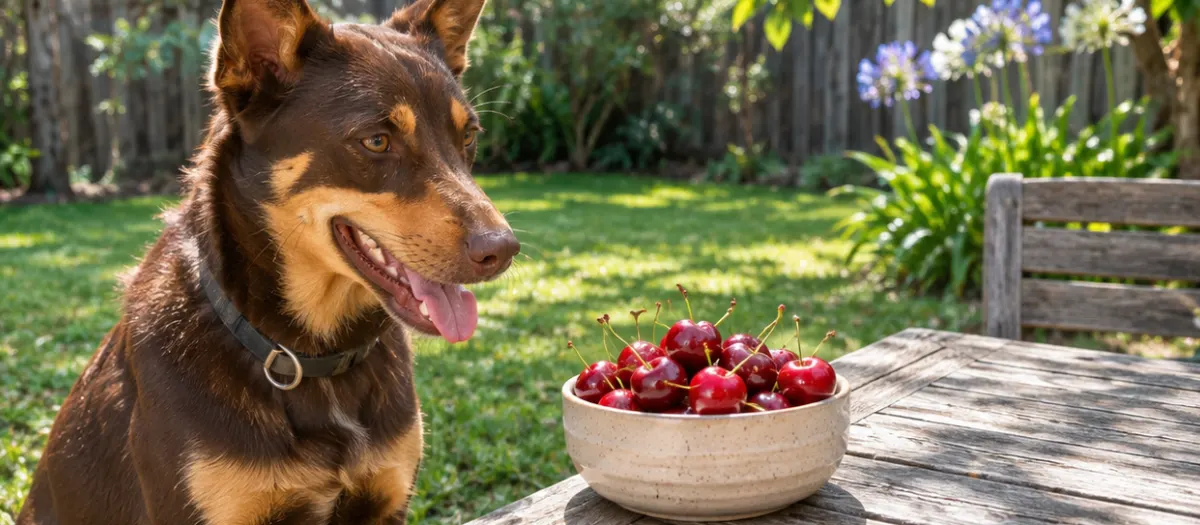
Quick answer: Can dogs eat cherries? The flesh isn't toxic, but the pits, stems and leaves can poison a dog and block the gut. A little pitted flesh is unlikely to cause harm, though we'd skip cherries and offer safer fruit. If your dog swallows a pit, call your vet.
Cherries turn up in Australian homes in a rush before Christmas, in bowls on the table, on pavlova and in lunchboxes, and dogs notice. This guide covers what's risky, what to do if a pit goes down, and which fruit is a better share. It sits alongside our festive food guides on ham and prawns.
Can dogs eat cherries without the pit?
Pitted cherry flesh isn't toxic, so a small piece is unlikely to hurt most healthy dogs. It's still not a food we'd pick for a treat. One missed pit or stem turns it into a risk, and safer fruit is easy to find. Cut the flesh small and check twice.
PetMD says the flesh of a cherry is safe for dogs while the pit can be toxic, and suggests cutting cherries into halves or quarters with every pit and stem removed (PetMD, updated 24 April 2025). It also says dogs with diabetes or obesity shouldn't have cherries. The FAQ below has its portion guide.
Treats of every kind should stay a small part of the diet, and PetMD gives about 10% of the daily diet as the limit. Start with one piece, and watch for vomiting or diarrhoea.
Are cherries bad for dogs?
The fruit itself isn't the problem. The pits, stems and leaves are. They can poison a dog and cause choking or a blockage, so cherries are a poor choice for sharing even though a bit of flesh is considered safe. The cherry flesh is also sugary, so it adds up fast.
Why are cherry pits, stems and leaves dangerous?
Cherry pits, stems and leaves contain a compound the body turns into cyanide, which stops cells using oxygen. They are also hard, so a pit can lodge in the throat or gut. Small dogs are at higher risk of a blockage, and chewing makes a pit more dangerous.
PetMD lists signs of cyanide poisoning as panting, drooling, bright red gums, vomiting, tremors, seizures and collapse, and says cyanide is dangerous even in small amounts (PetMD, updated 24 April 2025). Those signs can have other causes too, so they're a reason to call a vet, not a way to work out what's wrong at home.
This matters most with trees and bins. If you have a cherry tree, rake up fallen fruit and leaves, and keep your dog away from pruned branches. At Christmas, scrape pits into a lidded bin, or one your dog can't open. Our ham guide covers bins in more detail.
My dog ate a cherry pit: what should I do?
Call your vet straight away, even if your dog seems fine. PetMD says to contact a vet immediately if a dog has eaten any pits, stems or leaves, and to take the dog to the clinic (PetMD, updated 24 April 2025). Don't wait for signs, and don't try to make your dog vomit at home unless your vet tells you to.
Here is a simple way to handle it:
- Work out how much. Count the cherries missing from the bowl, and note whether the pits were chewed.
- Keep the packet if it was a glacé or maraschino product, or take a photo of what's left, and note your dog's weight.
- Call your vet or the Animal Poisons Helpline (1300 869 738, 24/7) and follow their advice.
- Watch your dog closely for vomiting, drooling, panting, a sore or swollen belly, straining to poo, or collapse, and go to a vet at once if any appear.
If it was a stem on its own, PetMD says to watch for symptoms and call a vet if they appear. With a whole pit or a chewed one, call first.
Can dogs eat cherry skin?
Yes, the skin on pitted cherry flesh is part of the fruit, and the sources we opened don't flag it as a problem. It's the pit, stem and leaves that matter. Wash the cherry, cut it open, remove the pit and stem, and serve a small piece.
PetMD's advice is to remove pits and stems and cut the cherry into halves or quarters (PetMD, updated 24 April 2025). Neither it nor the ASPCA page we read singles out skin as a hazard. If your dog has a sensitive tummy, a very small piece first is a sensible way to see how they go.
Can dogs eat glacé or maraschino cherries?
Better not. Glacé and maraschino cherries are heavy with sugar and preservatives, and cherry cake, pies and other sweets can hide worse ingredients. Cherry flavoured foods made for people are a poor choice too. Keep them for the humans at the table.
PetMD says maraschino cherries aren't toxic but aren't healthy because of the preservatives and added sugar, and that canned, maraschino and other flavoured cherries are best avoided (PetMD, updated 24 April 2025). Check labels on anything cherry flavoured for xylitol, which the ASPCA says can cause low blood sugar and possible liver damage (ASPCA, page read 6 November 2026). Fruit cake and Christmas mince often hold sultanas or raisins, which are toxic, so check our toxic foods list.
Safer fruits to share instead
If you want to share fruit, pick one with no pit or stem to worry about. Small pieces of watermelon without the seeds or rind, mango flesh and strawberries are easier choices, and our guides cover how to prepare each.
Our fruit guide lists which fruits suit dogs and which to avoid, and the strawberry guide shows how to serve a favourite summer berry. For something cold, try the dog ice cream guide. Whatever you choose, count it within the day's treats and introduce it slowly.
When to see a vet
Call your vet now if your dog has swallowed a cherry pit, chewed pits, or eaten stems or leaves, even if they seem fine. Don't wait for symptoms.
- Panting, drooling or bright red gums
- Vomiting or retching, especially more than once
- Tremors, seizures, weakness or collapse
- Straining to poo, or a swollen, hard or sore belly
- Coughing, gagging or pawing at the mouth, which can mean something is stuck
If your dog has eaten something toxic such as grapes, raisins or xylitol, call your vet or the Animal Poisons Helpline (1300 869 738, 24/7) straight away. See our toxic foods list.
Choose by situation
Cherries come up in a few different ways, from a stray one on the floor to a bowl on the Christmas table. Use this table to match your situation to the right step, then read the section it points to for the detail. When a pit or stem is involved, call your vet first.
| Your situation | What to look for | Our pick or guide |
|---|---|---|
| A cherry fell on the floor | Check whether it still has its pit and stem. A pitted piece of flesh is unlikely to hurt, but a swallowed pit needs a call to your vet | Can dogs eat cherries without the pit? |
| Your dog ate a pit or stem | Call your vet straight away, even if your dog seems fine, and note how many and whether the pits were chewed | My dog ate a cherry pit |
| A bowl of cherries on the Christmas table | Scrape pits and stems into a lidded bin and keep the bowl out of reach | Can dogs eat ham? Christmas food and bins |
| A puppy | We'd skip cherries. A pit or stem is a bigger blockage risk in a small body, so ask your vet before adding new fruit | See "Can puppies eat cherries?" in the FAQ below |
| Dried or glacé cherries | Heavy with sugar and preservatives, and fruit mixes can hide raisins or sultanas, which are toxic | Glacé or maraschino cherries |
| Looking for a safer fruit | Pick fruit with no pit or stem and serve small pieces within the day's treats | What fruits can dogs eat? |
Frequently asked questions
Can dogs have cherries?
A little pitted cherry flesh is considered safe, but the pits, stems and leaves aren't. They can poison a dog and cause a blockage. Because it's easy to miss a pit, we'd rather share a safer fruit, and keep any cherry portion tiny, with every pit and stem removed first.
My dog ate one cherry with the pit. Is that an emergency?
Treat it as urgent and call your vet. PetMD says to contact a vet immediately after any pit, stem or leaf, and a chewed pit releases more cyanide. One swallowed whole is a blockage worry. Your vet can judge the risk from your dog's size, so ring even if they seem fine.
Can puppies eat cherries?
We'd skip them. Puppies are smaller, chew everything and have sensitive tummies, and a pit or stem is a bigger blockage risk in a small body. Offer a puppy-friendly treat instead, and ask your vet before adding any new fruit to a growing puppy's diet.
Are cherry trees poisonous to dogs?
The leaves and stems are a concern. PetMD says the pits, stems and leaves contain amygdalin, which turns into cyanide in the body. If you have a cherry tree, rake up leaves and fruit, don't let your dog chew branches, and call your vet if they eat any.
How many cherries can a dog eat?
PetMD suggests about 1 cherry, pitted and cut up, for dogs under 4.5 kg (10 lb), up to about 5 for dogs over 41 kg (90 lb), 2 to 3 times a week. Dogs with diabetes or obesity shouldn't have them. Treats overall should stay under about 10% of daily calories.
Can dogs eat dried cherries?
We'd skip them. Dried cherries pack the sugar into a small, easy-to-swallow piece, and fruit mixes can include raisins or sultanas, which are toxic to dogs. PetMD says canned and other flavoured cherries are best avoided. Check our toxic foods list before sharing any dried fruit mix.
Can dogs eat cherry yoghurt or cherry ice cream?
Better not. Cherry flavoured yoghurt and ice cream made for people carry added sugar and sometimes xylitol, which the ASPCA says can cause low blood sugar and possible liver damage. If your dog wants something cold, our dog ice cream guide shows safer ideas. Call your vet if xylitol was in it.
Related guides
- Can dogs eat grapes?
- What fruits can dogs eat?
- Can dogs eat strawberries?
- Can dogs eat mango?
- Can dogs eat peaches? Stone fruit safety
- Can dogs eat watermelon?
- Can dogs eat ham? Christmas food and bins
- Can dogs eat prawns?
- Frozen KONG and lick mat recipes (toxic foods list)
- All our dog guides
Sources
- PetMD, Can dogs eat cherries? updated 24 April 2025, page read 6 November 2026 (https://www.petmd.com/dog/nutrition/can-dogs-eat-cherries)
- ASPCA, People foods to avoid feeding your pets, page read 6 November 2026 (https://www.aspca.org/pet-care/animal-poison-control/people-foods-avoid-feeding-your-pets)
This guide provides general information and isn't a substitute for veterinary advice. If you're concerned about something your dog has eaten, speak with your vet.