Staffy harness: picks that fit a broad chest and a strong puller
By Anish PuriUpdated 27 Nov 202616 min readResearched, not tested by us
Research guide. WhiskerFinds may earn a commission from links, at no extra cost to you.
Quick answer: The best staffy harness for most adult staffies is the PoyPet vest harness in Medium: it fits a neck of 32 to 46 cm and a chest of 37 to 77 cm, has front and back metal rings, and buckles on without going over the head. Measure your dog first, because each link here is for one size.
Staffies are built like little bricks: a broad front, a deep chest and a lot of pulling power for 11 to 17 kg. That shape can make a standard harness sit wrong. This guide compares five harnesses on the numbers that matter (neck range, chest range, clip positions and buckles) and shows how to measure. Our staffy guide covers the breed, and this page sits alongside the staffy collar, staffy toys and staffy bed guides.
Quick picks
Our top pickBest overall
PoyPet No Pull Vest Harness, Medium
Front and back metal rings; neck buckle so it doesn't go over the head; neck 32 to 46 cm, chest 37 to 77 cm
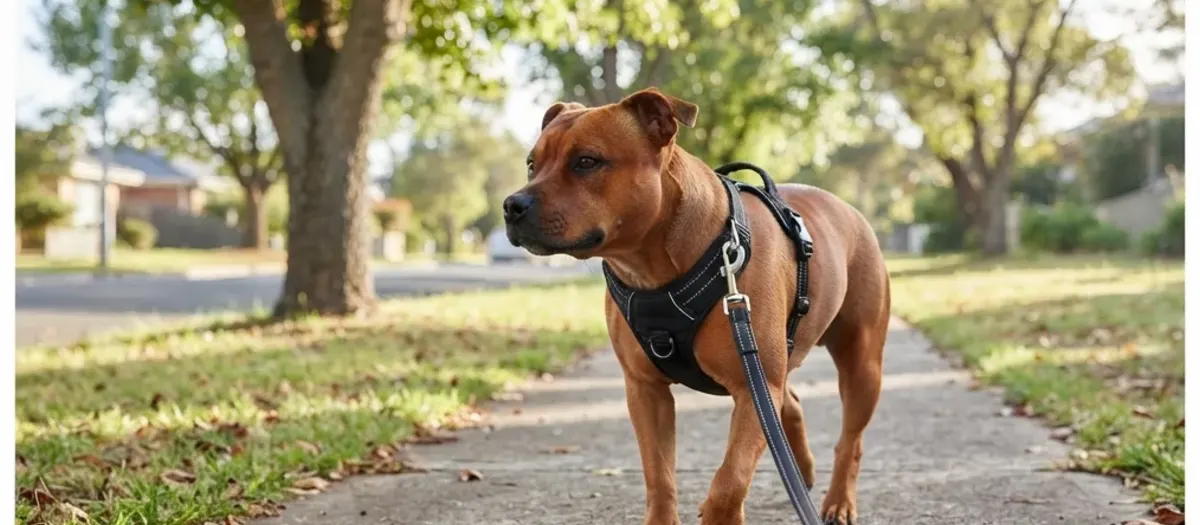
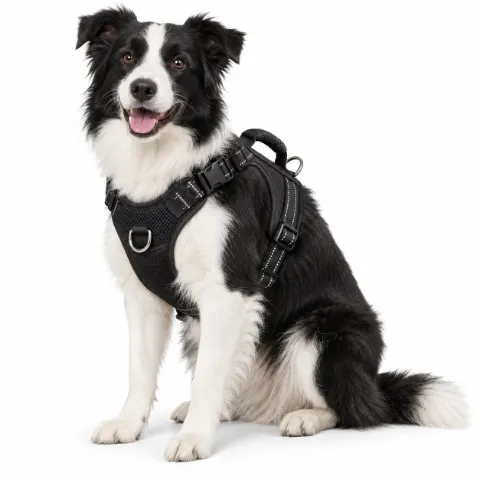
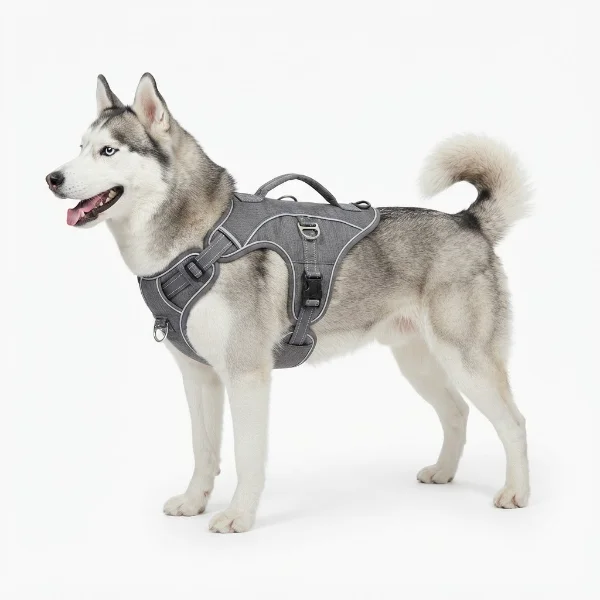
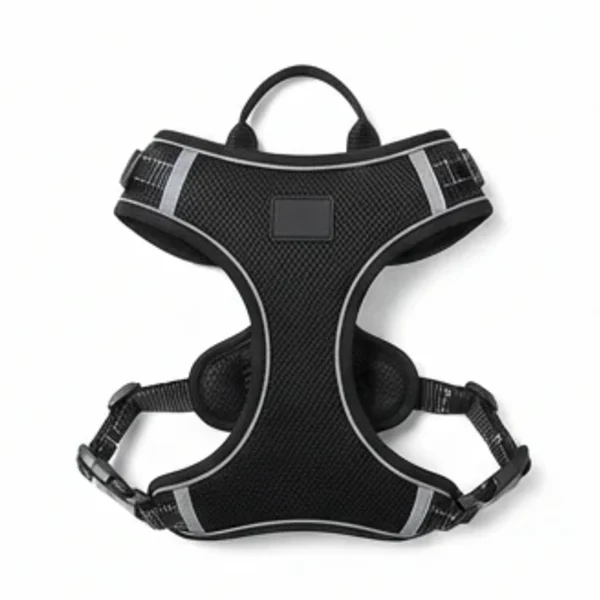
Pictures are illustrations, not the actual products.
What kind of harness suits a staffy?
A harness with a padded, adjustable chest section and a lead ring on the chest as well as the back suits most staffies. It spreads pressure across the body instead of the neck, and a staffy's broad, deep front gives straps room to sit flat.
RSPCA Australia says a standard harness is a good choice for walking and training because it takes pressure off the neck, and that a front-attach harness is a gentle training aid, best used with a double-ended lead (RSPCA Australia, page read 27 November 2026). The Dogs Australia breed standard describes the breed's front as broad with a deep brisket and well-sprung ribs, and gives 36 to 41 cm at the shoulder with males at 13 to 17 kg and females at 11 to 15.4 kg (Dogs Australia, page read 27 November 2026). Our staffy breed guide has the rest of the breed facts.
"Staffy" in Australia also covers American Staffordshire terriers and staffy crosses, which are often bigger. If yours is one of those, look at the larger sizes below and size by the tape, not the label.
Will a harness stop a staffy pulling?
No. A harness manages pulling by changing where the lead pulls from, but it doesn't teach loose-lead walking. VCA says most dogs need several months of regular practice to learn it, and results vary from dog to dog (VCA Animal Hospitals, page read 27 November 2026).
VCA also looks for at least two places to clip the lead, one on the back and one at the front of the chest, and warns that some "no pull" styles can cause injury by pressing on the front of the shoulder joint. Whichever harness you choose, check that no strap sits across the front of the shoulder and that your dog's front legs swing freely. For the full method on pullers, see our no pull dog harness guide and our front clip harness guide. For a dog that reacts to other dogs, start with reactive dog training and use gear as a helper, not the plan.
Our picks in detail
1. PoyPet No Pull Vest Harness, Medium: best overall
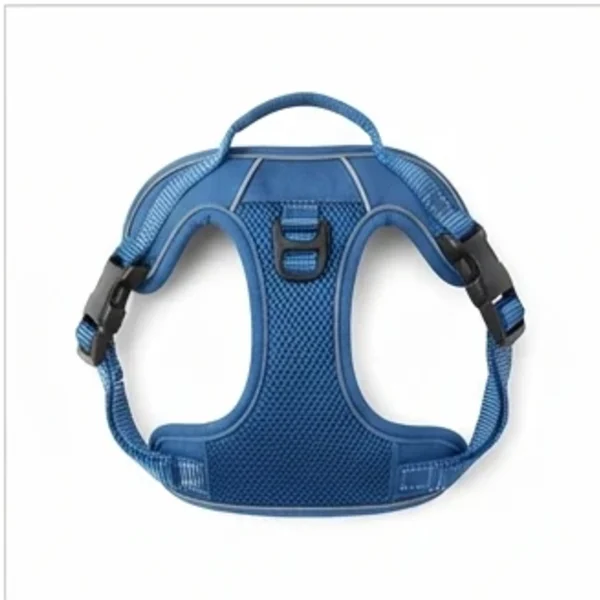
A padded vest in breathable air mesh with an oxford surface. The listing gives a neck of 12.60 to 18.11 in (32 to 46 cm) and a chest of 14.57 to 30.31 in (37 to 77 cm), a wide range for one size. It buckles on rather than going over the head: one lockable snap buckle at the neck plus two belly buckles, which helps a dog that hates a broad head being squeezed through a hole. The listing also says it has two metal clips (front to discourage pulling, back for relaxed walks), elastic sections in the belly straps, a padded handle, reflective stitching and four adjustment points. It weighs about 240 g.
It's our top pick because the range is wide and the fit doesn't depend on a head opening. It's already on our no pull harness guide.
Pros: neck and chest ranges in the listing, and the chest range is wide; front and back metal rings; goes on without going over the head; padded handle and reflective stitching
Cons: plastic buckles; hand wash only
Best for: most adult staffies, and dogs that hate a harness going over a broad head
Skip it if: your dog's chest measures over 77 cm (bigger American Staffies and crosses), or you want metal buckles
2. rabbitgoo No-Pull Harness, Large: best for bigger, stockier staffies
A nylon oxford vest with padding and mesh, two metal rings (chest and back), two quick-release buckles, four adjusting straps and a top handle. The listing gives a neck of 18 to 26 in (about 46 to 66 cm), a chest of 17 to 34 in (about 43 to 86 cm), a weight range of 15 to 45 kg and a weight of 0.3 kg. It also has reflective strips.
It goes on over the head, so it suits a dog that tolerates that. The Large is roomy for many purebred staffies, and the listing's weight band starts at 15 kg, so check the Medium size on the listing first if your dog is a smaller female. It's also on our no pull harness guide.
Pros: wide neck and chest ranges for a large chest; front and back metal rings; two quick-release buckles; top handle and reflective strips
Cons: goes on over the head; too roomy for many purebred staffies, so check the size chart for Medium; hand wash only
Best for: large males, American Staffies and staffy crosses from about 15 kg
Skip it if: your staffy is a small female (the listing's weight band starts at 15 kg and its neck range starts at about 46 cm), or dislikes overhead harnesses
3. Huntboo Harness with Extra Belly Strap, Medium: best for staffies that back out
Air mesh with 4 mm padding and fully reflective fabric. The listing gives five adjustment points, four quick-release buckles, front and back metal D-rings and a padded reflective handle. It pulls on over the head and fastens at both sides, and it weighs about 290 g.
The listing sells it as "escape proof". No harness is, so we say it's harder to back out of: the extra belly strap holds the body in place, but only if you fit it snugly (two fingers under every strap). The neck and chest ranges are in the listing's size chart image, not its text, so check the size chart on the listing before you order. For more on the problem, see our escape resistant harness guide.
Pros: five adjustment points; front and back metal D-rings; machine washable, per the listing; fully reflective fabric
Cons: four buckles take longer to fit; more straps to adjust
Best for: dogs that reverse out of a standard harness when startled
Skip it if: you want the lightest summer option or a quick two-buckle fit
4. rabbitgoo Tactical Harness, Medium: best heavy-duty with a handle
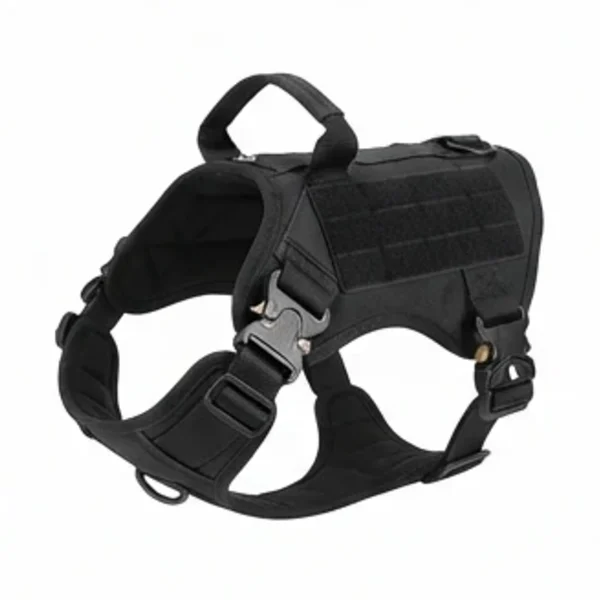
A heavy 1050D nylon vest with two metal shoulder buckles, front and back clips, five adjustable straps, four buckles and a reinforced top handle. The listing gives a neck of 41.6 to 72.4 cm, a chest of 64.5 to 91.5 cm, a back length of 27 cm and a weight range of 4.6 to 16.7 kg. It weighs 560 g. It also has MOLLE webbing and patch panels for add-ons, which most pet owners won't use.
The chest range starts at 64.5 cm, which is on the big side for many staffies, so measure before you consider it. The listing's weight range tops out at 16.7 kg, near the top of the breed's range. It's the bulkiest pick, so we mark it a caution for hot weather.
Pros: metal shoulder buckles and a solid handle; wide neck range; five adjustable straps
Cons: heavy at 560 g and covers more of the body, so it's warmer; extras such as MOLLE panels and patches that most owners won't use; hand wash only
Best for: very strong pullers and owners who want metal shoulder buckles and a solid grab handle
Skip it if: you walk in summer heat, or your dog measures under about 64 cm around the chest
5. rabbitgoo Harness, Medium: best no-overhead fit for a thicker neck
A mesh and oxford vest with three quick-release buckles, a lockable neck buckle, two metal leash points, a widened top handle and reflective stitching. The listing gives a neck of 19.2 to 23.5 in (about 49 to 60 cm) and a chest of 19.2 to 27.5 in (about 49 to 70 cm). It weighs 280 g. It's put on without going over the head.
Its place here is the neck range: PoyPet's Medium stops at 46 cm, and this one runs from about 49 to 60 cm without going over the head. That will be too big for some purebred staffies, so measure first. The listing says the harness isn't chew-proof and to keep it away from a dog that chews it when it's not in use, which is worth taking seriously with a staffy.
Pros: front and back metal rings; lockable neck buckle; 280 g with breathable mesh
Cons: neck range starts at about 49 cm, too big for smaller staffies; hand wash only and not chew-proof, per the listing
Best for: thick-necked staffies and crosses (neck about 49 to 60 cm, chest 49 to 70 cm) that won't take a harness over the head
Skip it if: your dog's neck is under about 49 cm, or it chews gear
How do you measure a staffy for a harness?
Measure your own dog, because no credible published figure exists for a "typical" staffy neck or chest, and staffies vary a lot. Use a soft tape and write down two numbers, chest girth and neck girth, taken where the American Kennel Club describes (AKC, page read 27 November 2026).
Swipe sideways to see every column
Measurement
Where to put the tape
What it does
Chest girth
Around the widest part of the ribcage, just behind the front legs
Sets the size; compare it with each listing's chest range in cm
Neck girth
Around the base of the neck, where a collar sits
Needs to sit inside the neck range of any harness that goes on with neck straps
Each harness below is a single size, so choose your size on the listing before you order. If your dog sits near the top or bottom of a range, check the next size on the listing. After you buckle it on, RSPCA South Australia says to adjust the chest and leg straps until two fingers slide underneath, and to compare your dog's stride with and without the harness, as a changed gait suggests the fit needs work. It also warns that a loose harness lets a dog work an elbow through and wriggle out (RSPCA South Australia, page read 27 November 2026). Our guide to how to put on a dog harness shows the steps.
Staffy harnesses compared
Details from each Amazon Australia listing, checked on 27 Nov 2026. Inches converted to cm.
Swipe sideways to see every column
Harness
Neck (cm)
Chest (cm)
Clips
Buckles
Overhead?
PoyPet Medium
32 to 46
37 to 77
Front and back, metal
Lockable neck buckle plus 2 belly buckles; plastic
No
rabbitgoo Large
About 46 to 66
About 43 to 86
Front and back, metal
2 quick-release
Yes
Huntboo Medium
Check the size chart on the listing
Check the size chart on the listing
Front and back, metal D-rings
4 quick-release
Yes
rabbitgoo Tactical Medium
41.6 to 72.4
64.5 to 91.5
Front and back, metal
4 quick-release, 2 metal shoulder buckles
Not stated
rabbitgoo Medium
About 49 to 60
About 49 to 70
Front and back, metal
3 quick-release, lockable neck buckle
No
Listing weight guides, where given: rabbitgoo Large 15 to 45 kg, rabbitgoo Tactical Medium 4.6 to 16.7 kg. The others give none in their text. Weight bands are the makers' estimates, so trust the tape over the label.
All are hand wash only except the Huntboo, which its listing says can be machine washed.
We searched Amazon Australia for harnesses built for strong, medium-sized dogs, then shortlisted those that met all of these checks:
Well rated: a strong average rating with plenty of buyer reviews.
No red flags: no pattern of poor reviews, safety complaints or listing problems.
Available on Amazon Australia when we checked.
Built for a strong, broad dog: metal lead rings, sturdy buckles and a chest range wide enough for a deep chest.
Sizes you can check: neck and chest ranges in the listing, or a note to read the size chart.
These are researched picks, not products we've personally tested. We compared the specifications and features on each Amazon Australia listing, checked on 27 Nov 2026, and we didn't accept payment from any brand.
Left out this time: step-in and mesh sets made for small dogs, near-duplicates of these picks, and harnesses sold with service-dog patches. The Halti range is covered on our Halti harness guide. We left out any harness whose chest loop tightens, so everything here is a fixed-fit design.
Where else can you buy a harness?
Pet shops and vet clinics stock harnesses and will often measure your dog with a tape. Trying one on in person is the easiest way to check the neck and chest fit, and a reward-based trainer can help with fitting, as RSPCA Australia suggests.
When to see a vet
Book a vet visit if your staffy coughs or gags on walks, has rubbing, redness or hair loss under the straps, limps or has a shorter stride, or suddenly resists being harnessed. These can have many causes, and a vet can work out which.
Go to a vet or emergency clinic straight away if your dog has trouble breathing, collapses on a walk, or has a strap caught around a leg that won't come free.
Frequently asked questions
Is a harness better than a collar for a staffy?
For walks, usually yes, because a harness keeps lead pressure off the neck, which RSPCA Australia calls ideal for walking and training. A flat collar still carries the ID tag. Our staffy collar guide compares the two in full and explains which collars to avoid.
Should the lead go on the front or back clip?
Use the back ring for relaxed walking and the front ring when you want to steer a dog that pulls. RSPCA Australia strongly recommends a double-ended lead with a front-attach harness: you lead from the back clip and use the front one to turn a dog that pulls. A front clip is a training aid, not a fix, so keep practising loose-lead walking with treats and patience.
Why does my staffy keep backing out of the harness?
A loose harness lets a dog work an elbow through a strap, as RSPCA South Australia explains. Tighten it until two fingers fit under each strap, check the neck and belly straps, and keep the lead steady. An extra belly strap, as on the Huntboo, can help. No harness is escape proof.
Do American Staffordshire terriers and crosses need a bigger harness?
Often, yes. Many are bigger than the Dogs Australia staffy standard of 11 to 17 kg. Measure the chest and compare it with each listing's range in cm: the rabbitgoo Large and the Tactical go up to 86 and 91.5 cm. Check the listing for the size that suits your dog.
Can a staffy puppy use these harnesses?
Puppies grow fast, so a harness is soon outgrown. RSPCA Australia says to check a puppy's collar or harness fit at least a few times a week. Ranges here start at 37 cm for the PoyPet, so a small puppy may need a smaller size. See our puppy harness guide instead.
Is a handle on a harness useful?
It gives you a quick grip when a strong dog lunges toward something, and it helps guide a dog past a hazard. It's for steadying, not for lifting or hauling your dog by the harness. The PoyPet, rabbitgoo and Huntboo picks all have one.
How should I clean a harness?
Follow the listing. Let it dry fully before the next walk, and check stitching, buckles and clips for wear before each outing. Retire any harness that frays.
Product details from each linked Amazon Australia listing, checked on 27 Nov 2026.
This guide provides general information and isn't a substitute for veterinary advice. If you're concerned about your dog's walking, pulling or comfort in a harness, speak with your vet.