Quick answer: To measure a dog for clothes, use a soft tape while your dog stands and take three numbers: chest girth at the widest part behind the front legs, neck girth where a collar sits, and back length from the base of the neck to the base of the tail. Check each maker's chart, chest first, and size up between sizes.
Sizes on dog clothes are wildly inconsistent, so a tape measure beats guessing from a label or your dog's weight. This guide walks through the three measurements, how to read a chart, what to do between sizes, the breeds that don't fit standard charts and how to check the fit once the clothes are on. If you're still deciding what to buy, start with our dog clothes guide.
A quick seasonal note: this guide is aimed at the cooler months, cold mornings in the south and the alpine and tableland areas, and it's published early so it's ready for autumn. In summer most dogs need nothing, and clothes on a hot day raise the risk of overheating.
Which three measurements do dog clothes need?
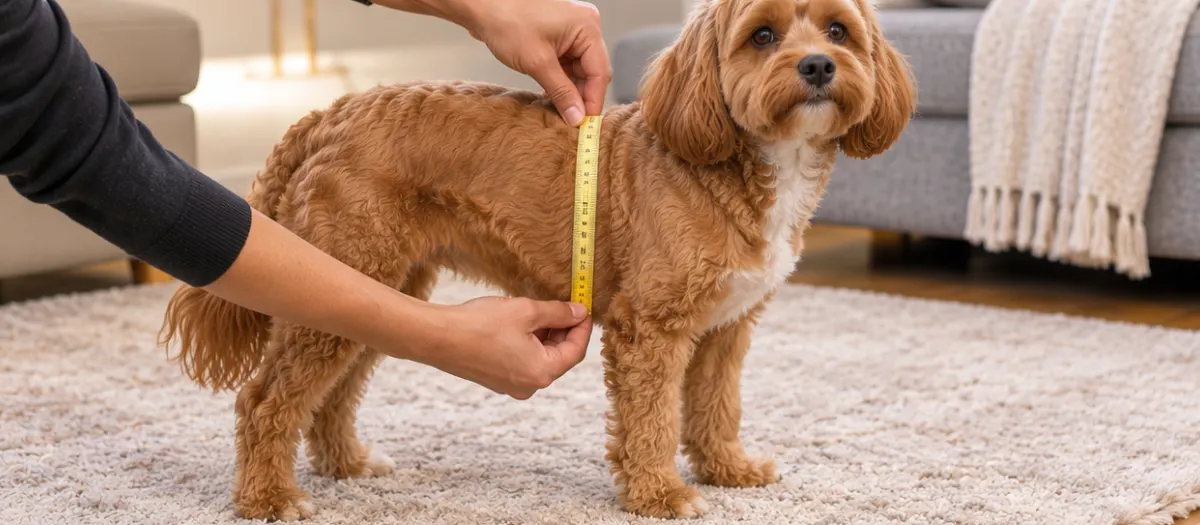
Dog clothes need chest girth, neck girth and back length. Measure each with a soft tape while your dog stands square on all four feet. Keep the tape snug but not tight, and slip two fingers under it on the girths. If you don't have a tape, use string and measure it against a ruler.
Write the numbers down in centimetres. Here's where each one goes, following the American Kennel Club and PetMD methods:
- Chest girth: wrap the tape around the widest part of the rib cage, just behind the front legs. This is usually the one that decides the size.
- Neck girth: measure around the base of the neck where a collar normally sits. It matters most for pullovers, hoodies and anything with a collar.
- Back length: run the tape along the top of the spine from the base of the neck, where the collar sits, to the base of the tail.
Some tips that make the numbers more reliable. Measure after a walk, when your dog is calmer, and have a helper offer treats or a lick mat so you aren't restraining them (PetMD). Measure twice. A wriggly dog who sits or slumps mid-measure will give you a smaller chest than the real one.
Why does chest girth decide the size?
Chest girth decides the size because it's the one dimension a garment can't easily cheat. A coat can be cut a little long or short in the back, but if it can't wrap around the ribcage it won't close, or it will pinch behind the front legs. The AKC calls chest girth typically the most important measurement for clothing.
Most makers agree. Gooby's hoodie and bomber listings and the FABRICASTLE listing tell buyers to follow the chest measurement first, and IECOii sizes each coat by a chest range. The one exception we found is the Gooby Stretch Fleece Vest, which is sized by back length because the fabric stretches, so read each listing's own instruction. If a chart gives only a weight band, treat that as a rough second check. Two dogs of 7 kg can have very different ribcages.
How do I read a dog clothes size chart?
A dog clothes size chart lists the dog measurements each size is made for, not the garment's own measurements. Compare your dog's chest, back and neck with those columns. Ignore the letter on the label until you've done that, because a "Medium" means something different in every brand.
Our own listings show how far the labels drift. A Medium covers a dog with a 36 cm chest in one brand and a 56 cm chest in another.
| Product and size | Label | Chest (cm) | Back (cm) | Neck (cm) |
|---|---|---|---|---|
| Dxhycc heart knit | Medium | 36 | 30 | 24 |
| Gooby Padded Vest | Small | 40.6 | not given | 29 |
| Gooby Stretch Fleece Vest | Medium | 40.6 | 29 | 30.5 |
| IECOii Extra Warm coat | Medium | 42 to 53 | 36 | 38 |
| Mihachi cable knit | Medium | 56 | 40.6 | 33 |
| FABRICASTLE fleece | Small | 34 | not given | 23 |
Figures read from each Amazon Australia listing on 18 November 2026. Charts change, so always check the live chart for the size and colour you're buying.
The same 16 in chest is a Small in one Gooby line and a Medium in another, and the Medium label alone covers a 36 cm chest in one listing and a 56 cm chest in another. Three more things to check on any chart:
- Is the chest a girth or a width? A flat measurement across the garment is about half the girth. Check which one the chart means.
- Is it a range? IECOii gives a chest range per size, which makes the cut-off obvious. Single numbers leave you guessing at the edges.
- Does the maker say it runs small? Some listings say so outright. Take that at its word and go up.
For the type-specific notes, see the measuring sections in our guides to dog coats, dog jumpers, dog hoodies and dog raincoats.
What if my dog is between sizes?
If your dog is between sizes, go up. Both the AKC and PetMD say a slightly looser fit is more comfortable than a tight one, and most listings give the same advice. The main exception is a pullover where the larger neck opening would then sag or slip over the shoulders.
For a pullover, the neck opening should be bigger than your dog's head but not loose enough to slide around. If the next size up has a neck far wider than your dog's neck, compare the back length too and consider a stretchier style instead.
PetMD suggests adding roughly 2.5 to 5 cm to girth measurements so a finger or two fits under the item, and some listings give their own allowance (FABRICASTLE says about 3.8 cm). Use one allowance, not both; the FAQ below has the detail.
Here's a worked example. Say your dog weighs 7 kg, with a chest of 42 cm, a neck of 30 cm and a back of 32 cm:
- The Gooby Stretch Fleece Vest Medium (chest 40.6, back 29) is just under your dog on both, so you'd move up a size.
- The Dxhycc Medium (chest 36) is well short, and the maker's chart would need a bigger size again.
- The IECOii chart lists a Small as 32 to 42 cm and a Medium as 42 to 53 cm, so 42 cm sits on the edge. Size up to the Medium, then check that its 38 cm neck doesn't float on a 30 cm neck once the collar is adjusted.
The weight didn't help in any of those. The tape did.
Which breeds don't fit standard size charts?
Long, short-legged dogs, deep-chested sighthounds, broad-chested flat-faced dogs and freshly clipped poodles often fall between sizes. Size by chest, then adjust for the shape that breaks the chart. The table below shows what usually goes wrong and where to look.
| Breed or shape | What breaks the chart | What to do | Where to look |
|---|---|---|---|
| Dachshund and other long, short-legged dogs | Back is long for the chest, so standard sizes gap at the belly or stop short | Size by chest, then pick adjustable or longer-cut styles that keep the belly covered (AKC, RSPCA) | Best small dog clothes, best dachshund harness |
| Greyhound and whippet | Deep chest, narrow waist and long neck, so standard coats slip | Choose a greyhound cut with a long neck and belly cover | Best greyhound coats |
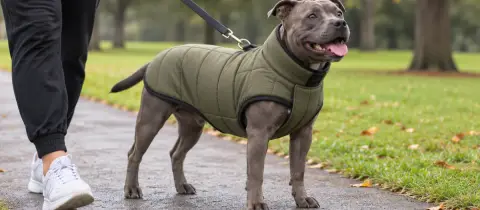
| Staffy, French bulldog and pug | Broad chest on a short back | Size by chest, then check the back isn't too long. Flat-faced dogs have less capacity to cool by panting (RSPCA Knowledgebase), so choose lighter layers | Best French bulldog harness |
| Clipped poodle or oodle | Coat length changes between grooms | Measure again after each clip | Best dog jumpers |
| Corgi | Long back and a thick double coat, but short legs put the belly near cold, wet ground (AKC) | Many need nothing in mild weather. If you do buy, size by chest and check the belly is covered | Best dog clothes |
Dachshund owners should know clothing doesn't protect a long back. The only point is that step-in and stretch styles avoid bending your dog to dress them. Our dachshund harness guide covers the back-care side.
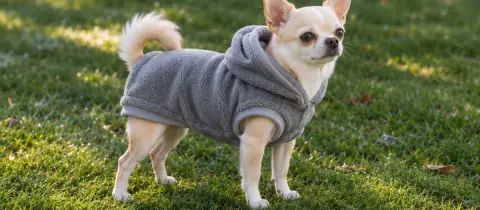
Tiny dogs have their own problem: a maker's small is often another's extra small. Our small dog clothes guide puts the cm charts side by side.
How should dog clothes fit once they're on?
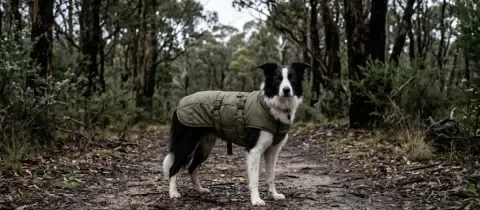
Once on, a coat should cover from the neck to the base of the tail and protect the belly, without restricting movement. Your dog must still be able to walk, see and toilet normally. Check two fingers fit under the neck and armholes, and that nothing dangles or flaps loose enough to tangle.
That checklist draws on a few sources. RSPCA Victoria and RSPCA Queensland describe the neck to tail base and belly coverage and say clothing shouldn't restrict movement. RSPCA South Australia says a poorly fitting coat may stop a dog walking properly, seeing clearly or toileting. The AKC says a coat should be fitted but not so loose that it tangles.
Run through these with your dog standing, then walking across the room:
- Armpits: no rubbing, and the front legs swing freely. Watch for a dog who starts to walk stiffly.
- Neck: two fingers fit under the collar or neck opening. A dog who tugs at it or paws at their face may be uncomfortable.
- Belly and tail end: the back edge shouldn't ride up and bunch, nor drag under the belly.
- Toileting: a male dog's garment shouldn't soak at the front, and a female dog should be able to squat without fouling the hem.
- Fastenings and trims: PetMD advises avoiding small buttons or decorations that could be swallowed.
- Attitude: RSPCA South Australia says never to push an animal into wearing something that upsets them. Go slowly with treats.
Take a few minutes to watch your dog after each fitting. Once they've warmed up from play, some no longer need the layer at all (PetMD), and indoors the clothes can usually come off. RSPCA Queensland says pets can overheat near heaters, and there's no need to keep a coat on inside.
Which clothes does my dog actually need?
Many dogs need no clothes at all. Small and toy breeds, lean short-coated dogs like greyhounds and whippets, short-legged dogs, clipped or hairless dogs, puppies, seniors and dogs with arthritis or illness may benefit (AKC, VCA, PetMD). Large thick-coated dogs generally don't, and individual dogs vary.
Two Australian figures are worth knowing, and neither is a general rule. RSPCA says that below 15°C a coat is essential for a greyhound, and RSPCA NSW gives a dog comfort zone of about 20 to 30°C that varies with age, health and how used to the weather a dog is. The AKC says there's no universal temperature. Watch your dog. Shivering, whining, lifting paws or refusing to walk can mean cold (VCA).
Once you know your dog's numbers, these guides help you choose:
- Best dog clothes for choosing between types
- Best small dog clothes for toy and small breeds
- Best dog winter vests for fitted vests sized by chest
- Best dog bandanas for neck sizing on bandanas
Useful guides
Once you have the three numbers, these guides turn them into a short list. None of them replace the maker's own chart.
- Dog coats for wrap-style coats with belly straps
- Dog jumpers for knits and fleece pullovers
- Dog hoodies for hoodies, including ones with a lead hole
- Dog raincoats for wet walks
- Greyhound coats for deep-chested sighthounds
- Dog Christmas pyjamas and dog Christmas outfits for festive sizing
- Thundershirt for dogs if you're wondering whether a snug garment calms a dog. Clothes aren't a calming aid, and that page covers it
Dog clothes are sold in pet shops, some vet clinics and clothing boutiques as well as online. Wherever you buy, try the garment on at home and keep the tags until you know it fits.
When to see a vet
Clothes are only a comfort aid. See your vet if you notice:
- Shivering that doesn't stop once your dog is warm and dry, or shivering indoors.
- An older dog who is stiff or reluctant to walk in cold weather. RSPCA Victoria and RSPCA Queensland both note that cold can make arthritis signs worse.
- Skin rubbed raw, bald patches or sores under straps or armholes.
- Panting, drooling or wobbliness while dressed on a warm day. This may be overheating. Take the clothing off, move your dog to shade, cool them with room-temperature water and call a vet straight away (RSPCA Knowledgebase).
- Any sudden change in how well your dog copes with cold, such as weight loss or other signs of illness.
Frequently asked questions
What size is a medium dog in clothes?
There's no single answer, because "Medium" varies by brand. Across the listings in our table above, a Medium chest is 36 cm in one, about 41 in another and 56 cm in a third. Measure your dog's chest, neck and back, then match them to the maker's chart rather than the letter.
Do you measure a dog for clothes sitting or standing?
Measure standing. The AKC says to stand your dog up straight so the spine is aligned and weight is spread evenly. A sitting or slumped dog gives a shorter back and a different chest. If your dog won't stay still, a helper with treats makes it much easier.
Does my dog's weight matter when choosing a clothes size?
Weight is a rough second check, not the main one. Two dogs of the same weight can have very different chests and back lengths, and weight bands on listings are only a guide. Choose by chest first, then back and neck, and use the weight band to catch obvious mismatches.
How do I measure a puppy that is still growing?
Measure on the day you buy, and measure again each time you buy. Puppies can outgrow a size quickly and growth varies by breed, so choose the size that fits now, not one they'll grow into, since a loose garment can tangle (AKC). Our small dog clothes guide has size tables in cm.
Can I use my dog's harness or collar size to pick clothes?
Not directly. Harness and collar sizes use different parts of the body and different allowances, and each brand has its own ranges. Your harness chest measurement is a handy starting point, but measure again and check the clothes chart. Our no pull harness guide explains harness fitting.
Why do dog clothes ride up or gap at the belly on a dachshund?
A dachshund's back is long for its chest, so a standard size that fits the chest often stops short at the belly, and one that fits the length can gape at the chest. Look for adjustable or longer-cut styles and check belly coverage. The AKC notes short-legged dogs chill when their bellies touch cold ground.
How can I tell if my dog's clothes are too small?
Signs include marks or rubbing under the armpits, a restricted stride, a neck opening where two fingers won't fit, or clothes that ride up and bunch. Your dog may also freeze, paw at the garment or refuse to walk. Take it off and go up a size.
Should I add extra centimetres to the chest measurement?
Only if the chart doesn't already allow for it. PetMD suggests adding about 2.5 to 5 cm to girth measurements, and FABRICASTLE's listing gives about 3.8 cm. Those are each source's own advice, not a vet rule. Compare your measurement with the chart's range and size up if you're near the top.
Related guides
- Best dog clothes: which type suits your dog and the weather
- Best small dog clothes: sizes in cm for toy and small breeds
- Best dog winter vests: padded and fleece vests by chest size
- Best dog bandanas: everyday bandanas sized by neck in cm
- Best dog coats
- Best dog jumpers
- Best dachshund harness
Sources
- American Kennel Club, "How to Measure Your Dog for Clothes and Gear", page read 19 November 2026.
- PetMD, "How To Measure a Dog", page read 19 November 2026.
- VCA Animal Hospitals, "Do Dogs Need Coats In The Winter?", page read 19 November 2026.
- RSPCA Victoria, "Hot pet tips for a cold winter", page read 19 November 2026.
- RSPCA Queensland, "Providing the best care for all pets in winter", 18 May 2023.
- RSPCA South Australia, "Our hot tips for keeping the cold at bay for your pets this winter", 19 June 2019.
- RSPCA NSW, "Just Because You're Cold Doesn't Mean Your Animal Is", 11 August 2025.
- RSPCA Knowledgebase, "What should I know about owning a greyhound?", updated 14 December 2025.
- RSPCA Knowledgebase, "How can I protect my dog from heatstroke?", updated 8 May 2023.
- PetMD, "Do Some Breeds Actually Need Dog Coats?", 24 January 2019.
This guide provides general information and isn't a substitute for veterinary advice. If you're concerned about your dog's comfort in cold weather or how they cope in clothes, speak with your vet.