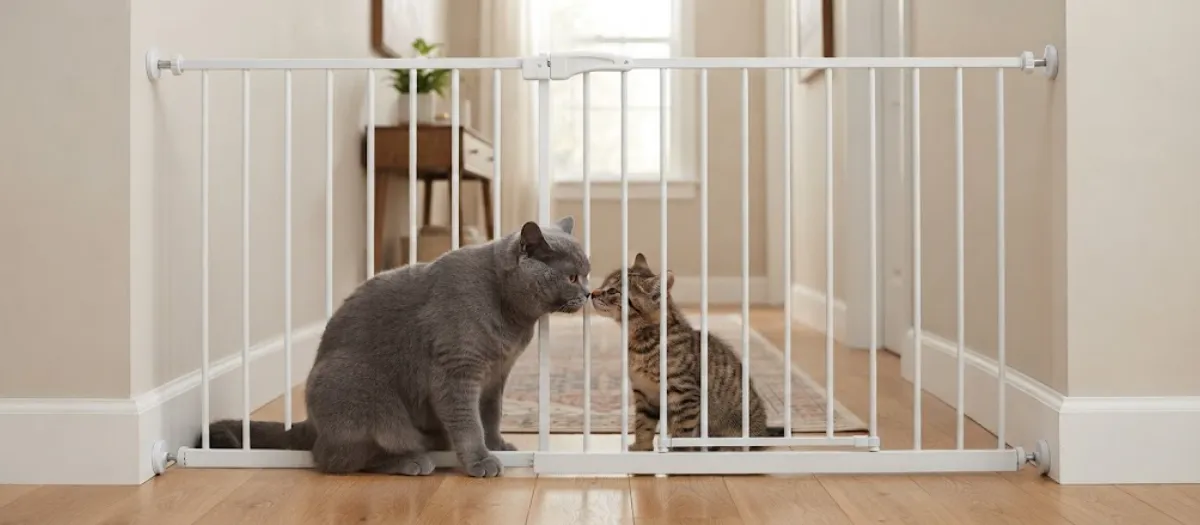
Quick answer: Introducing a kitten to an older cat works best slowly. Start with a separate room for the kitten, swap scents first, then let them see each other through a tall gate, then try short supervised meetings. Go at your cats' pace, because there's no set timeline. Our pick for see-but-don't-touch meetings is the No Pawblems 140 cm pet gate.
A kitten is exciting for you and can be a big change for the cat who was there first. This guide covers how to prepare, a stage-by-stage plan, what hissing can mean, how long it can take, and how to protect your older cat's routine. If you're still setting up, our kitten proofing checklist covers the rest of the house. Bringing a dog into the mix instead? See how to introduce a dog to a cat.
Quick picks

No Pawblems 140 cm extra tall pet gate
140 cm tall, pressure mounted with no drilling
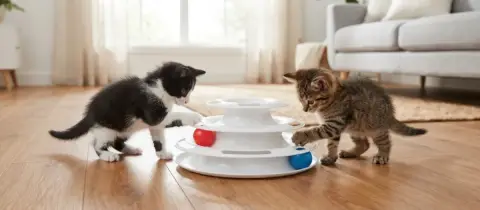
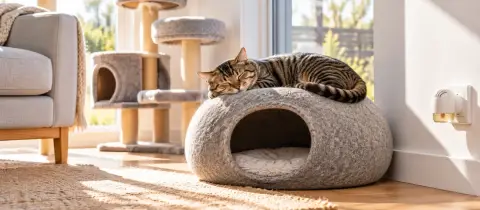
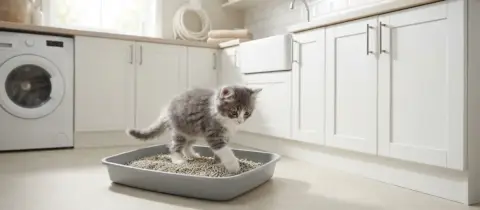
Pictures are illustrations, not the actual products.
The gate is one tool in the plan, not a shortcut. The step-by-step section below is what does the work.
Before your kitten comes home
Set up a separate room for the kitten before you collect them (if you can't spare a room, an indoor cat cage inside a quiet room can work for short stays), and keep your older cat's meals, bed and tray where they always were. A vet check for both cats is a good idea too. Preparing first means the first days are calm for everyone.
International Cat Care suggests using a room the resident cat doesn't normally use, stocked with food, water, beds, hiding places, a litter tray, toys and a scratching post, ideally new items or the kitten's own, because another cat's scent can cause stress (International Cat Care, updated 28 November 2025). It also says to keep a kitten in one quiet room for the first few weeks (International Cat Care, updated 26 September 2025).
A simple checklist:
- The kitten's room: a safe, quiet room with a hiding spot, a bed, water, food, a tray and a scratcher. Our guides to the best litter for kittens and the best kitten scratching post cover the setup.
- Vet checks: the RSPCA Australia knowledgebase suggests checking with your vet first, especially about any health or behaviour issues in your existing cat, and making sure all cats have had health checks and are up to date with vaccines, worming and parasite control (RSPCA Australia knowledgebase, updated 27 October 2025). Follow your vet's advice for your kitten's vaccinations, parasite control, microchipping and desexing. Our flea treatment for cats guide lists the age and weight minimums on each product.
- Your older cat's routine: keep feeding times, bedding and favourite spots the same, so the kitten doesn't feel like a loss of territory.
- A few rewards: the RSPCA also suggests having high-value treats and toys ready for rewards.
- Pheromone products: optional, and the evidence is mixed. Our FELIWAY guide explains what they may help with and the plug issue in Australia.
How to introduce a kitten to an older cat, step by step
The same pattern turns up in advice from the RSPCA and International Cat Care: separate rooms first, scent before sight, then short controlled meetings, only moving on when both cats are relaxed. Both say it can't be rushed and that never forcing the cats together matters. Here is a plain version of that plan, with no fixed dates for any step.
Stage 1: The kitten settles in their own room
Bring the kitten home in a covered carrier, take them straight to their room and let them come out when they choose. The RSPCA suggests keeping the cats out of sight of each other at the start. International Cat Care says settling in can take anywhere from several days to a week or two. A house with two exits, like the picks in indoor cat houses, means neither cat can corner the other, and a low tree from cat trees for kittens gives the kitten its own climbing spot.
Watch the kitten as well. International Cat Care lists scratching at doors, long meowing and pacing as signs a new cat may be frustrated if confined too long, so spend time in the room playing and cuddling, and speak to your vet if they aren't eating or using the tray.
Stage 2: Swap scents before sight
Swap bedding so each cat lies on the other's smell, or rub a soft cloth on each cat's cheeks and chin and leave it in the other's area. International Cat Care says to slow down if either cat reacts badly. The RSPCA also suggests playing with each cat on either side of a closed door, using a double-sided toy, in sessions under 20 minutes.
Wand toys have string, so use them together and put them away after every session. Never leave string, ribbon, elastic or thread out for a kitten to chew or swallow. Our kitten toys guide has safer picks for solo play, and the Hianjoo teaser set is covered in our cat toys guide.
Stage 3: Swap areas
Once the kitten is settled, shut your older cat in another room and let the kitten explore the shared space for a short time, then swap back. International Cat Care describes letting each cat explore the other's territory, one at a time. The RSPCA suggests the same swap before any visual contact. Your older cat gets to check out the kitten's smell without meeting them.
Stage 4: See each other through a barrier
Use a tall gate, glass door or mesh screen so the cats can see but not reach each other. International Cat Care suggests a glass door, stair gate or mesh screen, and says to call a cat's name to distract from any tension, not to use food or play as a reward at this step. The RSPCA suggests short, supervised sessions that get longer over time. Both are fine approaches, so follow whichever your cats take to, and keep each session short.
Check the kitten against the gate bars first. A very small kitten may squeeze through or get stuck in a gap, so supervise. This is where the No Pawblems 140 cm gate can help.
Stage 5: Short supervised meetings
Open the barrier when both cats look relaxed. International Cat Care says they only need to tolerate each other's presence, not interact. Replace the barrier and go back a step if tension appears. The RSPCA suggests keeping resources and feeding separate in the early shared sessions and staying ready to step in.
Stage 6: Short unsupervised time, then full access
International Cat Care suggests starting with a few minutes unsupervised and building up, keeping the cats apart in between. Phase out supervision gradually. Keep the kitten's own room as a safe base, and keep going back a step if there's a setback.
Is hissing normal when introducing a kitten?
A little hissing or a growl can be a cat saying "too close", and it may happen during introductions. A single hiss isn't a reason to give up. Look at the whole pattern, such as posture, whether either cat avoids the other, and whether it eases when you slow down.
International Cat Care lists hissing, growling and a tense body with rotating ears as signs of negative behaviour between cats, and friendly greetings, chirruping, purring, resting with the belly exposed, playing and normal eating, drinking, toileting and grooming as signs of comfort (International Cat Care, updated 28 November 2025). The RSPCA lists staring or blocking access to resources, hiding, reduced appetite or litter use, swatting or chasing, and tail lashing as warning signs, and says to separate the cats and go back at least one step (RSPCA Australia knowledgebase, updated 27 October 2025).
How long does it take for a cat to accept a kitten?
There's no fixed timeline. The RSPCA says to be prepared for the process to take weeks to months, and International Cat Care says the outcome depends on the individual cats, and that a cat's ability to become more sociable is limited once it reaches adulthood. Some cats become friends, some tolerate each other, and some prefer their own space.
Some factors may make it easier or harder. International Cat Care says younger cats are generally more likely to accept a newcomer, that a kitten's energetic play can stress an older cat, especially one with joint problems, and that cats that are unwell or stressed are less likely to welcome another cat (International Cat Care, updated 26 September 2025). It's hard to predict, so watch your own cats.
Signs things are going well can include:
- both cats eating, drinking and using the tray normally
- relaxed body language and curiosity about each other's scent
- one or both cats playing near the gate
- tolerating each other in the same room, even without interacting
Protecting your older cat
Give your older cat their own food, water, beds, trays and scratchers, spread around the home, plus high spots and hiding places the kitten can't get to. Less sharing means less pressure. Keep the older cat's quiet zone kitten-free, especially if they're elderly or stiff.
International Cat Care's guideline is one resource per cat plus one extra, in different locations, and it says to avoid clustering litter trays together because cats may treat them as one resource and block each other (International Cat Care, updated 26 September 2025). It also suggests perches for watching from above, ideally with two ways up or down so a cat can't be trapped, and private hiding places.
Practical ideas:
- Trays: the usual vet guideline is one tray per cat plus one extra, in different places. For a very young kitten, a non-clumping litter such as recycled paper pellets is often suggested (see our kitten litter guide). Never flush cat litter or cat poo, even if the packet says flushable: bin it. Our tofu litter guide explains why.
- High spots: a cat tree gives your older cat a place to watch from. Our cat enrichment guide has more ideas.
- Senior cats: if your older cat has stiff joints, make sure a low-sided tray is easy to reach. See our litter box for senior cats guide.
- Time with you: give your older cat one-on-one attention and play, separate from the kitten.
- Pheromones: products may help some cats, but the evidence is mixed. See our FELIWAY guide.
Keep the kitten indoors, and net balconies. See our balcony cat netting guide. Cat containment rules vary by council and state, so check our cat curfew rules page.
When to slow down or get help
Slow down if either cat is hiding for long periods, avoiding the tray or food, staring or blocking, hissing a lot, or if a meeting ends in swatting or chasing. Go back a step. If fighting continues or anyone is injured, speak to your vet or a qualified behaviour professional.
The RSPCA says to seek advice from a vet or veterinary behaviourist if conflict is persistent, causes injuries or involves toileting changes. International Cat Care says that if introductions go badly, or a good start breaks down, your veterinary team can advise or recommend a qualified clinical animal behaviourist. If either cat starts toileting outside the tray, see our cat peeing outside the litter box guide, because it can have a medical cause as well as a stress one.
How we chose
We searched Amazon Australia for tall pet gates for cat introductions, then shortlisted products that met all of these checks:
- Well rated: a strong average rating with plenty of buyer reviews.
- No red flags: no pattern of poor reviews, safety complaints or listing problems.
- Available on Amazon Australia when we checked.
- Tall enough: high enough that most kittens can't climb over it.
- Narrow bars: a bar gap the listing gives, so we can flag whether a very small kitten might slip through.
- No drilling: pressure mounted, for renters and shared hallways.
These are researched picks, not products we've personally tested. Specs come from each Amazon Australia listing, checked on 30 Oct 2026. We didn't accept payment from any brand.
Left out this time: short baby gates (cats can jump them) and anything sold as an instant calming fix.
Our pick in detail
1. No Pawblems 140 cm extra tall pet gate: best for see-but-don't-touch meetings
A 140 cm tall metal gate that is pressure mounted, so there's no drilling. The listing says it fits openings of about 76 to 112.7 cm with the included extensions, has a 3.48 cm bar gap, an auto-close door with a one-hand double lock and a stay-open mode, and a 2-year warranty.
It lets your cats see and smell each other through the bars at stage 4, with a physical barrier in between. It's one tool for that stage, not a fix for tension.
- Pros: tall; no drilling; narrow bars; the door can be held open for supervised meetings
- Cons: a determined adult cat may jump or climb 140 cm; a very small kitten may fit through or get stuck in a 3.48 cm gap, so check them against the bars and supervise; pressure gates shouldn't be used at the top of stairs
- Best for: hallways and doorways where you want the cats to see each other safely, and renters
- Skip it if: your kitten is tiny enough to squeeze through the bars, or you need a gate for the top of stairs
When to get help
See a vet promptly if your kitten stops eating, is very sleepy or weak, vomits repeatedly, has diarrhoea for more than a day, or strains in the tray. Very young kittens can go downhill fast.
A cat straining to pee with little or nothing coming out is an emergency. The University of Illinois veterinary college calls a urinary blockage a true emergency. Go to a vet or after-hours emergency vet straight away.
Suspected poisoning (lilies, medicines, chemicals) is an emergency: call your vet or after-hours emergency vet straight away.
Injuries from a fight, such as a bite, limp or pain when touched, need a vet check.
Book a vet check if either cat is hiding, off their food, or toileting outside the tray. The RSPCA lists reduced appetite, hiding and litter changes among the warning signs. If fights or tension continue, ask your vet about a qualified behaviour professional.
Frequently asked questions
Should I get a kitten if I have an older cat?
It depends on your older cat. International Cat Care says it's hard to predict, and that a kitten's energetic play can stress an older cat, especially one with joint problems. Some cats prefer to be alone. Think about your cat's health and personality, and ask your vet.
How do I introduce a kitten to an adult cat?
The steps are the same as above: a separate room for the kitten, scent swapping, seeing each other through a barrier, short supervised meetings and then more time together. Go at the cats' pace and go back a step if either looks stressed.
How do I introduce a kitten to a resident cat who hisses?
Some hissing can be normal, and it may mean "too close". Slow down, go back to scent swapping or the barrier stage, and keep sessions short. If the hissing comes with hiding, swatting, chasing or not eating, speak to your vet.
Should I let my cats fight it out?
No. Never force cats together or leave them to sort it out. The RSPCA says to separate the cats and go back at least one step if there's tension. Fighting can hurt both cats and set the relationship back, so go slower next time.
How long should the kitten stay in a separate room?
There's no set time. International Cat Care says settling in can take several days to a week or two, and it suggests keeping a kitten in one quiet room for the first few weeks. Move on only when both cats are calm, not by the calendar.
Can I introduce a kitten to a dog?
Carefully. RSPCA Australia suggests giving the kitten a private, dog-free room first, keeping the dog on a lead during early meetings, supervising closely and making sure the kitten has escape routes the dog can't follow (RSPCA Australia, 22 November 2021). Never force contact.
Does Feliway help when introducing cats?
It may help some cats, but the evidence is mixed. International Cat Care says feline facial pheromone products may have a calming effect during introductions. Treat it as a small support, not a fix. Our FELIWAY guide covers what to buy in Australia.
Related guides
- How to introduce a dog to a cat safely
- Best indoor cat houses
- Best cat trees for kittens
- Best kitten food
- Kitten proofing your home
- Best kitten scratching post
- Best kitten toys
- Best litter for kittens
- FELIWAY for cats: does it work?
- Best litter box for senior cats
- Best cat trees
- Cat enrichment ideas
Sources
- RSPCA Australia knowledgebase, How should I introduce a new cat or kitten to my existing cat?, updated 27 October 2025 (https://kb.rspca.org.au/knowledge-base/how-should-i-introduce-a-new-cat-or-kitten-to-my-existing-cat/)
- International Cat Care, Introducing cats, updated 28 November 2025 (https://icatcare.org/articles/introducing-cats)
- International Cat Care, Helping your new cat or kitten settle in, updated 26 September 2025 (https://icatcare.org/articles/helping-your-new-cat-or-kitten-settle-in)
- International Cat Care, Will my cat accept a new cat?, updated 26 September 2025 (https://icatcare.org/articles/will-my-cat-accept-a-new-cat)
- International Cat Care, Multi-cat households, updated 26 September 2025 (https://icatcare.org/articles/multi-cat-households)
- RSPCA Australia, How to introduce your new cat to the family dog, 22 November 2021 (https://rspca.org.au/blog/2021/how-introduce-your-new-cat-family-dog)
- University of Illinois College of Veterinary Medicine, Blocked cats: an emergency for male cats, 10 July 2025 (https://vetmed.illinois.edu/pet-health-columns/blocked-cats-an-emergency-for-male-cats/)
This guide provides general information and isn't a substitute for veterinary advice. If you're concerned about your cats getting along, speak with your vet.