Best cat trees for kittens: low, stable trees they can grow into
By Anish PuriUpdated 19 Nov 202615 min readResearched, not tested by us
Research guide. WhiskerFinds may earn a commission from links, at no extra cost to you.
Quick answer: The best cat tree for kittens is a low, wide, stable one with close platforms and a bed big enough for the adult cat your kitten will become. Start with the PAWZ Road 116 cm tree: five levels, a 45 x 40 cm hammock and a 48 x 30 cm top perch. Anchor it and supervise any hanging toys.
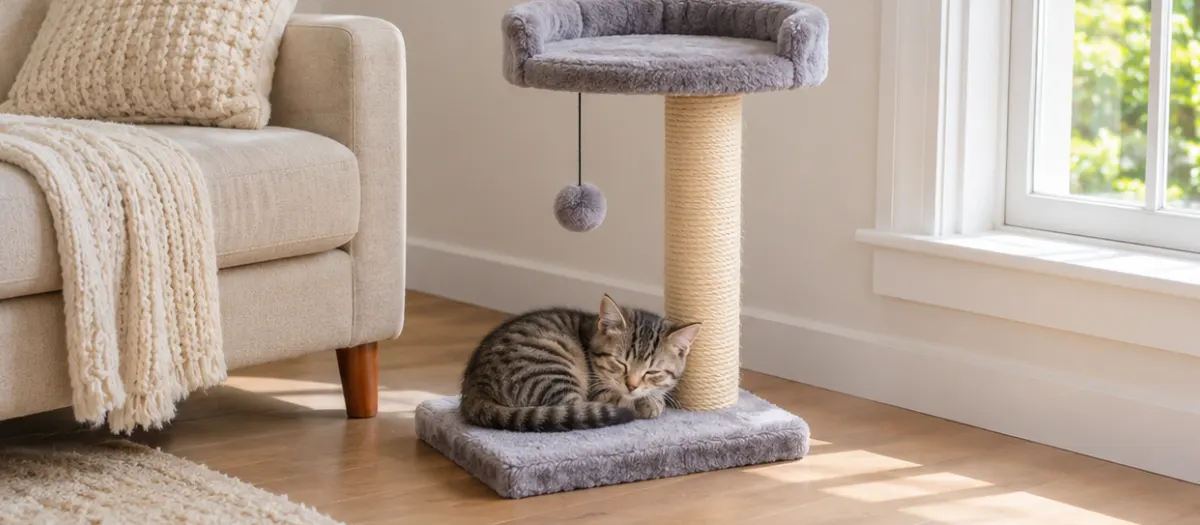
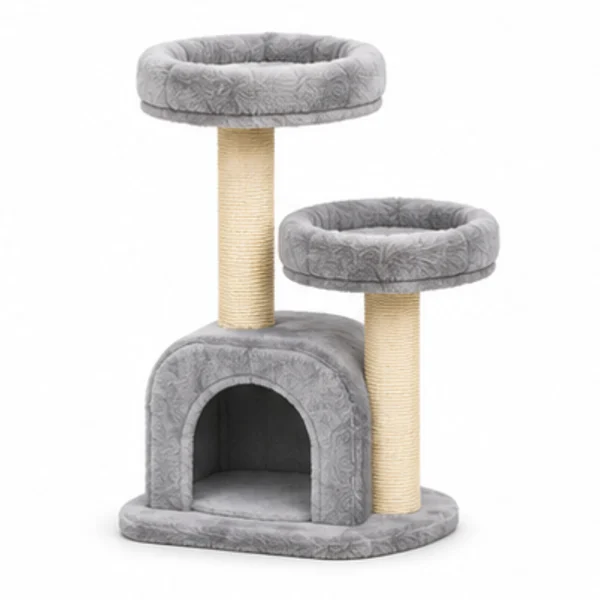
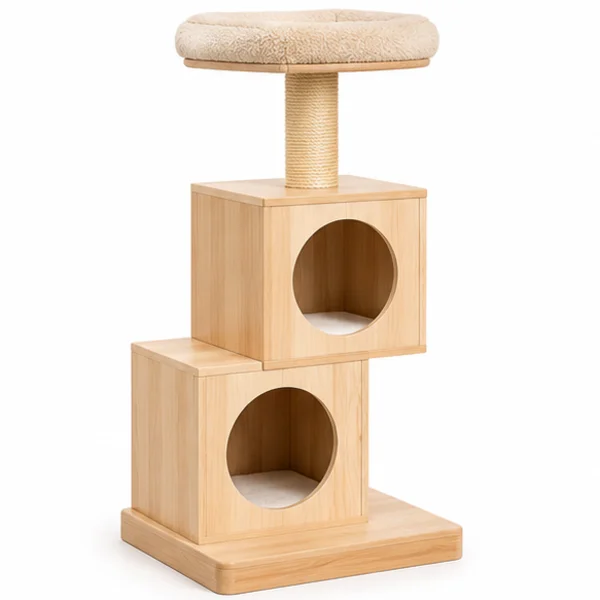
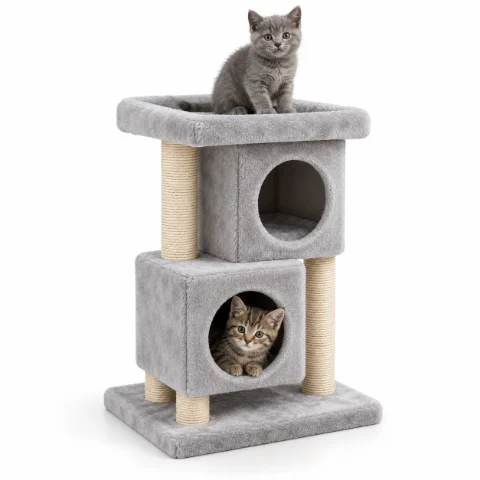
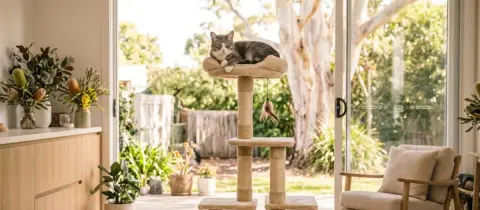
Illustration, not the actual product
Our top pickPAWZ Road 116 cm cat tree with hammock and top perch
Kittens are small, but they climb like they've been shot out of a cannon, and they learn to go up long before they learn to come down. So a kitten's first tree needs different things from an adult's: a short first step, a base that doesn't rock when they launch off it, and nothing dangling that can tangle. This guide compares five trees on Amazon Australia by height, footprint and levels in centimetres, and shows which ones suit a kitten now and which will still work when they've grown. If the tree you already have is being ignored, see our guide on why a cat won't use the cat tree. Our cat tree guide covers every size, including a low Feandrea tree with two caves that we haven't repeated here.
Quick picks
Our top pickBest overall
PAWZ Road 116 cm cat tree with hammock and top perch
Five levels, with a hammock and perch big enough for an adult cat
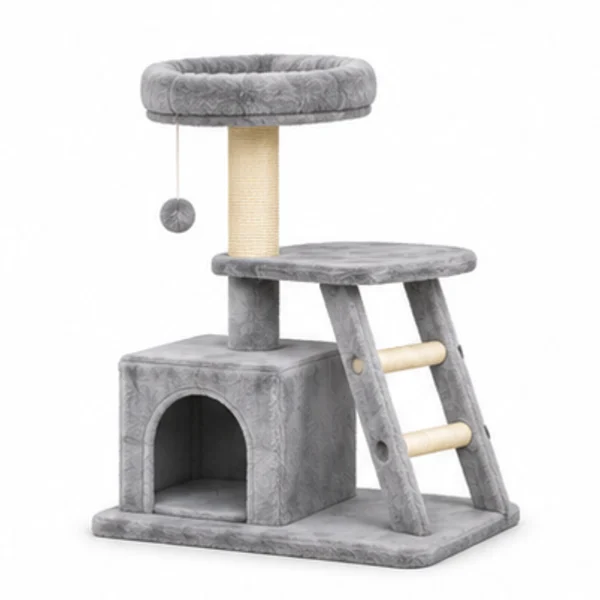
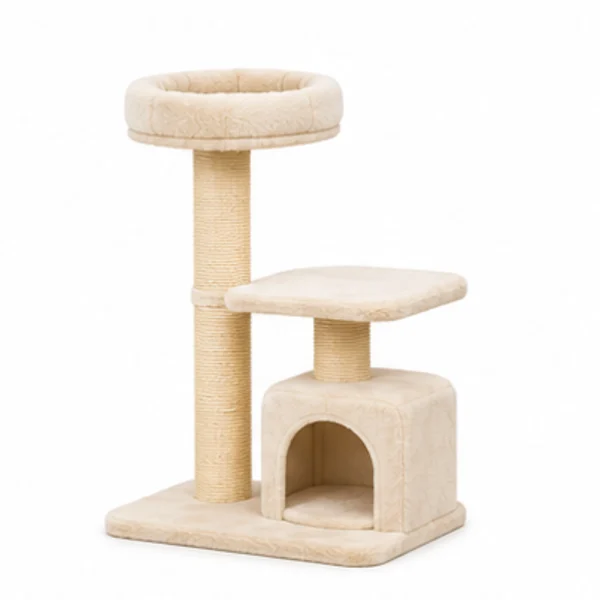
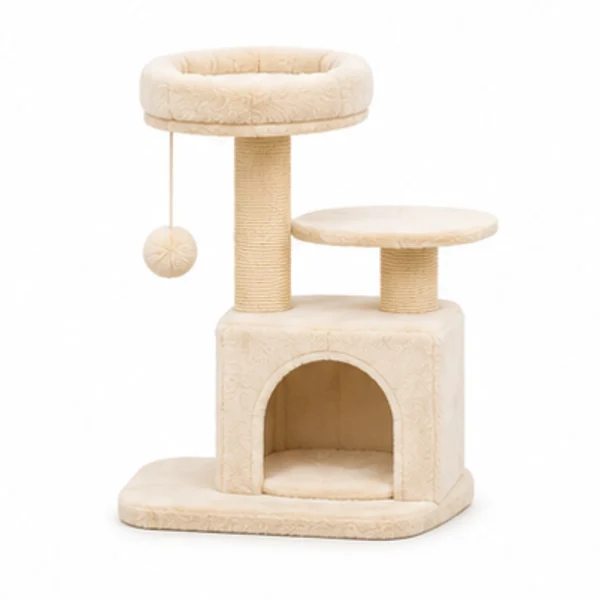
Pictures are illustrations, not the actual products.
What makes a good cat tree for a kitten?
A good kitten tree is low enough to climb without a big jump, wide enough that it doesn't rock, and made so a kitten can get down again easily. The RSPCA Australia suggests at least three resting or hiding places per cat in separate locations, including an elevated perch and an elevated hideaway (RSPCA Australia, "How should I look after my new kitten?", updated 23 September 2024, page read 19 November 2026). A tree can supply two of those at once.
What to check on a listing:
Height. A kitten tree doesn't need to be tall. Here the range is 44 to 116 cm.
Footprint against height. A wider base resists rocking. The ACCC says that securing furniture to a wall or floor is the best way to stop it tipping, and that a low-set or broad-based piece is safer (ACCC Product Safety, "Toppling furniture and televisions guide", page read 19 November 2026). It's written for furniture, and the same logic applies to a tree a kitten launches itself at.
Closely spaced levels. Kittens learn to go up before they learn to come down, so a tree with close steps lets them stop and think.
Washable parts. Kittens have accidents. Removable cushions are a real help.
Loose toys and cords. More on these below.
No vet source gives an age when a kitten can use a tree, or a platform gap in centimetres. Most kittens are climbing confidently by the time they come home at 8 weeks or older, and the gaps in our table are simply what the listings let us work out.
Kitten cat trees compared
Specs from each Amazon Australia listing, checked on 19 November 2026. "Not stated" means the listing doesn't say. None of the five gives a weight limit.
Swipe sideways to see every column
Tree
Footprint
Height
Levels and gaps
Weight limit
PAWZ Road 116 cm
45 x 41 cm
116 cm
5 levels; about 23 cm of height per level on average (our arithmetic)
Not stated
Heybly 100 cm
40 x 30 cm
100 cm
Gaps not stated; two hammocks at different heights
Not stated
SYANDLVY 66 cm
41 x 31 cm
66 cm
Gaps not stated; basket and top perch
Not stated
TWDEPART 44 cm
48 x 39 cm
44 cm
Low top platform only
Not stated
PAWZ Road 89 cm
48 x 44 cm
89 cm
Ground-floor condo, upper condo, ramp
Not stated
Beds, toys and washing:
Swipe sideways to see every column
Tree
Beds and sizes
Hanging toys
Washable parts
PAWZ Road 116 cm
Hammock 45 x 40 cm; top perch 48 x 30 cm
None listed
Cushions
Heybly 100 cm
Cave with two doorways; large top platform (size not stated)
Cat toys included (type not stated)
Not stated
SYANDLVY 66 cm
Basket lounger (size not stated)
One hanging ball
Cushions
TWDEPART 44 cm
Soft top platform (size not stated)
Spring and hanging balls
Not stated
PAWZ Road 89 cm
Extra-large top perch with raised rim (size not stated)
Detachable dangling ball
Top perch cover and mat
Where a size isn't in the text above, check the size chart on the listing.
Our picks in detail
1. PAWZ Road 116 cm cat tree with hammock and top perch: best overall
The tree a kitten grows into. The listing gives 45 x 41 x 116 cm, five levels, a hammock of 45 x 40 cm and a top perch of 48 x 30 cm, both big enough for an adult cat. It has sisal-covered scratching posts and removable, washable plush cushions, and the listing describes a metal frame. The material is engineered wood, polyester and sisal. No weight limit is stated.
Pros: the only pick with stated hammock and perch sizes; five levels give a young climber places to stop; washable cushions; grows with the cat
Cons: no weight limit stated; the top is high for a very young kitten; gaps between levels aren't in the listing
Best for: a kitten from about the time they're confident climbing, and a home that wants one tree to last
Skip it if: your kitten is under about 12 weeks and still learning to come down. Start with pick 3 or 4 and keep this for later.
2. Heybly 100 cm small cat tree with cave and two hammocks: best for two kittens
Two hammocks at different heights and a nest with two doorways, so neither kitten gets cornered. That matches the VCA advice on safe places with more than one entrance. The listing gives 40 x 30 x 100 cm and 6.5 kg, a large plush top platform, sisal posts and a reinforced base, in smoke grey, light grey, beige or beige-brown. The listing says toys are included but doesn't say what type, so check the cord on them as explained on this page.
Pros: two-door cave; two hammocks at different heights; plush top platform
Cons: imported, so check the delivery details on Amazon before you order; the 40 x 30 cm base is narrow for 100 cm, so stand it against a wall or in a corner; the listing says the manual may not be in English; no weight limit stated
Best for: two kittens, or a kitten and a young cat
Skip it if: you have no wall to stand it against
3. SYANDLVY 66 cm small cat tree with basket: best first tree for a young kitten
The lowest full tree here, with a basket a kitten can nap in. The details panel gives 41.1 x 31 x 66 cm (the listing's inch figures differ slightly, so we use the cm). The listing says the frame is P2-grade particle board with strengthened base plates, with two sisal-rope posts, a basket lounger, a top perch and a hanging ball. The cushions are removable and washable, and the veneered surfaces wipe clean. Its 75 cm sibling with a cave is a pick in our modern cat tree guide (ASIN B0DRVY1WGW).
Pros: the lowest full tree here; basket to nap in; removable washable cushions; small footprint
Cons: imported, so check the delivery details on Amazon before you order; a kitten will outgrow it as they reach adult size; hanging ball needs supervision; no weight limit stated
Best for: an 8 to 12 week kitten and a small flat
Skip it if: you want one tree for life
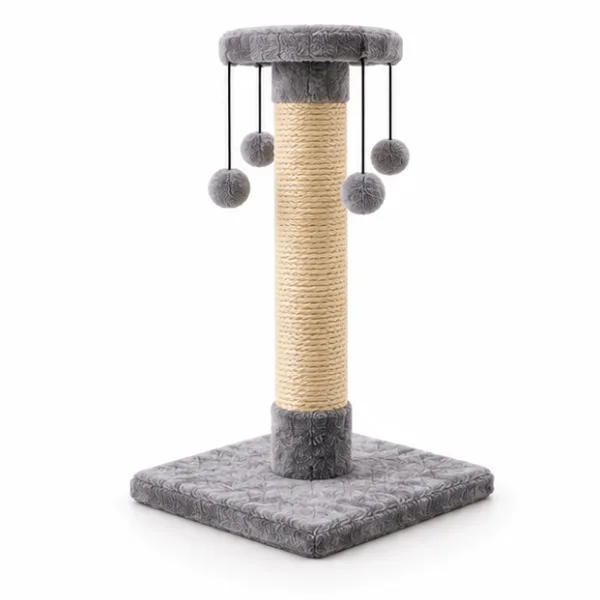
4. TWDEPART 44 cm activity centre with spring and hanging balls: best play centre
A play station rather than a lookout. The listing gives 48 x 39 x 44 cm, with sisal scratching surfaces, spring-mounted and hanging balls, and a soft top platform. It's light and easy to move, and the listing says to place it against a wall for stability.
Pros: built around play; low enough for the smallest kitten; easy to move
Cons: the balls hang on cords, so play must be supervised and the cord checked (see the cord checklist on this page); a play station, not a lookout, so pair it with pick 1 later; no weight limit stated
Best for: a toy-mad kitten in a small space
Skip it if: you want a bed or somewhere to hide, or your kitten chews cords
5. PAWZ Road 89 cm modern cat tower with dual condos: best for a kitten joining an older cat
The listing says the ground-floor condo needs no steps and suits both young kittens and older cats. The tower measures 48 x 44 x 89 cm, with an upper condo, an extra-large top perch with a raised rim, a sisal-wrapped post and a sisal-covered ramp. A wall security strap is included. The top perch cover and mat are removable and machine washable, and the dangling ball is detachable, with a spare. It's the top pick in our modern cat tree guide, which has the full write-up.
Pros: ramp and no-step condo; wall strap; washable top perch cover and mat; wide footprint for its height
Cons: dangling ball needs supervision; heavier and bigger than a kitten-sized tree; no weight limit stated
Best for: a kitten that shares a home with an older cat
Skip it if: you only want a kitten-sized tree
Choose by situation
Swipe sideways to see every column
Your situation
What to look for
Our pick
Kitten of 8 to 12 weeks
Lowest steps, a nap spot close to the floor
Pick 3, SYANDLVY 66 cm
Two kittens
Two exits and two beds so neither is cornered
Pick 2, Heybly 100 cm
Kitten joining an older cat
A no-step condo and a ramp for both ages
Pick 5, PAWZ Road 89 cm
Small flat
Small footprint
Pick 3 or 4 (41 x 31 cm or 48 x 39 cm)
Kitten who climbs everything
Something taller and wider to climb
Pick 1, PAWZ Road 116 cm
Kitten who loves chasing toys
A play centre they can bat things on
Pick 4, TWDEPART 44 cm
One tree for life
Bed sizes an adult cat can use
Pick 1
Tight budget for the first six months
A small tree you'll outgrow
Pick 3 or 4
How do I plan a kitten's first tree and the one after it?
When your kitten outgrows it, which can come sooner than you'd think. Plan a first tree and a bigger one later, or start with pick 1 and use it from the day the kitten stops needing a low first step. Two signs it's time to upgrade:
The kitten jumps straight to the top. If they skip every level, the tree no longer challenges them.
The tree looks cramped or wobbles under them. If the kitten can't turn round in the bed or the frame sways, move up.
Let them work it out, with low steps and your encouragement. Don't pick the kitten up and place it on the tree, and don't punish them if they avoid it, because Merck says punishment can make a cat afraid of its owner (Merck Veterinary Manual, "Behavior Problems in Cats", updated April 2026).
Supervise play with any hanging ball or spring toy.
Check the cord and ball every few days.
Remove the ball if the cord is frayed or your kitten chews it.
Take off or tuck away anything dangling when you leave the house.
Never leave string or ribbon on or near the tree.
Three of these five trees (picks 3, 4 and 5) have a hanging or dangling ball. Our kitten toys guide lists safer options.
Which tree suits a kitten joining an older cat?
Yes, if the tree gives both of them somewhere to retreat. VCA says that in multi-cat homes, safe places should have more than one entrance so one cat can't trap another, and that resources should be in separate locations (VCA Animal Hospitals, "Environmental needs of young cats").
Tighten every bolt, stand it on a hard level floor against a wall, use the anchor strap into a wall stud, and replace a tree that still rocks. Those steps are the same for any tree, and they matter more for a kitten because a kitten launches off a tree rather than stepping down. In order:
Tighten every bolt.
Stand the tree on a hard, level floor against a wall.
Use the anchor strap into a wall stud, where one is included. If it isn't, the ACCC says to buy an anchor kit. Renters should ask the landlord or agent first.
Replace a tree that still rocks.
The ACCC notes that children climbing on furniture cause many tip-overs, and a kitten is a small climber too (ACCC Product Safety, "Toppling furniture and televisions guide"). Only pick 5 lists a wall strap, and pick 4's listing says to place it against a wall. For the others, check the instructions. No listing says a tree is tip-proof, and nor do we.
How we chose
We searched Amazon Australia for kitten and small cat trees and shortlisted trees that met all of these checks:
Well rated: a strong average rating with plenty of buyer reviews.
No red flags: no pattern of poor reviews, safety complaints or listing problems.
Available on Amazon Australia when we checked.
Height of 116 cm or under, with a footprint in the listing, so a kitten can reach the first level.
A scratching surface on the tree itself.
Sizes in the listing, so you can match them to your space in centimetres.
These are researched picks, not products we've personally tested. We compared the specifications and features on each Amazon Australia listing, checked on 19 November 2026. We didn't accept payment from any brand.
Left out this time: a 2-level PVC-frame tower whose listing contradicts its own size panel and which looks too light for a kitten that launches off it; a 40 inch palm tree post, which is a post rather than a tree (see our tall cat scratching post guide); a 170 cm slim tower, which is adult height (see our modern cat tree guide); and the floor-to-ceiling and 205 cm trees, which suit cats that can already come down (see tall cat trees).
Where else can you buy a cat tree?
Pet shops and some vet clinics sell cat trees and scratching posts, and you can check the stability and height in person. Compare the footprint and height in centimetres against the tables above.
When to see a vet
See a vet soon if your kitten limps after a fall, cries when picked up, or goes off their food after a tumble from a tree. Book a vet check as the RSPCA suggests, soon after bringing a kitten home, and ask about desexing and vaccination timing.
Call a vet straight away if your kitten has chewed or swallowed a cord, string or part of a toy, or is vomiting, off their food or lethargic. An intestinal blockage can be fatal. If your kitten has chewed a plant and you're unsure it's safe, call the Animal Poisons Helpline on 1300 869 738 (24/7). See our lily guide.
Frequently asked questions
When can a kitten start using a cat tree?
Most kittens are climbing confidently by the time they come home at 8 weeks or older. No vet source gives a set age. Start with a low tree with close levels, because kittens learn to climb up before they learn to come down, and watch how your kitten copes.
How high should a cat tree be for a kitten?
Low to start with. A tree of 44 to 66 cm suits a young kitten, and one of around 100 to 116 cm suits a confident climber. No source gives a standard height, so match it to your kitten's size and your wall space, and make sure they can get down easily.
Do kittens need a cat tree or just a scratching post?
A post is enough to start, but a tree adds somewhere to perch and rest. The RSPCA suggests at least three scratching surfaces in different materials, plus elevated resting places. See our kitten scratching post guide for posts and cardboard scratchers.
Can a kitten share a cat tree with my adult cat?
Yes, if there's somewhere for each cat to go. Choose a tree with more than one level or entrance, so neither can block the other, and keep a second perch or tree elsewhere. A ramp or no-step condo helps a young kitten and an older cat alike.
Why does my kitten climb the curtains instead of the cat tree?
Curtains are tall, textured and close to the action. Put the tree by the window where they climb, play with a wand toy around the base, and offer a post nearby. A tree gives an outlet but won't stop curtain climbing alone. See our guide to stopping a cat scratching furniture.
Is it safe to leave a kitten alone with a cat tree?
A tree with no loose parts is lower risk, but anything on a cord or spring is only for supervised play. Remove balls and toys with string or small detachable parts when you're out, as VCA advises, and check the tree for loose bolts and frayed rope each month.
When should I replace a kitten cat tree with an adult one?
When your kitten jumps straight to the top, can't turn round in the bed, or the frame sways under them. Then move up to a sturdier, taller tree, as in our wooden cat trees or cat trees for large cats guides, and keep the small tree as a second resting spot.
Product details from each linked Amazon Australia listing, checked on 19 November 2026.
This guide provides general information and isn't a substitute for veterinary advice. If you're concerned about your kitten's health or behaviour, speak with your vet.