Best cat trees for large cats: sturdy picks sized for Maine Coons
By Anish PuriUpdated 18 Nov 202617 min readResearched, not tested by us
Research guide. WhiskerFinds may earn a commission from links, at no extra cost to you.
Quick answer: The best cat tree for large cats is one with a wide base, big perches and posts you can fix to a wall. Our best overall pick is the PAWZ Road 150 cm solid-wood tree: 60 x 56 cm base, 8.9 cm posts, and the only listing here that states both a per-cat limit and a total (12 kg each, 68 kg in all).
A big cat needs different things from a tree than a small one does. The perch has to be wide enough to lie on stretched out, the condo has to be a place a heavy cat can actually turn around in, and the base has to be wide enough that a running leap doesn't rock the whole thing. Headline height tells you very little about any of that.
This guide compares six trees on Amazon Australia by base, perch, condo and hammock sizes in centimetres, plus the weight limits the listings give (and the many they don't). If you want a general-purpose tree, our cat trees guide covers the whole range by cat size. Here, we only look at the big end.
Quick picks
Our top pickBest overall
PAWZ Road Solid Cat Tree, 150 cm
Stated 12 kg per cat limit, 60 x 56 cm base, solid 8.9 cm posts
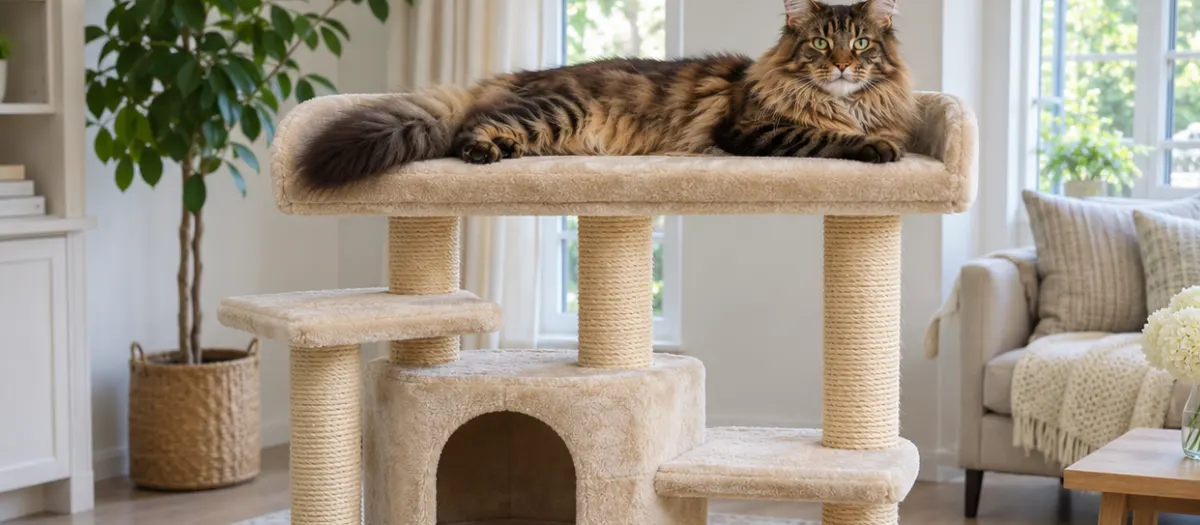
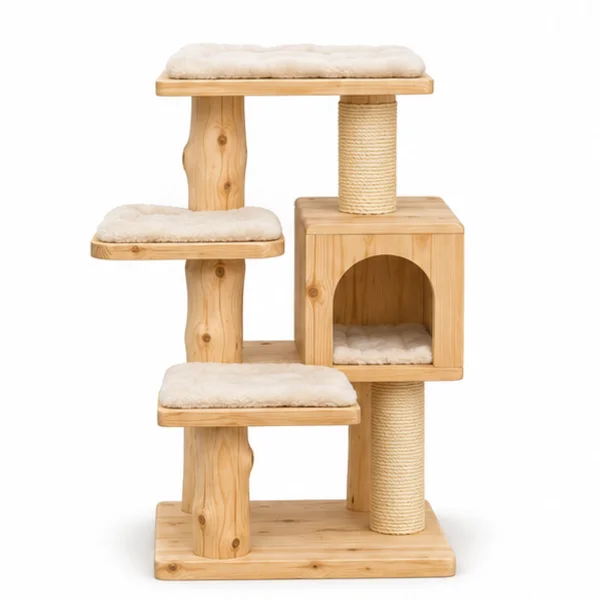
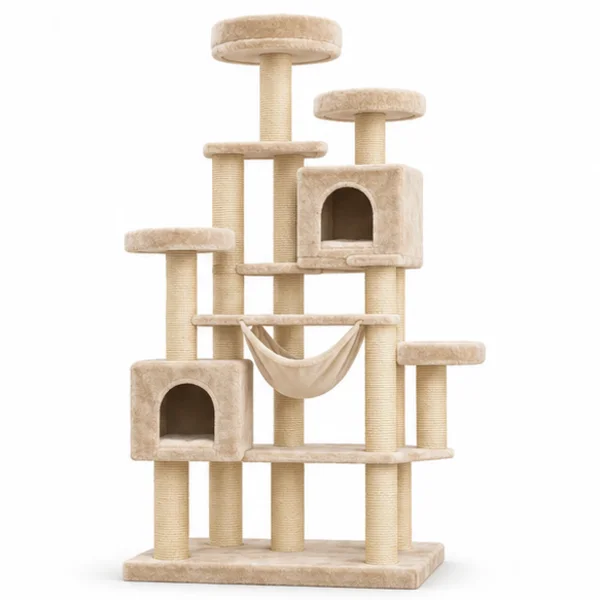
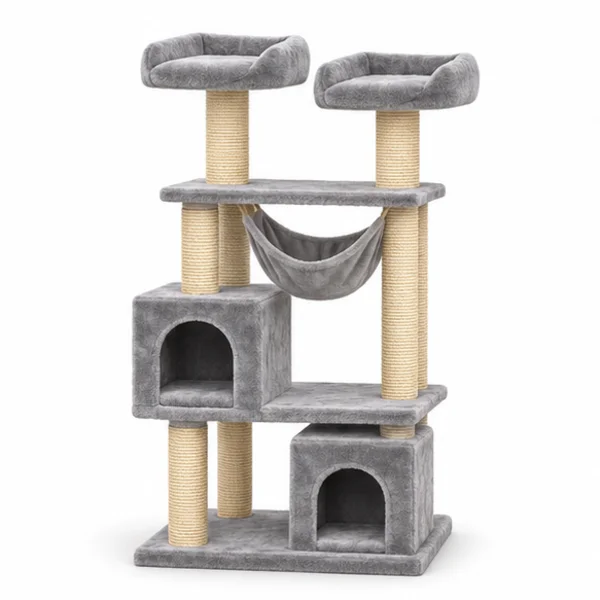
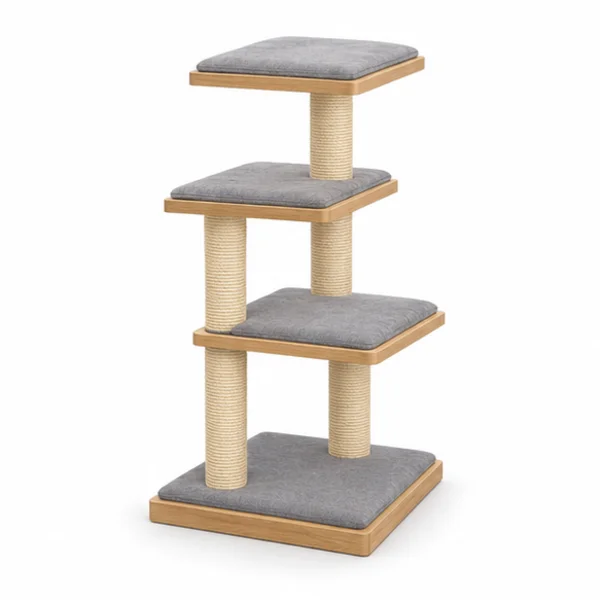
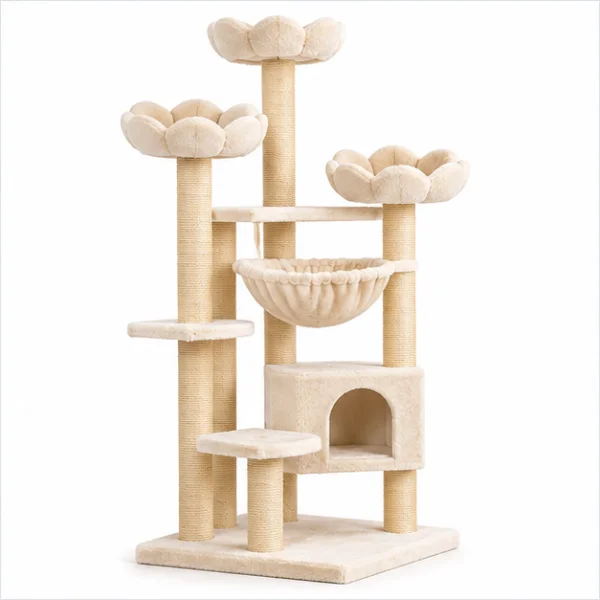
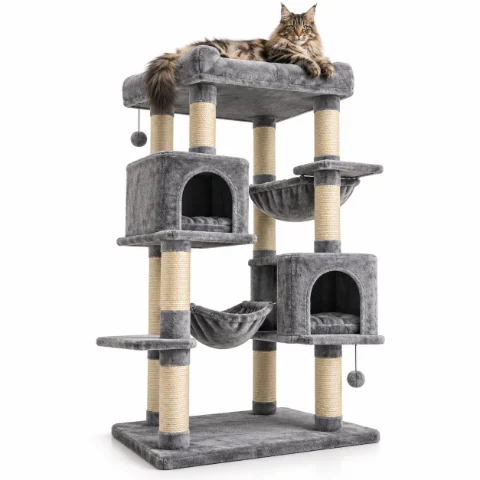
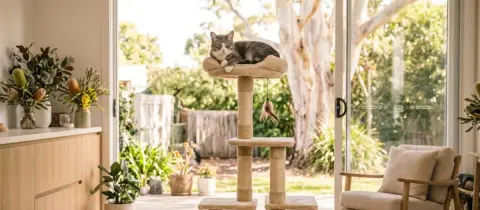
Pictures are illustrations, not the actual products.
Does a large cat need a special cat tree?
Usually, yes. Many standard trees have narrow perches and small bases, and a heavy cat soon outgrows them. The RSPCA says a scratching post should let your cat stretch fully and be sturdy enough to lean against, and VCA Animal Hospitals adds that it should be sturdy enough not to topple. Both points matter more as the cat gets bigger.
Check five things in this order: the base in cm, the perch and condo sizes in cm, any stated weight limit, the material field, and what the listing says about fixing the tree to a wall. Skip anything that only gives a height and the word "sturdy".
Base size. A wider base resists tipping. We show the base as a share of height for each tree. That is our own calculation from the listed measurements, not an industry rule.
Perch and condo size. Listings often give the condo but not the perch, or the reverse. Where a size is only in a listing image, check the size chart on the listing.
Weight limit. Only two of the six listings give one. For the rest we write "not listed" and don't guess.
Post thickness and material. The listing's material field tells you what the tree is made of. We can't say from a listing whether solid wood or engineered wood is stronger, so we report the field and the post thickness where given.
Anti-tip hardware. A strap only helps if you can fix it to a wall or solid furniture.
This is the only tree here where the listing gives both a per-cat limit and a total: it says the tree is for large cats up to 12 kg each, for 4 to 5 cats, with a total capacity of up to 68 kg. It measures 60 x 56 x 150 cm, with a triple-thickened base and solid 8.9 cm posts. The listing says the wood is FSC-certified, with a pear-wood trunk wrapped in sisal, three handwoven beds, a hammock and a bottom den, covered in 500 g/m² plush. It names Maine Coons, hairless cats and multi-cat homes.
What sets it apart is that limit and the base: 60 cm wide for 150 cm of height, the second-widest ratio on the page. The listing gives no perch sizes, so check the size chart on the listing before you buy. It also comes in another finish; we link the listing we checked.
Pros: stated per-cat and total limit; wide base for its height; solid 8.9 cm posts; hammock, beds and a den
Cons: fewer resting spots than the 184 cm tree; no enclosed condo above floor level; perch sizes not listed; the plush beds will need vacuuming
Best for: one or two heavy cats, or a multi-cat home that wants a stated limit
Skip it if: you want a condo your cat can hide in up high
2. PAWZ Road 184 cm Cat Tree with Hammock and Condos: best for multi-cat homes
Eight levels, seven sisal-wrapped posts and a scratching pad at the bottom. The listing says it suits 4 to 5 big cats, with a rectangular condo of 53 x 30 x 25 cm and a hammock it calls stable and wide enough for two cats. The base is 53 x 43 cm, and the material field says engineered wood (the bullet says "solid particle board"). It also comes in grey and green, and we link the main listing.
The condo is the largest listed on the page. Base width is the catch: 53 cm for 184 cm of height is about 29%, so this tree needs to be fixed to a wall.
Pros: big condo; hammock for two; plenty of levels for several cats; bottom scratching pad
Cons: no weight limit listed; narrow base for the height; particle board rather than solid wood; no strap mentioned
Best for: a multi-cat home with a wall to fix it to
Skip it if: you can't screw into the wall
3. PAWZ Road 175 cm Multi-Level Cat Tower: best for two cats under 9 kg
A seven-level tower for adult cats up to 9 kg, per the listing, with an anti-topple strap included. Condos are 40 x 30 x 30 cm, the hammock is 47 x 39 cm, and there are two top perches of 40 x 26 cm, which the listing says stop cats fighting for the top view. The base is 55 x 45 cm, the posts are wrapped in natural sisal, and the material field says engineered wood.
Two perches at the top suit a two-cat home where one cat would otherwise guard the high spot. The perches are shallower than the 135 cm tree's, though.
Pros: stated 9 kg limit; strap included; two top perches; condo and hammock sizes given
Cons: 9 kg rules out the heaviest Maine Coons; top perches are only 26 cm deep
Best for: two medium-to-large cats under 9 kg
Skip it if: your cat weighs more than 9 kg
4. PAWZ Road 135 cm Modern Cat Tree: best low tree for a heavy cat
The shortest tree here, with the widest base for its height: 60 x 40 cm for 135 cm (about 44%, our calculation). It has four tiers about 43 cm apart (the listing says 17 inches), a padded 40 x 40 cm top perch with a removable cover, and a 40 x 35 cm condo. The listing calls it pure solid wood, and the breed field says "Big Cats". For a style-led option, see our modern cat tree guide.
This is the only listing here that states the gap between tiers, so you can judge whether about 43 cm jumps suit a heavy or older cat. If your cat is reluctant to jump, see the vet box below.
Pros: the only square top perch on the page (40 x 40 cm), so a big cat can curl up; widest base for its height; removable perch cover; the only listing that states the gap between tiers
Cons: no weight limit listed; fewer levels; no hammock
Best for: one heavy cat, a renter, or a low ceiling
Skip it if: your cat wants height more than room
5. PAWZ Road 205 cm Flower Cat Tree: best for high ceilings
The tallest tree here: 205 cm over eight levels, with a base of 60 x 49 cm, seven sisal posts and a bottom scratching pad. The material field says engineered wood. The listing calls the condo and hammock large but gives no condo measurement, so don't assume it matches the 184 cm tree's. It also comes in green.
No weight limit is listed, the base is about 29% of the height (60 x 49 cm for 205 cm), the listing doesn't give the condo size, and it doesn't mention a strap, so fixing it to the wall with your own bracket is not optional.
Pros: tall climbing for a high ceiling; same sisal-post and bottom-pad layout as the 184 cm tree
Cons: no weight limit listed; base is narrow for the height; condo size not listed
Best for: a high-ceilinged room where you can fix the top to a wall
Skip it if: you rent and can't screw into the wall
6. Heybly 193 cm Heavy Duty Cat Tree: best non-PAWZ Road option
The only tree here from a different brand, and the widest base above 180 cm: 70 x 40 cm on five posts, about 36% of its 193 cm height. The listing gives a 55 x 30 cm top perch that detaches for cleaning, an integrated anti-tip strap, two condos, a basket, a hammock and dangling pom-poms. The breed field says "Large". Our cat trees guide compares it with general-purpose trees.
"Heavy Duty" is the product name, not our claim, and no weight limit is listed. The material field includes cardboard, so don't assume the posts are solid wood. The pom-poms hang on cords: check them daily and remove them if they fray, and don't add string or ribbon toys.
Pros: widest base over 180 cm; large top perch; strap built in
Cons: material field lists cardboard; condo and hammock sizes not listed; no weight limit; pom-poms on cords
Best for: a large cat in a home with a tall ceiling and a fixing point for the strap
Skip it if: you want solid-wood posts
Cat trees for large cats compared
Specs from each Amazon Australia listing, checked on 18 Nov 2026. "Not listed" means the listing doesn't say. Sizes are in cm; one tier gap is converted from inches.
Swipe sideways to see every column
Tree
Height
Base
Top perch
Condo
Hammock
Material (listing field)
PAWZ Road 150 cm solid
150 cm
60 x 56 cm
Not listed
Bottom den, size not listed
Yes, size not listed
Sisal, wood
PAWZ Road 184 cm
184 cm
53 x 43 cm
Not listed
53 x 30 x 25 cm
"Super large", size not listed
Engineered wood
PAWZ Road 175 cm
175 cm
55 x 45 cm
Two perches, 40 x 26 cm each
40 x 30 x 30 cm (multiple)
47 x 39 cm
Engineered wood
PAWZ Road 135 cm
135 cm
60 x 40 cm
40 x 40 cm, removable cover
40 x 35 cm
None listed
Faux fur, sisal, wood
PAWZ Road 205 cm
205 cm
60 x 49 cm
Not listed
Not listed
"Super large", size not listed
Engineered wood
Heybly 193 cm
193 cm
70 x 40 cm
55 x 30 cm, detachable
Two condos, sizes not listed
One, size not listed
Cardboard, faux fur, sisal
Measured fit: your cat against each perch and condo
Measure your cat before you pick: lay a tape from nose to the base of the tail while the cat is stretched out (asleep is easiest), and note their weight from the vet. A perch shorter than the body isn't wrong, since cats drape over edges, but the more of the body it holds, the more likely it gets used for a full nap.
Swipe sideways to see every column
Space
Biggest size listed
What to check
Top perch
55 x 30 cm (Heybly), 40 x 40 cm (135 cm tree), 40 x 26 cm (175 cm tree)
The 135 cm tree is square, so a cat can curl up; the Heybly is long but shallow
Condo
53 x 30 x 25 cm (184 cm tree)
The 25 cm height is low for a very bulky cat; 30 cm is the next best (175 cm tree)
Hammock
47 x 39 cm (175 cm tree)
Only one listing gives a hammock size; the others give none
Base
70 x 40 cm (Heybly), 60 x 56 cm (150 cm tree)
The wider the base in both directions, the harder to tip
The listing for the 184 cm tree names Maine Coons and Ragdolls "between 7 and 9 kg" as suited to its condo, and the 205 cm listing says the same. That is each listing's own suitability claim, not a weight range for the breeds. Measure your cat rather than trusting a breed name.
Does a tree's base width really matter?
Yes, and it varies more than the headline height suggests. Tall trees with narrow bases lean easily, and a heavy cat landing on a high perch is exactly the kind of load that finds the weak point. VCA's advice is that a post should be stable enough not to tip over, and we use base width to compare that across trees.
Swipe sideways to see every column
Tree
Height
Base (cm)
Base as share of height (our calculation)
Stated limit
Strap or anchor supplied
PAWZ Road 135 cm
135 cm
60 x 40
About 44%
Not listed
Not mentioned in the listing
PAWZ Road 150 cm
150 cm
60 x 56
About 40%
12 kg per cat, 68 kg total
Not mentioned in the listing
Heybly 193 cm
193 cm
70 x 40
About 36%
Not listed
Integrated anti-tip strap
PAWZ Road 175 cm
175 cm
55 x 45
About 31%
Up to 9 kg per cat
Anti-topple strap
PAWZ Road 205 cm
205 cm
60 x 49
About 29%
Not listed
Not mentioned in the listing
PAWZ Road 184 cm
184 cm
53 x 43
About 29%
Not listed
Not mentioned in the listing
No listing can promise a tree won't tip, so we say "stable when anchored" and judge the base and the strap. Where a listing doesn't mention a strap, plan to fix the tree with your own bracket (see the anchoring section).
How we chose
We searched Amazon Australia for cat trees made for large cats and shortlisted trees that met all of these checks:
Well rated: a strong average rating with plenty of buyer reviews.
No red flags: no pattern of poor reviews, safety complaints or listing problems.
Available on Amazon Australia when we checked.
Base and height in cm on the listing, with perch, condo or hammock sizes where the listing gives them, so you can compare them with your own cat; where a size isn't listed we say so.
Sized or labelled for large cats in the listing, not just a general-purpose tree with a bigger number.
These are researched picks, not products we've personally tested. We compared the specifications and features on each Amazon Australia listing, checked on 18 Nov 2026. We didn't accept payment from any brand.
Left out this time: four floor-to-ceiling tension-rod towers (two say on their own listings that they suit kittens and small to medium cats and that cats over about 9 kg may be too heavy for the top post; the other two have 40 x 24 cm and 60 x 40 cm bases for 275 to 285 cm of height), a 143 cm wooden tree with no large-cat sizing or limit, and a slim imported tower used on our modern cat tree guide instead.
Choose by situation
Swipe sideways to see every column
Your situation
What to look for
Our pick
One heavy cat
Stated limit, wide base
Pick 1, 150 cm (12 kg per cat listed)
Two or more big cats
Several perches and a stated total limit
Pick 1, 150 cm (68 kg total), or pick 6, 193 cm, for more height
Two medium cats under 9 kg
Two top perches
Pick 3, 175 cm
Low ceiling
Short tiers, widest base
Pick 4, 135 cm
Renter who can't screw into the wall
Widest base for the height
Pick 4 (44%) or pick 1 (40%), never picks 2 or 5
High ceiling, can anchor
Maximum height
Pick 6 (193 cm), or pick 5 (205 cm)
Older heavy cat who jumps less
A low tree with a stated tier gap, plus a vet check
Pick 4, 135 cm (about 43 cm between tiers), and the vet box below
Where should you put it, and how do you anchor it?
Put it beside the furniture your cat already scratches or near where they sleep. VCA suggests a post close to the cat's sleeping quarters and posts in several places where the cat spends time, and the RSPCA says to provide at least one post per cat in a multi-cat home. Our scratching furniture guide goes further on placement.
Fix tall trees to the wall with the supplied strap, into a stud or with a wall anchor suited to your wall type. Where there's no strap, a bracket and a screw into the frame do the same job. In a rental, ask first, or choose a low, wide tree like pick 4 or 1 and place it in a corner. Our cat wall shelves guide has more on safe fixing.
A few other habits help:
Air it first. New wood, glue and plush can smell. Let the parts sit open in a ventilated room before assembly; that is our general advice, not a listing claim.
Tighten the screws after a week or so, then every month.
Check cords. If your tree ships with a ball on a cord, check it daily and remove it if it frays. Never leave string, ribbon or dangling toys on it.
Pet shops and some vet clinics stock cat trees, though large-cat sizes can be harder to find in store. Take your cat's length and weight with you, and check the base size in centimetres on the label.
When to see a vet
See your vet if your cat becomes reluctant to jump up or down, jumps less often, stops using the tree, or seems sore after climbing. International Cat Care lists reluctance, hesitance or refusal to jump as a sign of arthritis, which a vet can work out, and suggests a series of steps or a ramp to reach high places. See our cat steps guide.
Also call your vet if your cat limps after a fall, has a sore or torn claw, or has chewed or swallowed part of a toy or cord. A tree is a tool for exercise and rest, not a treatment.
Frequently asked questions
How tall should a cat tree be for a Maine Coon?
Height matters less than the base and perches. Maine Coons are big, so look for one of the wider bases on this page (55 to 70 cm on the longer side) and a perch your cat can sprawl across, not just a tall tree. The trees here run from 135 to 205 cm. Check the size chart on each listing, and measure your cat first.
How much weight can a cat tree hold?
Most listings don't say. Of the six here, only two give a limit: the 150 cm PAWZ Road lists up to 12 kg per cat and 68 kg in total, and the 175 cm lists adult cats up to 9 kg. For the others we say "not listed". Use the base width and a wall fixing to judge stability.
What size perch does a large cat need?
Big enough for the cat to lie on without hanging off. The widest top perch here is 40 x 40 cm (the 135 cm tree) and the longest is 55 x 30 cm (the Heybly). Measure your cat from nose to tail base while stretched out, and pick the perch that holds the most of that.
How do I stop a cat tree wobbling?
Check the base is flat and tighten every screw, then fix the top to a wall with the supplied strap or your own bracket. Wobble often means one loose bolt or an uneven floor. If it still moves, a wider base helps more than extra weight.
Are floor-to-ceiling cat trees suitable for big cats?
Often not. Two of the tension towers we looked at say on their own listings that they are for kittens and small to medium cats, and that cats over about 9 kg (the listing says 20 lb) may be too heavy for the top post. All four have small bases for their height. A freestanding tree with a wide base suits a big cat better. We compare the tension-pole trees and their stated weight notes in tall cat trees.
Can I anchor a cat tree if I rent?
Ask your landlord first, since a strap needs a screw into the wall. If that isn't possible, choose the widest, lowest tree, like the 135 cm or the 150 cm one, and put it in a corner away from doorways. Avoid the 184 cm and 205 cm trees, which have narrow bases for their height.
Is a hammock strong enough for a heavy cat?
Only the 184, 205 and 175 cm listings say anything about hammock size or capacity: the first two say the hammock is wide enough for two cats, and the 175 cm one gives 47 x 39 cm. The 150 cm tree and the Heybly list a hammock but give no size. These are maker claims, so watch how your cat uses it and stop if the stitching looks strained.
My older big cat has stopped climbing. Is that normal?
It can happen, but it's worth a vet visit. Reluctance to jump up or down is one of the signs International Cat Care lists for arthritis, and a vet can work out what's going on. A lower tree, or steps and a ramp, can help while you wait for advice. Our guide to why a cat won't use the cat tree covers sore joints alongside placement and wobble.
Product details from each linked Amazon Australia listing, checked on 18 Nov 2026.
This guide provides general information and isn't a substitute for veterinary advice. If you're concerned about your cat's comfort, joints or behaviour, speak with your vet.