Research guide. WhiskerFinds may earn a commission from links, at no extra cost to you.
Quick answer: Cat wall shelves can be safe when they're fixed into wall studs or masonry with fixings suited to the load, and sit within the weight limit. Our top pick is the COOLEX 3-in-1 climbing wall steps, a three-step set the listing says holds at least 11 kg per step. Check the maker's instructions first.
Cat wall shelves and climbing walls give an indoor cat height, a scratching surface and a place to watch the room without taking up floor space. This guide compares four wall products on Amazon Australia, then covers mounting, layout and older cats. If you have the floor space, our cat tree guide covers freestanding towers, and our window hammock guide covers a sunny perch with no drilling.
Quick picks
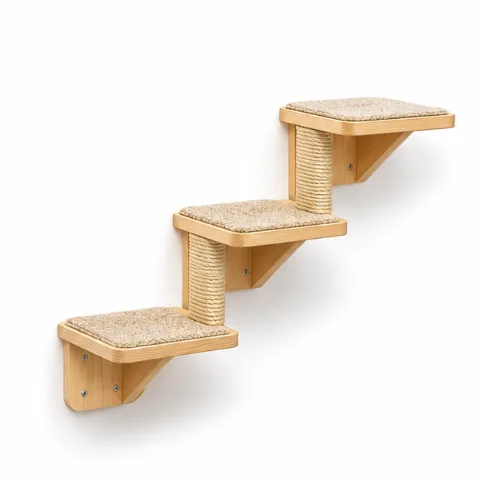
COOLEX 3-in-1 Cat Climbing Wall Steps with Hemp Rope
Three wooden steps with hemp rope, metal brackets and pre-drilled holes; the listing says each step holds at least 11 kg (25 lb)
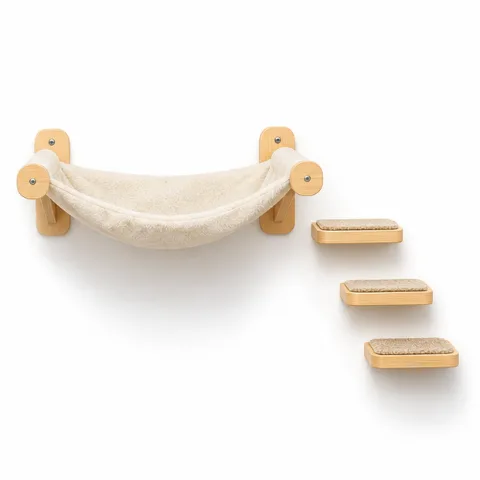
Wuudi Wall Mounted Cat Hammock with 3 Steps
Felt-covered platform with a fence and three steps, listed at 50 x 30 x 11 cm and 2.3 kg
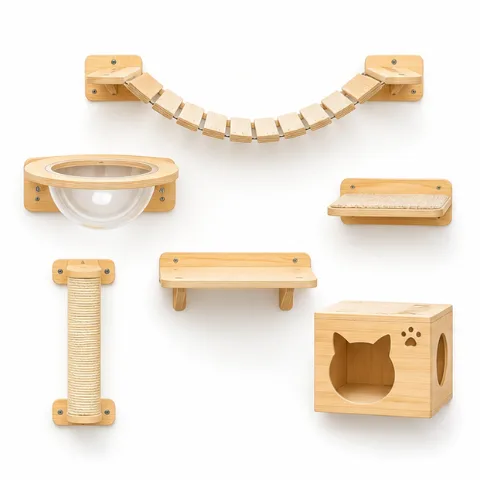
TRIXIE Cat Wall Furniture Set 1
Sisal-wrapped post 117 cm tall plus a perch, hardware and manual included, listed for cats up to 5.4 kg (12 lb)
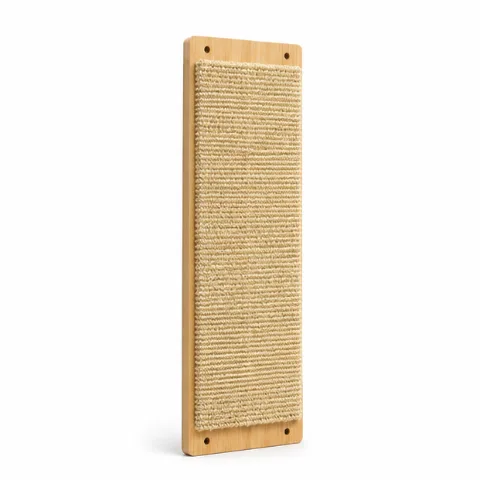
xympo Wall Mounted Cat Scratcher, Sisal
Three sisal sections on two aluminium brackets, listed at 85.6 cm tall, with drywall anchors and screws included
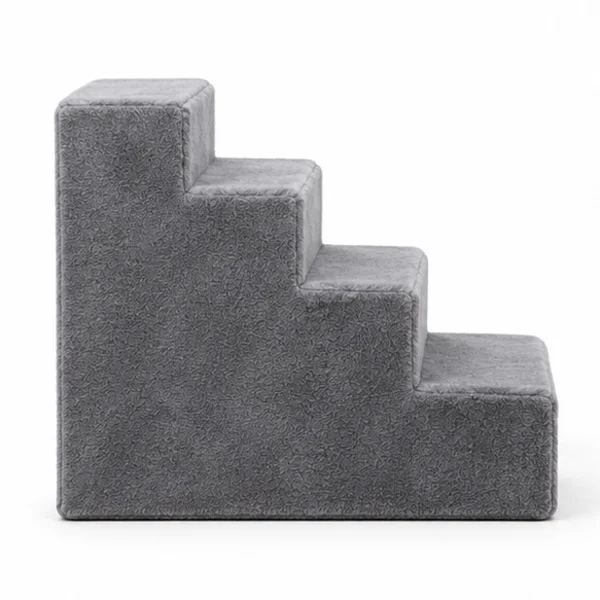
Feandrea 4-step foam stairs, 72 x 40 x 50 cm
Low steps give an older or stiff cat an easier way up to a bed or sofa.
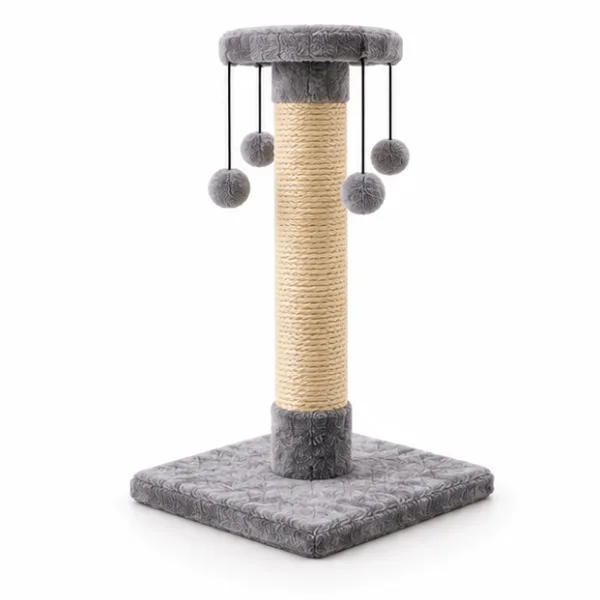
Dimaka 74 cm sisal scratching post
A floor-standing post near the base of your wall set, so the wall isn't the only scratching option.
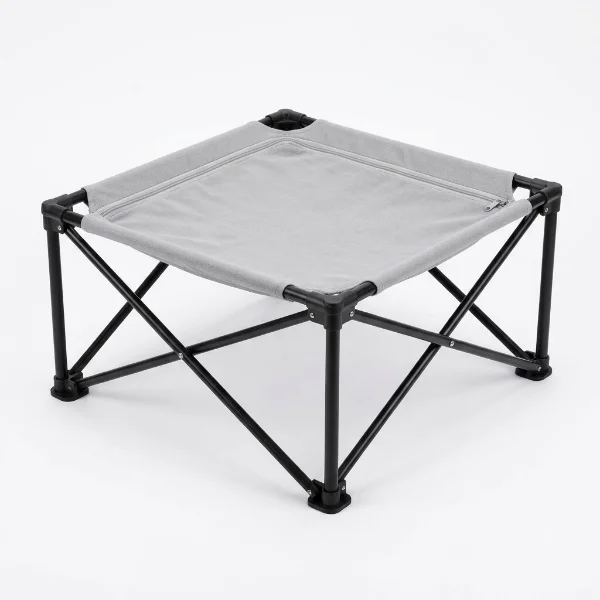
GUUSII raised cat hammock bed, 64 x 40 x 19 cm
A raised bed for a renter who can't drill, or as an extra lookout.
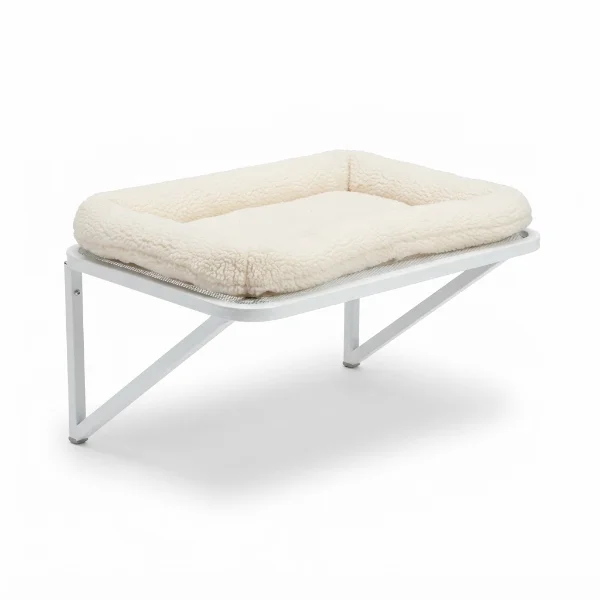
Zakkart metal window perch
A lookout at the window to go with the wall set, so your cat has more than one high spot.
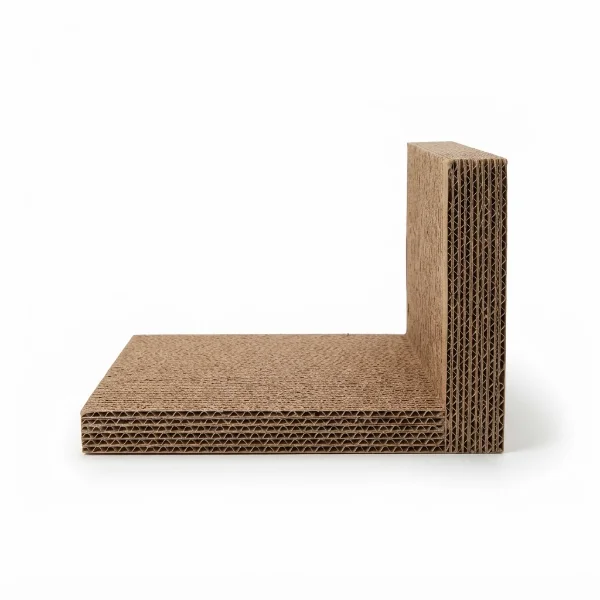
FUKUMARU L-Shape Cat Scratcher
A cardboard scratcher on the floor beneath the shelves, so the wall set isn't the only scratching spot.
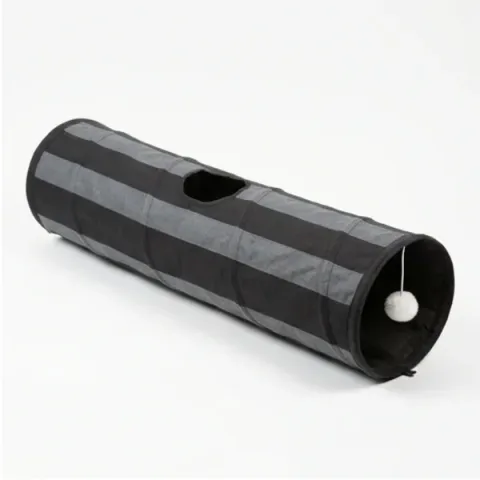
lionto Cat Tunnel, 30 x 130 cm
A folding play tunnel for floor games between climbs.
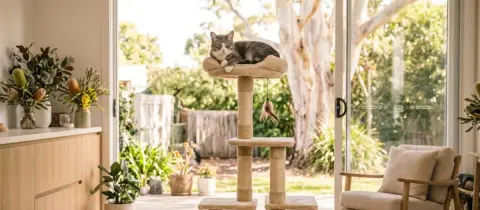
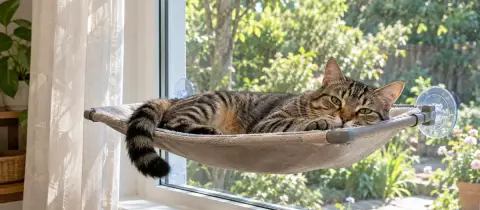
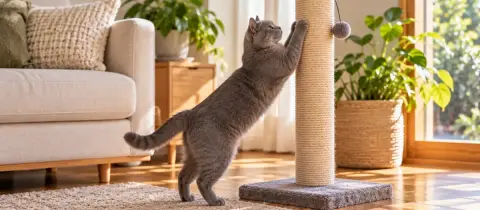
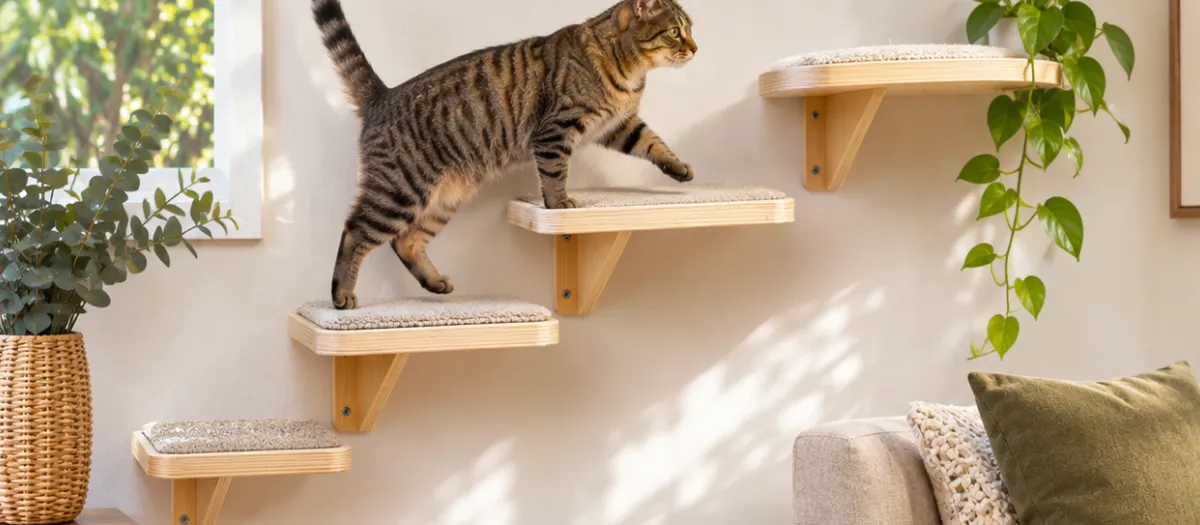
Pictures are illustrations, not the actual products.
Hardware stores, pet shops and some furniture retailers also sell wall shelves for cats, so you can see the build in person. A stud finder and the right drill bits are easy to pick up at a hardware store too.
Are cat wall shelves safe?
Yes, if fitted properly and kept within the weight limit. A shelf that pulls out of the wall or tilts under a landing is the main risk, so the fixing matters as much as the shelf. VCA Hospitals says to check each shelf's weight limit, and to choose one that can hold more than one cat if you have several (VCA Hospitals, page read 6 November 2026).
A cat landing from a jump puts more force on a shelf than a cat sitting still, so leave a margin under the stated limit. That's our own reasoning, not a figure from a source. Every few weeks, check each step for wobble or loose screws, and re-tighten if needed.
Two other safety points for these sets:
- Rope: two of our picks use rope or sisal as a scratching surface. Replace or remove it if it frays, because loose strands can be chewed or swallowed. Cats shouldn't have loose string or ribbon to play with at all.
- Supervise the first uses. Watch how your cat approaches the steps, and don't leave a nervous or very young kitten alone with a new wall set until they're confident.
How to mount cat wall shelves
Fix them into wall studs or masonry using fixings suited to your wall, and follow the maker's instructions. Plasterboard on its own is a weak anchor for a cat's landing. Use a stud finder to locate the timber, mark the positions with a level, and ask a handyperson if you're unsure what your wall is made of.
Some practical points:
- Read the listing and the manual first. The COOLEX and Wuudi listings both say you "nail" the steps to the wall through pre-drilled holes. Nails alone are not a fixing we'd trust into plasterboard, so check what the instructions call for and use fixings the maker says suit the load. The TRIXIE listing says all necessary hardware is included.
- Match fixings to the wall. Timber studs, brick, concrete and plasterboard each need different fixings. A hardware store can advise.
- Renters need permission. Screwing into walls leaves holes, so ask your landlord first. We left out adhesive-only shelves because none state a weight limit we could rely on, and "no drill" cat shelves are only as safe as the fixing and the limit.
- Fit the first step low enough for your cat to reach easily, and check it's level before the next one goes up.
If you're renting and can't drill, a freestanding cat tree, a window hammock or an elevated cat bed gives height with no wall holes.
Our picks in detail
1. COOLEX 3-in-1 Cat Climbing Wall Steps with Hemp Rope: best starter set
Three wooden steps with hemp rope wrapped on them for grip and scratching, made from particle board with metal brackets, per the listing. The steps arrive pre-assembled with pre-drilled holes and step-by-step instructions. The listing says each step withstands at least 11 kg (25 lb) and lists it for large breeds, indoor use. Care is a damp cloth.
The listing gives no overall dimensions, so measure your wall space against the maker's diagram before you buy. It says you nail the steps to the wall, so check the instructions for the right fixings for your wall.
- Pros: a stated weight limit per step; metal brackets; pre-drilled holes; instructions included; hemp rope for grip
- Cons: no dimensions on the listing; particle board can swell if it gets wet, so keep it away from damp areas; check the rope for fraying over time
- Best for: a first wall set, or a larger cat who needs a stated weight limit
- Skip it if: you want a platform to lie on, or you can't check the wall fixings first
2. Wuudi Wall Mounted Cat Hammock with 3 Steps: best hammock set
A set with a felt-covered platform with a fence and three steps, made of solid wood and felt. The listing says it's 50 x 30 x 11 cm and weighs 2.3 kg, comes with mounting accessories, and has reserved holes for fixing to the wall. It also says it has wooden reinforcement brackets and uses corner space. Care is spot clean only.
The listing doesn't state a weight limit, only that the brackets give a higher load capacity. Its size and breed fields are unclear (some entries are in other languages, and one says small), so we'd treat it as suited to small to medium cats until the maker confirms.
- Pros: a fenced platform for lounging; felt surface; solid wood; mounting accessories included
- Cons: no weight limit stated; some listing details are in other languages, so confirm the size; spot clean only, so felt will need regular vacuuming
- Best for: a small or medium cat who likes to nap up high
- Skip it if: you have a large cat, or you need a stated weight limit before you drill
3. TRIXIE Cat Wall Furniture Set 1: best modular set
A wall set with a climbable post wrapped in sisal rope and a raised platform. The listing gives the post as about 9 cm (3.5 in) across and 117 cm (46 in) tall, with a perch of about 15 by 35 cm (6 by 13.8 in), and says it suits cats up to 5.4 kg (12 lb). The whole set is listed at 35.1 x 24.9 x 130 cm and 2.77 kg. All necessary hardware and a manual are included, and some assembly is needed. It's called customisable, so you can build on it later.
The 5.4 kg limit rules out many adult cats. Check your cat's weight on the vet scales first.
- Pros: a stated weight limit and full dimensions; hardware and manual included; sisal for scratching; set can be added to
- Cons: a low weight limit; only one perch; spot clean only
- Best for: a kitten, small cat or cat under 5.4 kg
- Skip it if: your cat is above 5.4 kg, or you want several levels out of the box
4. xympo Wall Mounted Cat Scratcher, Sisal: best wall scratcher to pair with shelves
A wall-mounted scratching post made of three natural sisal sections, each wrapped around a paper tube and about 7.6 cm (3 in) across, held by two aluminium brackets. The listing gives the assembled post as 7.6 x 7.1 x 85.6 cm (about 34 in tall) and says it's for indoor cats of all ages. Drywall anchors and screws are included, and the listing says it suits drywall and wood surfaces. It also says the sisal sections can be rotated to extend the post's life, and the care note is to keep it indoors and dry.
It's a scratcher rather than a shelf, so it won't give your cat a place to lie down. It sits well beside a shelf set, so the wall isn't the only scratching option.
- Pros: tall enough for a full stretch, per the listing; fixings included; sisal sections can be rotated; slim and keeps the floor clear
- Cons: no weight limit stated, so we can't say how much a leaning or climbing cat can put on it; the listing's drywall anchors don't replace the maker's instructions, so check what they say suits the load; the paper tube core is not a chew toy; no platform to sit on
- Best for: a cat who stretches up to scratch, or a small home that wants a scratcher without a floor-standing post
- Skip it if: you have a large or very heavy cat and need a stated weight limit, or you want a perch
How to plan a cat wall layout
Plan a route your cat can step along, with each level easy to reach from the last. We couldn't find a vet or welfare source that gives a distance between shelves, so follow the layout shown in the maker's instructions rather than a number from us.
VCA Hospitals suggests linking shelves to other high spots such as a bookcase or a tree, to make a raised pathway (VCA Hospitals, page read 6 November 2026).
A few planning ideas of our own:
- Start with a clear landing at each end, so your cat isn't boxed in at the top.
- Keep steps clear of fans, windows left open and fragile shelves.
- Put a scratching post near the base, such as the ones in our scratching post guide, so the wall isn't the only option.
- Add a toy or two at the top from our cat toys guide. Skip anything on string.
- Think about how the cat gets down as well as up, especially in multi-cat homes where one cat can block another.
Cat wall shelves for large or older cats
For a large cat, pick a set with a stated weight limit well above your cat's weight. The COOLEX listing says each step withstands at least 11 kg (25 lb) and lists large breeds. The TRIXIE listing says cats up to 5.4 kg (12 lb), so it suits smaller cats. The Wuudi listing gives no weight figure, so we can't say what it holds.
For older cats, think about small steps and a stable, wide surface. VCA Hospitals lists reluctance to jump or use steps, stiff walking and trouble getting up and down as signs of arthritis in cats, and suggests a ramp, stool or step to reach higher places, plus soft bedding and non-slip floors (VCA Hospitals, page read 6 November 2026). The Wuudi listing says its steps are especially suitable for older cats, which is the maker's claim. A wall set isn't a mobility aid, so ask your vet what suits your cat.
Choose by situation
Your wall, your cat and your lease decide which set makes sense, so start with the situation rather than the product. This table uses facts from the listings and the sources on this page, and points to a related guide where a wall set isn't the right fit.
| Your situation | What to look for | Our pick or guide |
|---|---|---|
| Small flat or apartment | Wall-mounted pieces that keep the floor clear; the xympo is listed at 85.6 cm tall and 7.6 cm wide | xympo scratcher, or COOLEX 3-in-1 |
| Renter | Permission from your landlord first, as screws leave holes; or a freestanding option | See our cat tree guide |
| Senior cat | Low steps, a wide stable surface, and vet advice first | Wuudi hammock set (the listing says suited to older cats), or our elevated cat bed guide |
| Large cat | A stated weight limit well above your cat's weight | COOLEX 3-in-1 (at least 11 kg per step, per the listing) |
| Kitten | A stated limit that suits a small cat, and supervision on first uses | TRIXIE Set 1 (cats up to 5.4 kg) |
| Multi-cat home | A limit that can hold more than one cat, and more than one way down | COOLEX 3-in-1 steps |
| Cat who scratches furniture | A tall, sturdy scratching surface in the spot they already use | xympo scratcher, or our scratching post guide |
Cat wall shelves compared
Details from each Amazon Australia listing, checked on 5 Nov 2026.
| Set | Levels | Weight limit stated | Size listed | Material |
|---|---|---|---|---|
| COOLEX 3-in-1 | 3 steps | At least 11 kg (25 lb) per step | Not listed | Particle board, hemp rope |
| Wuudi hammock set | Platform and 3 steps | Not stated | 50 x 30 x 11 cm, 2.3 kg | Solid wood, felt |
| TRIXIE Set 1 | Post and 1 perch | Cats up to 5.4 kg (12 lb) | 35.1 x 24.9 x 130 cm, 2.77 kg | Wood, sisal |
| xympo scratcher | 1 post (3 sections) | Not stated | 7.6 x 7.1 x 85.6 cm | Aluminium, sisal |
How we chose
We searched Amazon Australia for cat wall shelves, climbing steps and wall furniture sets, then shortlisted ones that met all of these checks:
- Well rated: a strong average rating with plenty of buyer reviews.
- No red flags: no pattern of poor reviews, safety complaints or listing problems.
- Available on Amazon Australia when we checked.
- Dimensions or a weight limit given where the listing states them, with any gap pointed out in the cons.
- Fixings included or mounting holes described on the listing.
These are researched picks, not products we've personally tried. We compared the specifications and features shown on each Amazon Australia listing, checked on 5 Nov 2026. We didn't accept payment from any brand, and no brand saw this page before it was published.
Left out this time: sets without any weight limit or dimensions, and adhesive-only shelves.
When to see a vet
If a cat who used to jump and climb stops, hesitates or seems stiff, see your vet. VCA Hospitals lists reluctance to jump or use steps, stiff walking and trouble getting up or down among the signs of arthritis in cats, and these signs can have other causes too, so a check is the way to find out.
See your vet straight away if your cat falls, limps afterwards or cries out. Don't force a cat onto a shelf, and take the set down if a fixing loosens.
Frequently asked questions
How do you mount cat shelves?
Find the studs with a stud finder, mark level positions, and fix the brackets with the fixings the maker recommends for your wall type. Plasterboard alone is a weak anchor. If you're unsure whether your wall is timber, brick or plasterboard, ask a hardware store or handyperson before you drill.
How far apart should cat shelves be?
We couldn't find a vet or welfare source that gives a distance, so follow the spacing in the maker's instructions. Plan a route with each step easy to reach from the last, and think about the way down as well as the way up, especially in homes with more than one cat.
Are there no-drill cat shelves?
Not that we'd recommend. We left out adhesive-only shelves because none gave a weight limit we could rely on. If you can't drill, a freestanding cat tree, a window hammock or an elevated bed gives height without wall holes, and renters should always ask their landlord first.
Are there cat shelves for large cats?
Yes, but check the weight limit. The COOLEX set's listing says each step withstands at least 11 kg (25 lb) and lists large breeds. The TRIXIE set is listed for cats up to 5.4 kg, and the Wuudi listing gives no weight figure. Leave a margin under any stated limit.
Do cats use wall shelves?
Many do, but it varies by cat. A confident climber may take to them quickly, while a shy or stiff cat may need time and treats on each step. Don't force your cat up. If an older cat stops using them, ask your vet whether pain could be a factor.
Can I put cat shelves on plasterboard?
Not on plasterboard alone, because it's a weak anchor for a cat's landing. Aim for wall studs or masonry, or use anchors rated for the load if the maker's instructions allow it. The xympo listing includes drywall anchors but states no weight limit, so confirm with the maker before you rely on them.
Do cat wall shelves damage walls?
They leave screw holes, and a poorly fixed shelf can pull out and tear the plasterboard around it. Holes from a few screws are usually simple to fill when you take the set down, but renters should ask their landlord first. Fixing into studs as the maker directs also helps stop a shelf loosening.
How high should cat shelves be?
We couldn't find a vet or welfare source that gives a height, so follow the maker's layout. Fit the first step low enough for your cat to reach easily, keep clear space above the top step, and keep steps away from fans and open windows. Older or stiff cats may do better with lower steps.
Related guides
- Why won't my cat use the cat tree?
- Best tall cat trees
- Best modern cat trees
- Cat steps for bed
- Best cat trees
- Best cat window hammocks
- Best cat scratching posts
- Best window catio
- Best cat toys
- Best elevated cat beds
Sources
- VCA Hospitals: How to make vertical space for cats, read 6 November 2026
- VCA Hospitals: Arthritis in cats, read 6 November 2026
- Product details from each linked Amazon Australia listing, checked on 5 Nov 2026.
This guide provides general information and isn't a substitute for veterinary advice. If you're concerned about your cat's mobility, speak with your vet.