Best tall cat trees: freestanding towers and floor-to-ceiling trees for Australian ceilings
By Anish PuriUpdated 19 Nov 202617 min readResearched, not tested by us
Research guide. WhiskerFinds may earn a commission from links, at no extra cost to you.
Quick answer: The best tall cat tree for most homes is the PAWZ Road 184 cm tower. It stands free under a 2.4 m ceiling with room to spare, has eight levels, and suits a confident climber. The PAWZ Road 216 to 285 cm adjustable tree is our floor-to-ceiling pick. Measure your ceiling first, and anchor whichever you choose.
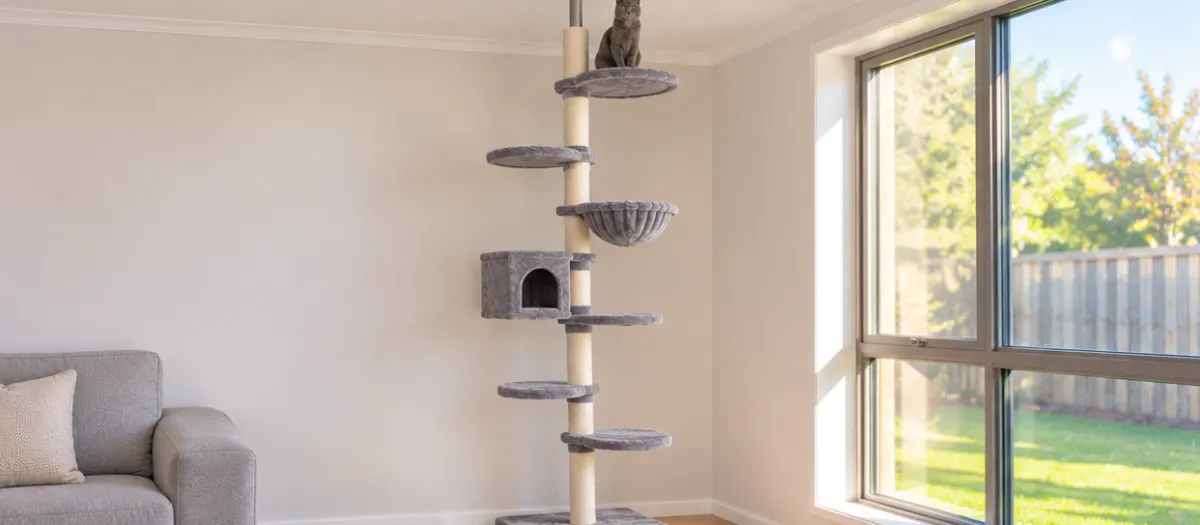
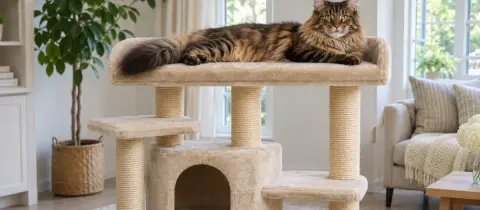
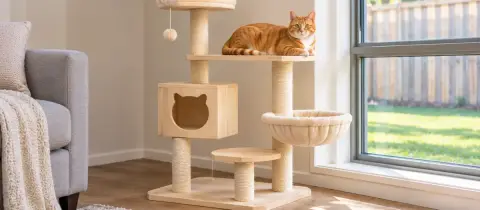
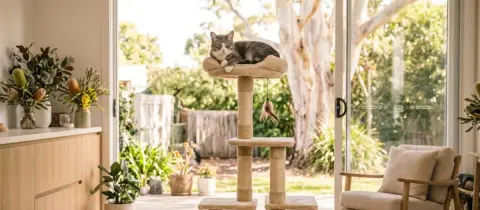
Illustration, not the actual product
Our top pickPAWZ Road 184 cm cat tree with hammock and condos
A tall tree gives a cat what cats look for: somewhere high to rest and watch the room from. It also takes a small patch of floor, which is why people with small flats and busy lounge rooms ask about it. This guide compares five tall PAWZ Road trees on Amazon Australia by height, base size and ceiling fit, all in centimetres. Two are freestanding and three are floor-to-ceiling tension trees. If your cat is heavy, start with our cat trees for large cats guide, which is about weight and perch size. For everyday trees by cat size, see best cat trees and towers. If your cat has ignored a tree before, read why a cat won't use the cat tree first.
Quick picks
Our top pickBest overall
PAWZ Road 184 cm cat tree with hammock and condos
Tallest freestanding tree that still fits under a 2.4 m ceiling
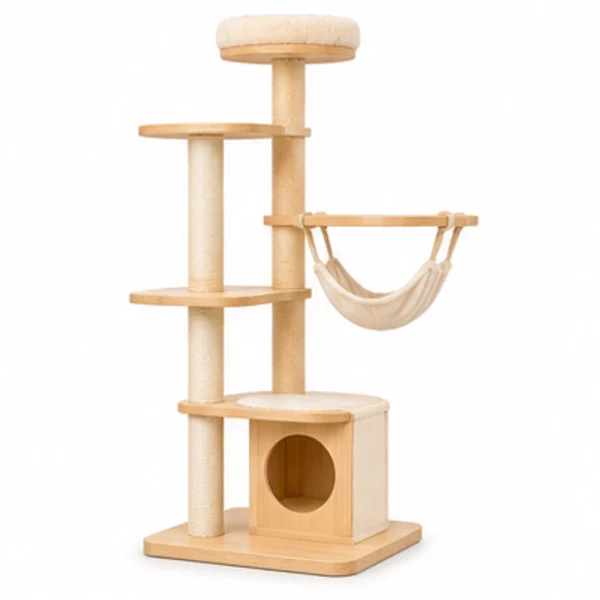
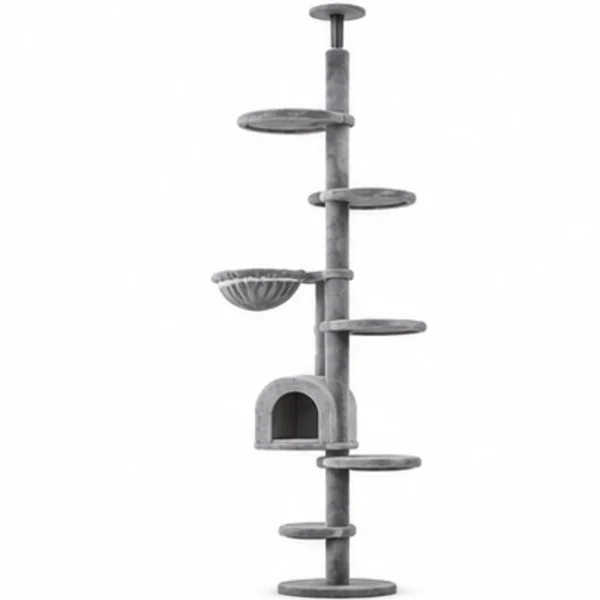
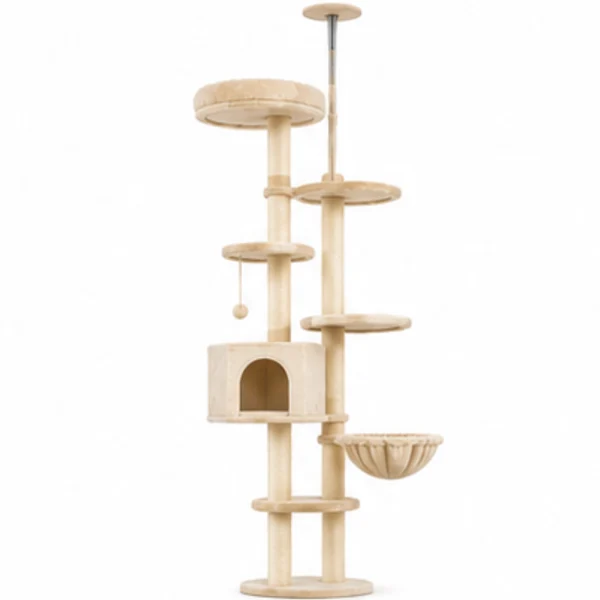
Pictures are illustrations, not the actual products.
Freestanding or floor-to-ceiling: which tall cat tree suits you?
A freestanding tree stands on its own base, tops out at 184 or 205 cm here, and should be strapped to the wall. A floor-to-ceiling tree has a spring-loaded or screw tension rod at the top that presses against the ceiling, so it can reach 2.4 m and more without any drilling, according to the listings. Neither type is a fix for a nervous or elderly cat, and no standards body publishes a stability test for cat trees, so the table below is our own comparison.
Swipe sideways to see every column
Freestanding (picks 1 and 5)
Floor-to-ceiling (picks 2, 3 and 4)
Holds still by
A wide base, plus a wall strap you fit
Pressure between floor and ceiling, plus a wall if the base is narrow
Floor space
53 x 43 cm and 60 x 49 cm
44 x 25, 40 x 24 and 60 x 40 cm
Height
Fixed at 184 or 205 cm
Adjustable, 216 to 285 cm across the range
Moving house
Re-fit the strap
Re-measure the new ceiling
Ceiling marks
None
A pad presses on the ceiling, so check it and ask first if you rent
Suits
Two cats, a bigger cat, a lounge with a free wall
Tight floors, a climber who wants the full height
How much ceiling height does a tall cat tree need?
For a freestanding tree, leave at least 30 cm above the top perch so your cat can sit up without bumping the ceiling. That 30 cm is our rule of thumb, not a standard. For a tension tree, the ceiling is part of the tree: your ceiling must sit inside the tree's adjustment range.
Pick 3's range comes from the listing's 95 to 107 inches, and its detail panel gives a different height (228 cm), so check the listing's size chart before you order. Cornices, bulkheads, downlights and sloped ceilings all change the usable height, so measure at the exact spot you plan to use.
Our picks in detail
1. PAWZ Road 184 cm cat tree with hammock and condos: best overall
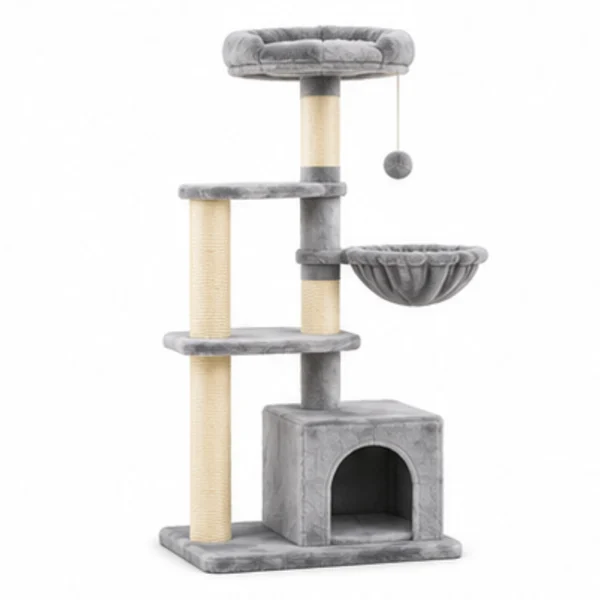
The tallest freestanding tree here that still clears a 2.4 m ceiling by more than half a metre. It measures 53 x 43 x 184 cm over eight levels, with seven sisal-wrapped posts, a horizontal scratching pad at the base, a large hammock and a rectangular condo of 53 x 30 x 25 cm that the listing says suits cats of 7 to 9 kg, such as Maine Coons and Ragdolls. The listing says particle board under plush. A pink floral version of the same frame is B0DCZ4GWD4, with a 26 x 17 cm scratching pad. The grey tree is also on our large cat tree guide, where it is covered by weight and perch size.
Pros: fits under a 2.4 m ceiling with room to spare; eight levels; seven sisal posts plus a base scratching pad; big hammock and condo; wider base than the tension trees
Cons: a 184 cm tree on a 53 x 43 cm base should be strapped to the wall, and the listing doesn't mention a strap; no weight limit stated; particle board under plush
Best for: a confident adult cat in a 2.4 m room, or two cats who share well
Skip it if: your cat is a kitten still learning to come down, or a senior with stiff joints
2. PAWZ Road adjustable cat tree, 216 to 285 cm: best floor-to-ceiling tree
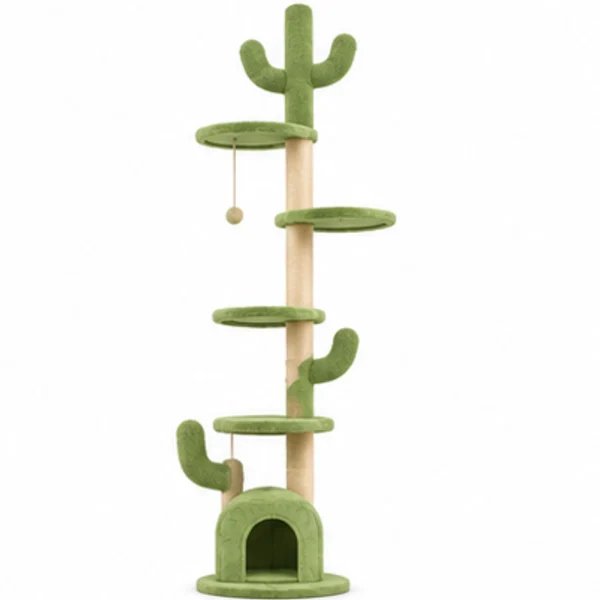
The most adjustable tree here, with a tension rod that lets you set the height from 216 to 285 cm without drilling, per the listing. It has a 60 x 40 cm base and seven tiers: a sisal stair, five platforms, three hammocks and a condo. The listing says two posts meet the ceiling, which it calls steadier than a single-post design. Posts and stair are sisal covered, in a green and yellow cactus shape.
Pros: widest adjustment range here; two top posts and the widest base of the tension trees; many resting spots
Cons: no weight limit stated; the pad presses on your ceiling, so check it for marks and re-tension after the first week; won't suit a ceiling under 216 cm
Best for: a lounge where you want the full height of the room, and a cat that climbs confidently
Skip it if: your ceiling is under 2.16 m or sloped, or you rent and your landlord won't accept marks on the ceiling
3. PAWZ Road floor-to-ceiling cat tower with sisal post and bed: best slim tower for one small or medium cat
A slim tower for one cat and a tight floor. The base is 44 x 25 cm and the whole tree weighs 8.7 kg. Five plush platforms sit about 44 cm apart (the listing gives 17.3 inches), on posts 9 cm across wrapped in plush and sisal, with a bed and a dangling ball. The tension rod adjusts across 241 to 272 cm. A second colour with the same listing text is B09NFLD1Q4.
The listing says it suits kittens and small to medium cats and that cats over about 9 kg may be too heavy for the top post. At only 25 cm deep, it needs a wall behind it. Use our dangling-ball rule on this page.
Pros: smallest footprint with a decent climb; light enough to carry; posts 9 cm across
Cons: the listing itself cautions against cats over about 9 kg; only 25 cm deep; the height range doesn't reach a minimum 2.4 m ceiling; the listing's height figures disagree (228 cm in the details, 241 to 272 cm in the text); the cord on the ball needs watching
Best for: one small or medium cat in a flat, with a wall alongside and a ceiling clearly above its 241 cm minimum
Skip it if: your cat is over about 9 kg, or you have two cats who race to the top
4. PAWZ Road cactus floor-to-ceiling cat tree, 5-tier: best for a cat who likes a basket up high
A tension tree built around a lounging basket. The base is 40 x 24 cm and it adjusts from 239 to 274 cm (the listing gives 94 to 108 inches). Five tiers sit about 45 cm apart, on 9 cm poles in sisal and carpet, with a basket, an acrylic nest you can see into, a hammock and a dangling ball. The listing's "Christmas gift" wording is a leftover and doesn't change the product.
It has the narrowest base here at 24 cm deep, so it is a wall-side tree for one cat or two light cats, and not a busy multi-cat route. Check the ball's cord as in the setup section.
Pros: basket, see-through nest and hammock; reaches a 2.4 m ceiling; 9 cm poles
Cons: the narrowest base here at 24 cm deep, so it is a wall-side tree for one or two light cats; no weight limit stated; the cord on the ball needs watching
Best for: one cat who naps high up, with a wall alongside
Skip it if: you want the sturdier two-post design of pick 2
5. PAWZ Road 205 cm cat tree, green: best for 2.7 m ceilings and multi-cat homes
The tallest freestanding tree and the widest, at 60 x 49 x 205 cm. It has eight levels, seven sisal posts, a bottom scratching pad, a wide hammock, dual condos and two padded perches. The listing sizes the condo for cats of 7 to 9 kg, and says particle board under plush. The flower-coloured version is a pick on our large cat tree guide, where it is covered by weight and perch size. Here we cover the height.
Under a 2.4 m ceiling it leaves about 35 cm above the top, so a cat can't sit upright on the top perch in a minimum-height room. It suits rooms of 2.7 m.
Pros: the widest freestanding base here; two condos, so cats can rest apart; two padded perches and a wide hammock
Cons: too tall for a minimum 2.4 m room; no weight limit stated; particle board under plush; strap it to the wall, since the listing doesn't mention one
Best for: a taller room, or a home with two or three cats who share a tree
Skip it if: your ceiling is 2.4 m, or you want a kitten-friendly first tree
Tall cat trees compared
Specs from each Amazon Australia listing, checked on 19 November 2026. "Not stated" means the listing doesn't say. Spare height in the table above is our own subtraction.
Swipe sideways to see every column
Tree
Base (cm)
Height or range (cm)
Levels and extras
Weight note per listing
184 cm tower
53 x 43
184
8 levels, 7 sisal posts, base scratching pad, hammock, condo 53 x 30 x 25 cm
The 184 and 205 cm listings both describe a condo sized for cats of 7 to 9 kg. That is a sizing note for the condo, not a weight limit for the tree. Only pick 3 gives a weight caution.
Does a narrow base matter?
It does. A tall tree on a small base has less to resist a cat landing hard on a high perch. Dividing height by the narrower side of the base gives a quick way to compare. Again, this is our comparison, not a standard.
Swipe sideways to see every column
Tree
Narrow base side
Height
Height per cm of base
205 cm tower
49 cm
205 cm
4.2
184 cm tower
43 cm
184 cm
4.3
Adjustable 216 to 285 cm
40 cm
216 to 285 cm
5.4 to 7.1
Slim tower
25 cm
241 to 272 cm
9.6 to 10.9
Cactus 5-tier
24 cm
239 to 274 cm
10.0 to 11.4
The two freestanding trees are the lowest ratio, and pick 2 is the widest of the tension trees. Picks 3 and 4 rely on the ceiling to stay upright, which is why we suggest standing them against a wall.
How do I set up and anchor a tall cat tree?
Anchoring is the best way to stop a tall piece of furniture tipping, and a broad, sturdy base helps. If no anchor kit comes with the tree, buy one. Renters should ask the landlord or agent first and offer to remove the anchor when the tenancy ends (ACCC Product Safety, "Toppling furniture and televisions guide", page read 19 November 2026). Tighten every bolt, stand it on a hard level floor against a wall, use the anchor strap into a wall stud, and replace a tree that still rocks.
For the tension trees, add these:
Measure the ceiling at the exact spot first.
Follow the maker's instructions to set the rod so the top pad presses firmly and the posts stand straight.
Re-tension after the first week, and check it again each month.
Look at the ceiling pad now and then for marks or movement.
Keep it clear of shelves, windows and the TV, so a jump from the top has somewhere safe to land.
Kittens still learning to come down, older cats with stiff joints, and any cat that has fallen from a tree before. Cats like to rest and watch from high places, but they must also be able to get down easily, especially older cats (International Cat Care, "Making your home cat friendly", updated 26 September 2025). A lower tree with close platforms suits all three.
We searched Amazon Australia for tall cat trees and shortlisted trees that met all of these checks:
Well rated: a strong average rating with plenty of buyer reviews.
No red flags: no pattern of poor reviews, safety complaints or listing problems.
Available on Amazon Australia when we checked.
Height and base size in the listing, so you can match it to a ceiling in centimetres.
Sisal on the posts or stairs, so the tree doubles as a scratcher.
Whether a weight limit is printed, and what the listing does say about cat size.
Where a listing has a limitation, we say so in the cons. These are researched picks, not products we've personally tested. We compared the specifications and features on each Amazon Australia listing, checked on 19 November 2026. We didn't accept payment from any brand.
Left out this time: a 91 cm palm-style scratching post (a post, not a tree; see tall cat scratching posts), an 80 cm two-level tower, a 135 cm tree and a 100 cm kitten tree that belong on our large cat and kitten pages, and an 89 cm low tower. For a 170 cm option, see the AIFY slim tower in modern cat trees, and for a shorter wooden tree, see wooden cat trees.
Where else can you buy tall cat trees?
Pet shops and some vet clinics stock cat trees, and seeing one in person helps you judge the base. Ranges vary, so take your ceiling measurement with you and compare the base and height in centimetres on the label.
When to see a vet
See your vet if your cat stops climbing or jumping, hesitates or takes several small jumps, creeps down instead of jumping, hides more, grooms less, or starts missing the litter tray. These can be more consistent with sore joints, and only an exam can tell. See our guide to a cat that won't use the cat tree and our cat steps guide.
Also see your vet after a fall from a tree, or if your cat limps. If you think your cat has swallowed part of a cord or a ball, call your vet at once, because an obstruction can be fatal.
Frequently asked questions
How tall should a cat tree be for an indoor cat?
Tall enough to give your cat a real lookout, with room under the ceiling to sit up. In a 2.4 m room, a 184 cm tree leaves about 56 cm. Kittens and seniors do better with lower trees, because cats must be able to get down easily.
Do floor-to-ceiling cat trees damage the ceiling?
The listings don't say. A pad pressing on a ceiling can leave a mark, so check it after the first week and now and then after that. Re-tension if it loosens. If your ceiling is cracked, sagging or textured, or you rent, ask the landlord or a builder before you fit one.
How do I measure my ceiling for a floor-to-ceiling cat tree?
Run a tape from the floor to the ceiling at the exact spot where the tree will stand, and check two or three points. Cornices, bulkheads, downlights and sloped ceilings all change the height. Then compare that figure with the tree's range in centimetres, and allow for the pad.
Are tension-pole cat trees safe for heavy cats?
The only weight note we have is on the slim tower, whose listing says cats over about 9 kg may be too heavy for the top post. The others state no limit. A tension pole is no guarantee of strength, so for a heavy cat start with our large cat tree guide.
Can a tall cat tree go in a rental?
Ask the landlord or agent first. Anchoring is the best way to stop a tall tree tipping, and the ACCC says renters should offer to remove the anchor at the end of the tenancy. Tension trees need no drilling, per the listings, but they still press on the ceiling.
Do tall cat trees need to be against a wall?
Yes, for the best result. A freestanding tree is strapped to a wall stud, and the slim and cactus tension trees have bases only 24 to 25 cm deep, so they stand better beside a wall. A wall also keeps a cat's landing zone clear.
Is a 2 metre cat tree too tall for a small room?
It can be, but floor space matters as much as height. The 205 cm tree has a 60 x 49 cm base and leaves about 35 cm under a 2.4 m ceiling. In a small room with a minimum-height ceiling, the 184 cm tree is the better fit.
How do I stop my cat jumping off the top of a tall cat tree onto furniture?
Place the tree away from shelves, the TV and glass, and add a lower platform or step nearby so your cat has a gentler way down. The ACCC's toppling guide advises securing tall furniture and televisions to the wall; a cat landing hard on an unsecured piece adds to that risk.
Product details from each linked Amazon Australia listing, checked on 19 November 2026.
This guide provides general information and isn't a substitute for veterinary advice. If you're concerned about your cat's health, mobility or behaviour, speak with your vet.