By Anish PuriUpdated 31 Oct 202614 min readResearched, not tested by us
Research guide. WhiskerFinds may earn a commission from links, at no extra cost to you.
Quick answer: A cat cage is a short-term tool for a specific job, such as settling in a new cat, keeping a kitten safe or vet-advised cage rest, not a place to live. For an adult cat, our top pick is the Amazon Basics 3-tier wire cat cage. Soft playpens suit kittens, travel and short stays.
Cat cages and playpens give you a contained, safe space inside the house for a limited time. This guide compares four on Amazon Australia, explains when a cage helps and when it doesn't, and covers sizes and setup. If your goal is safe outdoor time, see our guide to the best cat enclosure instead.
Quick picks
Our top pickBest overall
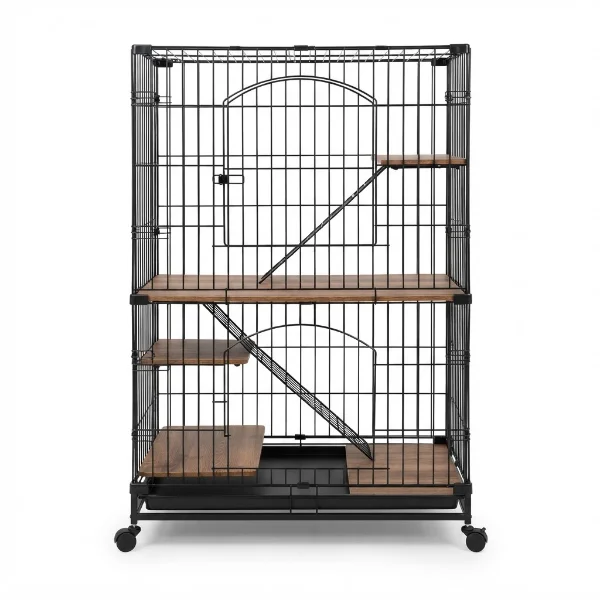
Amazon Basics 3-tier wire cat cage
Tall steel wire cage with 3 shelves, 2 doors and wheels
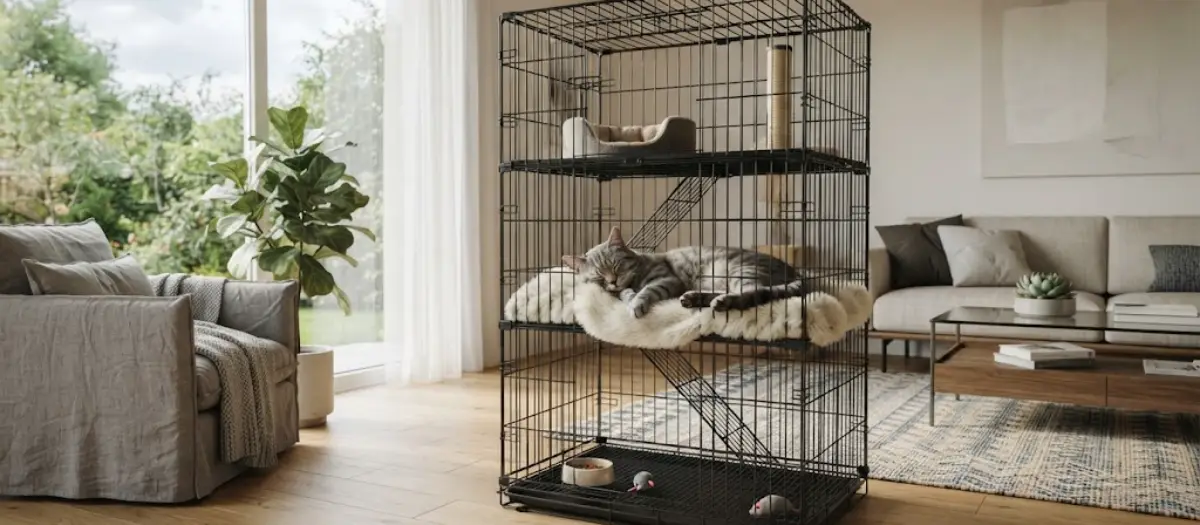
Pictures are illustrations, not the actual products.
Each pick suits a different job, so read the next section before you choose.
When is a cat cage a good idea?
A cage makes sense for short, specific jobs: settling a new cat or kitten, keeping a cat to one area when your vet advises cage rest, and temporary or travel setups. It isn't suited to long-term housing, because a cat needs room to move, climb, hide and toilet away from where it eats.
Here are the situations where a cage or playpen earns its place:
A new cat or kitten. A contained starter space lets a newcomer settle before meeting the rest of the house. The ASPCA suggests a separate quiet room for a new cat with its own food, water, litter and hiding spots (ASPCA, page read 31 October 2026). A cage can work inside that room if you can't close one off.
Keeping a kitten safe for short periods. This is useful while you cook, shower or can't supervise. Our kitten-proofing guide covers making the rest of the house safe.
Travel or a temporary stay. A soft playpen folds up and can be set up at a relative's place or a holiday rental. For the trip itself, use a proper carrier. See our cat carriers guide.
If your cat is shut away because of toileting, scratching or night-time noise, a cage is rarely the fix. Look at the cause, and talk to your vet if a behaviour has changed suddenly.
Is it cruel to keep a cat in a cage?
It isn't cruel when it's short, calm and has a clear purpose, but it can be if a cage becomes a cat's everyday home. RSPCA Australia says keeping a cat safe and happy at home means providing for all their needs, including some that roaming once met (RSPCA Australia knowledgebase, page read 31 October 2026).
A cage can't meet those needs all day, so the safest approach is to treat it as a base, not a sentence. Some habits help keep it fair:
Keep stays short, and plan plenty of time out in the house with you.
Follow your vet's instructions exactly if the cage is for cage rest, including how long.
Put the cage in a room where you spend time, so your cat isn't isolated. PDSA suggests this for cats who like company.
Offer things to do. PDSA suggests puzzle feeders and extra attention during cage rest. Our cat enrichment guides have more ideas.
Watch your cat. Hiding at the back, hissing, not eating or not toileting can be signs of stress, and it's a reason to end the stay and call your vet.
A cage also doesn't replace outdoor-style space. If your aim is more room for a contained cat, a catio or enclosure does that job better. See catio ideas and the window catio guide.
Our picks in detail
1. Amazon Basics 3-tier wire cat cage: best overall
A tall steel wire cage with a rust-resistant black finish. The listing says it has 3 interior shelves for perching or napping, 2 swing-open doors with locking latches, 4 wheels, a removable leak-proof plastic floor pan and a fold-down design. Bar spacing is listed at 4.45 cm and it weighs about 17 kg.
Pros: shelves give an adult cat height; two doors make setup and cleaning easier; floor pan removes for cleaning; folds flat
Cons: heavy to move even with wheels; the 4.45 cm bar gaps may be wide for a very small kitten, so check before use; the listing is mixed, calling it a cat cage but also tagging it for transport and large breeds, and its size varies slightly between lines
Best for: an adult cat settling in, or a short introduction period. For vet-advised cage rest, ask your vet whether the shelves should be blocked off or whether a single-level crate suits better
Skip it if: you have a small kitten who could slip through the bars, or you need something light to travel with
2. X-ZONE PET portable pet playpen: best soft playpen
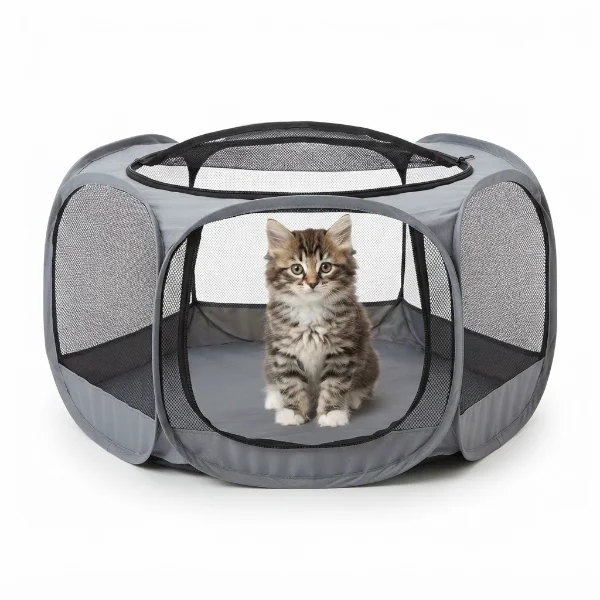
A small fabric pen made of 600D oxford cloth with 8 mesh panels. The listing says the front door and removable top close with self-locking metal zips, and it comes with a carry case, a side pocket and a mesh pocket for a water bottle.
Pros: light and foldable; mesh panels let you see your pet; the top can come off for access
Cons: small, so it isn't for an adult cat long term; the listing calls it round in one place and hexagonal in another, and is aimed at dogs and small animals as much as cats; fabric and zips can be clawed or chewed, so it isn't for an escape artist
Best for: a kitten, or a short stay
Skip it if: your cat is large or likes to claw and chew fabric
3. LUCKITTY portable cat playpen: best for recovery and litters
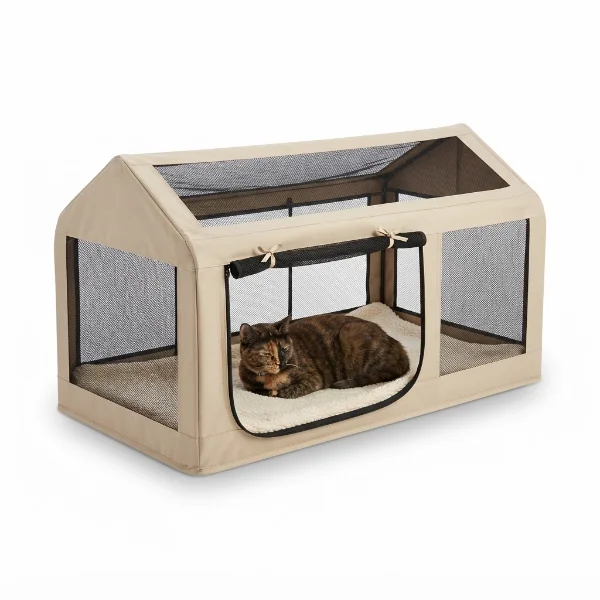
A long soft pen in a house design. The listing says the left side is the living area and the right side holds the litter box, with a door curtain fixed by Velcro, and a small opening at the bottom to catch scattered litter. It's made of 600D oxford cloth and a mesh net with a steel frame and nylon zips.
Pros: built-in space for a tray, so the toilet stays apart from the bed; the listing says it suits multi-cat homes; folds up
Cons: assembly is needed; the listing is confusing about size, giving 55 inches in one place and listing two playpens of 23.6 and 15.7 inches in another; no shelves for perching
Best for: vet-advised cage rest where a tray must be close by, or a mum cat and kittens
Skip it if: your cat chews or claws fabric, or you want a pen with perches
4. AmazonBasics portable soft pet playpen, 114 cm: best for travel
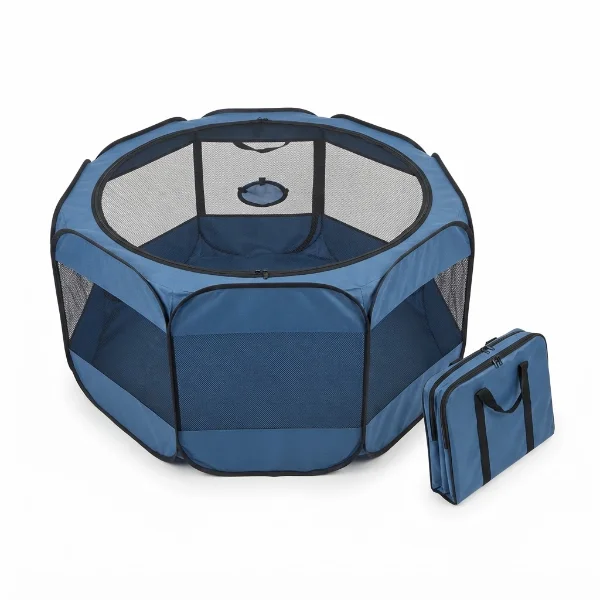
An 8-sided soft pen with an enclosed mesh top, mesh windows and oxford canvas walls and floor. The listing says it collapses for storage and has a Velcro pouch for supplies.
Pros: the mesh top helps keep a cat in; folds away easily; light for its size
Cons: the listing is aimed at small dogs as well as cats, and its material line says metal, so check the fabric before you buy; it has no built-in litter area or shelves
Best for: holidays, visits and temporary setups with you nearby
Skip it if: you want something for daily use or a strong, climbing cat
How long can a cat stay in a cage?
There's no single number of hours that suits every cat. Kittens, older cats and nervous cats cope with much less. For cage rest, your vet sets the length and the rules. For anything else, keep stays short, build up gradually and give your cat plenty of time out.
Be especially careful with overnight stays. We couldn't find a veterinary or welfare body that gives a safe time limit for putting a cat in a cage at night, so ask your vet, particularly for a kitten, a senior cat or a cat who seems stressed. A cat-safe room with a tray, water and a bed is often a gentler option than a small cage. Never leave a cage in the sun, near a heater or in a hot room.
What size cat cage do you need?
Pick the size by the job. For cage rest, PDSA says the crate should fit your cat's bed, litter tray and food bowls but be too small for running, jumping or climbing. For a new cat or a longer stay, you want room for a tray, a bed and water kept apart, plus a shelf or hiding spot.
Quick sizing guide, from the listings:
Adult cat, longer stay or settling in: a tall cage such as the Amazon Basics 3-tier, listed at 91.44 x 55.88 x 129.54 cm. Shelves give height to perch on.
Kitten or very short stay: the X-ZONE PET pen is listed at 29.5 inches across and 15.5 inches high. That's small, so it suits a kitten or a short stay, not an adult cat long term.
Recovery with a built-in tray, or a small litter of kittens: the LUCKITTY pen is listed at 55 x 23.6 x 23.6 inches. It's long and low.
Travel and holiday use: the AmazonBasics soft playpen is listed at 114.3 x 114.3 x 61 cm, with a mesh top.
Can you use a dog crate for a cat? Often, yes, if it has room for the tray, bed and bowls, a door that latches and bars or mesh your cat can't squeeze through. PDSA describes a crate for cage rest in exactly this way. A cat cage with shelves offers more to do than a flat dog crate. For dogs, see our dog crate guide.
Cat cages compared
Details from each Amazon Australia listing, checked on 31 Oct 2026.
We searched Amazon Australia for cat cages and indoor playpens, then shortlisted ones that met all of these checks:
Well rated: a strong average rating with plenty of buyer reviews.
No red flags: no pattern of poor reviews, safety complaints or listing problems.
Available on Amazon Australia when we checked.
Enough room for a litter tray, bed and water with space between them.
Secure doors or zips.
Easy to clean.
A listed size that matches its use: a tiny pen for a kitten, a tall cage for an adult.
These are researched picks, not products we've personally tested. We compared the specifications and features shown on each Amazon Australia listing, checked on 31 Oct 2026. We didn't accept payment from any brand, and no brand saw this page before it was published.
Left out this time: small "small animal" plastic pens without a roof (cats can jump out), cages with a pattern of broken latches or flimsy panels, and listings whose sizes conflicted so badly we couldn't tell what you'd get. Where a pick's listing has a smaller inconsistency, we say so in its cons.
Setting up a cat cage
Set the cage up so your cat can eat, sleep and toilet in separate spots. RSPCA Australia says litter trays belong in quiet, private, easy-to-reach places away from food and water (RSPCA Australia knowledgebase, page read 31 October 2026). In a small cage, that means keeping the tray at one end and the food and water at the other.
A simple setup:
Place the cage somewhere quiet and out of the sun, away from heaters and draughts. Choose a room where you spend time, as PDSA suggests.
Add a tray with a low side if your cat is recovering. PDSA suggests a tray that's easy to get in and out of, and litter that won't stick to a wound, such as paper or wood-based pellets. See our kitten litter guide for gentle options, and the litter box enclosure guide for hiding a tray in the rest of the house.
Add a bed and a hiding spot, such as a covered bed or a towel draped over part of the cage (leave airflow).
Put water at the opposite end from the tray, in a bowl that won't tip.
Use the shelves in a tiered cage for perching, if your vet hasn't asked for limited climbing.
Keep the cage settings the same. RSPCA Australia advises against often moving trays, because it can confuse and stress a cat.
Don't leave string, ribbon or small loose toys in the cage. Offer puzzle feeders or a safe toy when you're there, and see our cat toys guide.
Using a cage to introduce a new cat or kitten
A cage is one way to give a new cat a safe base while a resident cat gets used to the scent. It works best inside a closed room. The ASPCA says to let the cats smell and hear each other but not see or touch at first, and to move at their pace, with no fixed timetable.
The ASPCA's steps, in short:
Give each cat its own food, water, litter tray and hiding spots.
Build good associations, such as treats near the door or a towel with each cat's scent.
Start sight sessions once both cats are calm, eating and using the litter tray, and keep them to a few minutes.
If there's a fight, don't touch them, block the view, and go back a step for about a week.
Moving slowly beats rushing. Our guide to introducing a kitten to an older cat goes through it step by step, and Feliway diffusers are one option some owners add to a routine. They're a tool, not a fix. If one cat keeps hiding, stops eating or avoids the litter tray, slow right down and ask your vet or a qualified behaviour professional.
When to see a vet
Follow your vet's instructions for cage rest, including how long it lasts and how much movement is allowed. PDSA says to contact your vet if your cat has extreme tiredness or can't stand, has low energy for more than 48 hours, seems in pain, has trouble passing urine, has redness, swelling, bleeding or discharge near a wound, is vomiting or has diarrhoea, or refuses food for more than 24 hours (PDSA, page read 31 October 2026).
Call your vet if your cat seems very distressed in a cage, isn't eating, or hasn't used the litter tray for a day. A cat that is straining to toilet needs a vet promptly. A cage is a tool, not a treatment for stress or anxiety.
Frequently asked questions
Is it okay to put a cat in a crate at night?
It depends on the cat, and we couldn't find a vet or welfare body that gives a safe limit. A kitten or newcomer may be fine for a short period with a tray, water and a bed, but a cat-safe room is often gentler. Ask your vet, especially for kittens, seniors or stressed cats.
Should I cover a cat cage with a blanket?
Partly, yes. A towel or blanket over some of the cage can give your cat a hiding spot, but leave the front and a side or two open for airflow and so you can see your cat. Don't cover it fully in warm weather, and keep fabric away from heaters.
Can two cats share a cat cage?
Not usually. A cage is a base for one cat at a time, with its own tray, food, water and hiding spot. When introducing cats, the ASPCA advises letting them smell and hear each other before they see each other, so keep them in separate spaces to start.
Can I use a dog crate for a cat?
Often, yes, if there's room for a tray, bed and bowls, the door latches and your cat can't squeeze through the bars. PDSA describes using a crate for cage rest in this way. A tiered cat cage gives more to do. See our dog crate guide for sizes.
Do I need a cage to introduce a new cat?
No. A closed spare room does the same job, and a cage is just one option inside it. The aim is to let the cats smell and hear each other before they see each other, with separate food, water and litter. Go at your cats' pace.
Are soft cat playpens safe?
They can be for short, supervised stays. Fabric and zips can be clawed or chewed, so check them often and don't leave a determined escape artist alone. Never put a soft pen in the sun, and check airflow. For longer stays, a wire cage is stronger.
Product details from each linked Amazon Australia listing, checked on 31 Oct 2026.
This guide provides general information and isn't a substitute for veterinary advice. If you're concerned about your cat's wellbeing or recovery, speak with your vet.