Quick answer: A catio is an enclosed outdoor space where your cat gets fresh air without roaming. The right type depends on your home: a walk-in catio for a yard, a window box for a flat, netting for a balcony, or a fence kit for the whole garden. Our walk-in pick is the PetsCosset Walk-in Catio.
Most cats can be happy at home if they have somewhere safe to watch the world, and a catio is one way to give them that. This guide helps you pick a type, size it, fit it out and keep it safe. Some councils require cats to be contained, so also see our cat curfew rules guide.
Quick picks
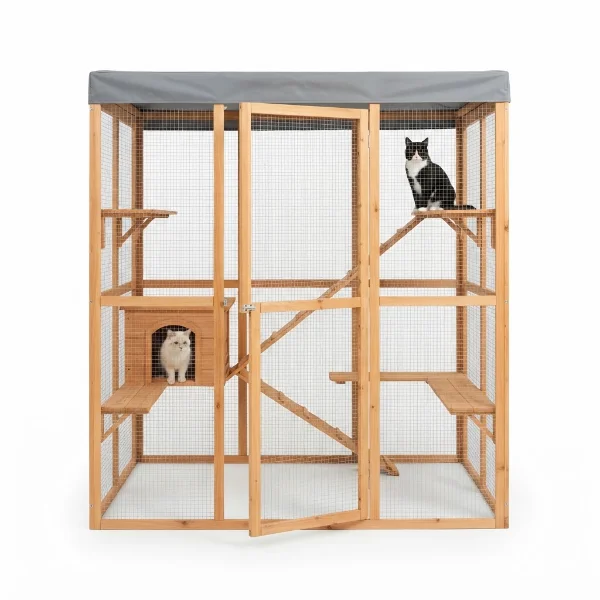
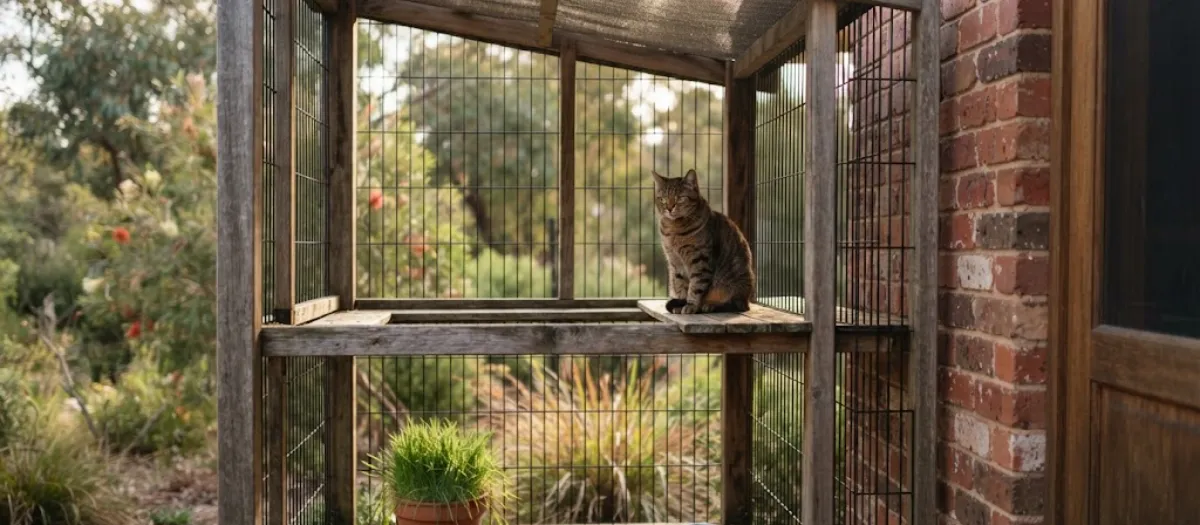
PetsCosset Walk-in Catio
Solid fir frame about 1.8 m tall with a waterproof roof cover and 6 platforms
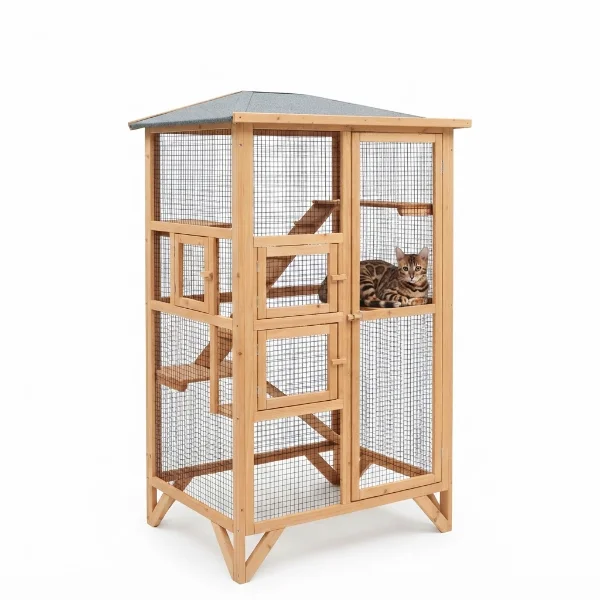
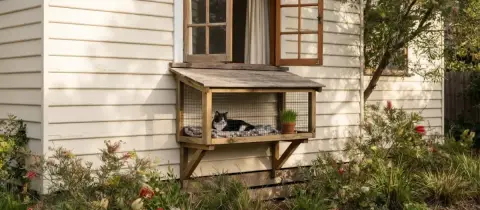
PetsCosset Window Catio (wooden)
Stands outside against the wall and covers a window; see our window catio guide
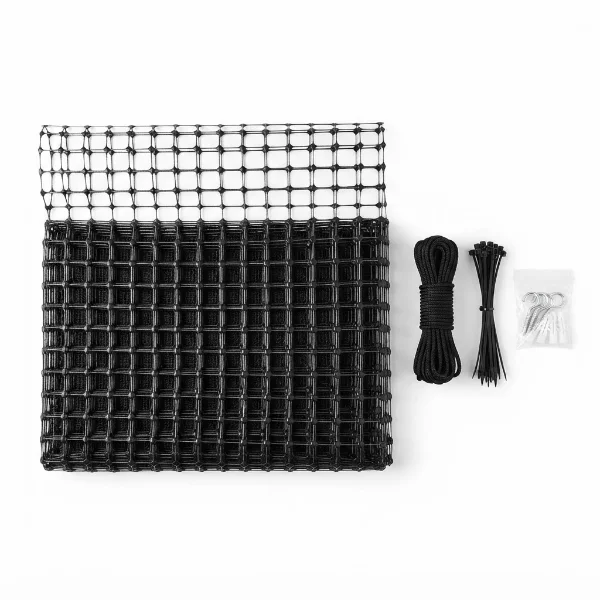
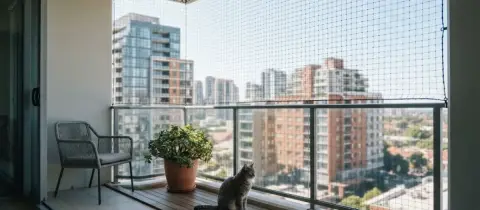
JUMXSRLE Wire-Reinforced Cat Netting
Steel-wire net you can cut to size; see our balcony netting guide
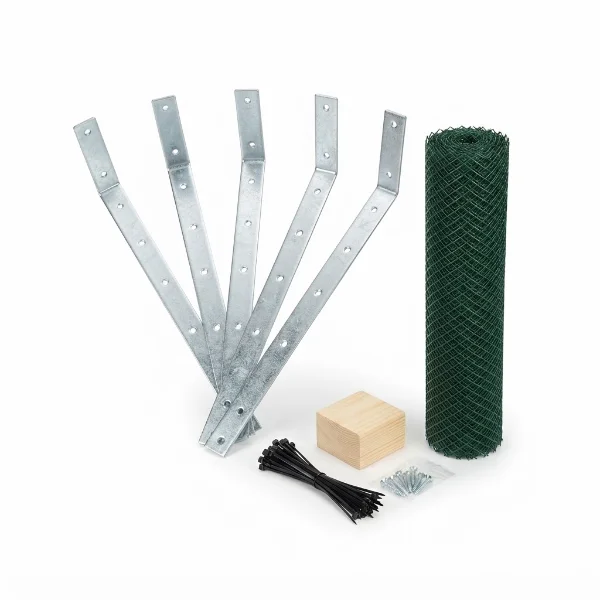
Cat Fence Anti Climb kit, silver brackets
Overhang brackets and mesh for the top of an existing fence; see our cat proof fence guide
Pictures are illustrations, not the actual products.
What is a catio?
A catio is a "cat patio": an enclosed outdoor space, such as a walk-in cage, a window box, a netted balcony or a fenced garden, that lets a cat enjoy fresh air and sun while staying on your property and away from traffic, other animals and wildlife.
RSPCA Australia recommends a safe, escape-proof enclosure or fenced space for cats with a balcony, courtyard or garden. It says an enclosure gives a contained cat more choice, activity and stimulation (RSPCA Australia, 20 June 2025). RSPCA Queensland adds that enclosures can be personalised, from platforms through to bedding (RSPCA Queensland, 1 December 2020).
Which type of catio suits your home?
Pick by what you own and what you're allowed to change. Renters and apartment dwellers usually suit a window box or balcony netting. A house with a yard can take a walk-in catio or a fence kit. Always check permission first, as the box near the end of this guide explains.
Window box
A small box that sits at a window so your cat can sit in the fresh air and watch the street. Our window catio guide compares three. Suits: flats, units and small homes. Watch out for: window type and size. Many Australian homes have sliding, awning or casement windows, so measure before you buy.
Walk-in or freestanding catio
A frame and mesh room you can step into, usually in the garden or on a patio. Suits: houses with a yard and cats who like to climb. Watch out for: the weight, the assembly and where it sits. Keep it out of hot afternoon sun and away from where dogs or other cats can reach it, since RSPCA Queensland lists safety from other animals as a reason for enclosures. A big structure may need council approval, so check with your council.
Attached lean-to or connected catio
A catio joined to the house by a cat door or a window so your cat can come and go. RSPCA Australia's Safe and Happy Cats guide recommends connecting a freestanding enclosure to the house so the cat can choose where to be (Safe and Happy Cats). Our cat door guide covers the flap. Watch out for: the join between house and catio, which needs sealing with no gaps, and a flap you can lock when you want your cat in.
Balcony netting
Net stretched across the open sides and top of a balcony. Our balcony netting guide covers fitting and no-drill options. Suits: apartments with a balcony. Watch out for: body corporate or landlord permission, plus gaps at corners and edges.
Cat-proof fence for the whole yard
Brackets and mesh fitted to the top of your fence so a cat can't climb over. Our cat proof fence guide compares two kits. RSPCA Australia's Safe and Happy Cats guide mentions modifying fence tops, cat-proof netting, checking gaps around gates, where the fence meets the building and overhanging trees, and a cat-proof fence height of at least two metres in total. Suits: owners who want the whole garden. Watch out for: shared fences and trees or sheds a cat could use as a ladder. Talk to your neighbours before fitting anything to a dividing fence.
Tunnels from house to catio
A mesh tunnel from a window or cat door to a catio lets your cat choose when to go out. Several window and walk-in catios have small doors for tunnel ports. Watch out for: a tunnel that heats up in full sun, so keep it shaded.
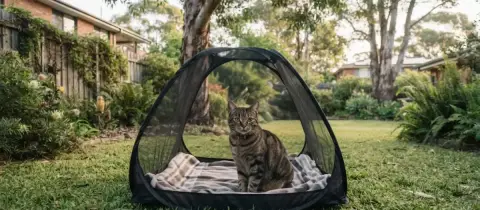
Pop-up tents
Pop-up tents and cage-style playpens are a quick, temporary option for supervised time. We haven't picked one: they are light, and wind can move them, so only use one while you're watching.
Catio types compared
| Type | Best for | Space needed | Effort | Main watch-out |
|---|---|---|---|---|
| Window box | Flats and units | A suitable window | Low | Window type and size |
| Walk-in catio | Houses with a yard | A flat patch of garden | High | Assembly, heat, council approval |
| Attached lean-to | Cats that come and go | A wall with a door or window | Medium to high | Permission and a secure join |
| Balcony netting | Apartments | A balcony | Medium | Strata or landlord permission, gaps |
| Fence kit | Whole garden | A sound fence | High | Shared fences, trees as ladders |
How big should a catio be?
Bigger is better, and height counts as much as floor area. Cats like to climb, so shelves, platforms and perches make a small footprint feel larger. Plan for more room if you have more than one cat. Make sure each cat can sit apart, hide and reach water without squeezing past another.
RSPCA Australia's Safe and Happy Cats guide gives no minimum enclosure floor area, so we don't state one. It does suggest cosy hiding places and cool shaded spots, which is a good reason to leave room for a box or covered bed. As a guide, the PetsCosset walk-in catio listing gives about 1.8 m tall, 1.8 m long and 1.2 m wide, with 2 resting houses and 6 platforms, which works out at roughly 2 square metres of floor. The window catio is about 2 m tall but only about 60 cm deep, and the listing says it suits 1 to 3 cats, but it works as a lookout rather than a room.
Is it cheaper to build or buy a catio?
It depends on your skills, tools and time. Building gives you a custom size, but you need to source wire, timber and fixings, and mistakes can leave gaps. A kit comes with pre-cut parts and instructions but still takes hours to put together. Netting and fence kits cost less effort than a full structure.
A DIY build lets you fit an odd space, such as a narrow side passage. The trade-off is welded mesh that must be fixed without gaps, a roof that sheds rain, and a latch your cat can't work out. A kit like the PetsCosset window catio has pre-drilled parts, but plan on a long session with two people for any unit that size. If you can't build safely, buy a kit or ask a handyperson. We left DIY plans out of this guide on purpose.
What should you put in a catio?
Give your cat things to do and places to hide. Good basics are shelves at different heights, a covered hiding spot, a scratching post, shade, fresh water and a safe plant such as cat grass. For stays of more than a short visit, add a litter tray. Skip string and ribbon toys.
- Shelves and perches: vertical space matters. Our outdoor cat tree guide compares weatherproof towers, and the cat tree guide covers indoor ones.
- A hiding spot: a covered bed or box, so your cat can feel hidden.
- Shade: a shade cloth or a roof cover over part of the catio, so your cat can pick sun or shade.
- Water: a heavy bowl that can't tip, or a fountain if there's power. See our cat water fountain guide.
- Safe plants: cat grass and catnip are easy choices. Never use lilies, which the ASPCA lists as toxic to cats (ASPCA). Check any other plant against a reliable toxic plant list first.
- Toys: a few cat toys that you put away when you leave. No string, ribbon or laser-only play.
- A litter tray: for longer stays, in a sheltered corner.
For more ideas on indoor play, see our cat enrichment guide.
Keeping your cat safe in a catio
Check the whole structure for gaps before your cat goes in, and supervise until you're sure. Look at the roof, latches, corners and where mesh meets the ground or wall. Provide shade, fresh water and a way back inside. Never leave a cat in a catio in heat or storms.
- Heat and shade: RSPCA Australia says outdoor pets need a cool, shaded, well-ventilated spot and a steady supply of fresh water, with extra containers in case one is knocked over (RSPCA Australia, 20 January 2021). Avoid putting a catio where hot afternoon sun hits, particularly on the west or north side of a house, and remember that metal and dark roofing can get hot. See our keep your cat cool in summer guide.
- Gaps and weak points: walk around the catio and press on the mesh, joins and door. Ask whether a determined cat or a wildlife visitor could get in or out.
- A secure latch: use a latch your cat can't open, and check it each time.
- A way back inside: a catio is not a reason to leave a cat outside for long periods. Bring them in when it's hot, stormy or you're away.
- Supervise early: stay nearby for the first visits until your cat is settled and you've seen how the structure copes with wind.
- Ticks: if you live where paralysis ticks are found, a catio doesn't remove the risk, so see our paralysis ticks guide.
Do vets and animal welfare groups recommend catios?
Animal welfare groups generally encourage keeping cats contained, and a catio is one way to do it. RSPCA Australia recommends an escape-proof enclosure or fenced space for cats with outdoor areas. A catio doesn't suit every cat or every home, so ask your vet if you're unsure.
RSPCA Queensland says enclosures can protect cats from traffic, other animals, disease and theft, and can help protect native wildlife (RSPCA Queensland, 1 December 2020). RSPCA Australia says an enclosure lets a contained cat enjoy being outdoors without the risks of roaming (RSPCA Australia, 20 June 2025). For the local rules side, Maribyrnong City Council's page says cats must be safely contained on their owner's property between 7pm and 7am each day (Maribyrnong City Council, read 22 October 2026). Rules differ elsewhere, so see our cat curfew rules guide.
How we chose
We picked one solid option for each catio type, then shortlisted products that met all of these checks:
- Well rated: a strong average rating with plenty of buyer reviews.
- No red flags: no pattern of poor reviews, safety complaints or listing problems.
- Available on Amazon Australia when we checked.
- Right for the type: one option per catio type, with the listing giving full dimensions and materials.
- Honest about limits: every pick has clear cons, and we only repeat the brand's claims as "the listing says".
These are researched picks, not products we've personally tested. We compared the specifications shown on each Amazon Australia listing on 30 Oct 2026. We didn't accept payment from any brand, and no brand saw this page before it was published.
Left out this time: pop-up tents and cage-style playpens (other sites cover them, and light tents can be blown over in wind, a general caution rather than a claim about one product), and DIY plans.
Our picks in detail
1. PetsCosset Walk-in Catio: best walk-in catio for a yard
A walk-in catio in solid fir, about 176.5 cm long, 119.4 cm wide and 180.3 cm tall. The listing gives reinforced steel wire mesh, a removable waterproof roof cover, 2 resting houses and 6 platforms. It has 2 small doors for connecting pet doors or tunnels, and the listing says two sets can be joined. The walk-in door is listed at about 145 cm, so taller people will duck.
- Pros: room for a person to step in; platforms and houses included; roof cover; doors for tunnels
- Cons: a big assembly job; wood needs care in wet weather; a roof cover is not shade on its own; may need council approval
- Best for: a house with a flat spot in the yard and a cat who likes to climb
- Skip it if: you rent, you have no yard, or you can't shade the spot from afternoon sun
We compare this walk-in catio with pop-up tents and tunnel sets in our cat enclosure guide.
2. PetsCosset Window Catio (wooden): best window catio
A tall wooden unit, about 173 cm wide, 60 cm deep and 205 cm high, that stands outside against the wall on four triangular legs and covers a window up to about 147 cm wide. The listing gives solid fir, a waterproof roof, high-density mesh, 3 large doors, 2 removable tunnel ports and 4 jump platforms, for 1 to 3 cats. Full details are in our window catio guide.
- Pros: pre-drilled parts; multiple platforms; tunnel ports; suits up to 3 cats, per the listing
- Cons: assembly is a long job for two people; it needs a suitable wall and window; shallow, so more of a lookout than a room
- Best for: a ground-floor window and a home with a wood or brick wall
- Skip it if: your window is wider than the listed range or you can't fix to your wall
3. JUMXSRLE Wire-Reinforced Cat Netting: best for balconies
A black HDPE (hard plastic) net with steel wire reinforcement and 3 x 3 cm mesh. The listing says it resists cat bites and the weather, and sun and ageing for up to 3 years. The linked size is 6 x 3 m (also 4 x 3 m and 8 x 3 m), and it can be cut to fit. The box includes rope, cable ties, screw-in hooks and anchors. See our balcony netting guide.
- Pros: can be cut to size; fittings included; listing says wire reinforced
- Cons: fitting takes time; check on arrival that the wire is actually in the net before you cut it; renters who can't drill need a no-drill method
- Best for: a balcony where you have permission to fit netting
- Skip it if: you rent and can't fix anything, or you want a ready-made room
4. Misc Home Cat Fence Anti Climb Kit, silver brackets: best for a whole backyard
A fence-top kit with overhang brackets so a cat can't climb over. The listing says 4 mm hot-dip galvanised steel brackets, 60 GSM plastic mesh, a corner wooden block, 100 cable ties and screws, with an instruction manual. Comes as a 15 m or 20 m kit. See our cat proof fence guide.
- Pros: covers the whole yard; uses your existing fence; hardware and ties included
- Cons: you need a sound fence; trees and sheds near the fence can still give a way over; a dividing fence is shared, so talk to the neighbour first
- Best for: a house with a tall, solid boundary fence
- Skip it if: your fence is weak, shared with a neighbour who objects, or you rent
When to get help
Treat heat stress as an emergency. RSPCA Australia lists heavy panting that keeps increasing, drooling, agitation or restlessness, very red or pale gums, vomiting, lethargy, weakness and muscle tremors. Move your cat somewhere cool, wet their fur with tepid or cool water, avoid ice-cold water, and go to a vet straight away.
Call your vet if your cat is hurt trying to get out of the catio, or if they seem stressed, hide a lot, over-groom, or start toileting outside the tray after a change to their routine. These can have medical causes, so a vet check comes before assuming it's the catio.
Check permission with your landlord, body corporate or council before fixing anything to a building, balcony or boundary fence.
Frequently asked questions
Is it safe to keep my cat outside in a catio?
It can be, once the catio is escape-proof, shaded and checked for weak points. Stay nearby at first, give fresh water, and always keep a way back inside. Don't leave a cat out in heat, storms or for long periods.
Can cats be happy with a catio?
Many can. A catio gives a cat fresh air, sun and things to watch, and RSPCA Australia says enclosures give contained cats more choice and stimulation. Cats differ, so watch how yours reacts and go slowly if they seem unsure.
What is a good size for a cat enclosure?
We couldn't find one agreed minimum from an Australian welfare group. Aim for height, perches, hiding spots and room for each cat to sit apart, and add space for every extra cat. See How big should a catio be? for what the listings give.
How does a catio connect to a window?
Either a window box sits at the window, or a tunnel or cat door links the window to a catio. The window catio listings include tunnel ports. Our window catio guide covers fitting, and a cat door can be an alternative.
Can I build a catio if I rent?
Possibly, but ask first. Fixings to walls, balconies or fences usually need written permission from your landlord, and a body corporate may have rules too. Freestanding or no-drill options are easier to remove, but still ask before you buy, and keep the answer in writing.
Do I need council approval for a catio?
Possibly, for a large or permanent structure. Rules differ between councils, so check with yours before you build or fix anything to a boundary fence. Our cat curfew rules guide covers containment rules. Use a harness and leash for supervised time outside while you plan.
Our catio and containment guides
- Cat netting for balconies: net, fittings and no-drill options for apartments
- Cat proof fence options: fence-top kits for the whole yard
- Window catio picks: window boxes and tall units compared
- Cat curfew rules in Australia: what containment rules mean for you
- Best cat prams: a safe, enclosed way to take your cat outside
Related guides
- Best cat prams
- Best outdoor cat houses
- Best cat trees
- Best cat toys
- Cat enrichment and indoor cat boredom
- Best cat harness and leash
- Cat doors and microchip cat flaps
- All our cat guides
- Outdoor cat trees for catios and runs
Sources
- RSPCA Australia, How to create a cat friendly contained environment for your cat and why it matters, 20 June 2025 (https://www.rspca.org.au/latest-news/blog/how-to-create-a-cat-friendly-contained-environment-for-your-cat-and-why-it-matters/)
- RSPCA Queensland, Cat enclosures, 1 December 2020 (https://rspcaqld.org.au/blog/pet-care/cat-enclosures)
- RSPCA Australia, Keeping your pet safe during heat, 20 January 2021 (https://rspca.org.au/blog/2021/keeping-your-pet-safe-during-heat)
- RSPCA Australia, Safe and Happy Cats guide, read 30 October 2026 (https://www.safeandhappycats.com.au)
- ASPCA, Lily (toxic and non-toxic plants) (https://www.aspca.org/pet-care/animal-poison-control/toxic-and-non-toxic-plants/lily)
- Maribyrnong City Council, Cat curfew, read 30 October 2026 (https://www.maribyrnong.vic.gov.au/Residents/Pets-and-animals/Cat-curfew)
- Product details from each linked Amazon Australia listing, checked 30 October 2026.
This guide provides general information and isn't a substitute for veterinary advice. If you're concerned about your cat's health or behaviour, speak with your vet.