Quick answer: A catnip plant is easy to grow in Australia if you give it full sun, well-drained soil and a drink when the soil dries out. Choose true catnip (Nepeta cataria), not ornamental catmint, and start from seed or a nursery seedling. Protect young plants from cats until they settle in.
Growing your own catnip means fresh leaves on hand, and a plant that comes back year after year. This guide covers which plant to buy, how to grow it in different Australian climates, how to protect it from your own cat, and how to dry it. If you're new to catnip, start with our guide to what catnip does to cats.
We didn't find catnip seed kits on Amazon Australia that we were happy to recommend, so buy seed or a seedling from a local nursery or garden centre.
What is a catnip plant?
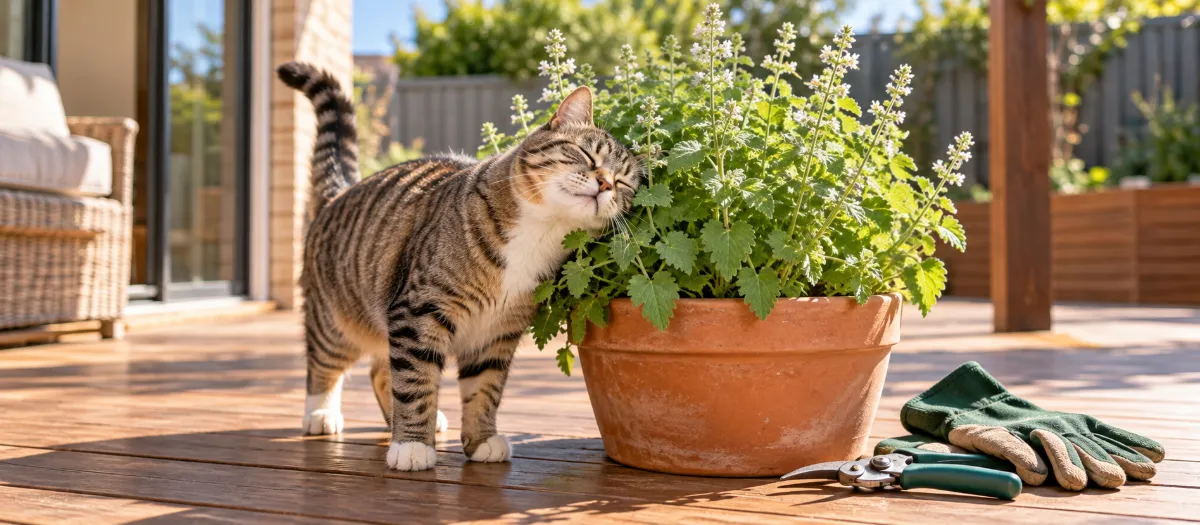
Catnip is a leafy perennial herb with the botanical name Nepeta cataria. Its leaves are toothed and grey-green, with small white or pale pink flowers on spikes, and it tends to grow in loose, untidy clumps (Gardener's Path). Many cats react to it by sniffing, rubbing and rolling.
In a 2017 study of 100 domestic cats, 68% responded to catnip, so about one in three didn't (Bol et al., BMC Veterinary Research, March 2017). The cats in that study showed sniffing, licking, cheek rubbing, rolling and kicking with the back legs. So a catnip plant is a fun extra for most cats, but not a sure hit.
Catnip or catmint: which should you grow?
Grow catnip (Nepeta cataria) if you're growing it for your cat. Garden centres also sell catmint, such as Nepeta x faassenii, which looks pretty but contains much lower levels of the compound that affects cats. Cats may nibble catmint, but usually don't react as strongly (Gardener's Path).
Check the botanical name on the plant label, because "catmint" is often used loosely. Here's how the two compare.
| Catnip | Ornamental catmint | |
|---|---|---|
| Botanical name | Nepeta cataria | Nepeta x faassenii (and similar) |
| Effect on cats | Strong for many cats | Usually much milder |
| Look | Loose, untidy grey-green clumps with pale flowers | Neat mound with lilac flowers |
| Spread | Tends to spread readily | Faassen's catmint is described as sterile |
| Best for | A cat plant or herb pot | Garden beds |
The table is from Gardener's Path (as above). If your goal is enrichment, catnip is the one to look for.
How do you grow catnip in Australia?
Catnip likes at least six hours of full sun a day and well-drained soil enriched with organic matter. Sow seed 5 mm deep, expect seedlings in about 10 to 20 days, and water when the soil about 5 cm down is dry (an Australian seed supplier's growing guide).
Here's a simple way to do it:
- Pick your time. The supplier's chart suggests sowing in January to March and October to December in cool zones, January to April and September to December in temperate zones, and April to September in subtropical, tropical and arid zones. Check the chart for your area.
- Choose a sunny spot. At least six hours of sun a day, with soil that drains well. Weed the area, loosen the soil and mix in compost.
- Sow or plant. Press seed 5 mm deep. If you buy seedlings, move them out once they have their first true leaves and are about 5 to 10 cm tall, spaced 60 cm apart.
- Water sensibly. Keep seedlings moist but never soggy. Once they're growing, water deeply when the soil 5 cm down is dry, and try to keep the leaves dry to cut the risk of fungal problems.
- Skip the fertiliser. The grow guide says plants tolerate poor soil and don't need feeding in the ground. That's handy for cat safety too, since you don't need to put products down where your cat walks.
- Tidy up after flowering. Prune spent stems to encourage new growth, and cut plants back just above the ground in late autumn, or remove dead foliage when new leaves appear in spring.
What about frost and heat? Catnip is a perennial that lives for several years, but the grow guide says plants may die back in cold weather. In cool climates it suggests starting seed indoors about six weeks before the last expected frost. In hot places, the main job is watering when the top layer has dried out. Your local nursery will know what suits your area best.
Can you grow catnip in a pot or indoors?
Yes. A pot suits catnip well, because the plant can spread. Use good-quality potting mix in a container of at least 10 litres, and expect to feed container plants, as the grow guide says they may need extra fertiliser. Choose a pet-safe fertiliser product and keep it away from your cat.
Gardener's Path says growing catnip in containers helps contain this spreader, and indoor plants need a sunny spot such as a south-facing windowsill. In Australia that would mean a north-facing one, but the idea is the same: the brightest window you have. Rotate the pot every few days so it doesn't get leggy, and let the soil dry between waterings (Gardener's Path).
A pot also makes it easier to move the plant out of reach. A hanging basket works if your cat can't jump to it.
How do you stop cats destroying a catnip plant?
Cover young plants with a cage until they're established. Cats that respond to catnip like to rub, roll and chew, and a small seedling won't survive that. Fencing offers protection from curious cats (Gardener's Path). A wire cage, such as an upturned hanging basket or a tomato cage, does the same job.
Some ideas that work together:
- Cage it until it's tall. Remove the cage once the plant is well established, and let your cat have supervised access.
- Raise it. A hanging pot or a high shelf keeps it out of reach until you decide to harvest.
- Give your cat a share. Offering a pinch of picked leaves, or a catnip toy, can take the pressure off the plant.
- Pick often. Regular harvesting keeps the plant bushy.
How do you harvest and dry catnip?
Pick leaves and flowers when the plant is in bloom, because flowering raises the oil concentration. You can pick small amounts as needed, or up to a third of the plant at once by cutting the top third of each stem. Hang stems in a dark, dry place until the leaves crumble easily (Gardener's Path).
Once dry, strip the leaves and flowers off the stems and crumble them. Keep dried catnip in a tightly lidded jar in a dark cabinet. Fresh leaves and flowers are best used right away, though they can be kept in a zippered bag in the fridge for a few days (same source).
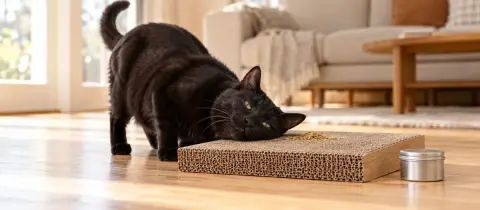
Dried catnip is handy for a homemade toy (no string, ribbon or small parts, and supervise play) or for sprinkling in a small amount on a scratching post. Keep the amount modest. Use only the plant itself. We don't recommend sprays, which are usually made with plant oil or extract.
Is a catnip plant safe for cats?
The ASPCA's plant list marks catnip as toxic to cats, but the only signs it gives are vomiting and diarrhoea, and it notes catnip sedates some cats and stimulates others (ASPCA). So offer small amounts and don't let your cat eat the whole plant.
The bigger risks are what surrounds the plant:
- Garden chemicals. Don't use snail bait, pesticides or lawn chemicals where your cat roams. Signs of poisoning are urgent (see the vet box below).
- Lilies. All parts of a lily are highly toxic to cats, and even a small amount can cause kidney failure, so never grow lilies near your catnip or keep them in your home (RSPCA Australia knowledge base, updated 18 December 2024). See our list of toxic plants and household items.
- Spreading. Catnip tends to spread readily (Gardener's Path). If you garden near bushland, check with your local council before planting it, and keep it in a pot if you're unsure.
Catnip is enrichment, not a treatment. It doesn't treat anxiety or stress, and a cat with a sudden change in behaviour should see a vet.
No garden, or a cat that ignores catnip?
A garden isn't needed. Our guide to the best catnip toys covers ready-made options for apartments and rentals, and about one in three cats didn't respond to catnip in the 2017 study anyway. In that study, 79% of cats responded to silvervine, and 22 of the 31 cats that ignored catnip (71%) responded to it (Bol et al., BMC Veterinary Research, March 2017).
Our silvervine guide is the next stop if catnip does nothing for your cat.
If your cat likes chewing plants, a pot of safe grass may suit better. See our guide to cat grass.
When to see your vet
Ring your vet or an emergency clinic straight away if:
- your cat may have chewed a lily or another toxic plant (this is urgent, even if your cat seems fine)
- your cat shows signs of poisoning after garden chemicals, such as drooling, tremors or wobbliness
In Australia you can also call the Animal Poisons Helpline on 1300 869 738 (24 hours, 7 days). It's also on our Cats page.
Book a vet visit if vomiting or diarrhoea continues after your cat has eaten plants, or if your cat's behaviour changes suddenly.
Frequently asked questions
Is catnip easy to grow in Australia?
Yes, in most areas. Catnip needs full sun, well-drained soil and water when the top layer has dried. An Australian seed supplier gives different sowing times for cool, temperate and warmer zones, so check which one you're in. Plants can die back in cold weather. See how to grow catnip.
When should I plant catnip seeds?
It depends on your climate zone. An Australian seed supplier's chart suggests January to March and October to December in cool zones, and January to April and September to December in temperate zones. In warmer zones it suggests April to September. Check the chart for your area before you sow.
Does catnip come back every year?
Catnip is a perennial that lives for several years, so it can return each season. An Australian seed supplier says plants may die back in cold weather, and suggests cutting back just above the ground in late autumn. Pick a permanent spot that won't be dug over.
Is catmint the same as catnip?
No. Both are Nepeta species, but catmint such as Nepeta x faassenii has much lower levels of the compound that affects cats, so most cats react less. If you want a plant for your cat, look for Nepeta cataria on the label. See catnip or catmint.
Will a catnip plant attract neighbourhood cats?
It could. About two in three cats respond to catnip in the study we read, so any cat that does may be drawn to a plant growing in an open garden. If that worries you, keep the plant in a pot or cage it, or grow it indoors.
Can I give my cat fresh catnip leaves?
Yes, in small amounts. The ASPCA gives vomiting and diarrhoea as the only signs, and Texas A&M's vet school says too much can cause nausea and vomiting (Texas A&M, 5 December 2019), so offer a pinch rather than a handful. Fresh leaves are best used right away (Gardener's Path). If your cat is unwell afterwards, call your vet.
Related guides
Sources
- The Seed Collection: How to grow catnip seeds (Australian grow guide)
- Gardener's Path: Learn how to plant and grow catnip
- Gardener's Path: Catnip vs. catmint, what's the difference?
- Bol et al. Responsiveness of cats (Felidae) to silver vine, Tatarian honeysuckle, valerian and catnip. BMC Veterinary Research, March 2017
- ASPCA: Catnip, toxic and non-toxic plants
- Texas A&M School of Veterinary Medicine: Feline fine, the benefits of catnip (5 December 2019)
- RSPCA Australia knowledge base: Are lilies toxic to cats? Updated 18 December 2024
This guide provides general information and isn't a substitute for veterinary advice. If you're concerned about your cat's health, speak with your vet.