Quick answer: What does catnip do to cats? In cats that respond, sniffing it usually triggers a short burst of rubbing, rolling, licking and play, lasting about 10 to 30 minutes, then the interest fades. It's inherited, so some cats never react. Our top toy pick is the Yeowww! Catnip Toy, Yellow Banana.
If you've ever watched a cat go glassy-eyed over a toy and wondered what's going on, this guide explains it. We cover why cats react, why some don't, whether catnip is safe (including for kittens), how to use it, and what to try if it does nothing. Our detailed picks live in the catnip toys guide, the silvervine guide and the cat grass guide.
Quick picks
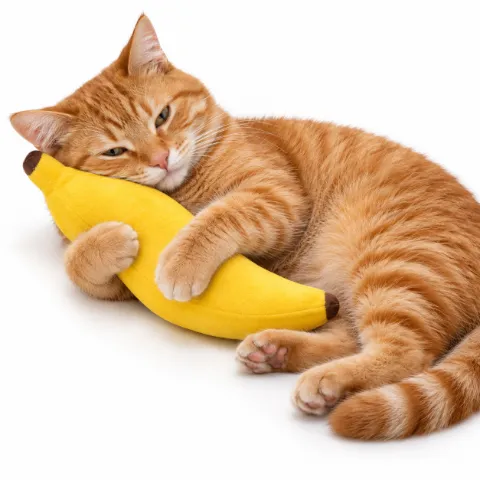
Yeowww! Catnip Toy, Yellow Banana
A catnip-filled banana the listing describes as handmade and filled with organic catnip
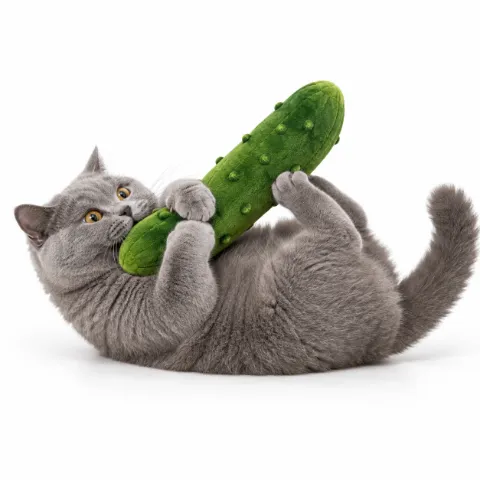
Catstages Crunchy Pickle Kicker
A kicker-style toy for cats who like to grab and bunny-kick
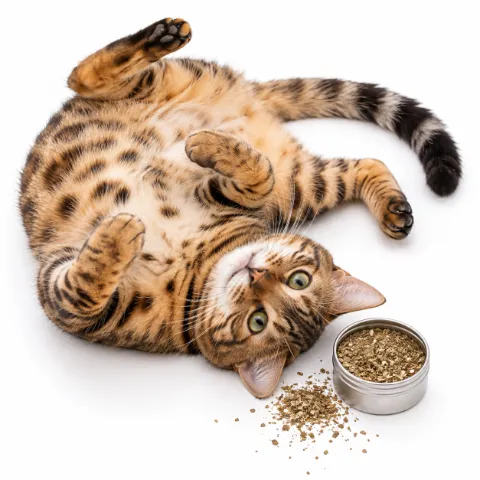
Meowy Janes Silver Vine for Cats
A silvervine powder in a reusable tin
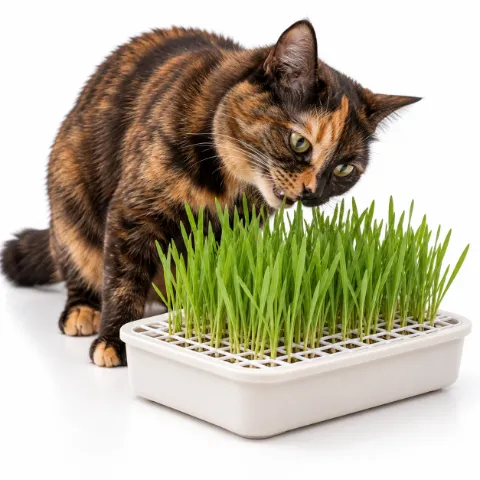
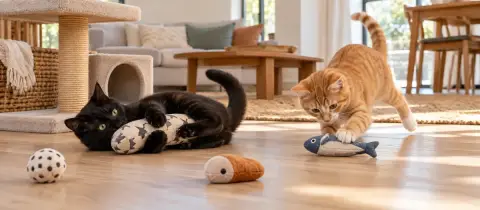
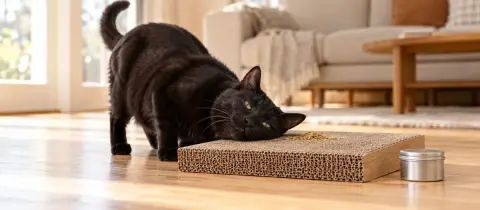
Pictures are illustrations, not the actual products.
Full details, pros and cons for each are in the linked guides: catnip toys, silvervine and cat grass. There's a short summary of each pick near the end of this page.
What does catnip do to cats?
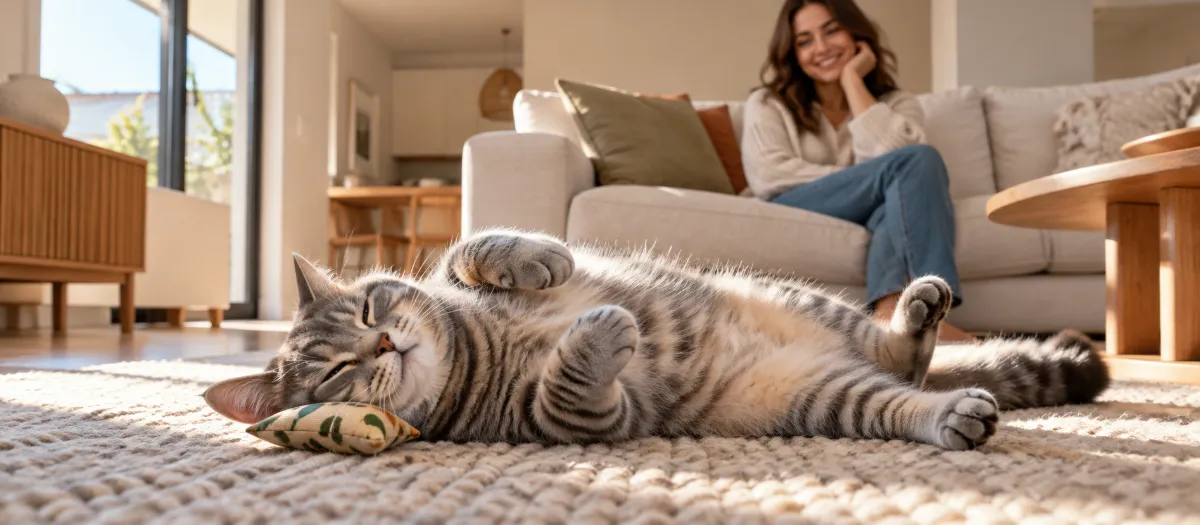
In cats that respond, catnip usually causes a short burst of sniffing, licking, chewing, head and cheek rubbing, rolling and playfulness. International Cat Care describes the effects as harmless, nonaddictive and short-lived (International Cat Care, updated 26 September 2025). Some cats get excited, and others seem mellow.
Texas A&M's vet school says smelling catnip can act as a stimulant for some cats, while eating it can have a sedative effect, and that the reaction lasts about 15 to 30 minutes (Texas A&M School of Veterinary Medicine, 5 December 2019). PetMD puts it at around 10 minutes (PetMD, updated 31 January 2025), so expect a short spell of about 10 to 30 minutes. Texas A&M also notes that not every cat is susceptible and that frequent exposure might reduce the effect.
A typical session might look like this: your cat sniffs the toy, rubs a cheek along it, grabs it with both front paws, bunny-kicks it, then rolls over and walks off. Context matters. A cat who swats or growls at the toy may just be overstimulated, so give space (see the safety section below).
Why do cats like catnip?
The plant contains an oil called nepetalactone, and when a cat sniffs it, the oil enters the nasal tissue and sets off the behaviours above. Texas A&M's vet school says nepetalactone is found in the leaves and stems, and that it's thought to act on the same receptors as natural cat pheromones (Texas A&M, 5 December 2019).
Why would a plant do this? Researchers think the rubbing may be useful for cats. A 2021 study in Science Advances found that rubbing on silvervine spread a compound called nepetalactol onto the face and head, and that this repelled mosquitoes (Uenoyama et al., Science Advances, January 2021). The same paper reported that nepetalactol raised a feel-good chemical (β-endorphin) in cats. The study focused on silvervine, though it also tested catnip's nepetalactone on a small group of cats, and the mosquito idea is a possible explanation, not a settled one.
The reaction is about smell, so a cat doesn't need to eat the plant to feel it. If you'd like to know why a cat that loves one toy ignores the next, the next section explains.
Why doesn't my cat react to catnip?
Most often because the response is inherited, and a good share of cats simply don't have it. International Cat Care says the response is hereditary (International Cat Care, updated 26 September 2025). In a 2017 study of 100 domestic cats, 68% responded to catnip, so about one in three didn't (Bol et al., BMC Veterinary Research, March 2017). A non-responding cat isn't unwell.
Other reasons to check:
- Age. Young kittens often don't react. International Cat Care says kittens under about three months old don't respond to catnip, and some cats only start responding when they're older (International Cat Care, updated 26 September 2025).
- Freshness. Texas A&M says some cats prefer fresh catnip over dry, or the other way around. Dried catnip kept open for a long time can lose its smell, so store it sealed and use a fresh pinch (PetMD says catnip loses potency over time, so keep it in an airtight container: PetMD, updated 31 January 2025).
- Too much, too often. Frequent exposure might reduce the effect, so keep it for occasional use.
Why do Australian cats not like catnip?
We didn't find any evidence that Australian cats respond differently from cats anywhere else. The reasons above (inherited response, age and stale catnip) explain it better. A shop-bought catnip toy that's been on a shelf a long time may also just be tired.
If your cat doesn't respond, try silvervine. In that study, 22 of the 31 catnip non-responders tested on every plant (71%) responded to silvervine (Bol et al., 2017). Our silvervine guide has the picks.
Is catnip safe for cats and kittens?
Catnip is generally low risk in small amounts. The ASPCA's plant list marks catnip as toxic to cats, but the only signs it gives are vomiting and diarrhoea, and it notes catnip sedates some cats and stimulates others (ASPCA). Texas A&M's vet school says overdose is unlikely, though too much can cause nausea and vomiting.
For kittens, International Cat Care says kittens under about three months old don't respond to catnip, and says it's harmless and short-lived. It doesn't give an age at which it becomes unsafe. If you'd like to introduce it to a young kitten, a small pinch of dried catnip is plenty, and ask your vet if you're unsure.
A few common-sense points:
- If your cat eats a lot and vomits, remove the catnip, as Texas A&M advises.
- Some cats get over-excited and swat or bite at hands, so keep your hands out of the way and give your cat space.
- Don't use catnip as a way to calm a stressed or anxious cat. It's enrichment, not a treatment. If your cat's behaviour changes suddenly, book a vet check.
- If you grow catnip, keep lilies out of the home entirely. All parts of a lily are highly toxic to cats, and even a small amount can cause kidney failure (RSPCA Australia knowledge base, updated 16 October 2026). See safety, plants and household items.
How much catnip should you give, and how often?
A small pinch, now and then, is plenty. There's no official dose, so we won't invent one. Texas A&M's vet school says to be careful how often you offer catnip because frequent exposure might reduce the effect, and your vet can advise on your own cat.
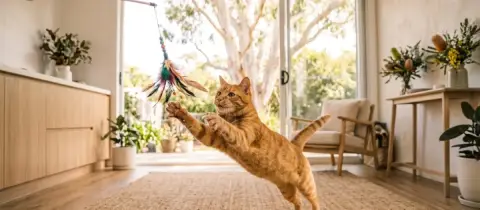
A simple routine is to bring a catnip toy out for play sessions, then put it away in a sealed container. That keeps the smell strong and stops your cat getting used to it. Pair it with a wand toy from our cat toys guide for a bit of active play.
How do you give catnip? Dried, toys or the plant
You can offer dried catnip, a catnip-filled toy, or a growing plant. A toy is the tidiest, a pinch of dried leaves rolled between your fingers can liven up a scratching post, and a plant gives a fresh supply. Best Friends Animal Society suggests rolling catnip between your fingers to release the oil (Best Friends Animal Society).
- Toys. Most cats get a good workout from a toy they can grab and kick. Check toys for damage and throw out any that are torn, because filling or stuffing shouldn't be swallowed. Toys with tails, feathers or bells are for supervised play. See our best catnip toys.
- Dried catnip. Sprinkle a small pinch on a scratching post or cat tree, or into a puzzle toy. Our cat trees guide has sturdy options.
- Growing plant. Our guide to growing catnip covers pots, sun and picking.
- Food puzzles. Catnip is for play, not meals. For mealtime games, see cat puzzle feeders for wet food.
We don't recommend catnip sprays. They're often made with plant oil or extract, and we left them out of every pick.
Catnip vs silvervine vs cat grass
These three get mixed up all the time. Catnip and silvervine are scent plants that some cats react to, while cat grass is a plant to nibble and doesn't work the same way.
| Plant | What it is | What it does | How to use it |
|---|---|---|---|
| Catnip | A mint-family herb containing nepetalactone | Triggers rubbing, rolling and play in cats that respond | Dried pinch, toy or plant, occasionally |
| Silvervine | A vine whose leaves and fruit contain nepetalactol | Triggered a response in 79% of cats in a 2017 study (Bol et al., March 2017) | Powder or toy, occasionally |
| Cat grass | Young grass such as oat or wheat, grown in a pot | Something safe to nibble; not a scent high | Keep a pot growing; see our cat grass guide |
Silvervine is worth trying if your cat shrugs at catnip, though responses vary from cat to cat. Compare options in our silvervine guide.
How we chose
We looked at catnip toys, silvervine and cat grass products on Amazon Australia and shortlisted products that met all of these checks:
- Well rated: a strong average rating with plenty of buyer reviews.
- No red flags: no pattern of poor reviews, safety complaints or listing problems.
- Available on Amazon Australia when we checked.
Each guide adds its own checks. For this page, we also looked for products made for cats with no sprays or oils, no string, ribbon or rope.
These are researched picks, not products we've personally tested. We compared the specifications shown on each Amazon Australia listing, checked on 20 Oct 2026. We didn't accept payment from any brand, and no brand saw this page before it was published.
Left out this time: catnip and silvervine sprays (they're usually made with plant oil or extract); rope and string chew toys; toys with small parts we weren't comfortable with; and refill-style toys and silvervine sticks that didn't pass our checks.
Our picks in brief
1. Yeowww! Catnip Toy, Yellow Banana: best catnip toy
A banana-shaped toy the listing says is handmade, made in the USA and filled with 100% organic catnip. It's a good first catnip toy to find out whether your cat responds. Full comparison in our catnip toys guide.
- Best for: cats who like to grab, carry and kick
- Skip it if: your cat has shown no interest in catnip before, or you want a toy for unsupervised chewing
2. Catstages Crunchy Pickle Kicker: best kicker
A kicker-style toy. The listing gives little detail beyond the title, so check the size and material on the page before buying. See the catnip toys guide for how it compares.
- Best for: cats who like to wrap their paws around a toy and bunny-kick
- Skip it if: your cat prefers small toys to bat around, or your cat doesn't react to catnip
3. Meowy Janes Silver Vine for Cats: for cats who ignore catnip
A 45 g tin of silvervine granules, which the listing says are processed in the USA from raw fruit. Powder means no hard pieces to chew. The listing makes stronger claims about how cats react, so treat those with caution and see the silvervine guide.
- Cons: Imported, so check the delivery details on Amazon before you order
- Best for: cats who ignore catnip
- Skip it if: you want a sprinkle-free option, or your cat has no response to either plant. Silvervine isn't a treatment for anxiety.
4. Catit Grass Planter: something to grow
A planter designed for growing cat grass. It has a low grid cover over the planter to make digging and knock-overs harder. This is cat grass, not catnip. The listing bullets don't mention seeds, so check what's included in the box before you order. More in the cat grass guide.
- Best for: cats who like to nibble greenery
- Skip it if: you want a ready-to-go kit that includes seeds and growing medium, or you want something that triggers a catnip-style reaction
When to see your vet
Book a vet visit if your cat has:
- a sudden change in behaviour, such as new aggression, hiding or restlessness
- aggression that doesn't settle once the catnip is gone
- vomiting or diarrhoea that continues after eating plants or catnip
- over-grooming, or other signs of stress
See a vet straight away if your cat may have chewed or eaten a lily or another toxic plant. For lilies, even a small amount, or water from a vase, can be an emergency. Catnip and silvervine are enrichment, not a treatment for anxiety or stress. The RSPCA Australia knowledge base lists where to find plant safety information.
Frequently asked questions
Is catnip like getting high for cats?
It's often described that way, and Texas A&M's vet school uses the word "high" for the short reaction. But we can't know what a cat feels. Researchers have linked a similar plant compound to a rise in a feel-good chemical in cats (Uenoyama et al., 2021).
Is it okay to give cats catnip daily?
There's no official limit, so ask your vet. Texas A&M advises care about how often you offer it because frequent exposure might reduce the effect. We'd keep it for play sessions and store it sealed. See how much and how often.
What do vets think of catnip?
The vet sources we opened treat it as low risk for most cats. International Cat Care calls it harmless, nonaddictive and short-lived, Texas A&M says overdose is unlikely, and the ASPCA lists it as toxic to cats with vomiting and diarrhoea as the signs. Ask your own vet if unsure.
Can kittens have catnip?
International Cat Care says kittens under about three months don't respond, so a young kitten ignoring it is normal. Try again when they're older. Meanwhile, see kitten toys that suit young kittens. International Cat Care calls catnip's effects harmless, nonaddictive and short-lived. See safety for cats and kittens, and ask your vet if you have concerns.
Does catnip calm cats down?
Sometimes, but not reliably. Texas A&M says smelling it can stimulate a cat while eating it can be sedating, so the effect differs from cat to cat. Don't use catnip as a treatment for stress or anxiety. A vet can help with those.
Why do Australian cats not like catnip?
We found no evidence that Australian cats differ. The response is inherited, kittens don't react early, and stale catnip loses its smell. Store dried catnip sealed and offer a fresh pinch. Read more under why doesn't my cat react, then try silvervine.
Related guides
- Best catnip toys for cats
- Best silvervine for cats
- Cat grass: what it is and how to grow it
- How to grow a catnip plant
- Cat enrichment ideas for indoor cats
- Best cat toys
- Best cat trees
- Best cat puzzle feeders for wet food
Sources
- International Cat Care: Why do cats..? (updated 26 September 2025)
- International Cat Care: Playing with your cat (updated 26 September 2025)
- Texas A&M School of Veterinary Medicine: Feline Fine, the benefits of catnip (5 December 2019)
- ASPCA: Catnip, toxic and non-toxic plants
- Uenoyama et al., Science Advances, January 2021: response of domestic cats to plant iridoids and mosquitoes
- Bol et al., BMC Veterinary Research, March 2017: cat responses to silver vine, Tatarian honeysuckle, valerian and catnip
- PetMD: What is catnip? (updated 31 January 2025)
- RSPCA Australia knowledge base: plants that might be poisonous for pets (updated 16 October 2026)
- Best Friends Animal Society: What does catnip do to cats?
This guide provides general information and isn't a substitute for veterinary advice. If you're concerned about your cat's behaviour or health, speak with your vet.