Quick answer: Cat curfew rules in Australia depend on where you live, as there's no single national cat curfew. The ACT requires cats born after 1 July 2022 to be contained, and City of Melbourne requires cats contained between 6pm and 8am. Rules differ by council, so check your own council's website before relying on any summary.
This guide explains where cats must be kept in, what the rules we checked say, how to find your own council's rule and how to keep a cat settled at home. If you want safe outdoor time as well, our catio ideas hub covers the options. Laws change, and this is general information, not legal advice: check your council or state government for the current rule.
Do cats have a curfew in Australia?
Not nationwide. There is no single cat curfew that applies everywhere. The ACT has a territory-wide containment rule, in Victoria cat curfews are set council by council, and NSW law doesn't require cats to be kept indoors. Where you live decides the rule, so your council is the place to check.
Some rules are a night curfew, some keep a cat on the owner's property around the clock, and some only ban cats from certain areas. Everything below was checked against the pages we cite in late October 2026, and council rules in particular can change.
Cat curfew rules by state and territory
Here is the short version of what we found, followed by a bit more detail for each place. If your council isn't named, that doesn't mean it has no rule. It means we haven't verified it, so check with your council.
| State or territory | Statewide rule | Who sets local rules | Example | Source checked |
|---|---|---|---|---|
| ACT | Cats born after 1 July 2022 must be contained | Territory-wide, plus declared containment suburbs | All cats contained in declared suburbs | ACT City Services, 30 Oct 2026 |
| NSW | No requirement to keep cats indoors | Councils (wildlife protection areas) | Cats banned from signposted wildlife protection areas | NSW Office of Local Government, 30 Oct 2026 |
| Victoria | No statewide curfew found | Councils | Melbourne 6pm to 8am; Maribyrnong 7pm to 7am | Council pages, 30 Oct 2026 |
| Queensland | No statewide curfew found | Councils (local laws) | Ipswich: contained to house or enclosure | Ipswich City Council, 30 Oct 2026 |
| South Australia | Dog and Cat Management Act 1995 | Councils (by-laws) | Check your council | Dog and Cat Management Board, 30 Oct 2026 |
| Western Australia | Councils can't currently set cat curfews | State (a bill would change this) | Bill not yet law | WA Government and Parliament, 30 Oct 2026 |
| Tasmania | No statewide containment requirement | Councils may make by-laws | Cats can be trapped in declared prohibited areas | NRE Tasmania, 6 Jan 2026 |
| Northern Territory | Not checked statewide | City of Darwin by-laws | Darwin: cat contained on its premises | City of Darwin, 30 Oct 2026 |
ACT
The ACT has a territory-wide rule. All cats born after 1 July 2022 must be contained on the owner's property, and in suburbs declared cat containment areas, all cats of any age must be contained. ACT City Services says containment means keeping the cat on your premises 24 hours a day. That can be the house or apartment, an enclosed area in a backyard or courtyard, a cat crate, or on a leash (ACT City Services, "Cats", read 30 October 2026).
NSW
The Companion Animals Act 1998 doesn't require owners to keep cats indoors. Cats are banned from wildlife protection areas, which local councils designate and signpost, and from public areas where food is prepared or eaten. A cat can also be declared a nuisance, for example if it repeatedly defecates on property other than where it lives (NSW Office of Local Government, "Nuisance pets", page updated 1 July 2024, read 30 October 2026).
Victoria: is there a statewide cat curfew?
In Victoria, cat curfews are set council by council, and we found no statewide curfew. Some councils now have one, and others are bringing one in. We cover the Melbourne, Maribyrnong and Merri-bek examples in the Melbourne section below. A council that isn't listed there may still have a rule, so check yours.
Queensland
We found no statewide curfew in Queensland, and local laws vary by council. As one example, Ipswich City Council says cats aren't allowed to roam and must be contained to the house or a suitable enclosure at all times, and keepers must meet the council's local laws (Ipswich City Council, "Cat Owner Obligations", read 30 October 2026). Other Queensland councils may differ, so check yours.
South Australia
State law is the Dog and Cat Management Act 1995. Councils handle day-to-day administration and can set by-laws that apply in their own area only (Dog and Cat Management Board, "Legal responsibilities for cat owners", read 30 October 2026). We haven't verified any individual South Australian council's cat rule, so check your council's by-laws.
Western Australia: what are the new cat laws?
WA's new cat laws are a bill, not law yet. The Cat Amendment (Local Laws) Bill 2026 would let local governments restrict cats to their owners' premises, keep them out of public areas or set curfews. Under the current Cat Act 2011 they can't. Until it passes, no WA council can run a cat curfew.
WA is in the middle of a change. Under the current Cat Act 2011, local governments can't introduce cat containment rules or curfews, according to a City of Cockburn statement of 11 June 2026 (City of Cockburn). The Cat Amendment (Local Laws) Bill 2026 would let local governments restrict cats to owners' premises, keep cats out of public areas or introduce curfews (WA Government, media release published 23 February 2026, updated 17 June 2026). When we checked on 30 October 2026, it was at second reading in the Legislative Council, so it wasn't yet law (Parliament of Western Australia, Progress of Bills, Bill No. 53).
Tasmania
Tasmania has no statewide requirement to contain cats, but councils may make containment by-laws, and cats in declared cat prohibited areas can be trapped (NRE Tasmania, "Roaming and nuisance cats FAQs", published 6 January 2026).
Northern Territory
City of Darwin by-laws require a cat to be properly contained on its premises and under effective control off them. Some areas, including around Casuarina Coastal Reserve and Lee Point, have extra cat controls (City of Darwin, "Animal by-laws and infringement offences"). We haven't checked other Northern Territory councils.
Cat curfew in Melbourne: what the City of Melbourne requires
The City of Melbourne requires all cats to be contained to their owner's property between 6pm and 8am. Council resolved this on 1 April 2025, and it has been in effect since 1 October 2025. If you live in another Melbourne council area, a different rule may apply, so check your own council.
According to The Age, City of Melbourne allows cats out during curfew hours on a leash (The Age, 16 October 2025). Check the council's page for the current wording before you rely on that (City of Melbourne, "Cat containment", read 30 October 2026).
Nearby councils have their own rules:
- Maribyrnong: Maribyrnong City Council's page says cats must be safely contained on their owner's property between 7pm and 7am each day (Maribyrnong City Council, "Cat curfew", read 30 October 2026). Its announcement of 29 May 2026 gives a start date of 1 July 2026 and says residents can still give cats outdoor time through enclosed outdoor areas, cat-proof fencing or supervised time (Maribyrnong City Council, "Safer nights for cats and wildlife in Maribyrnong").
- Merri-bek: the council adopted a curfew with its 2025 to 2029 animal management plan. From 1 April 2027, cats registered before that date must be contained from 7pm to 7am, and cats registered after it must be contained 24 hours a day. That start date is still in the future (Merri-bek City Council, 13 November 2025).
Are cats allowed outside in Melbourne?
Yes, but in the City of Melbourne only between 8am and 6pm, or on a leash during curfew hours according to The Age's report, and other Melbourne councils set their own rules. Maribyrnong's curfew runs 7pm to 7am and Merri-bek's starts on 1 April 2027. Check your own council's page before relying on this.
How do I find my council's cat rules?
Search your council's website for "cat" or "cat containment", or look in its animal management plan. If you can't find a clear answer, phone the council and ask. Your registration renewal notice or council newsletter may also mention changes, so read them when they arrive.
A few practical steps:
- Search the council site for "cat curfew", "cat containment" or "pets and animals".
- Check the animal management plan. Many councils publish one, and new cat rules often appear there first. Merri-bek's curfew was adopted with its plan.
- Ask the council directly if the wording is unclear. Ask what counts as contained (house, enclosure, leash) and which hours apply.
- Check body corporate or lease rules too, which can sit on top of council rules.
- Note the date you looked. Rules change, and some start dates are in the future.
Why do councils bring in cat curfews?
Councils and animal welfare groups point to the safety of cats and the protection of wildlife, and councils also respond to nuisance complaints. RSPCA Australia supports keeping cats contained to the owner's property, not necessarily indoors only, and recommends a secure, escape-proof enclosure or fenced space.
RSPCA Australia's blog on keeping cats contained says exactly that: containment doesn't have to mean the house alone (RSPCA Australia, 20 June 2025). Maribyrnong's announcement is titled "Safer nights for cats and wildlife", which gives a sense of how that council frames its curfew. In NSW, the rules we checked deal with wildlife protection areas and nuisance cats. Whether curfews are the right approach is something people disagree on, and this guide doesn't take a side. Its job is to help you follow the rule where you live.
What happens if my cat is out during curfew?
It depends on the council. As one example, City of Melbourne says its officers may investigate reports, cat traps can be hired, and owners may face fees and other enforcement action, including fines. Other places can trap cats in some areas or act on nuisance complaints.
In Tasmania, for example, cats in declared cat prohibited areas can be trapped, and in NSW a cat can be declared a nuisance. Fines may apply in some places, but we haven't printed amounts because they change. Your council's page will give the current position. If your cat has slipped out once, bring them in calmly and look at how they got out, rather than waiting for a complaint.
How to keep your cat in at night
Make the evening routine do the work: feed dinner indoors at dusk, close the cat flap and doors before the curfew starts, and give your cat something worth coming home to. A cat that is fed, played with and comfortable inside is more likely to settle. Every cat is different, so be patient.
Some ideas to try:
- Feed indoors at dusk, at the same time each day, so coming in becomes part of the routine.
- Do an evening play session before bed. Wand toys with a toy at the end work well, and put them away afterwards. Our cat toys guide has ideas.
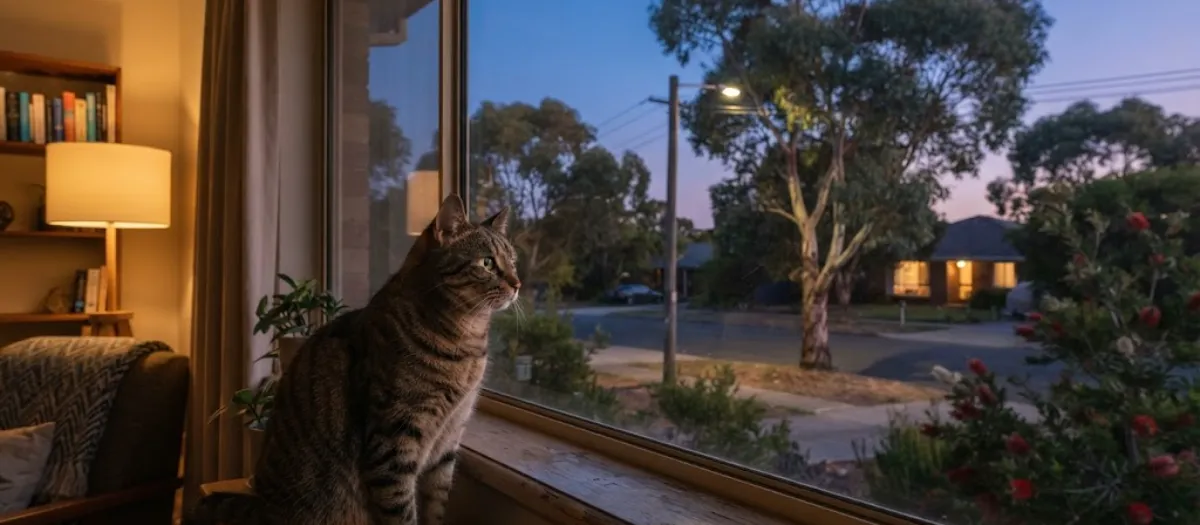
- Add things to do inside: window perches, climbing and hiding spots. See our cat enrichment guide and best cat trees, and a cat exercise wheel suits a young cat with energy to burn.
- Keep a clean litter tray ready so your cat has no reason to go out to toilet (see litter box smell for an easy routine).
- Lock the cat flap overnight. Our cat door guide covers the options. If you have a screen door, see cat doors for screen doors, which also covers keeping cats in at night.
- Offer fresh water in more than one spot inside. A fountain suits some cats; see cat water fountains.
Giving a contained cat outdoor time
Being contained doesn't have to mean no fresh air. Maribyrnong's announcement lists enclosed outdoor areas, cat-proof fencing and supervised time as options, and RSPCA Australia recommends a secure enclosure or fenced space. Check any setup for gaps and weak points, and supervise until you're confident it holds.
- Catio ideas: types, sizes and how to set one up.
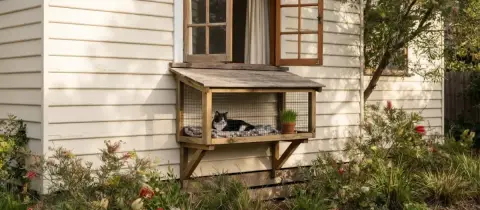
- Window catio picks: a small enclosed box on a window, useful if you rent or have little space.
- Cat netting for balconies: to enclose a balcony, with permission if you rent or live in a strata building.
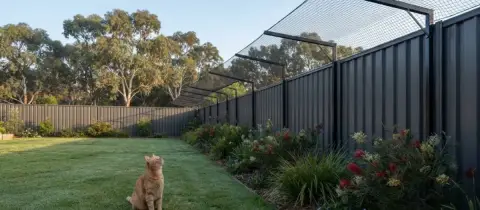
- Cat proof fence options: to keep a cat inside your own yard, and mind shared fences and neighbours.
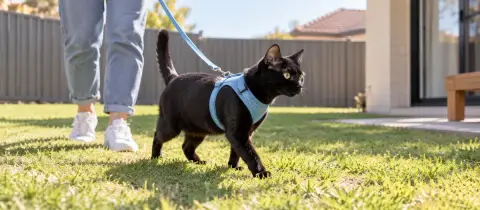
- Cat harness and leash: supervised outdoor time, where your council or territory allows a leash.
Whatever you choose, give your cat shade, fresh water and an easy way back inside, and don't leave them out for long periods or in heat or storms. Our keep your cat cool in summer guide has more on warm days.
When to get help
Some cats find it hard to adjust to being kept in. Book a vet check if your cat yowls a lot, toilets outside the tray, over-grooms or seems unwell or very distressed after the change. These can have medical causes, and International Cat Care (updated 26 September 2025) says a cat that starts soiling indoors will likely need a vet examination to rule out medical causes.
See a vet straight away if your cat is straining in the litter tray with little or no urine, hasn't eaten, or seems lethargic or in pain. Some owners try calming products such as FELIWAY as a small support, but they aren't a fix, and a vet should look at sudden changes first.
Frequently asked questions
Is it illegal to let cats roam at night?
It depends on your council or territory. In the ACT, cats born after 1 July 2022 must be contained, and City of Melbourne and Maribyrnong have night curfews. NSW law doesn't require cats to be kept indoors. See the state table and check your council.
Why is there a cat curfew in Australia?
Councils that bring one in generally point to cat safety and wildlife protection, and RSPCA Australia supports keeping cats contained to the owner's property. Nuisance complaints are the other trigger, as the NSW rules show. See why councils bring in curfews.
Are cats allowed outside in Victoria?
In Victoria, cat curfews are set council by council. City of Melbourne requires cats contained between 6pm and 8am, and Maribyrnong between 7pm and 7am. Merri-bek's starts on 1 April 2027. Other councils may differ, so check yours. Supervised or enclosed outdoor time may still be allowed.
Are cats allowed outside in WA?
Under the current Cat Act 2011, local governments in WA can't introduce cat curfews, according to the City of Cockburn. A 2026 bill would let them, but when we checked on 30 October 2026 it wasn't yet law. Check the bill's progress and your local government's website.
Are cats allowed outside in Queensland?
We found no statewide curfew, and local laws vary. Ipswich City Council says cats must be contained to the house or a suitable enclosure at all times. Other councils may have different rules, so check your own council's local laws and animal management pages.
Is there a cat curfew in South Australia?
Not a statewide one. South Australia's Dog and Cat Management Act 1995 sets the framework, and councils can make by-laws for their own area, so a curfew or containment rule depends on where you live. The Dog and Cat Management Board's page explains the split. Search your council's site for "cat by-law" or phone them.
What happens if my cat breaks curfew?
It depends on the council. Some can investigate a report, trap a roaming cat or fine the owner, and others only act on nuisance complaints. Bring your cat in, work out how they got out and fix that gap. Our section on what happens during curfew gives the City of Melbourne example, and your council's page has the current position.
Do I have to keep my cat indoors all the time?
Not always. ACT City Services says containment can include an enclosed area in a backyard or courtyard, a crate or a leash, and RSPCA Australia says containment isn't necessarily indoors only. Check what your council counts as contained. See outdoor time.
Our catio and containment guides
- Catio ideas: types, sizes and how to set one up
- Cat netting for balconies
- Cat proof fence options
- Window catio picks
If a neighbour's cat keeps visiting your garden, our cat repellent guide covers humane deterrents and what never to use.
Related guides
- Cat in heat: keeping her in until desexing
- Should you get a cat flap?
- Best cat prams
- Best outdoor cat houses
- Cat doors and microchip cat flaps
- Cat doors for screen doors
- Cat enrichment and indoor cat boredom
- Best cat harness and leash
- How to keep your cat cool in summer
- All our cat guides
- Outdoor cat trees for catios and runs
Sources
- ACT City Services, Cats, read 30 October 2026 (https://www.cityservices.act.gov.au/pets-and-wildlife/cats)
- NSW Office of Local Government, Nuisance pets, page updated 1 July 2024, read 30 October 2026 (https://www.olg.nsw.gov.au/pets/nsw-pet-registry/pet-control/nuisance-pets)
- City of Melbourne, Cat containment, read 30 October 2026 (https://www.melbourne.vic.gov.au/cat-containment)
- The Age, Melbourne cats given the freedom to go out at night, on one condition, 16 October 2025 (https://www.theage.com.au/national/victoria/melbourne-cats-given-the-freedom-to-go-out-at-night-on-one-condition-20251009-p5n1f1.html)
- Maribyrnong City Council, Cat curfew, read 30 October 2026 (https://www.maribyrnong.vic.gov.au/Residents/Pets-and-animals/Cat-curfew)
- Maribyrnong City Council, Safer nights for cats and wildlife in Maribyrnong, 29 May 2026 (https://www.maribyrnong.vic.gov.au/News/Safer-nights-for-cats-and-wildlife-in-Maribyrnong)
- Merri-bek City Council, Merri-bek City Council adopts new animal management plan and cat curfew, 13 November 2025 (https://www.merri-bek.vic.gov.au/my-council/news-and-publications/news/merri-bek-city-council-adopts-new-animal-management-plan-and-cat-curfew/)
- Ipswich City Council, Cat Owner Obligations, read 30 October 2026 (https://www.ipswich.qld.gov.au/Live/Animals/Dogs-and-Cats/Cat-Owner-Obligations)
- Dog and Cat Management Board (SA), Legal responsibilities for cat owners, read 30 October 2026 (https://dogandcatboard.com.au/cats/laws-for-cats)
- City of Cockburn, Cat control and containment, 11 June 2026 (https://www.cockburn.wa.gov.au/City-and-Council/Events-and-News/Media-Releases-and-Responses/Responses-to-media/2026/Cat-control-containment)
- WA Government, Better protection the way for Western Australia's wildlife, 23 February 2026, updated 17 June 2026 (https://www.wa.gov.au/government/announcements/better-protection-the-way-western-australias-wildlife)
- Parliament of Western Australia, Progress of Bills, Bill No. 53, read 30 October 2026 (https://www.parliament.wa.gov.au/parliament/bills.nsf/BillProgressPopup?openForm&ParentUNID=0267E3C49F8D5B6448258DA800209A4F)
- NRE Tasmania, Roaming and nuisance cats FAQs, 6 January 2026 (https://nre.tas.gov.au/invasive-species/responsible-cat-ownership/roaming-and-nuisance-cats/roaming-and-nuisance-cats-faqs)
- City of Darwin, Animal by-laws and infringement offences (https://www.darwin.nt.gov.au/resident-services/pets/dog-cat-management/animal-by-laws-and-infringement-offences)
- RSPCA Australia, How to create a cat-friendly contained environment for your cat and why it matters, 20 June 2025 (https://www.rspca.org.au/latest-news/blog/how-to-create-a-cat-friendly-contained-environment-for-your-cat-and-why-it-matters/)
- International Cat Care, Soiling indoors, updated 26 September 2025 (https://icatcare.org/articles/soiling-indoors)
This guide provides general information and isn't a substitute for veterinary or legal advice. If you're concerned about your cat's behaviour or health while adjusting to being kept in, speak with your vet.