Quick answer: A cat in heat is usually very vocal, extra affectionate, rolling on the floor and raising her rear when stroked. A heat lasts about a week on average and comes back every few weeks until she is mated or desexed. Keep her inside, stay calm and book the desexing with your vet.
A cat in heat can be loud, clingy and hard to settle, and it's easy to mistake for illness. This guide covers the signs, the timing, how to keep her safe and comfortable at home, and when to desex. If she is also marking walls, see our guide to cat spraying.
How can I tell if my cat is in heat?
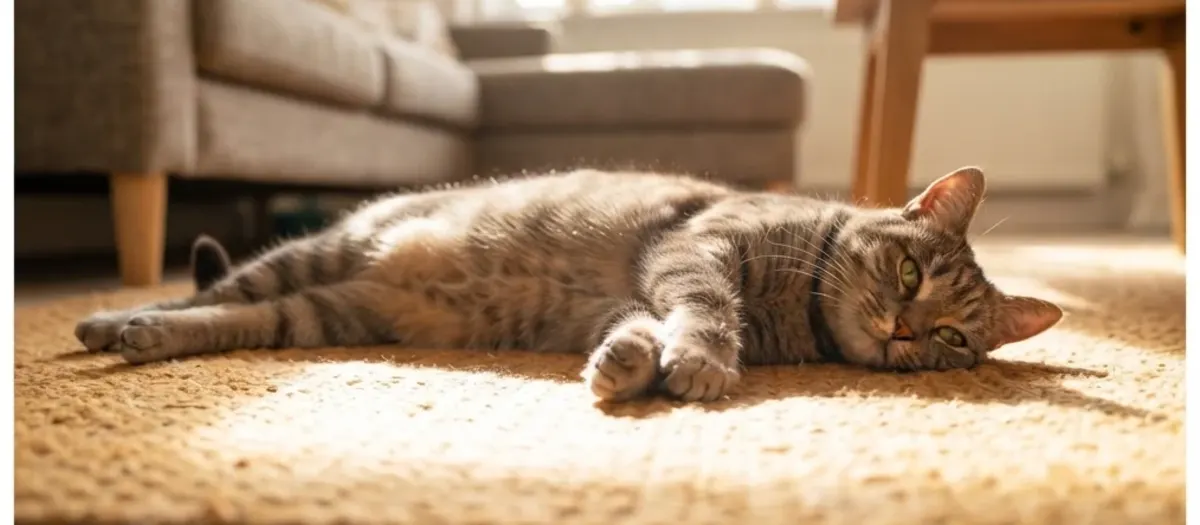
The main signs are behaviour changes: loud, repeated calling, much more affection, rubbing on people and furniture, rolling on the floor, and raising her rear with her back legs treading when you stroke her. VCA Animal Hospitals notes owners sometimes mistake these changes for illness.
Some cats also urinate more often or spray vertical surfaces. VCA says the urine carries signals that can attract tomcats, which is one reason she may start marking (VCA Animal Hospitals, updated 13 June 2025, page read 23 November 2026).
Look at the pattern, not one sign. The table shows what heat may look like and when something else is more likely.
| Sign | What heat looks like | When it's more consistent with something else | What to do |
|---|---|---|---|
| Yowling | Loud, drawn-out calling, often at night, in a cat who is not desexed | Sudden calling in an older cat, or in a desexed cat | Ask your vet if it's new or doesn't fit the cycle |
| Rolling | Rolling and rubbing on the floor, furniture and you | Rolling with licking at one spot, or a cat who seems sore | Watch for pain signs; see your vet if unsure |
| Raised rear | Rear up and back legs treading when stroked | Same posture with straining or discomfort in the tray | Straining needs a vet (see the vet box) |
| Spraying | Small squirts on walls, doors and windows | A cat who is desexed, or marking with no other heat signs | Read our cat spraying guide |
| Restlessness | Pacing, trying to get out, not settling | Restlessness with hiding, not eating or vomiting | Illness is possible; call your vet |
How long does a cat stay in heat, and how often does it come back?
A heat lasts about seven days on average but can run anywhere from one to 21 days. If she isn't mated, she settles for roughly a week and then comes back into heat, so a full cycle averages about three weeks. Timing varies a lot between cats.
Here are the numbers in one place, with the sources named.
| Question | Figure | Source |
|---|---|---|
| First heat | Around 6 months, shifting a little with daylight | VCA |
| Length of one heat | About 7 days on average, range 1 to 21 | VCA |
| Time out of heat if not mated | About 7 days, range 2 to 19 | VCA |
| Full cycle | 1 to 6 weeks, about 3 on average | VCA |
| Season in Australia | Starts around August, through spring and summer | RSPCA NSW |
| Earliest breeding age | About 4 months | RSPCA NSW, RSPCA Australia |
A cat can also come back into heat again and again through the season, which is why a short, quiet spell doesn't mean it's over.
When do cats come into heat in Australia?
Cats in Australia usually start cycling around August, as the days lengthen, and keep going through spring and summer. That's the opposite of the northern-hemisphere timing on many overseas pages. RSPCA NSW says a queen can have up to two litters in a season (RSPCA NSW, 18 November 2022, page read 23 November 2026).
VCA, a North American source, gives roughly January to late autumn for the northern hemisphere. It also says cats are driven by day length, and that mainly indoor cats, or cats in tropical areas, may cycle year-round.
Can a cat in heat go outside?
No. A cat in heat can fall pregnant, and tomcats will find her. She may also bolt for the door, which puts her at risk of fights, cars and getting lost. RSPCA NSW says contained cats are less likely to fight, get lost or injured, or catch FIV (RSPCA NSW, 7 November 2021).
Indoor cats slip out in a hurry when they're in heat, so tighten the house up for a few weeks:
- Check screen doors latch properly, and keep windows secure.
- Lock any cat flap while she's in season. Our guide on whether to get a cat flap explains the trade-offs.
- Ask visitors and tradies to close doors behind them.
- Make sure her microchip details are up to date.
Some councils have desexing rules and permits, and some have curfews. Check yours using our cat curfew rules guide.
What helps a cat in heat feel calmer?
Nothing stops heat, but a few things can take the edge off. Keep her warm and comfortable, give her short play sessions, make her a quiet spot, and keep the home calm. Heat usually passes on its own, and the lasting fix is desexing.
- Warmth: Some cats seek a warm spot while they're restless. A pet heat pad or a warm bed can give her somewhere to settle. Follow the maker's safety instructions.
- Play: A few short sessions with a wand toy can use up energy. See our cat wand toys guide, and put the toy away afterwards.
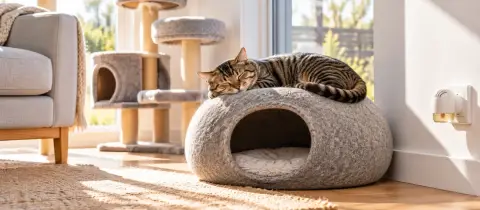
- A hiding spot: A cat cave bed gives her a place to retreat.
- Pheromones: Feliway's maker says its products help cats feel calmer. That is the maker's claim, not a cure for heat. See does Feliway work. Our calming collar guide covers collars, and why we don't pick any.
- Spraying: If she starts marking, our cat spraying guide covers cleaning and what to change, and a UV torch helps you find dried marks.
- Nappies: A cat nappy can catch mess for a short, supervised stretch. It doesn't treat heat, and it should come off when wet.
Don't punish her for calling or marking. She can't help it, and it only adds stress.
When should a kitten be desexed in Australia?
RSPCA Australia recommends desexing at or before four months of age, and notes cats can breed from about four months. It says early desexing is safe, with no greater short or long-term risk, and recovery is quicker (RSPCA Australia, 17 June 2021, page read 23 November 2026).
VCA's US advice is to spay at about six months, ideally before the first heat. That's later than the Australian recommendation, and because cats can breed from about four months, waiting can mean an early heat or pregnancy. Your vet will advise on timing for your kitten.
Can a cat be desexed while she's in heat?
Ask your vet. Vets decide the timing for each cat, and the answer can depend on her health and the clinic's approach. Phone ahead, say she's in heat, and book the earliest suitable day.
If she has been mated, or you suspect a pregnancy, tell the clinic promptly so they can talk you through the options.
Useful guides
Nothing sold online treats heat itself, so these guides are for comfort and safety while you wait for desexing:
- Pet heat pads, for a warm spot to settle
- Cat wand toys, for short play sessions
- Feliway for cats, if you want to try a pheromone diffuser or spray
- Cat nappies, for short, supervised use only
- Cat cave beds, for a quiet hiding spot
When to see a vet
Book a vet visit if your cat's heat comes with any of these:
- heat that seems constant, with barely any break
- a heat-like pattern in a cat who has been desexed
- any discharge
- lethargy, hiding, vomiting or not eating
- an accidental mating or a likely pregnancy (ask about options promptly)
A cat, especially a male, straining, crying or passing little or no urine needs a vet straight away; a urinary blockage is an emergency and can be fatal (RSPCA Australia).
Frequently asked questions
Do cats in heat yowl all night?
Many do. Calling is one of the most common signs, and it often seems louder at night when the house is quiet. It usually settles when the heat ends, but it can return with the next cycle. Desexing is the lasting fix, and your vet can advise if the noise is new.
How old is a kitten at her first heat?
VCA says puberty is reached at about six months, though daylight can shift it a little. RSPCA says cats can breed from about four months, so some kittens come into heat earlier than owners expect. Results vary, so book desexing early rather than waiting for the first heat.
Can an indoor cat go into heat in winter?
Yes. Most cats here start cycling around August, which is late winter, as the days lengthen. VCA says cats are driven by day length, and that cats living mainly indoors may cycle year-round, so an indoor cat can come into heat in the colder months too. If you're unsure what you're seeing, ask your vet.
Can a desexed cat still act like she's in heat?
It's worth asking your vet. Calling, rubbing or restlessness can have other causes, including stress, pain or medical problems, so it's best not to guess. Note when it happens and what else you see, and book a check, especially if the behaviour is new.
Do male cats go into heat?
No, heat is a female cycle. An entire tom reacts to a female in heat and may call, roam and mark. Keep him contained too, and talk to your vet about desexing. If a male cat is straining or passing little urine, that's an emergency, so see a vet straight away.
How can I tell if my cat is in heat or in pain?
Heat comes in a pattern: calling, rolling, raised rear and affection, then a break, then it returns. Pain tends to look different, such as hiding, not eating, flinching when touched or straining. If you can't tell, or she seems unwell, see your vet rather than waiting.
Will a cat in heat try to escape?
Often, yes. A cat in heat is driven to find a mate, so she may dash out the moment a door opens, push at screens or try gaps she has ignored before. Treat every exit as a risk until she's desexed, and use the door, screen and cat flap checklist above.
Can a cat get pregnant during her first heat?
Yes. A young cat can fall pregnant at her very first heat if she's mated, and RSPCA says cats can breed from about four months. That's why the advice is to desex early and keep her inside. If you think she's been mated, call your vet promptly.
Related guides
- Cat spraying indoors: why cats mark and how to stop it
- Cat nappies: washable and disposable picks
- Cat calming collars: do they work, and are they safe?
- UV pet urine detector torches
- Cat curfew rules in Australia
- Should you get a cat flap?
- Does Feliway work?
- Best pet heat pads
- Best cat wand toys
- Why is my cat peeing outside the litter box?
Sources
- VCA Animal Hospitals: Estrous cycles in cats, updated 13 June 2025, read 23 November 2026
- RSPCA NSW: 'Tis the season for kittens, 18 November 2022, read 23 November 2026
- RSPCA NSW: Warmer and longer days mean it's kitten season, 7 November 2021, read 23 November 2026
- RSPCA Australia: Early desexing a better choice for our feline friends, 17 June 2021, read 23 November 2026
- RSPCA Australia Knowledgebase: Why is my cat urinating inappropriately?, updated 30 May 2024, read 23 November 2026
This guide provides general information and isn't a substitute for veterinary advice. If you're concerned about your cat's heat cycle or health, speak with your vet.