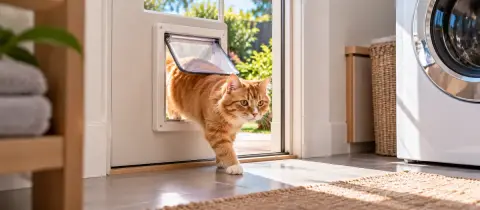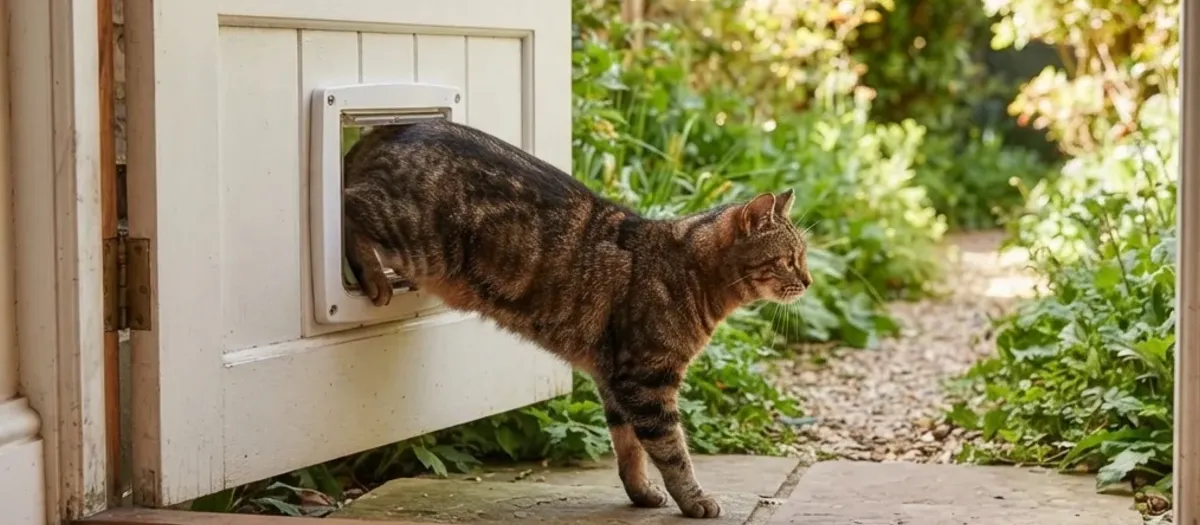
Quick answer: Should you get a cat flap? It can suit a cat that's allowed outside, in a home where you can lock the flap at night and whenever you're out. If your council requires 24-hour containment, fit it only into a catio, and if roaming cats are about, choose a selective flap. A flap is a convenience, not a security device.
A cat flap is a small change that affects your whole household: who comes and goes, when, and what else can wander in. This guide helps you decide whether to fit one at all, then which type suits your home. If you've already decided, our best cat door guide compares the flaps themselves.
Is a cat flap a good idea?
It can be, for the right cat in the right home. A flap gives your cat a way in and out without you playing doorman, but it also opens a gap in your house. It works best where outdoor access is already safe and allowed, and where you're happy to lock it overnight and when you're out.
Find your situation in the table. "Maybe" means it can work with changes.
| Your situation | Flap? | What to do instead or as well | Our guide |
|---|---|---|---|
| Council requires 24-hour containment | Maybe | Fit it only into a catio or enclosed run, never the open yard | Cat curfew rules |
| Night curfew only | Yes | Use "in only" at dusk, or a timed lock if your flap has one | Cat curfew rules |
| Indoor cat with a catio | Yes | Put the flap into the catio, not the open yard | Catio ideas |
| Street with roaming or stray cats | Maybe | A selective flap that is designed to open only for your cat | Best cat door |
| Bush edge or snake country | Maybe | Lock it when you're out and overnight, especially in spring | See the snake section below |
| Rented home | Maybe | Get written consent first, or choose a no-cut option | Cat flaps for windows |
| Dog in the house | Yes | Size the flap for the cat, or use a door sized for both | Small dog doors |
| House on a busy road | No | A catio, balcony netting or supervised time instead | Cat netting for balconies |
| Kitten not yet desexed or vaccinated | No | Wait, then supervise the first outings | Kitten proofing |
Cat flap pros and cons
A flap saves you opening the door and lets your cat choose when to go out. The downsides are a permanent gap in the house, other animals getting in, and a cat that is out when you can't see it. Weigh both lists against your own street.
| Pros | Cons |
|---|---|
| Your cat can come and go without you | Other cats and wildlife can get in if the flap isn't selective or is left unlocked |
| Fewer doors opened for a cat that likes to patrol | Your cat is outside when you can't watch it |
| Can feed into a catio or enclosed run | Not allowed everywhere if your council requires containment |
| Works with a selective flap that is designed to open only for your cat | Selective flaps need batteries and set-up |
| Lets a cat reach a litter room inside | Needs cutting into a door, wall or glass, which may need a tradesperson or your landlord's consent |
None of this means cats need outdoor access, or are happier with a flap. Plenty of cats live well indoors, with enrichment and a catio. A flap is a convenience, not a welfare requirement.
Can you have a cat flap if your council has a cat curfew?
Often yes, but how you use it changes. Where cats must be contained at night, the flap needs to be in-only or locked at curfew time. Where containment is 24 hours, a flap on the open yard is the wrong choice, though one into an enclosure can fit.
We keep the state and council rules on one page. Read our cat curfew rules guide, then check your own council's website. A flap with an in-only setting, or a timed lock, makes the dusk routine easy: your cat comes in for dinner and the flap stays shut. Our cat door guide shows which flaps have those settings.
What can get in through a cat flap? Strays, possums and snakes
Anything small enough to fit can come through a flap that is unlocked in both directions or propped open. A selective flap is designed to open only for your cat, but that is the maker's claim, and it only holds while the flap is set up and locked properly.
Use the table to see what each type lets in.
| Basic 4-way | Magnetic key | Microchip | |
|---|---|---|---|
| Your cat | Yes | Yes, with the magnet on its collar | Yes, once programmed |
| Neighbourhood cats | Yes, if unlocked | Designed to keep them out (maker's claim) | Designed to keep them out (maker's claim) |
| Possums and other small animals | Can fit through if unlocked | Designed to keep them out (maker's claim) | Designed to keep them out (maker's claim) |
| Unlocked in both directions, or propped open | Anything that fits | Anything that fits | Anything that fits |
Sure Petcare notes that while a flap is propped open, any cat can come in (Sure Petcare). Sure Petcare also advises programming your cat's chip into a microchip flap before you fit it, so you don't add a neighbour's cat by mistake.
What about snakes? We can't promise any flap keeps one out, and no flap is snake-proof. An unlocked flap is a gap at ground level, so our advice is to lock it when you're out and overnight, especially in spring when snakes are on the move. If you see a snake, RSPCA Australia says not to try to catch or kill it, to keep your pets away from it, and to call a licensed snake handler. Most bites happen when people try to remove a snake. If one is indoors, shut the door of that room and put a towel under it (RSPCA Australia Knowledgebase, updated 1 May 2019, page read 21 November 2026).
Which type of cat flap suits your home?
The right flap depends mostly on where it goes, then on whether you want it selective. Work out the location first, since glass, brick and timber each need a different kit and a different tradesperson.
| Where will the flap go? | Start here |
|---|---|
| Glass door or window | Cat flaps for windows and glass |
| Brick or weatherboard wall | Cat doors for walls |
| Internal door, such as a litter room | Interior cat doors |
| Screen or security door | Cat doors for screen doors |
| Timber door | Best cat door |
| Shared with a small dog | Small dog doors |
Then pick the lock style. A basic 4-way flap is the simplest and has locking settings. A magnetic one opens for a magnet on your cat's collar, and International Cat Care recommends a snap-open collar (International Cat Care, updated 26 September 2025). A microchip flap reads your cat's chip, and the maker states which chips it works with, so check the compatibility list before you buy. Cutting into glass is a job for a glazier, and a wall may need a tradesperson, so don't plan a quick DIY.
Should an indoor cat have a cat flap?
An indoor cat doesn't need an outside flap. A flap can still be useful inside: into a catio, onto an enclosed balcony, or between rooms so a cat can reach its litter tray while the dog stays out.
If you want safe outdoor time without open-yard risks, a flap into a catio is a good fit. Our catio ideas guide covers types and sizes, and window catios suit small spaces. For doors between rooms, the interior cat door guide explains sizing. Other fixes for litter and food raiding include a dog gate and a microchip cat feeder.
How do you get a cat used to a new flap?
Go slowly and let your cat set the pace. Prop the flap open at first, tempt your cat through with a treat, then remove the prop only once your cat goes through happily. Never push your cat through, and stay nearby while it's propped, because Sure Petcare notes an open flap lets any cat in. Our cat door guide has the full step-by-step.
Useful guides
We don't link specific products here. These guides compare what's available for each situation:
- Best cat door: the main buying guide for timber doors, with microchip and magnetic picks
- Cat flaps for windows and glass: glass hole sizes and glazier-fitted options
- Cat doors for walls: tunnel kits by wall thickness
- Interior cat doors: keep the dog out of the litter and food
- Cat doors for screen doors: flyscreen and security door options
- Small dog doors: when a small dog shares the door
When to see a vet
Book a vet visit if your cat:
- has a bite or scratch after a fight with another cat, especially with swelling, limping or a lump that may be an abscess
- has been hurt by the flap or frame
- stops eating, hides or sprays indoors after an intruder cat has been about
If you think your cat has been bitten by a snake, go to a vet straight away and keep your cat calm and still. A vet can work out what is going on. Our snake bite guide covers cats too.
Frequently asked questions
Are cat flaps a security risk for your house?
A flap is a gap in your house, and it isn't a security device. Anything small enough can use one that is unlocked or propped open. Lock it when you're out and overnight, fit it where you're comfortable with an opening, and don't count on it to keep anyone or anything out.
Can I put a cat flap in a rental?
Only with permission. The NSW Government says tenants can make changes if the lease allows it or the landlord gives written permission (NSW Government, page read 21 November 2026). Pet doors aren't named on that page, and rules differ by state, so ask in writing before cutting anything. A no-cut option, such as a sash window insert, may be easier to get agreed.
How long does it take a cat to learn a cat flap?
There's no fixed timeline. Sure Petcare says it can take days or weeks (Sure Petcare, 30 October 2019), and results vary from cat to cat. Keep sessions short and positive, and watch how your cat responds rather than working to a deadline. The steps are in the training section above.
Can kittens use a cat flap?
Wait until your kitten is desexed and fully vaccinated, and check your council's rules first. Then supervise the first outings and keep the flap locked at night. A kitten can fit through a flap well before it's ready to be outside, so don't let size decide the timing.
Can a cat flap lead into a catio?
Yes, and it's one of the safest ways to use one. The flap opens into an enclosure and not the open yard, so your cat gets fresh air while staying contained. Check the enclosure for gaps first. Our catio ideas guide covers types and sizes.
Where is the best place to put a cat flap?
Choose a quiet spot that doesn't face a road or pool area, and keep it away from the litter tray and food bowls so a cat in the doorway doesn't block the way. A flap onto a fenced yard or catio is easier to manage than one onto the street.
Can you fit a cat flap in a security door?
Sometimes. Flyscreen and security doors are thin and often metal, so you need a flap designed for that material, and the cut should be done carefully. Our cat doors for screen doors guide covers options and how to size one.
What's the difference between a cat flap and a cat door?
Usually only the wording. Both mean a small opening, often with a hinged panel, that lets a cat pass through. "Cat door" is also used for bigger or no-flap openings, such as the ones on our interior cat door guide.
Related guides
- Cat curfew rules in Australia
- Best cat door in Australia
- Cat flaps for windows and glass
- Cat doors for walls
- Interior cat doors
- Small dog doors
- Cat doors for screen doors
- Catio ideas
- How to install a dog door
Sources
- RSPCA Australia Knowledgebase: There's a snake in my backyard, what should I do?, updated 1 May 2019, read 21 November 2026
- Sure Petcare: How to train a cat to use a cat flap, 30 October 2019, read 21 November 2026
- International Cat Care: Should my cat wear a collar?, updated 26 September 2025, read 21 November 2026
- NSW Government: Making changes to a rental property, read 21 November 2026
This guide provides general information and isn't a substitute for veterinary advice. If you're concerned about your cat's safety outdoors, speak with your vet.