Best indoor cat food: dry picks for weight and hairballs
By Anish PuriUpdated 25 Nov 202615 min readResearched, not tested by us
Research guide. WhiskerFinds may earn a commission from links, at no extra cost to you.
Quick answer: The indoor cat food we'd start with for most adult cats aged 1 to 7 is Royal Canin Indoor Adult, which states the clearest indoor purpose and comes in three bag sizes. "Indoor" formulas adjust fat and add fibre, but a complete adult food in the right amount also works. Weight loss needs a vet plan.
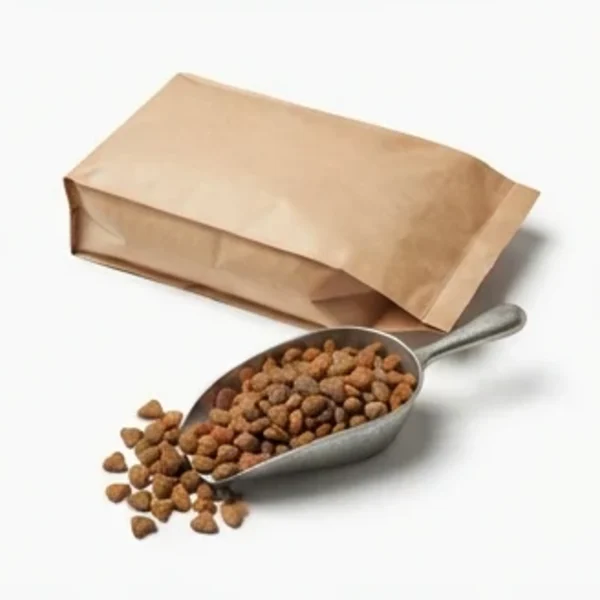
Illustration, not the actual product
Our top pickRoyal Canin Indoor Adult dry food, 2 kg
Indoor cats burn fewer calories and groom a lot, which is why makers sell a separate bag for them. This guide compares five dry foods on Amazon Australia by bag size in kilograms, life stage and what each listing says it is for. If your cat is 7 or older, go to our senior cat food guide. For a cat with urinary signs, start with the cat UTI guide, not a new food.
All five picks are dry. Dry food adds little moisture, so if you want to add some, see our wet cat food guide.
Quick picks
Our top pickBest overall
Royal Canin Indoor Adult dry food, 2 kg
Adults 1 to 7; clearest stated indoor purpose; three bag sizes
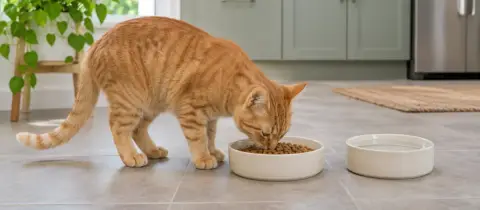
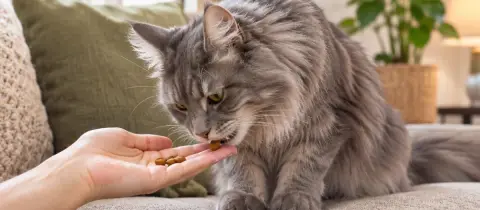
Pictures are illustrations, not the actual products.
Do indoor cats need special indoor cat food?
Not strictly. Indoor formulas are built around lower activity, so they tend to use less fat and more fibre, but a complete food made for your cat's life stage, fed in the right amount, suits many indoor cats. Body condition matters more than the front of the bag.
In these listings, "indoor" means some mix of a moderate fat content, added fibre and a stated hairball or stool benefit. These are the makers' claims, not something we've verified.
Our picks in detail
1. Royal Canin Indoor Adult dry food, 2 kg: best overall
The listing is for "indoor adult cats 1-7 years old" and states its purpose most clearly of the set. It says highly digestible protein and fibre reduce the quantity and odour of stools, that a moderate fat content is "adapted to the lower activity of indoor cats", and that fibres including psyllium help pass swallowed hair. The listing's analysis gives 27 per cent protein, 13 per cent fat and 4 per cent crude fibre. The 4 kg and 10 kg bags are separate listings.
The ingredients include wheat, soy and fish oil, and the listing's allergen field names fish, soy and wheat. The listing's "Care for cats with sensitive stomach" and "Gastrointestinal discomfort" lines are the maker's own wording. A sensitive stomach needs a vet's advice, not a bag.
Pros: clear indoor purpose; three bag sizes; protein, fat and fibre stated; fibre for hair and stools per the listing
Cons: no wet version at this listing; contains wheat, soy and fish per the listing
Best for: indoor cats aged 1 to 7
Skip it if: your cat is under 1 or over 7 (see pick 5 or our senior guide), or needs a grain free or fish-free food
The listing's recommended use is "weight management and hairball control for indoor adult cats". Its details describe a "highly digestible formula with fiber" and "high-quality protein", and the special ingredients field lists wheat gluten. It's the one pick that names weight and hairballs together, which matches this page's topic.
The Amazon description on this listing is muddled, with some text that belongs to another Hill's product, so we've used only the title and details fields. Check the pack for the full ingredient list and feeding guide before you buy.
Pros: names both weight management and hairball control; chicken; a large bag for a cat already settled on it
Cons: one size at this listing; the description is muddled; contains wheat gluten
Best for: adult indoor cats where weight and hairballs are both on your mind
Skip it if: you want a small trial bag, since this is 4 kg only
3. Purina ONE Adult Indoor dry food, chicken, 1.4 kg: best small bag
The smallest bag here, and the listing gives the country of origin as Australia. It's an adult chicken food with a "Weight Management" use field. The listing has no feature bullets, but its analysis gives protein minimum 34 per cent, fat minimum 13 per cent and fibre maximum 4 per cent, the ingredients include wholegrain wheat, corn and barley, and there is a feeding guide by cat weight.
A small bag suits a trial. Our view: it's a sensible way to check your cat will eat an indoor formula before you buy a big one. In a two-cat home 1.4 kg runs out quickly.
Pros: small bag; Australian origin per the listing; chicken
Cons: no feature bullets on the listing, so the maker doesn't say what "indoor" changes; 1.4 kg runs out fast with two cats
Best for: a single-cat home trying an indoor formula
Skip it if: you want the maker's explanation of the indoor formula before buying
4. Wellness CORE+ Adult Indoor grain free dry food, chicken and turkey, 2.27 kg: best grain free indoor
The listing is titled for indoor cats, adult, grain free, with chicken and turkey, listing 5 lb, which is 2.27 kg. It says a high concentration of animal protein from turkey and chicken, a fish and flax omega blend and probiotics. The uses field lists hairball control and weight management, and the allergen field says soy free and wheat free. The listing says made in the USA.
Grain free isn't the same as low carbohydrate, and the listing gives no nutrient percentages. Our grain free cat food guide covers what grain free does and doesn't mean, plus other grain free picks. Choose this only if you have a reason to avoid grains.
Pros: indoor formula; poultry; soy and wheat free per the listing; probiotics listed
Cons: imported, so check the delivery details on Amazon before you order; one bag size
Best for: owners who want an indoor formula without grains
Skip it if: you have no reason to avoid grains, or you want an Australian-made food
5. Hill's Science Diet Kitten Indoor dry food, chicken, 3.17 kg: best for indoor kittens
The only kitten food here, for kittens raised indoors. The listing says small kibble, DHA from fish oil for brain and eye development, natural fibres for digestion and easy litter box cleanup, balanced minerals for bones and teeth, and no artificial flavours or preservatives. The allergen field says chicken meat. The listing's "Raw" diet-type field is a data error; this is dry kibble.
Switch to an adult food when the maker's label says so, using the slow change on this page. Kitten food is richer than an adult indoor cat needs. Our kitten food guide covers wet and dry options.
Pros: small kibble; DHA from fish oil per the listing; fibre for digestion
Cons: one flavour; 3.17 kg is a large bag for a single small kitten
Best for: kittens raised indoors, until the label says to move to adult food
Skip it if: your cat is an adult
Indoor cat foods compared
Details from each Amazon Australia listing, checked on 25 Nov 2026.
Swipe sideways to see every column
Food
Life stage
Bag (kg)
Main protein and allergens
What the listing says it is for
Royal Canin Indoor Adult
Adults 1 to 7
2 (also 4 and 10)
Poultry protein; wheat, soy and fish listed
Moderate fat for lower activity; fibre including psyllium for hair; less stool and odour
Hill's Adult Indoor
Adult
4
Chicken; wheat gluten listed
Weight management and hairball control for indoor adults
Purina ONE Adult Indoor
Adult
1.4
Chicken; wheat, corn and barley listed
A "Weight Management" use field; no feature bullets
Wellness CORE+ Indoor
Adult
2.27 (5 lb on the listing)
Turkey and chicken, grain free
Hairball control and weight management fields; probiotics
Hill's Kitten Indoor
Kitten
3.17
Chicken
Small kibble, DHA, fibre for digestion and easy litter box cleanup
Which bag size should you buy?
Buy the smallest bag that lets your cat try the food properly. Dry food loses freshness once opened, and a cat that refuses a new food leaves you with a big bag. Royal Canin Indoor is the only food here with three listed sizes, so it's the one to scale up once your cat is settled.
Whichever you pick, change foods slowly. PetMD suggests shifting over about 7 to 10 days, starting near 75 per cent old food and 25 per cent new and moving to all new food, and checking with your vet first (PetMD, "How To Switch Cat Food", page read 25 November 2026).
How do you keep an indoor cat at a healthy weight?
Measure the food, feed set meals and keep your cat moving. Cornell calls obesity the most common nutritional disorder in cats and names free feeding as a major cause. It recommends scheduled meals and a vet-supervised plan for any cat that needs to lose weight.
Feeding amounts come from the pack's guide, adjusted with your vet as your cat's body condition changes. We don't give gram amounts because they vary by food and cat. Cornell suggests a baby scale at home and a body condition score chart to track progress (Cornell Feline Health Center, "Obesity", page read 25 November 2026).
If your cat needs to lose weight, don't cut food sharply. Cornell says fast loss on a starvation diet can cause hepatic lipidosis (fatty liver disease) and suggests gradual loss, around one or two per cent of body weight a week. A vet sets the pace for your cat. No food on this page treats obesity.
The Royal Canin listing says its fibres, including psyllium, help move swallowed hair along. The Hill's listing names hairball control as a use. Both are the makers' statements. Cornell also warns against giving laxatives or hairball diets marketed for blockages without your vet's approval. Our hairball remedies guide and hairball treats guide go further.
Where else can you buy indoor cat food?
Pet shops, vet clinics and supermarkets stock indoor formulas in a range of bag sizes. A vet clinic can also check your cat's weight and body condition and suggest a food, which is useful if you're unsure your cat needs one. Compare the life stage and bag size on the pack with the listings above.
Choose by situation
Swipe sideways to see every column
Your situation
What to look for
Our pick
Adult indoor cat, aged 1 to 7
A stated indoor purpose and bag sizes you can scale
We searched Amazon Australia for dry indoor cat foods and shortlisted those that met all of these checks:
Well rated: a strong average rating with plenty of buyer reviews.
No red flags: no pattern of poor reviews, safety complaints or listing problems.
Available on Amazon Australia when we checked.
Made for indoor cats in its title or listing, not just an ordinary adult food.
Life stage and bag size in kilograms stated on the listing.
Not a vet diet. Prescription foods are the vet's call, so none are here.
Where a listing is thin or muddled, we say so in the cons. These are researched picks, not products we've personally tested. We compared the specifications and features on each Amazon Australia listing, checked on 25 Nov 2026, and we didn't accept payment from any brand.
Left out this time: Hill's 7+ and 11+ Indoor and Royal Canin Indoor 7+ (senior formulas, on our senior cat food guide), and the 4 kg and 10 kg Royal Canin bags as separate picks, since they're sizes of pick 1.
When to see a vet
Book a vet visit if your cat is gaining or losing weight, vomits or brings up hairballs repeatedly, retches without producing anything, goes off their food for more than a day or two, or has constipation. These can have many causes, and a vet can work out which. Cornell says weight-loss plans should be vet-supervised, and a vet visit is also the place to ask about hairballs. See our hairball remedies guide.
Go to a vet straight away, at any hour: a cat that keeps straining and passes little or no urine, especially a male cat, needs a vet straight away because a blocked urethra is life-threatening. Crying in the tray counts too. Cornell calls an obstruction an absolute emergency. For other urinary signs, such as blood in the urine or a lot of licking under the tail, see a vet within a day and read our cat UTI guide.
No food on this page treats a medical problem. Never give human medicines to your cat, and ask your vet before giving a laxative.
Frequently asked questions
Can I mix indoor dry food with wet food?
Yes, and many cats do well on both. Cornell notes canned food is at least 75 per cent water, which helps with hydration, while dry is 6 to 10 per cent. Follow each pack's guide and ask your vet to adjust amounts. See our wet cat food guide.
Can an outdoor cat eat indoor cat food?
Usually, if it's complete for your cat's life stage, but an active outdoor cat may burn more energy than the formula assumes. Watch body condition and ask your vet. Our dry cat food guide covers choosing an ordinary adult food.
When should I switch my kitten to adult food?
When the maker's label says so, which varies by food. Hill's own table on the kitten listing gives "up to 1 year old". Cornell says labels state the life stage. Switch slowly over about 7 to 10 days and ask your vet if your kitten is small or large for their age.
Is grain free better for an indoor cat?
We don't claim it is, and nothing in the listings says it is. A cat with itchy skin or tummy trouble needs a vet-guided food trial, not a guess. Our grain free cat food guide goes through what grain free does and doesn't mean, with sources.
How often should I feed my indoor cat?
Cornell recommends scheduled meals over leaving food out all day. How many a day, and how much, depends on your cat and the food, so use the pack's guide and your vet's advice. A water bowl or water fountain should always be available.
Will indoor food make the litter tray smell less?
The Royal Canin listing says its protein and fibre reduce stool quantity and odour, and the Hill's kitten listing mentions easy litter box cleanup. These are the makers' claims. A cat's tray also depends on litter and cleaning, so see our litter box smell guide.
Why is my indoor cat putting on weight?
Common reasons are free feeding, extra treats and low activity, but weight gain can also come from a medical problem. Cornell says obesity limits activity, which can feed the cycle. A vet can check body condition and rule out illness before you change the food.
Does a cat over 7 need a different food?
Possibly. Makers label foods for ages such as 7+ and 11+, and there's no single agreed age for "senior". If your cat is 7 or older, our senior cat food guide compares those formulas. Weight loss in an older cat is a vet matter.
Product details from each linked Amazon Australia listing, checked on 25 Nov 2026.
This guide provides general information and isn't a substitute for veterinary advice. If you're concerned about your cat's weight, hairballs or diet, speak with your vet.