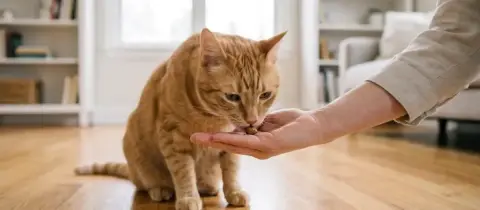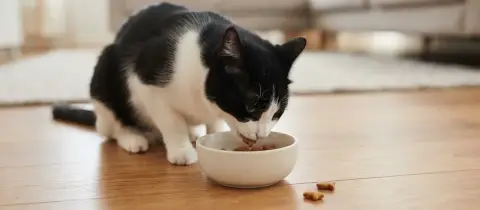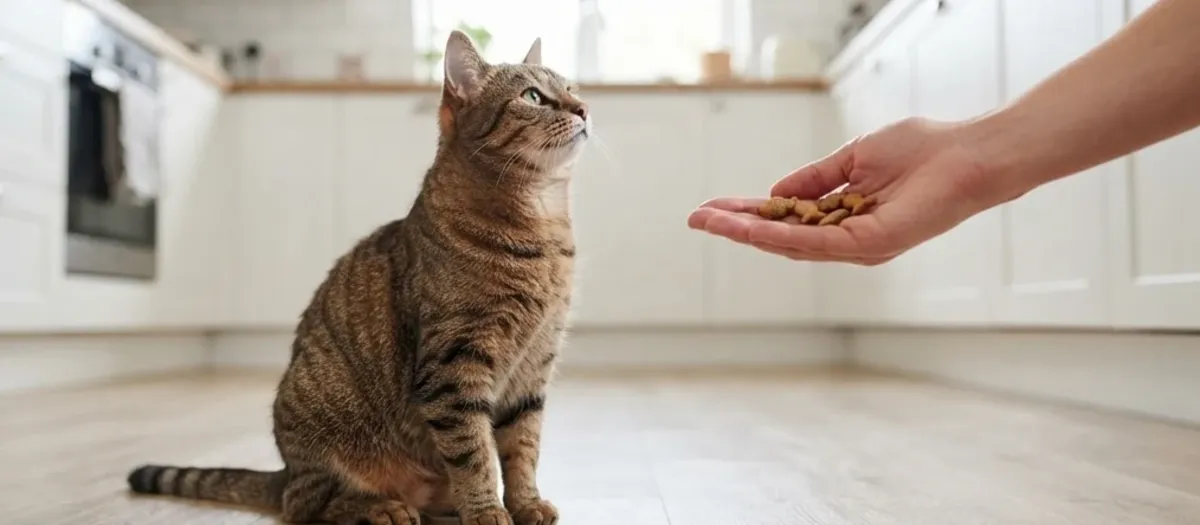
Quick answer: How many treats can a cat have a day? Vets commonly say treats should make up no more than about 10% of a cat's daily calories. For a 4.5 kg neutered adult at ideal weight, that's about 26 kcal, or roughly 12 crunchy treats listed as under 2 calories each. Ask your vet for your cat's real figure.
Treat packs give one number, your vet may give another, and the 10% rule gives a third. This guide turns the rule into a table by cat weight in kilograms, then into treat counts for crunchy, lickable and pill-hiding treats. For a quick look at the types, see our best cat treats guide.
How many treats can a cat have a day?
Treats should make up no more than about 10% of your cat's daily calories, with the rest from complete and balanced food. That percentage is the number to work from, because treats differ in size and calories. Count every source: training rewards, pill treats, lickable tubes and scraps from the plate.
VCA Hospitals gives the same 90/10 split and says too many treats can interfere with appetite for regular food (VCA Hospitals, "Cat treats", page last updated 26 September 2024, read 21 November 2026). It also says treats labelled "light" or "lower calorie" aren't necessarily much lower in calories, so look for a real figure on the pack.
Treats aren't meals. Even when a pack says "complete and balanced", we still count it as a treat and keep it inside the 10%.
How many calories does my cat need a day?
A neutered adult cat at an ideal weight of 4.5 kg needs about 260 kcal a day by the standard vet formula, so about 26 kcal can go to treats. Smaller cats have less room. Use your cat's ideal weight, not their current weight, and treat the result as a starting point.
The MSD Veterinary Manual gives resting energy as 70 × (weight in kg) to the power of 0.75. A neutered adult needs about 1.2 times that, and an obesity-prone adult about 1.0 times (MSD Veterinary Manual, nutritional requirements of small animals, reviewed November 2023, read 21 November 2026; MSD table of daily maintenance energy requirements). We worked out the table below from those formulas. It's our own calculation. Kcal are rounded to whole numbers, and the treat counts are worked out from the unrounded figures at 2 kcal per treat (the top of the "under 2 calories" claim on the crunchy treat listings we read), then rounded down. They're a cautious maximum.
| Ideal weight | Neutered adult, kcal a day | 10% for treats | Treats at 2 kcal | Obesity-prone, kcal a day | 10% for treats | Treats at 2 kcal |
|---|---|---|---|---|---|---|
| 2.5 kg | 167 | 17 | 8 | 139 | 14 | 6 |
| 3 kg | 191 | 19 | 9 | 160 | 16 | 7 |
| 3.5 kg | 215 | 21 | 10 | 179 | 18 | 8 |
| 4 kg | 238 | 24 | 11 | 198 | 20 | 9 |
| 4.5 kg | 260 | 26 | 12 | 216 | 22 | 10 |
| 5 kg | 281 | 28 | 14 | 234 | 23 | 11 |
| 5.5 kg | 302 | 30 | 15 | 251 | 25 | 12 |
| 6 kg | 322 | 32 | 16 | 268 | 27 | 13 |
| 7 kg | 361 | 36 | 18 | 301 | 30 | 15 |
MSD says an individual animal may need as much as about 30% more or less than the calculated figure, and that any calculation is only a starting point. So treat this table as a guide, not a prescription. A cat who is losing weight needs a plan from your vet, not a formula from a website. RSPCA Australia says the amount a cat needs depends on size, age and activity, and that a vet can weigh your cat and assess their body condition (RSPCA Australia Knowledgebase, "What should I feed my cat?", updated 23 November 2026, read 25 November 2026).
How many treats is that for each type of treat?
It depends on the treat. A crunchy treat listed as under 2 calories uses very little of the allowance, a lickable tube uses more, and some treats list no calorie figure at all. Where a pack gives no figure, we can't give a count, so check the pack and start small.
The table below uses a 4.5 kg adult with a 10% allowance of about 26 kcal. It sets what each pack says against our sum. The calorie figure for Churu comes from our Churu guide.
| Treat | What the listing says | Inside 26 kcal? |
|---|---|---|
| Temptations, Australian packs | Up to 17 treats for a 4.5 kg adult cat daily, each under 2 calories | 17 is above our cautious 12 at 2 kcal. The pack implies smaller treats but doesn't print a figure, so start lower and ask your vet |
| Temptations, US-label packs | 10 to 12 treats per 4.5 kg | Close to our figure |
| Feline Greenies Dental | 8 treats twice a day (16) for a 4.5 kg cat, under 2 calories each, and adjust the main meal | Up to about 32 kcal at 2 kcal each, which is more than the 26 kcal allowance. Trim the meal, as the label says |
| Greenies SmartBites | 18 treats per 10 lb (4.5 kg) through the day | Same point: count them and trim the meal |
| INABA Churu tube | 6 calories per tube | About 4 tubes with no other treats |
| Freeze-dried meat | No calorie figure on any listing we read | Check the pack. Use small pieces |
Notice that the pack directions for Temptations and both Greenies treats can use the whole allowance or more if each treat is close to 2 calories. That isn't a mistake, but it means the pack's amount shouldn't be stacked on top of other treats. Our Temptations cat treats guide goes through the Australian pack directions, and our Greenies cat treats guide covers the dental amounts and which Greenies lines are on the VOHC list for tartar.
Do treats for pills, training and puzzle toys count?
Yes. Every treat counts toward the 10%, whatever it's used for: a pill hidden in a soft pocket, a reward during training, or a kibble-sized treat dropped into a puzzle toy. Add them up across the day, and trim the main meal if the total goes over.
Pill pockets have no calorie figure on the Greenies listing we read, so follow the pack and ask your vet whether your cat's medicine can be given with food. Our pill pockets guide and Greenies cat treats guide cover them.
Puzzles are different, because they can use food your cat is already due to eat. Weighing the day's dry food and moving a portion into a puzzle feeder turns part of a meal into a foraging game without adding calories. Food puzzles are a way to let cats work for their food, and the research team behind a 2016 paper says most cats can adjust to them with time, patience and an appropriate introduction (ScienceDaily summary of Dantas et al., "Food puzzles for cats", Journal of Feline Medicine and Surgery, 2016, read 21 November 2026; DOI). Moving a portion in rather than adding food is our own suggestion. See our cat puzzle feeder guide for how to start.
Which cats should have fewer treats, or none without a vet's OK?
Cats who gain weight easily need a smaller allowance, and cats with a medical condition or a special diet need a vet's OK first. That covers kidney disease, diabetes, urinary diets and prescription diets. VCA Hospitals says to check with your vet before treats if your cat has a medical condition or is on a special diet.
The obesity-prone column in the table is a good starting point for cats who put on weight easily, though a vet should confirm which column suits your cat.
Some foods aren't treats at all. RSPCA Australia lists onions, garlic, chocolate, grapes and raisins as harmful to cats, and says milk can upset their stomachs. Plain boiled or steamed chicken, or tinned fish in spring water with any bones removed, can be offered occasionally, as RSPCA Australia says. Our what can cats eat guide has the full list.
Are cat treats bad for cats?
Not in themselves. For a healthy cat, treats made for cats are generally fine in small amounts, and they're useful for training and bonding. The trouble is amount: too many treats can dull appetite for regular meals and add weight. A treat that isn't a meal can't replace one.
A common question is whether Temptations are bad for cats. For a healthy cat, the number matters more than the brand. Our Temptations guide looks at what's in them. Treats with a long ingredient list aren't automatically worse than a short one, but a short list is easier to check.
Freeze-dried meat treats need a caution of their own. VCA Hospitals says freeze-dried or dehydrated raw treats carry a risk of bacterial contamination that can spread to other pets and people. If you choose one, our freeze-dried cat treats guide covers how to handle it like raw meat.
Useful guides
Our buying guides compare the treats and puzzles mentioned above:
- Temptations cat treats, for crunchy treats and the pack directions
- Greenies cat treats, for dental treats and Pill Pockets
- Cat puzzle feeders and treat balls for dry food, for turning part of a meal into a game
- Freeze-dried cat treats, for single-ingredient treats and raw handling
- Churu cat treats, for lickable tubes
- Best cat treats, for the types side by side
When to see a vet
See your vet if your cat has any of these:
- vomiting or diarrhoea after a new treat
- not eating for more than a day
- weight gain or weight loss
- drinking much more or much less than usual
Ask your vet before giving treats to a cat with kidney disease, diabetes, or a urinary or prescription diet. If your cat may have eaten something toxic, call your vet, an emergency vet or the Animal Poisons Helpline on 1300 869 738 (24/7) straight away, even if your cat seems fine. See our what can cats eat guide for foods to avoid.
Frequently asked questions
Do treats make cats fat?
They can, if they push the day's calories past what the cat burns. Treats are easy to overlook, and small cats have little room. Keep them inside about 10% of daily calories, trim the main meal when you give more, and ask your vet to check your cat's weight and body condition.
Can I use my cat's dry food as treats?
Yes. A few pieces of your cat's own complete dry food make a simple reward, and they count toward the day's food, so take them out of the meal. Hand-feeding or a puzzle feeder works well. Keep the total the same and don't add extra on top.
How many treats can a kitten have?
Ask your vet. We found no vet source that gives kitten treat amounts, and kittens need a lot of calories for growing. Choose a treat whose pack names kittens or all life stages, keep pieces tiny, and never let treats replace kitten food. Some Greenies Dental packs say 1 year or older.
Do lickable treats count towards the 10%?
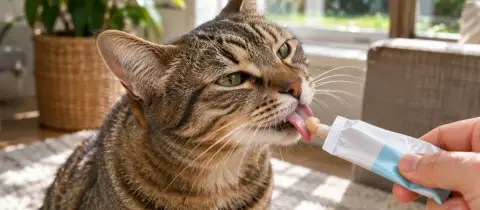
Yes. Lickable treats are treats, however they're served. The Churu figure on our guide is 6 calories per tube, so about four tubes would use the whole allowance for a 4.5 kg adult. Some lickable packs list no calorie figure, so check the pack and keep to small amounts.
What should I do if my cat begs for treats all day?
Cats repeat what works, so a treat given for begging teaches more begging. Hold treats for set times, such as after play, and use part of the daily food for rewards. If your cat seems hungry all the time or is losing weight, see your vet.
Should an overweight cat still get treats?
Possibly, but only with your vet's plan. A cat who needs to lose weight needs a vet-set calorie target, and treats come out of it. Use a few pieces of the cat's own kibble, play, and attention as rewards. Don't cut meals on your own.
How do I tell if my cat is a healthy weight?
A vet can weigh your cat and assess their body condition score, as RSPCA Australia says. Cats differ in frame and build, so a number on the scales or a photo isn't enough on its own. Ask your vet to check at the next visit, and ask what your cat's ideal weight is.
Can a cat on a prescription diet have treats?
Only if your vet says so. Prescription and urinary diets are balanced for a medical reason, and treats can work against them. VCA Hospitals says to check with your vet before giving treats to a cat on a special diet. Your vet may suggest a treat that suits the diet.
Related guides
- Best cat treats
- Temptations cat treats
- Greenies cat treats
- Cat puzzle feeders and treat balls for dry food
- Freeze-dried cat treats
- Churu cat treats
- What can cats eat? Safe and unsafe foods
- Best dry cat food
- Cat enrichment ideas
Sources
- VCA Hospitals: Cat treats, page last updated 26 September 2024, read 21 November 2026
- MSD Veterinary Manual: Nutritional requirements of small animals, read 21 November 2026
- MSD Veterinary Manual: Daily maintenance energy requirements for dogs and cats, read 21 November 2026
- RSPCA Australia Knowledgebase: What should I feed my cat?, updated 23 November 2026, read 25 November 2026
- ScienceDaily: Food puzzles for cats, 1 September 2016, read 21 November 2026
- Pack directions from the Amazon Australia listings of the products on our linked guides, checked on 20 November 2026.
This guide provides general information and isn't a substitute for veterinary advice. If you're concerned about your cat's weight or diet, speak with your vet.