Quick answer: What can cats eat? Complete and balanced cat food should be the whole diet, with small extras such as plain cooked chicken, white fish or egg, with no bones, skin or seasoning. Treats and scraps together stay at about 10% of the day's calories. Onion, garlic, chocolate, grapes and cooked bones stay off the menu.
Most cats do best on proper cat food, and the kitchen is for the odd small extra. This guide gives you a safe list, a never list, a simple way to keep portions sensible and what to do if your cat gets into something. For treats made for cats, see our cat treats guide.
Quick picks
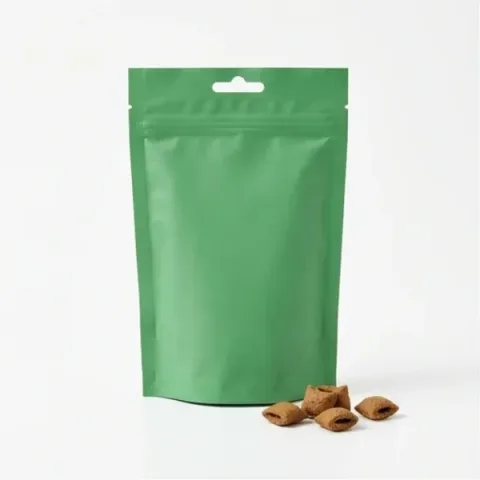
Greenies Feline Dental Cat Treats, Catnip, 60 g
Crunchy wafers under 2 calories each per the listing; count them in the 10%

Vitakraft Liquid Snack for Cats, Chicken, 48 x 15 g
Chicken sachets with taurine and no added sugar; follow the pack and count them in

INABA Churu Bites, chicken, 18 tubes
Soft baked bites with a creamy centre, made for cats
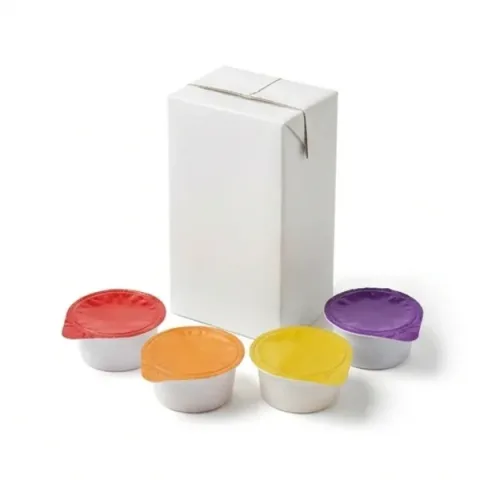
animonda Milkies Variety, 4 x 20 cups
Lactose-reduced cat milk in single-serve cups; counts toward the 10%
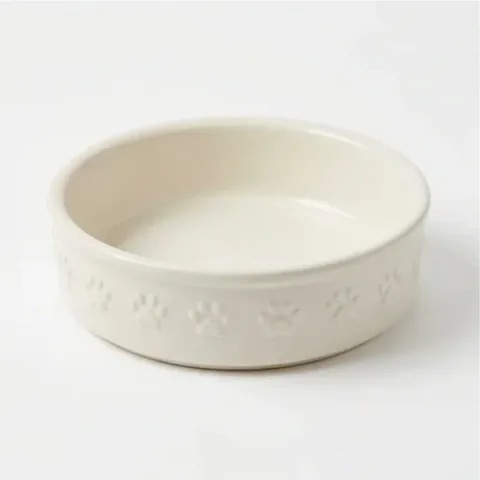
Mason Cash Cat Saucer, stoneware, 13 cm
Heavy stoneware saucer that is easy to wash, for small plain extras

Catit Pixi fountain
Fountain for cats that like moving water; water is the drink cats need
INABA Churu Bites, chicken
A soft treat made for cats, so it's a tidier choice than scraps from the kitchen.
animonda Milkies Variety
Lactose-reduced cat milk in single-serve cups, a better option than cow's milk as an occasional treat.
Mason Cash Cat Saucer
A wide, shallow stoneware saucer that is easy to wash, handy for small plain extras.
Catit Pixi fountain
A water fountain for cats that like moving water, since fresh water is the drink cats need.
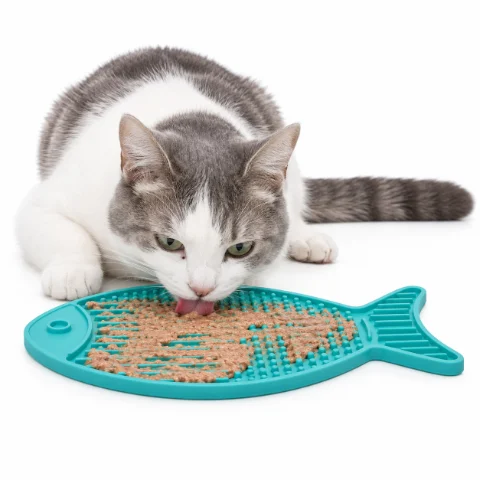
LickiMat Felix
A lick mat that turns a small, safe extra like a smear of wet cat food into a slower, calmer snack.
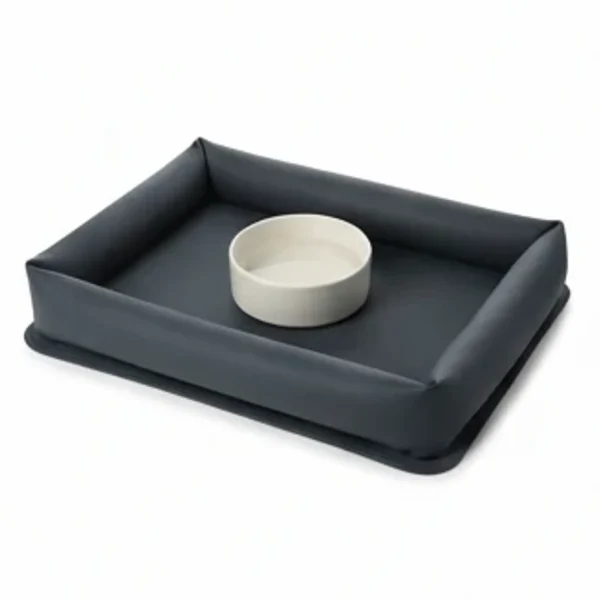
Reopet silicone feeding mat with raised edge
A wipe-clean mat that catches crumbs and spills under the food and water bowls.
Pictures are illustrations, not the actual products.
More detail on the first two is in Useful gear for safe snacking below. Treats are extras on top of complete cat food, and they don't replace your vet's advice.
What human food can cats eat?
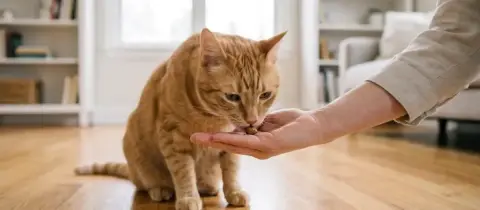
Cats can have small amounts of plain cooked meat, fish, egg and a few plain vegetables as an occasional extra. Cook it without salt, oil, butter, herbs or stock, and take out every bone and the skin. These are extras on top of cat food, never a replacement for it.
PetMD says plain cooked chicken (baked or boiled, not fried) with skin and bones removed is a fine snack, that most fish is fine when thoroughly cooked with skin and bones removed, and that plain pureed pumpkin suits a healthy cat but raw pumpkin is hard to digest (PetMD, published 5 September 2023).
| Food | Safe? | How to serve |
|---|---|---|
| Chicken, turkey | Yes, small amounts | Plain and fully cooked, no skin, no bones, no seasoning |
| Beef, lamb | Yes, small amounts | Plain and cooked, trimmed of fat, no bones, no gravy |
| White fish | Yes, occasionally | Cooked, with all bones and skin removed, no seasoning |
| Canned fish | Occasionally | Packed in spring water, not oil, brine or sauce; check there are no bones |
| Egg | Yes, small amounts | Plain and fully cooked, never raw; see can cats eat eggs? |
| Pumpkin | Yes, small amounts | Plain, cooked and mashed, no salt or spices; see our pumpkin guide |
| Carrot, rice | Small amounts | Plain and cooked until soft, nothing added |
| Cat grass | Yes | Grown for cats; see our cat grass guide |
PetMD didn't cover egg, lamb, carrot or rice on the page we read, so treat those as small, plain extras and ask your vet if your cat has a health condition. ASPCA says raw meat and raw eggs carry a food safety risk for pets, which is one more reason to cook everything (ASPCA, page read 7 November 2026).
What can cats not eat?
Cats should never have onion, garlic, leeks or chives, chocolate, caffeine, grapes, raisins and sultanas, alcohol, raw yeast dough or cooked bones. If your cat eats any of them, ring your vet or the Animal Poisons Helpline (1300 869 738, 24/7) straight away, even if your cat seems fine.
| Food | Why it's dangerous |
|---|---|
| Onion, garlic, leeks, chives | Allium plants can damage red blood cells and cause anaemia. Cats are more sensitive than dogs, per ASPCA. Powder, stock, gravy, sauces and baby food count too |
| Chocolate | Can cause vomiting, tremors and seizures, per ASPCA's general pet warning |
| Coffee, tea, caffeine | Same group of risks as chocolate, including tea bags and coffee grounds |
| Grapes, raisins, sultanas | ASPCA says they can cause kidney damage (named for dogs) and advises keeping them away from pets; watch for fruit cake, hot cross buns and trail mix |
| Alcohol | Dangerous for pets in small amounts, including in cakes and puddings |
| Raw yeast dough | Can keep rising in the stomach, causing painful gas and alcohol, per ASPCA |
| Cooked bones | Can splinter and injure or block the gut, per ASPCA and PetMD |
| Lilies | A plant, not a food, but extremely toxic to cats. See are lilies poisonous to cats? |
ASPCA says cats are more susceptible than dogs to onion, garlic and chives, and warns that baby food containing onion or garlic powder can poison a pet (ASPCA, page read 7 November 2026, ASPCA cat care, page read 7 November 2026). ASPCA's page speaks about pets generally for chocolate, caffeine, alcohol and yeast dough, and names dogs for grapes and raisins. We haven't found a cat-specific figure for grapes, so we treat them as a no. Dog owners can see our toxic foods list for dogs.
How much human food can a cat have?
Treats, scraps and extras together should stay at about 10% of the day's calories, with the rest from complete and balanced cat food. VCA Hospitals says treats should be limited to 10% of a cat's daily calories (VCA Hospitals, page read 7 November 2026).
Here's an example only. If a cat's daily food comes to 200 calories (your vet can give you your cat's real figure), 10% is 20 calories. That has to cover every treat, lick of cheese and piece of chicken from the kitchen. A small, less active or indoor cat may have even less room. PetMD gives size examples: a 2.5 cm (1 inch) cube of cooked chicken or fish for a healthy cat, and about a tablespoon of plain pumpkin a few times a week.
Ask your vet first if your cat has kidney disease, diabetes, a weight problem or eats a prescription diet.
Can cats eat human food every day?
A small plain extra now and then is fine for a healthy adult cat, but it shouldn't become the meal. Daily scraps add up quickly against the 10% allowance, and they can crowd out the balanced food cats need. Keep extras small and count them in.
If your cat is on a prescription diet, VCA warns that extra foods can stop some of those diets working properly, so check with your vet before offering anything. For kittens, kitten food matters most, so ask your vet before adding human food at all.
What can cats eat instead of cat food?
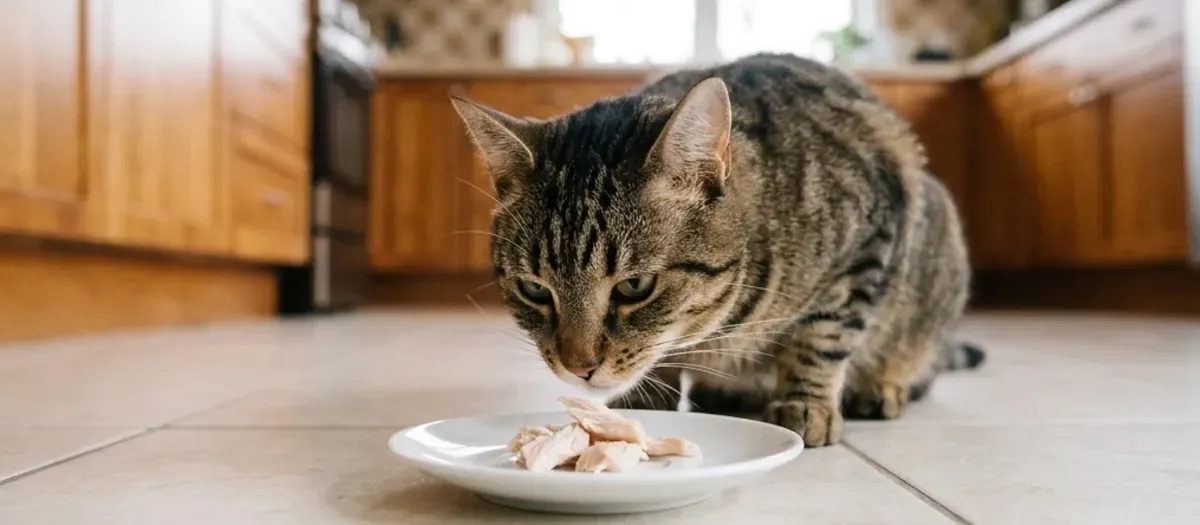
For one night while you get more cat food, plain cooked chicken or white fish with no bones, skin or seasoning is a sensible stopgap. It isn't complete and balanced, so it's a short-term fix. Buy cat food as soon as you can, and see your vet if your cat won't eat.
Don't reach for dog food, tuna every day or milk to fill the gap.
Can cats eat dog food?
Not as a diet. A bit of dog food isn't toxic, but PetMD says cats can't be maintained on it, because cats are obligate carnivores who need meat protein and animal fats, and they can't make taurine themselves (PetMD, published 5 May 2020).
PetMD says taurine deficiency can weaken the heart and cause vision loss, and that dog foods rarely include taurine while commercial cat food does. If you share a home with a dog, feed them apart so each pet eats its own food.
Can cats eat tuna and other fish?
Tuna is an occasional extra, not a diet. PetMD says to limit tuna to an occasional snack, that canned tuna is safe if packed in water rather than oil, and that albacore is very high in mercury (PetMD, published 1 April 2024).
PetMD also says plain human tuna is low in vitamin E, unlike tuna made for cats, which is supplemented. It says tuna should be cooked to human standards and served plain, so skip sushi and raw scraps. If your cat will only eat tuna, mix cat food in slowly and ask your vet for a plan, because fussy habits can be tricky to undo.
Can cats eat cheese or drink milk?
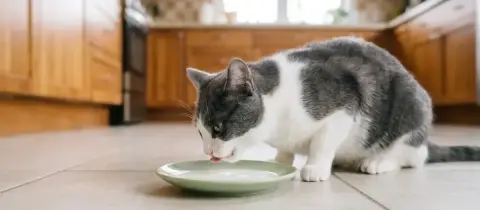
Most adult cats don't digest lactose well, so cow's milk and cheese can cause an upset stomach and diarrhoea. PetMD says cow's milk isn't good for cats, plant milks like almond, oat, soy and coconut aren't recommended either, and fresh water is the drink cats need (PetMD, published 1 August 2023).
If you want to offer a milky treat, lactose-free cat milk counts toward the 10%. See our cat milk guide.
Can cats eat raw meat?
Ask your vet before feeding any raw meat, and don't treat it as a swap for complete cat food. ASPCA flags raw meat and raw eggs as a food safety concern for pets, and bones as a risk of injury or blockage (ASPCA, page read 7 November 2026).
VCA Hospitals is also wary of freeze-dried or dehydrated raw treats because of a risk of bacterial contamination that can spread to other pets and people. We don't recommend a raw diet. If you're curious about one, talk it through with your vet.
What if my cat eats something toxic?
Call your vet, an emergency vet or the Animal Poisons Helpline (1300 869 738, 24/7) straight away, even if your cat seems fine. Say what was eaten, how much, when, and your cat's weight. Don't try to make your cat vomit at home unless a vet tells you to.
Keep the packet or a sample of what was eaten, and take it with you. If you think it might be a lily, treat it as an emergency too, even from pollen on fur. Our lilies guide explains why.
What is a silent killer for cats?
There isn't one single answer, and we can't diagnose from a question. People often mean lily poisoning, kidney disease or a urinary blockage, all of which can be easy to miss early. Changes in drinking, appetite or litter tray use are worth a vet visit.
A cat straining in the litter tray with little or no urine needs a vet urgently. For lilies, see are lilies poisonous to cats?.
Choose by situation
| Your situation | What to do | Our guide |
|---|---|---|
| Cat begging at dinner | Offer a small plain piece of cooked chicken or a proper cat treat, and count it in the 10% | Cat treats |
| Out of cat food tonight | Plain cooked chicken or white fish for one meal, then buy cat food | Cat treats |
| Kitten | Kitten food matters most, so ask your vet before adding human food | Cat milk |
| Prescription diet, kidney disease or diabetes | Ask your vet before any extras | Ask your vet |
| Ate onion, garlic, chocolate, grapes or a lily | Call your vet or the helpline now | Lilies guide |
| Cat that only wants tuna | Keep tuna occasional, mix cat food in slowly, ask your vet | Cat treats |
| Christmas or BBQ leftovers | Fatty scraps, bones and onion in stuffing are out; give a proper treat instead | Churu cat treats |
Useful gear for safe snacking
Supermarkets, pet shops and vet clinics also sell treats like these. Both picks are from our cat treats guide, and the first is also in our cat dental treats guide.
- Greenies Feline Dental Cat Treats, Catnip, 60 g: crunchy wafer treats that the listing says help reduce tartar when used daily, with less than 2 calories per treat per the listing. The listing names chicken as an allergen.
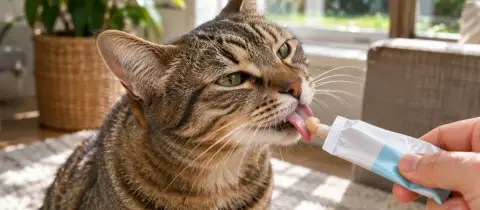
- Vitakraft Liquid Snack for Cats, Chicken, 48 x 15 g: lickable chicken sachets that the listing says contain taurine, with no added sugar, colours or preservatives. The listing gives no calorie figure, so follow the pack and count them in the 10%. The listing says from 3 months, but ask your vet before giving treats to a kitten.
When to see a vet
Call your vet or the Animal Poisons Helpline (1300 869 738, 24/7) now if your cat has eaten onion, garlic, leeks, chives, chocolate, coffee or anything with caffeine, grapes, raisins, sultanas, alcohol, raw dough or a lily, even if they seem fine.
- Vomiting or diarrhoea after a new food, or lasting more than a day
- Not eating for more than a day
- Weight gain or loss
- Drinking much more or much less than usual
- Straining in the litter tray with little or no urine, which is an emergency
Check with your vet before extras if your cat has kidney disease, diabetes or eats a prescription diet. See our lilies guide and Can my pet eat this? checker.
Frequently asked questions
Which human foods are best for the odd treat?
Small amounts of plain cooked chicken, turkey, beef, white fish, egg and pumpkin, with no bones, skin, salt or seasoning. PetMD names chicken, fish and plain pumpkin as suitable snacks. Keep extras within about 10% of daily calories and ask your vet if your cat has a health condition.
Can cats eat eggs?
Yes, plain and fully cooked, in a small amount counted in the 10%, and never raw. Our can cats eat eggs guide covers scrambled vs boiled, how much, kittens and cats with kidney disease.
Are leeks toxic to cats?
Yes, treat them as toxic. Leeks belong to the same onion family as garlic and chives, which ASPCA says cats are more susceptible to than dogs, with a risk of anaemia. Check stock, gravy and sauces too. If your cat has eaten any, call your vet or the helpline.
Can cats eat ice cream?
We'd say no. Most adult cats don't digest lactose well, and ice cream also has sugar and fat. PetMD says cow's milk isn't good for cats, so ice cream carries the same dairy problem. Some flavours, like chocolate, are toxic. Offer a cat treat instead.
Can cats eat tuna every day?
No. PetMD says to limit tuna to an occasional snack, that albacore is very high in mercury and that plain human tuna lacks vitamin E. A cat can't live on it. If yours only wants tuna, ask your vet how to move them to a complete cat food.
What can cats eat from the fridge?
Plain cooked chicken, turkey or beef with no skin, bones or sauce, a little plain cooked egg, or canned fish in spring water with no bones. Skip cheese, milk, ham, leftovers with onion or garlic, and anything in gravy or stock. Count the extra in the 10% allowance.
What can cats eat and drink?
Complete and balanced cat food and fresh water cover everything a cat needs. Wet food adds water to the diet. Small plain extras from the safe table are fine as treats. Milk is a treat, not a drink, and plant milks aren't recommended. See our cat water bowl guide for drinking tips. Our wet cat food and dry cat food guides compare complete foods, and our kitten food guide covers growing kittens.
Related guides
- Best wet cat food
- Best dry cat food
- Best kitten food
- Can cats eat eggs?
- Best cat treats
- Best cat milk
- Best cat bowls
- Best cat water bowls
- Churu cat treats
- Best cat dental treats
- Are lilies poisonous to cats?
- Cat hairball remedy
- Cat grass
- Can my pet eat this? food checker
- Foods you must never use: the toxic foods list for dogs
- All our cat guides
Sources
- ASPCA, People foods to avoid feeding your pets, page read 7 November 2026 (https://www.aspca.org/pet-care/animal-poison-control/people-foods-avoid-feeding-your-pets)
- ASPCA, General cat care, page read 7 November 2026 (https://www.aspca.org/pet-care/cat-care/general-cat-care)
- VCA Hospitals, Cat treats, page read 7 November 2026 (https://vcahospitals.com/know-your-pet/cat-treats)
- PetMD, What human foods can cats eat? published 5 September 2023, page read 7 November 2026 (https://www.petmd.com/cat/nutrition/what-human-foods-can-cats-eat)
- PetMD, Can cats eat tuna? published 1 April 2024 (https://www.petmd.com/cat/nutrition/can-cats-eat-tuna)
- PetMD, Can cats drink milk? published 1 August 2023 (https://www.petmd.com/cat/nutrition/can-cats-drink-milk)
- PetMD, Can cats eat dog food? published 5 May 2020 (https://www.petmd.com/cat/nutrition/can-cats-eat-dog-food)
- Product details from each linked Amazon Australia listing, checked on 7 Nov 2026.
This guide provides general information and isn't a substitute for veterinary advice. If you're concerned about what your cat has eaten, speak with your vet.