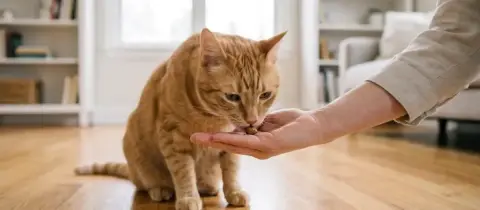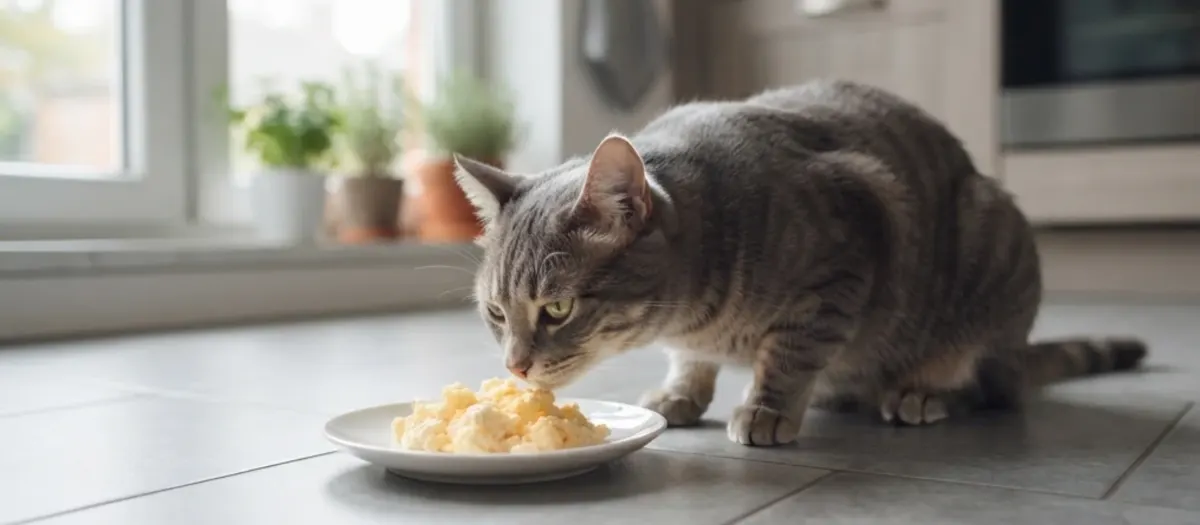
Quick answer: Can cats eat eggs? Yes, plain, fully cooked egg in a small amount is fine for most healthy cats as an occasional extra. Scramble or boil it with no butter, oil, salt or seasoning, and never serve it raw, as raw egg can carry Salmonella. A little on top of normal food, counted in the 10% treat allowance, is plenty.
Eggs are one of the easiest things to share at breakfast, and cats are very good at asking. The safe version is simple, but the cooking method, the amount and your cat's health all matter. This guide covers raw and cooked egg, how much fits in a day, kittens and cats with health conditions. For the wider picture, see our list of what cats can eat.
Can cats eat eggs?
Yes. Plain, fully cooked egg is safe for most healthy cats in small amounts, as an extra on top of complete cat food, according to PetMD and Purina. Egg white is protein without fat, while the yolk is mostly fat with some protein, so portions stay small.
PetMD says cats can eat scrambled or boiled egg with no salt or seasonings, and that eggs shouldn't be a cat's only source of protein (PetMD, Dr Dalal Hares, 30 June 2020). Purina agrees that cats can eat eggs "in moderation and always cooked", and suggests a small piece alongside the normal meal rather than a whole egg at once (Purina UK, 18 December 2025).
Here is what is in a hard-boiled egg, from the USDA's food database (USDA FoodData Central, entry 173424):
| Per 100 g of hard-boiled whole egg | Amount |
|---|---|
| Energy | 155 kcal |
| Protein | 12.6 g |
| Fat | 10.6 g |
| Phosphorus | 172 milligrams |
The USDA entry is for the whole egg, so it doesn't split white from yolk. PetMD says the fat sits mostly in the yolk, and that fat can raise the risk of obesity and, in some cats, tummy upsets and pancreatitis. That is why we keep the yolk small for any cat who is overweight.
Can cats eat raw eggs?
No. Raw egg can carry Salmonella and E. coli, which can make your cat and the people in your home sick, and cooking destroys them. Raw egg white also contains avidin, which binds biotin. Since cooking solves both problems, there's no good reason to serve it raw.
The ASPCA says raw eggs can carry bacteria such as Salmonella and E. coli that are harmful to pets and people alike (ASPCA, page read 14 November 2026). PetMD says Salmonella can infect cats and people and cause vomiting and diarrhoea. Hill's says handling pet dishes can pass contamination to people and advises washing your hands after preparing meat or eggs, so wash the bowl and your hands after any raw egg (Hill's Pet Nutrition, 9 July 2018).
On avidin, the Merck Veterinary Manual explains that raw egg white contains a protein that binds biotin and stops it being absorbed, while egg yolk is a good biotin source (Merck Veterinary Manual, updated September 2024). Merck also says true biotin deficiency is very rare in cats and dogs. So the avidin point isn't a reason to panic, just one more reason to cook the egg.
How should I cook eggs for a cat: scrambled, boiled or fried?
Hard-boiled, or scrambled in a dry non-stick pan, is the way to go. Cook until the egg is firm all the way through, let it cool, and add nothing. Fried egg isn't ideal because the oil or butter adds fat, which our sources say can upset a cat's gut and may trigger pancreatitis.
PetMD says to cook egg to an internal temperature of about 71°C (160°F), and to let it cool before serving. Purina says scrambled egg should have no seasoning, fats, oils, garlic or onion, and boiled egg should be hard-boiled and shelled with no salt or pepper. No source we read covers plain fried, soft-boiled or poached egg, so those rows below are our reasoning from the cook-through and fat advice.
| Method | Safe for your cat? | Why |
|---|---|---|
| Scrambled in a dry non-stick pan | Yes, small amount | Fully set, nothing added (PetMD, Purina) |
| Scrambled with butter, oil or milk | Not ideal | Added fat; the ASPCA says dairy can cause diarrhoea because pets lack lactase |
| Hard-boiled, shelled | Yes, small amount | Cooked through, no seasoning (Purina) |
| Soft-boiled or runny yolk | No | Not cooked through, so the raw egg risks may remain |
| Poached | Only if firm all through | A runny yolk is the same problem as soft-boiled |
| Fried in oil or butter | Not ideal | Extra fat (our reasoning from PetMD and Purina) |
| Egg fried rice | No | Usually contains onion, which can damage red blood cells (Purina) |
| Egg mayonnaise | No | High in fat and salt (Purina) |
| Raw, including raw yolk | No | Salmonella, E. coli and avidin |
Salt matters too. The ASPCA says too much salt can cause thirst and urination, and in larger amounts vomiting, diarrhoea, tremors and seizures, so don't season your cat's portion. Set a plain piece aside before you add anything to your own breakfast. Cheese is one to skip as well, for the same dairy reason. If your cat likes a milky drink, our cat milk guide covers lactose-free options made for cats.
How much egg can a cat have?
A small amount, occasionally. PetMD suggests about 1 tablespoon of egg white on top of your cat's normal diet. Treats, scraps and extras together should stay at about 10% of the day's calories (VCA Hospitals). For a cat eating 200 calories a day, that works out at about a quarter of a large hard-boiled egg, if it's the only treat.
VCA says treats should be limited to 10% of your cat's daily calorie intake, and to check with your vet team for your cat's calorie needs (VCA Hospitals, Cat treats, updated 26 September 2024). The table below is our own worked example from the USDA figures above. A large egg is about 50 g, and a tablespoon of chopped egg is about 8.5 g. PetMD and the USDA mean a US tablespoon (about 15 ml, against 20 ml for an Australian tablespoon), so go by weight or use a teaspoon, which is 5 ml in both. Your cat's real calorie target depends on their size, age and weight, so use your vet's figure.
| Cat's daily food | 10% treat allowance | Hard-boiled egg that fits (if it's the only treat) |
|---|---|---|
| 200 kcal | 20 kcal | About 12 to 13 g, roughly a quarter of a large egg |
| 150 kcal (a smaller or indoor cat) | 15 kcal | About 10 g, a little over 1 tablespoon chopped |
| Any cat, one whole large egg | About 78 kcal | Far more than a day's treat allowance for either cat |
Treat it as an occasional extra, not a daily habit. PetMD and Purina give no set frequency, and we won't invent one. If you also give a dental treat or a lickable treat that day, the egg needs to shrink to make room. Our best cat treats guide lists treats made for cats and how to count them.
Can kittens eat eggs?
Yes, in small amounts, but kitten food matters most. PetMD says kittens can eat scrambled or boiled egg in small amounts and that egg shouldn't be a kitten's only food. Purina says occasional egg only with your vet's approval. Ask your vet before adding human food at all.
Kittens are growing fast and have small tummies, so a bit too much of anything rich can upset them. Egg has none of the balance a growing kitten needs from a proper kitten diet. We found no source giving egg amounts for kittens, so we don't give one. If your vet agrees, think of it as a lick-sized taste of plain, cooked, cooled egg, never a meal. Our kitten proofing checklist covers other things to sort out around the house.
Can cats with kidney disease, diabetes or pancreatitis have eggs?
Ask your vet first. Egg is a protein food and, per the USDA, hard-boiled egg has 172 milligrams of phosphorus per 100 g. VCA says limiting phosphorus appears to help delay the progression of kidney disease in cats that already have it, so a cat on a kidney diet gets nothing extra until the vet agrees.
VCA's kidney page links phosphorus to protein content and says kidney diets have less phosphorus and moderately less protein (VCA Hospitals, kidney disease nutrition for cats, updated 3 March 2025). That page doesn't mention eggs, so the link to egg is our reasoning from the USDA figure, which is why the vet makes the call.
PetMD says fatty meals can cause gastrointestinal upset and pancreatitis, and yolk is mostly fat. A cat with a history of pancreatitis, diabetes or a weight problem needs a vet's say-so before any new extra. The same goes for cats on a prescription diet, because extra food can stop some of those diets working properly.
Which cats can have egg, and which should ask the vet first?
A healthy adult cat can usually have a small amount of plain, cooked egg now and then. Kittens, overweight cats and cats with kidney disease, diabetes, pancreatitis or a prescription diet need a vet's okay first. Egg is a sometimes extra for everyone, never a meal.
| Your cat | What to do |
|---|---|
| Healthy adult | A small piece of plain, fully cooked egg now and then, counted in the 10% |
| Kitten | Kitten food comes first; ask your vet before adding any human food |
| Overweight | Keep it very small, mostly white, and ask your vet about a weight plan |
| Kidney disease | Nothing extra until your vet agrees, as egg adds protein and phosphorus |
| Diabetic | Ask your vet before adding any new food |
| History of pancreatitis | Ask your vet first, and keep every bit of added fat away |
| On a prescription diet | Ask your vet before offering anything outside the diet |
| Fussy eater who only wants egg | Egg isn't a complete diet; a cat refusing cat food can be unwell, so a vet can check |
Useful guides
We found no egg product on Amazon Australia that earns a place here, because plain egg from your own kitchen does the job. These guides help you serve extras well.
- What can cats eat?: the safe and toxic lists, with portion rules.
- Best cat treats: treats made for cats, and how many a day.
- Best cat bowls: a shallow dish suits a small extra.
- Churu cat treats: a lickable alternative for a cat who begs.
When to see a vet
Call your vet if your cat is vomiting repeatedly, has diarrhoea, seems lethargic or won't eat after raw or undercooked egg, and ring sooner for a kitten, an elderly cat or an unwell cat. Call your vet or the Animal Poisons Helpline (1300 869 738, 24/7) if your cat has eaten egg cooked with onion or garlic, such as egg fried rice. Call your vet if your cat shows any of these signs:
- Vomiting or diarrhoea that lasts more than a day or two, or comes back
- Lethargy, weakness or refusing food
- A tender or painful belly with vomiting after a fatty meal, which can be consistent with pancreatitis
- Itchy skin, over-grooming, vomiting or diarrhoea after eating egg, which can be consistent with a food allergy
- Gagging, coughing or pawing at the mouth after eating shell
Never give human medicines for tummy trouble, as some are dangerous for cats, and ask your vet before giving anything. Never try to make your cat vomit. See our what can cats eat guide for the toxic foods list.
Frequently asked questions
What happens if a cat licks a raw egg?
A lick is low risk for a healthy adult cat, but Salmonella and E. coli are the concern. Watch for vomiting, diarrhoea or lethargy over the next day or two (Hill's). Call your vet if signs appear, or sooner for a kitten, elderly or unwell cat. Wash the bowl, bench and your hands.
Can I give my cat an egg every day?
We'd say no. Keep egg an occasional extra, counted in the 10% treat allowance, and a whole large egg is far more than that for most cats. Hill's quotes one vet who gives her own cats scrambled egg about once a week, but that's her habit, not a rule. Ask your vet.
Should cats have the yolk or the white, and can they have raw yolk?
Cooked white is lower in fat, so it suits cats who are overweight or sensitive to fat. Cooked yolk is fine in small amounts for healthy cats, but it's mostly fat (PetMD). Raw yolk is a no, as raw egg can carry Salmonella and E. coli, so cook it all the way through.
Can cats eat eggshells?
We'd avoid them. PetMD says shell has calcium but is less palatable, and mineral supplements should only be given under a vet's direction. Purina warns large pieces of shell can be a choking risk. Complete cat food already supplies the calcium your cat needs, so there's no need to add shell.
Can cats eat egg fried rice or egg mayonnaise?
No to both. Purina says egg fried rice usually contains onion, which damages red blood cells, so ring your vet or the Animal Poisons Helpline (1300 869 738, 24/7) if your cat eats some. Egg mayonnaise is high in fat and salt, which is a poor mix for cats.
Can cats be allergic to eggs?
It's uncommon but possible. Purina says signs can include excessive grooming, itchy skin, vomiting and diarrhoea, and Hill's says egg is a common food allergen in cats and dogs, though food allergy overall is uncommon. If you notice these signs after egg, stop offering it and talk to your vet.
Can cats eat rice?
Small amounts of plain, cooked, soft rice with nothing added are fine as an occasional extra, and it counts toward the 10% treat allowance. See the carrot and rice row in our what can cats eat guide. Skip rice cooked with onion, garlic, salt, stock or butter.
Related guides
- What can cats eat? Safe and toxic human foods list
- Best cat treats
- Best cat bowls
- Churu cat treats
- Best cat milk
- Kitten proofing your home
- Cat hairball remedies
- All our cat guides
Sources
- PetMD, Can cats eat eggs? Dalal Hares DVM, 30 June 2020, page read 14 November 2026 (https://www.petmd.com/cat/nutrition/can-cats-eat-eggs)
- Purina UK, Can cats eat eggs? Purina Editorial Team, 18 December 2025, page read 14 November 2026 (https://www.purina.co.uk/articles/cats/feeding/what-cats-eat/can-cats-eat-eggs)
- Merck Veterinary Manual, Nutritional requirements and related diseases of small animals, Sherry Lynn Sanderson DVM PhD DACVIM, updated September 2024, page read 14 November 2026 (https://www.merckvetmanual.com/management-and-nutrition/nutrition-small-animals/nutritional-requirements-and-related-diseases-of-small-animals)
- ASPCA, People foods to avoid feeding your pets, undated, page read 14 November 2026 (https://www.aspca.org/pet-care/animal-poison-control/people-foods-avoid-feeding-your-pets)
- VCA Hospitals, Cat treats, updated 26 September 2024, page read 14 November 2026 (https://vcahospitals.com/know-your-pet/cat-treats)
- VCA Hospitals, Nutrition for cats with chronic kidney disease, updated 3 March 2025, page read 14 November 2026 (https://vcahospitals.com/know-your-pet/nutrition-for-cats-with-chronic-kidney-disease)
- USDA FoodData Central, Egg, whole, cooked, hard-boiled, FDC 173424, SR Legacy, April 2019, page read 14 November 2026 (https://fdc.nal.usda.gov/food-details/173424/nutrients)
- Hill's Pet Nutrition, Can cats eat eggs? Kara Murphy, 9 July 2018, page read 14 November 2026 (https://www.hillspet.com/cat-care/nutrition-feeding/can-cats-eat-eggs)
This guide provides general information and isn't a substitute for veterinary advice. If you're concerned about your cat's diet or what they've eaten, speak with your vet.