Best cat ear cleaner: when cats need it and how to clean safely
By Anish PuriUpdated 12 Nov 202616 min readResearched, not tested by us
Research guide. WhiskerFinds may earn a commission from links, at no extra cost to you.
Quick answer: The best cat ear cleaner for most owners is Rufus & Coco Ear and Wound Care, an Australian-made liquid labelled for cats, which the listing says is APVMA registered. But most cats never need routine ear cleaning. Ask your vet first, clean only the outer ear, and treat smelly, red or scratchy ears as a vet visit.
Illustration, not the actual product
Our top pickRufus & Coco Ear and Wound Care, 150 ml
This guide compares four cat ear cleaners on Amazon Australia: two liquids and two finger wipes. It starts with the honest bit, which is whether your cat needs one at all, then covers ingredients to avoid, a safe method, and what ear mites and infections look like. Cleaning a dog's ears is a different job, so see our dog ear cleaner guide for that.
Quick picks
Our top pickBest overall
Rufus & Coco Ear and Wound Care, 150 ml
Australian-made liquid labelled for cats, APVMA registered per the listing, no essential oil listed
Pictures are illustrations, not the actual products.
Do cats need their ears cleaned?
Most cats don't. PetMD, in an article by veterinarians, says most cats do not need regular ear cleaning, and the UK charity PDSA says it isn't necessary unless your vet has asked you to. Check your cat's ears now and then, leave healthy ears alone, and ask a vet before reaching for a cleaner.
A cleaner is a tool for a job your vet has given you, not a routine.
PDSA also says to ask the vet first because infections, mites or eardrum problems may need medication before any cleaning, and that cleaning alone won't remove ear mites (PDSA, January 2023, page read 12 November 2026).
When a cat's ears need cleaning, and when they need a vet instead
A quick look is easy to do while your cat is relaxed. Ears that look clean and smell of nothing are fine. Dark debris, a smell, redness, discharge or a cat that keeps shaking its head or scratching points to a vet visit, not a wipe. PetMD says not to clean if you suspect an infection or injury.
This table is a guide to what may be going on, not a diagnosis; a vet works out the cause.
Swipe sideways to see every column
What you see
What it may be more consistent with
What to do
A little wax at the entrance, ears look and smell normal, cat unbothered
Nothing that needs treating
Leave it. Mention it at the next check-up
Dark, crumbly or gooey debris
Ear mites, according to Cornell Feline Health Center, though other causes also happen
Vet visit. Mites are confirmed with an otoscope or a swab under a microscope
Thick dark wax with a foul smell
Otitis, which can involve yeast overgrowth (Cornell)
Vet visit. Without the cause being found, infection tends to return
Discharge, redness, swelling or a sore-looking flap
Infection, injury or something stuck in the ear (PetMD, International Cat Care)
Vet visit. Don't clean it
Head shaking, near-constant scratching, ears held flat
Mites or otitis, and it can be painful
Vet visit
Sudden head shaking after time outdoors
A grass seed or other foreign material can lodge in the canal (International Cat Care)
Vet visit
A head tilt, wobbly walking or signs of hearing loss
A 150 ml liquid made in Australia. The listing calls it a dog and cat ear cleaner for routine cleaning, says it contains organic acids and says it's APVMA registered. It's also labelled for wounds and horses.
The directions on the listing say to put it in the ear liberally, massage the base and repeat as required, and for irritated ears to repeat it one to three times a day for several days "or as directed by your vet". The label says it helps treat ear inflammation. We'd put that the other way round for a cat: an inflamed, smelly or painful ear is a vet visit first, and the vet decides what goes in it.
Pros: Australian-made and labelled for cats; no essential oil listed; a small, light bottle at 170 g; a plain "as directed by your vet" line in the directions
Cons: the listing gives only "organic acids" and not the full ingredient list; it doesn't say whether it's fragrance-free or alcohol-free; the bottle is a multi-use ear and wound product with no cat-specific method- Best for: cats whose vet has asked for home cleaning, when you want an Australian label
Skip it if: your vet has prescribed something else, or your cat has a painful or inflamed ear
2. Virbac Epi-Otic Advanced ear cleanser: best vet-recommended brand
A 118 ml (4 oz) liquid. The listing says it's for routine cleansing of sensitive ears and for pets with chronic otitis externa, removes debris and excess wax, has a neutral pH and is "safe to use with other ear preparations". Ingredients per the listing are salicylic acid 0.2% in a "mild citrus aroma" cleansing solution, with PCMX, disodium EDTA and docusate sodium.
This is a US-labelled pack, so the label's units and wording are American, and the Australian 125 ml pack is the one on our dog ear cleaner guide. The listing title says dogs and cats, though its description mentions dogs, so check with your vet that it suits your cat.
Pros: a brand that vet clinics and pet shops stock here; neutral pH and designed for routine cleansing; the listing says it can go with other ear preparations; a small pack at 136 g
Cons: a US-labelled pack, so units and wording are American; the listing says "a mild citrus aroma" and doesn't say what gives the scent, so it may not suit a cat that reacts to scented products
Best for: a cat with sensitive or repeat ear trouble that your vet is managing
Skip it if: you want an Australian label, or your cat reacts to scented products
A 50 count pack of finger-sleeve wipes for cats and dogs. The listing says they're alcohol-free, paraben-free and fragrance-free, with witch hazel water, coconut oil, and aloe and oat extracts. The directions say not to use them deep into the ear canal, to use the pack within three months of opening and to stop and see a vet if redness occurs.
The listing makes claims we won't repeat as fact, such as preventing infection and being vet recommended.
Pros: fragrance-free and alcohol-free per the listing; a short session; a plain "not deep into the ear canal" direction; a clear stop-and-see-a-vet line
Cons: only the flap and the entrance, so it won't tackle debris in the canal; the pack must be used within three months of opening; the listing's marketing talks about infection, which wipes can't treat
Best for: a quick, gentle tidy of the outer ear when your vet is happy with it
Skip it if: your cat has visible debris in the canal, because that's a vet job, not a wipe
4. Kopmath ear finger wipes: best alternative wipes
A 50 count pack of finger wipes. The listing says they contain aloe vera, cornflower extract and vitamin E and are alcohol-free, paraben-free and fragrance-free. The finger shape is textured and about 3.8 cm wide, and the listing says it fits most adults' index fingers.
Pros: fragrance-free and alcohol-free per the listing; a textured, flexible finger shape; a second pack suits a home with a dog and a cat
Cons: the listing's wording about reaching "deeper inside the ears" doesn't fit safe practice, so ignore it; made in China per the listing; very close to the PawSono, with no use-within date on the listing
Best for: a multi-pet home that wants a second fragrance-free wipe
Skip it if: you've already got the PawSono, because they're close
How to clean a cat's ears step by step
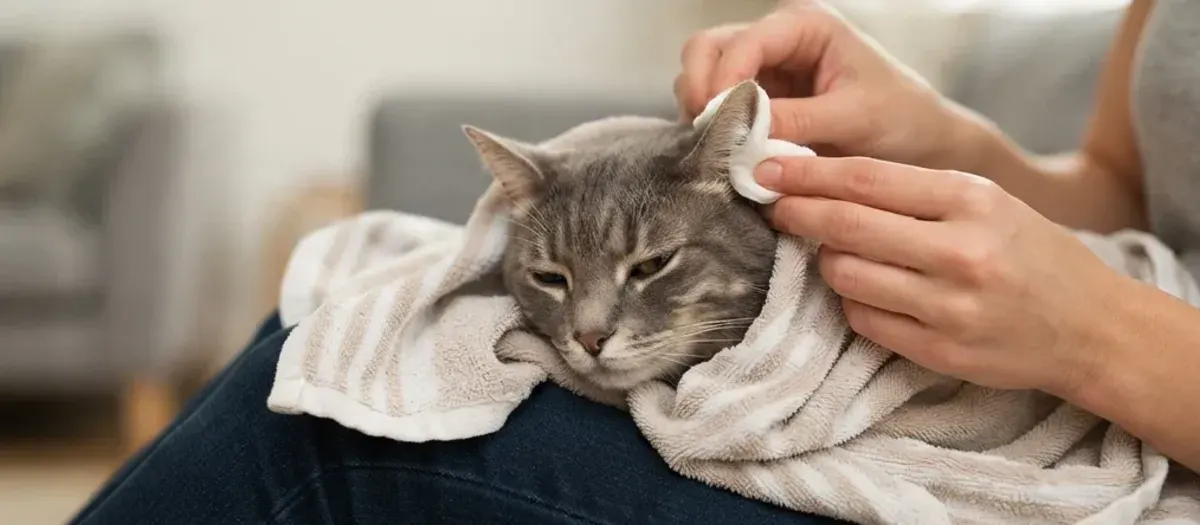
Only do this if your vet has said to, and with the cleaner your vet suggests. The method below follows PDSA and PetMD, which agree on the main points. Keep everything at the entrance of the ear, never push anything deeper into the canal, and never use cotton buds (PDSA says they can push dirt in and burst the eardrum).
Get set up somewhere calm. Have the cleaner, cotton wool or gauze, a towel and treats ready, and hold your cat gently in a loose towel wrap (PetMD).
Hold the ear flap upright and put the cleaner's tip at the entrance, not down inside, then squeeze in the amount the label or your vet gives.
Massage the base of the ear for a short time. A squelching sound is normal.
Let your cat shake its head, standing back because the liquid flies, then wipe the flap and the visible entrance with cotton wool or gauze over your finger.
Reward your cat with a treat and some calm time.
If your cat won't allow it, stop. PDSA says to contact the vet in that case.
Ingredients to avoid in a cat ear cleaner
Cats have fewer of the liver enzymes needed to break down essential oils, which is why they're vulnerable to them. VCA Animal Hospitals lists the oils of cinnamon, citrus, pennyroyal, peppermint, pine, sweet birch, tea tree, wintergreen and ylang ylang as poisonous to cats, and says skin contact counts because cats groom it off (VCA, updated 24 July 2026, page read 12 November 2026).
Pet Poison Helpline says even a few concentrated drops of tea tree oil on the skin can cause severe poisoning. So we keep essential oils and tea tree off our cat pages entirely, in any form.
Swipe sideways to see every column
Ingredient
What to know for cats
On our picks
Essential oils (tea tree, citrus, peppermint, pine and others)
Never. Poisonous to cats, including through grooming (VCA)
None listed on any pick
Hydrogen peroxide
Never use it in cat ears (PetMD)
None listed
Alcohol
Avoid it (PetMD)
PawSono and Kopmath say alcohol-free; the other two don't state it
Fragrance
Check what gives the scent, because citrus aromas can come from citrus oils
Epi-Otic lists "mild citrus aroma" without saying what gives it; PawSono and Kopmath say fragrance-free; Rufus & Coco doesn't state it
Salicylic acid
On Epi-Otic's label at 0.2%, in a cleansing solution
Epi-Otic only
Organic acids
The Rufus & Coco listing says it "contains organic acids" and doesn't give the full ingredient list
Liquid cleaner or wipes: which cat ear cleaner suits your cat?
Liquids loosen wax inside the ear entrance, which is why vets often ask for them. Wipes only reach the flap and the entrance, so they suit a quick tidy, not a deep clean. Neither treats mites or infection, and neither is a routine.
Swipe sideways to see every column
Liquid cleaner
Finger wipes
What it cleans
The ear entrance, with the base massaged to loosen wax
The flap and the visible entrance only
When a vet usually asks for it
To clean before or alongside medication, or for an ear that needs regular care
Less often. Handy for a quick wipe if your vet is happy with it
Handling time
Longer: fill, massage, shake, wipe
Short: one wipe per ear
Mess
More, because the cat shakes
Little
Ingredients to check
Fragrance, oils, alcohol
Alcohol, fragrance, how long it keeps once opened
Our picks
Rufus & Coco, Epi-Otic
PawSono, Kopmath
Cat ear cleaners compared
Details from each Amazon Australia listing, checked on 12 Nov 2026. Brand claims are the listings' own. "Not stated" means the listing doesn't say.
Your vet has asked you to clean at home, and you want an Australian label
An Australian-registered liquid labelled for cats
Rufus & Coco
A cat with sensitive or repeat ear trouble that your vet is managing
A neutral pH liquid, discussed with your vet
Epi-Otic
You'd only wipe the flap or entrance
A fragrance-free finger wipe
PawSono
A multi-pet home
A second wipe pack for dogs and cats
Kopmath, or PawSono
A cat that hates being handled
A short wipe session, not a liquid with a shake
PawSono or Kopmath, or ask the vet to do it
Dark debris, a smell or a scratchy cat
No cleaner at all
A vet visit
Ear mites in cats: why a cleaner won't fix them
Ear mites are the most common cause of otitis in cats, according to Cornell Feline Health Center. They cause an inflamed outer ear, ears held flat, near-constant scratching and head shaking, and a dark, gooey, foul-smelling build-up of wax and mite debris. Cleaning alone won't get rid of them, and your vet needs to confirm them first. Our ear mites in cats guide covers the signs, what the vet checks and the products whose labels list ear mites.
International Cat Care says mites spread easily between cats and can survive off the cat for two to three weeks, so other pets in the home may need checking too. The mite is just visible as a dirty white speck, but don't rely on spotting it yourself, because the Merck Veterinary Manual notes mites can be hard to detect and vets sometimes treat without confirming them.
Cornell says treatment usually starts with the vet cleaning the ears so medication can reach the mites. Home care follows only once the vet has shown you what to do. Left alone, mites can lead to infection that affects the eardrum, hearing and balance.
Cleaning the ears of a cat that hates being handled
If your cat fights it, you've probably already tried too long a session. Keep the first tries brief, and stop before your cat is worked up. These are our own tips, built on PetMD's towel-wrap advice:
Wrap loosely in a towel with the head free, in a quiet room.
Do one ear per session, and the second ear later in the day if your cat is calm.
Use wipes instead of liquid if your vet is happy with that, because the session is shorter.
Stop if your cat is stressed. PDSA says to contact your vet if your cat won't allow it, and a vet clinic can do it for you.
We searched Amazon Australia for cat ear cleaners and shortlisted ones that met all of these checks:
Well rated: a strong average rating with plenty of buyer reviews.
No red flags: no pattern of poor reviews, safety complaints or listing problems.
Available on Amazon Australia when we checked.
Labelled for cats, not only for dogs.
No essential oil, tea tree, peroxide or alcohol in any listed ingredient, following VCA, PetMD and PDSA.
A product that fits a clean-the-outer-ear method, with no cotton swabs in the kit.
These are researched picks, not products we've personally tried. We compared the specifications and features on each Amazon Australia listing, checked on 12 Nov 2026. We didn't accept payment from any brand.
Left out this time: an Australian cleaner labelled for cats whose listed ingredients include citrus oils (we keep essential oils off our cat pages; it's labelled for cats and simply doesn't pass our stricter rule), a kit built around cotton swabs, a wipe whose listing promised to treat infections and a near-duplicate wipe pack.
Where else can you buy a cat ear cleaner?
Vet clinics and pet shops also sell ear cleaners, and your vet can tell you which one suits your cat. Ask before you buy, and check the label says it's for cats.
When to see a vet
A cleaner is not a treatment. See your vet if your cat has a smell from the ears, dark or crumbly debris, discharge, redness or swelling, or keeps shaking its head or scratching. A vet can work out whether it's mites, yeast, infection or something stuck in the ear.
Go the same day if your cat has a head tilt, is wobbly, seems unable to hear or is in obvious pain. Untreated ear infections can affect the eardrum, hearing and balance (Cornell Feline Health Center). Don't use cleaner on a painful ear, and don't use cotton buds. See our cat guides for more.
Oils and poisons: if your cat has licked or been given any essential oil, tea tree or other oil, call your vet or the Animal Poisons Helpline on 1300 869 738 (24/7) straight away. Signs can include drooling, wobbliness, tremors or trouble breathing.
Frequently asked questions
What are the signs of ear mites in cats?
Cornell Feline Health Center lists an inflamed outer ear, ears held flat, near-constant scratching and head shaking, and dark, gooey, foul-smelling wax with mite debris. These signs are more consistent with mites but can have other causes, so a vet needs to look in the ear to confirm.
Can I treat ear mites at home?
Not on your own. PDSA says cleaning alone won't remove mites, and Cornell says treatment usually begins with the vet cleaning the ears so medication can reach them. Home follow-up is fine only once your vet has shown you how. Other pets in the home may need checking too.
Can I use a dog ear cleaner on my cat?
Only if the label says it's for cats as well. PDSA says dog cleaners aren't suitable for cats, so always use one made for cats. All four picks on this page are labelled for both species, but check the label and ask your vet which one they suggest.
What home remedy can I use to clean my cat's ears?
We don't recommend one. PetMD says never to use hydrogen peroxide and to avoid alcohol, and PDSA calls olive oil messy. Essential oils and tea tree can poison cats. If the ears need attention, your vet will say what to use and how.
How often should I clean my cat's ears?
Most cats never need routine cleaning, according to PetMD, and PDSA says it isn't necessary unless your vet has asked you to. If your vet has asked for it, follow their directions on how often. A cat that needs frequent cleaning needs a vet to find out why.
Can I use cotton buds in my cat's ears?
No. PDSA says cotton buds can push dirt in and burst the eardrum, and PetMD says not to use swabs. Use a cotton ball, cotton wool or gauze over your finger and wipe only the flap and the visible entrance, never deeper.
What kills yeast in a cat's ears?
A cleaner doesn't. Cornell says Malassezia yeast lives in every cat's ears and can overgrow when conditions change, and a vet needs to find the cause or the problem returns. Treatment is vet-directed, so don't try home mixtures. A vet can take a swab to see what's there.
Why does the vet want to check the eardrum before I use a cleaner?
Because the eardrum's condition decides what is safe to put in the ear. Cornell says an otoscope shows whether the eardrum is intact, and PDSA says infections, mites or eardrum problems may need medication first. That check tells your vet whether a cleaner is safe for your cat at all.