By Anish PuriUpdated 26 Oct 202613 min readResearched, not tested by us
Research guide. WhiskerFinds may earn a commission from links, at no extra cost to you.
Quick answer: The best cat shampoo is one made for cats, with no essential oils, no insecticides and no strong fragrance. Our pick is Burt's Bees Hypoallergenic Shampoo for Cats, which the listing says is fragrance-free and pH balanced for cats and kittens. Most healthy cats rarely need a bath, so keep it for when it helps.
Illustration, not the actual product
Our top pickBurt's Bees Hypoallergenic Shampoo for Cats, 296 ml
Cats groom themselves, so what goes on the coat ends up in the mouth. This guide compares three gentle cat shampoos on Amazon Australia, explains which ingredients to avoid, and walks through a calm bath. For everyday coat care, start with our guide on how to groom a cat.
Quick picks
Our top pickBest overall
Burt's Bees Hypoallergenic Shampoo for Cats, 296 ml
Pictures are illustrations, not the actual products.
Brushing before a bath helps, so see our best cat brushes guide.
Do cats need baths?
Usually not. International Cat Care says there's no reason to bath a healthy cat, and that most cats don't tolerate it well (International Cat Care, updated 26 September 2025). VCA Animal Hospitals says healthy cats generally don't need regular baths because they groom themselves, though cats with skin problems such as allergies, infections or parasites may benefit from one, and a vet may advise it (VCA Animal Hospitals).
A bath can make sense when something sticky or messy is on the coat, when a long coat is getting grubby, or when a vet advises a skin treatment. Older or overweight cats who struggle to reach their back end may also need help, but ask your vet first, because a dirty coat can be a sign of a health problem. Regular brushing does most of the work for everyone else.
What makes a shampoo safe for cats?
A safe cat shampoo is made for cats, uses gentle cleansers, and has no essential oils or insecticides. Cats lick their coat clean, so anything left on the fur is likely to be swallowed. VCA notes that cats' grooming means products on their skin are often ingested (VCA Animal Hospitals, updated 24 July 2026).
When we shortlisted, we looked for:
Labelled for cats (or cats and kittens), not "pets" in general with no mention of cats.
Gentle formulas: soap-free, pH balanced or fragrance-free.
A clear description or ingredient list, so we could check for oils and insecticides.
Thorough rinsing: every shampoo here says to rinse well, and you should.
Our picks in detail
1. Burt's Bees Hypoallergenic Shampoo for Cats: best overall
A gentle shampoo for cats and kittens. The listing says it's pH balanced for cats and kittens and "free of fragrances, sulfates and colorants". The listed ingredients start with water, coco betaine and coco-glucoside (mild cleansers), with glycerin, honey and shea butter further down, and no essential oils. The listing also says it won't wash off a topical flea treatment when you follow that treatment's directions, so check your flea product's label for its own bathing advice.
Pros: fragrance-free; no essential oils in the ingredient list; labelled for cats and kittens
Cons: "hypoallergenic" is the brand's claim, and any cat can still react to any product; not a medicated shampoo, so it won't treat a skin condition
Best for: most cats who need a bath, including sensitive ones
Skip it if: your vet has prescribed a medicated shampoo for a skin problem
2. Aloveen Oatmeal Shampoo: best for dry or itchy skin
A soap-free oatmeal shampoo by Australian company Dermcare. The Amazon listing says it uses oatmeal extracts in an aloe vera gel base and is pH balanced, but it doesn't mention cats. Dermcare's own page describes it as a gentle, soap-free cleanser with oatmeal and aloe vera, suitable for dogs, cats and horses (Dermcare).
Pros: soap-free and pH balanced; simple oatmeal and aloe base; used on dogs and cats, so one bottle can cover both
Cons: the Amazon listing itself doesn't mention cats (Dermcare's own page does); the full ingredient list isn't on the listing; oatmeal won't treat the cause of itching
Best for: cats with dry or mildly sensitive skin whose vet has said a gentle wash is fine
Skip it if: your cat's skin is red, broken or smelly (see your vet first)
3. Burt's Bees Tearless Kitten Shampoo with Buttermilk: best for kittens
A tearless shampoo made for kittens, from the same brand as our top pick. The listing says it's tearless, made with buttermilk, sulfate free, and suitable for kittens and adult cats. Its listed ingredients start with water, coco glucoside, glyceryl oleate and coco betaine (mild cleansers), with glycerin, honey, beeswax and buttermilk powder further down, and no fragrance or essential oils are listed. The listing also says it won't wash off a topical flea treatment when you follow that treatment's directions, and to avoid the eyes, rinse thoroughly and towel dry.
Pros: made for kittens; no fragrance or essential oils in the listed ingredients; tearless; 10 fl oz (about 296 ml) bottle
Cons: imported, so check the delivery details on Amazon before you order; "tearless" still means keep it out of the eyes; the listing suggests a bath every 4 to 6 weeks, which is the brand's view, not veterinary advice (see how often below); no minimum age is given
Best for: kittens and small cats who need a bath
Skip it if: you'd rather avoid an imported product (choose the Burt's Bees Hypoallergenic)
The listing doesn't give a minimum age, so ask your vet before bathing a very young kitten.
What ingredients should you avoid in cat shampoo?
Avoid essential oils, anything with permethrin or other insecticides, and strong fragrance. Pet Poison Helpline names tea tree, eucalyptus, citrus, peppermint and pine among the oils known to poison cats (Pet Poison Helpline), and we'd leave lavender off a cat too. VCA lists tea tree and citrus among the essential oils that are poisonous to cats, including through the skin, and notes cats may swallow oils from their fur (VCA Animal Hospitals, updated 24 July 2026).
Essential oils: check ingredient lists for words like "melaleuca", "lavender oil" and "eucalyptus oil". "Natural" doesn't mean safe for cats.
Permethrin: a Sydney referral hospital study of 42 cats with permethrin poisoning found that in most cases a dog spot-on flea product containing permethrin had been put directly on the cat (American Association of Feline Practitioners, study summary). Dog flea products are not for cats.
Strong fragrance: it isn't poisonous in the same way, but a heavily scented coat gets licked and may bother a sensitive cat.
Can you use human shampoo, dog shampoo or dish soap on a cat?
Use a shampoo made for cats. Human and baby shampoos are made for human skin and often carry fragrance, and dog flea shampoos can contain permethrin, which is a serious risk for cats. Dish soap isn't a routine option. If your cat has something toxic on its coat, call your vet first.
Human or baby shampoo: we couldn't find a vet or welfare source endorsing it, so we don't suggest it. If you're stuck, plain warm water is gentler.
Dog shampoo: only if the label clearly says it's also for cats, as Dermcare does for Aloveen. Never a dog flea shampoo.
Dish soap: VCA's advice if essential oil gets on a cat is to call your vet or a poison helpline immediately and wash the product off the skin or fur with liquid dishwashing detergent (VCA Animal Hospitals). That's an urgent step, not a way to wash your cat.
Cat shampoos compared
Details from each Amazon Australia listing, checked on 19 Oct 2026 (the kitten pick on 26 Oct 2026).
We searched Amazon Australia for cat shampoo, then shortlisted products that met all of these checks:
Well rated: a strong average rating with plenty of buyer reviews.
No red flags: no pattern of poor reviews, safety complaints or listing problems.
Available on Amazon Australia when we checked.
Labelled for cats (or cats and kittens).
No essential oils, tea tree or insecticides in the listed ingredients or description.
Gentle: soap-free, pH balanced or fragrance-free.
These are researched picks, not products we've used ourselves. We compared the specifications and features shown on each Amazon Australia listing, checked on 19 Oct 2026, and the kitten pick on 26 Oct 2026 with an Australian delivery address. We didn't accept payment from any brand, and no brand saw this page before it was published.
Left out this time: tea tree and other essential-oil shampoos; flea shampoos (ask your vet about cat-safe flea control instead, because dog flea products with permethrin are toxic to cats); waterless sprays that were unavailable or whose ingredients we couldn't confirm; a lavender no-rinse shampoo; and human shampoo and dish soap.
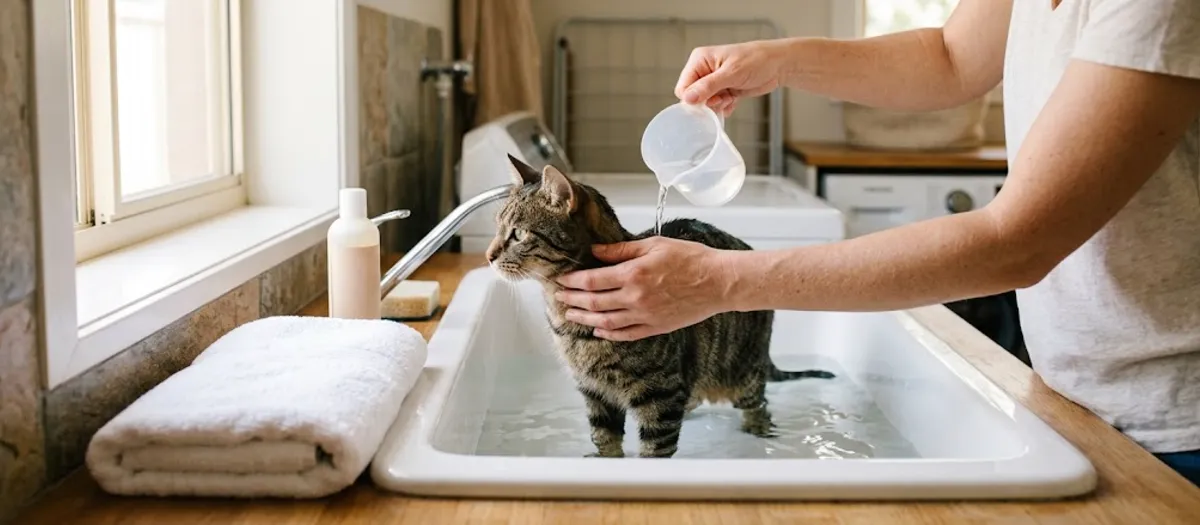
How do you bath a cat calmly?
Bathe a cat in a small, quiet space with a non-slip mat, comfortably warm water and plenty of treats. VCA suggests a sink or small tub with a mat, testing the water with your hand or elbow, and rewarding calm behaviour with high-value treats (VCA Animal Hospitals).
Our general tips, which aren't from a single source:
Prepare first: gather shampoo, a cup, towels and treats. Brush out tangles and mats before the coat gets wet, because water tightens them. Our cat brush guide can help. For mats that won't brush out, see cat hair clippers.
Keep it shallow: a few centimetres of warm water in a sink or tub, with a non-slip mat.
Two people help: one gently supports the cat while the other washes.
Wet the body, not the head: use a cup or gentle sprayer from the neck back. Keep water out of the eyes, ears and nose, and wipe the face with a damp cloth.
Use a small amount of shampoo and massage it in, then rinse until no suds are left. Leftover shampoo gets licked.
Dry gently: wrap your cat in a big towel and squeeze rather than rub. Keep the room warm and draught-free until the coat is dry.
Stop if your cat is very stressed. A panicking cat can scratch or hurt itself, and a calmer second try, or a groomer or vet nurse, may be better.
Only when there's a reason. Most healthy cats go their whole lives without needing one, and International Cat Care says there's no reason to bath a healthy cat (International Cat Care, updated 26 September 2025). VCA says healthy cats generally don't need regular baths (VCA Animal Hospitals). If your vet has advised a medicated or skin-soothing bath, follow their schedule, because it varies by condition.
Washing more often than your vet advises may dry the skin. The Burt's Bees kitten listing suggests a bath every 4 to 6 weeks, but that's a product suggestion, not veterinary advice for cats, so ask your vet what suits yours.
How can you clean a cat without a bath?
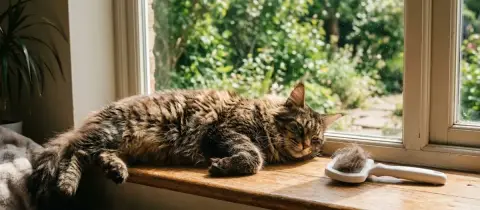
For a small mess, wipe the spot with a damp, warm cloth and dry it with a towel. Regular brushing lifts loose hair and dirt, and it's the easiest way to keep a coat fresh. Brushing also helps with loose hair that may become hairballs; see our cat hairball remedy guide.
We didn't pick a waterless (no-rinse) shampoo. The ones we found were unavailable, listed fragrance or lavender, or had vague ingredient names we couldn't check. Plain wiping and brushing do the job for most cats.
Kittens and medicated shampoos
Kittens often don't need baths either. If a kitten is messy, spot-clean with a warm damp cloth and ask your vet about anything more. VCA suggests getting kittens used to the idea early with treats, so it's less scary later (VCA Animal Hospitals).
Medicated and antifungal shampoos are for use only on your vet's advice. They treat specific problems, and the wrong one can irritate a cat's skin. Fleas in a cat need cat-safe flea control from your vet, not a flea shampoo. If you're also checking your cat for ticks, see our paralysis tick guide.
When to see your vet
Book a vet check if your cat has itchy, red, flaky or greasy skin that doesn't settle, bald patches, scabs, a smell from the skin or ears, or signs of fleas. Ask about cat-safe flea control rather than using a shampoo.
Call your vet straight away if your cat reacts after a bath, with redness, drooling, wobbliness, tremors or breathing trouble. This is urgent if a product with essential oils or permethrin was used, or if a dog flea product was put on your cat. Take the product with you.
Frequently asked questions
Which shampoo is safe for cats?
One made for cats, with no essential oils, no insecticides and little or no fragrance. Of our picks, Burt's Bees Hypoallergenic Shampoo for Cats is fragrance-free, and Burt's Bees Tearless Kitten Shampoo is made for kittens. Check the label and ask your vet if your cat has a skin condition.
What can I safely bathe my cat with?
A shampoo made for cats, or plain lukewarm water if the coat only needs a rinse. Avoid anything with essential oils or insecticides. For a small mess, a damp cloth is often enough. See the safe shampoo section.
What can I use if I don't have cat shampoo?
Plain warm water or a damp cloth is gentlest. If something harmful is on the coat, call your vet before washing, as they may advise a specific wash. We don't suggest human shampoo, and dish soap is for emergencies on a vet's advice only.
Can I use human shampoo on my cat?
We don't suggest it. Human shampoo is made for human skin and may be fragranced, and cats lick it off. Choose a cat shampoo, or use plain warm water. See the section on human, dog and dish soap.
Can I use dog shampoo on my cat?
Only if the label says it's also for cats. Never use a dog flea shampoo: permethrin-containing dog products are a serious risk for cats, and most cases in a Sydney hospital study involved dog spot-on flea products. Call your vet if this has happened.
What shampoo can I use on a kitten?
Use a shampoo made for kittens, such as Burt's Bees Tearless Kitten Shampoo, and keep it away from the eyes and ears. We couldn't find a minimum age, so ask your vet before bathing a very young kitten. Often a damp cloth is enough.
How often should you bathe a cat?
Only when needed. Healthy cats generally don't need regular baths, so most go months or longer without one. If your vet has advised a medicated bath, follow their schedule. See how often to bath a cat.
Are dry shampoos good for cats?
We didn't recommend one. The waterless products we found were unavailable, scented with lavender or had ingredient names we couldn't verify, and cats lick their coat. Brushing and a damp cloth are simpler. Ask your vet if your cat can't be bathed. If it's your dog who needs a freshen up, see our dry shampoo for dogs guide.
Product details, and ingredients from each linked Amazon Australia listing, checked on 19 Oct 2026 (the kitten pick on 26 Oct 2026).
This guide provides general information and isn't a substitute for veterinary advice. If you're concerned about your cat's skin or coat, speak with your vet.