Quick answer: Matted cat hair is easiest to deal with by preventing it: brush your cat regularly, using a comb on long coats. Tease small, loose mats apart gently with your fingers, and never cut them out with scissors. For tight or large mats, see a groomer or vet. Our pick for everyday brushing is the aumuca self-cleaning slicker brush.
Most cats do much of their own grooming, but a bit of help from you keeps the coat comfortable and gives you a regular chance to check skin, claws, ears and eyes. This guide covers the basics, from brushing and nails to matted fur, and links to our full guides on cat brushes, cat nail clippers, cat shampoo and cat hair clippers.
Quick picks
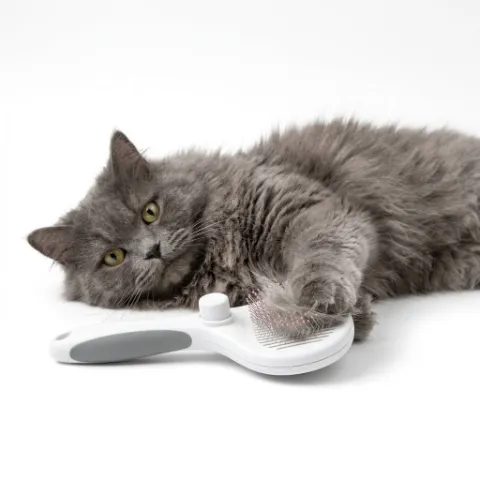
aumuca Self-Cleaning Slicker Brush
Rubber-tipped pins and a release button that pushes the hair off
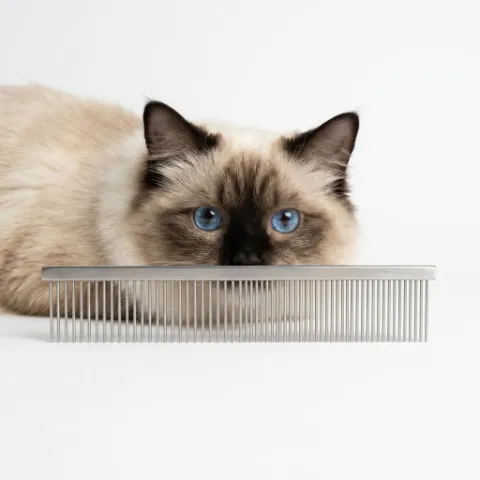
Andis Steel Comb, 190 mm
A stainless steel comb for working through tangles and finishing
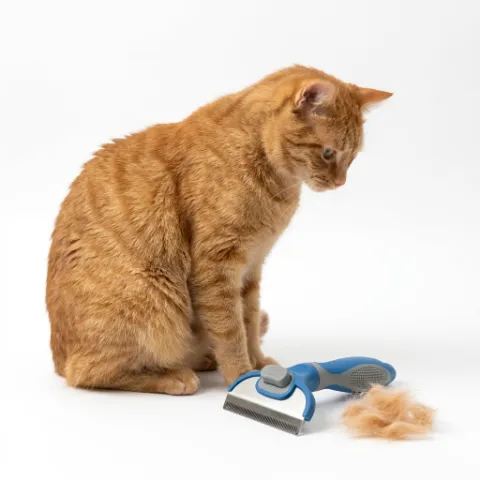
FURminator Undercoat deShedding Tool, short-haired cats
Reaches loose undercoat, with a skin guard and an edge guard
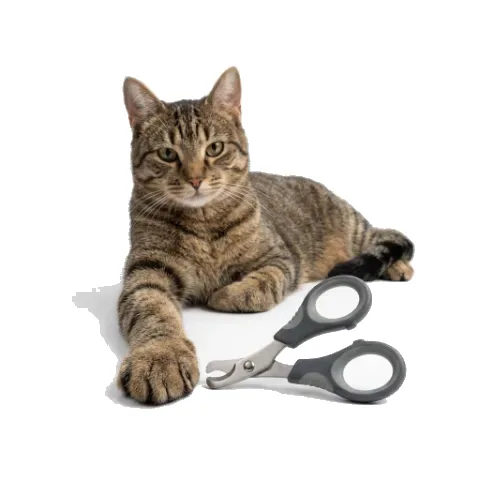
Pet Republique Cat Nail Clipper
Stainless blades with a larger soft grip, for cats and kittens
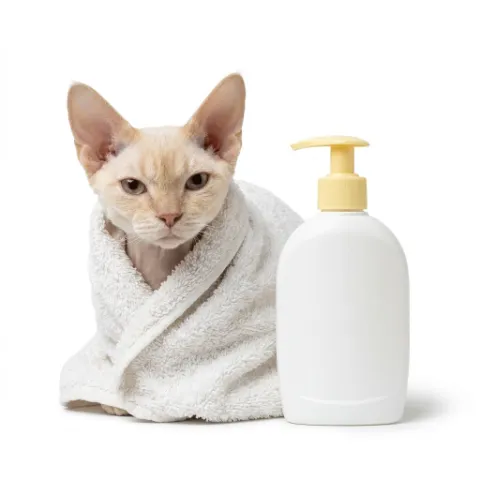
Burt's Bees Hypoallergenic Shampoo for Cats
Made for cats and kittens, with no fragrance or sulfates listed
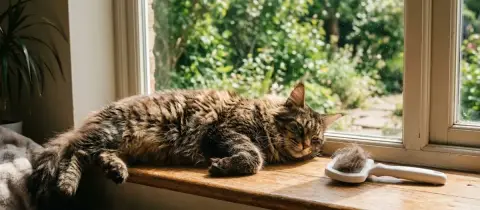
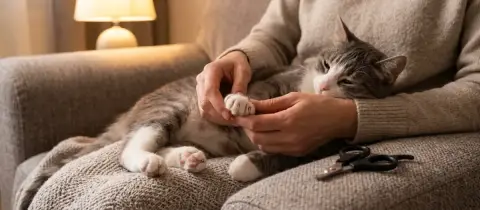
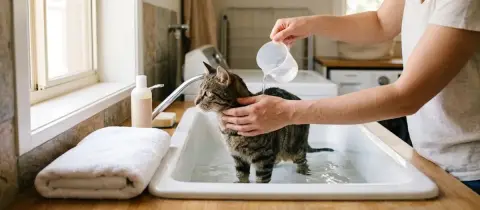
Pictures are illustrations, not the actual products.
Each pick comes from one of our full guides, where we compare more options: cat brushes, cat nail clippers and cat shampoo.
Do cats need grooming?
Cats groom themselves, and many short-haired cats manage well with a weekly brush from you. Long-haired cats, seniors, overweight cats and cats with stiff joints often need more help. International Cat Care says older cats become less flexible and can struggle to groom, so you may notice matting over the lower back and hindquarters (International Cat Care, updated 26 September 2025).
Cornell's Feline Health Center says regular brushing keeps the coat tidy, makes it easier to spot skin parasites or problems, and cuts down the hair your cat swallows (Cornell Feline Health Center, updated May 2017). It's a small habit that also builds trust.
What do you need for cat grooming at home?
A basic cat grooming kit is short: a brush or comb that suits your cat's coat, a nail clipper made for cats, and treats. A cat shampoo is optional, because most cats rarely need a bath. Skip any all-in-one kit that includes tools you won't use.
- Brushes and combs: a rubber-tipped slicker for everyday brushing, a wide-toothed steel comb for long coats, and an undercoat tool for heavy shedders. Our cat brushes guide compares them.
- Nail clippers: a small scissor-style or guillotine clipper made for cats. See our cat nail clippers guide.
- Shampoo: only a product made for cats, never dog flea shampoo or human shampoo. See our cat shampoo guide.
- Treats and a towel: a few small treats, and a non-slip towel or mat for the cat to sit on.
How do you groom a cat at home, step by step?
Pick a quiet moment when your cat is relaxed, and keep sessions short. Start with the areas they enjoy, brush gently in the direction the fur grows, and stop before your cat gets fed up. Finish with a treat or play so grooming feels like a good thing.
International Cat Care suggests starting only when your cat is relaxed, keeping the session as long as your cat is happy with, and ending on a positive note with treats and praise (International Cat Care, updated September 2025).
- Choose the spot. A quiet room, with your cat on your lap or on a towel on the couch.
- Let them sniff the brush and try a few gentle strokes on the cheeks, chin or back, wherever your cat likes being touched.
- Brush with the lie of the coat, using light pressure. Long coats need a comb as well, working in small sections.
- Take extra care under the front legs and between the back legs, where the skin is thin and mats form most often.
- Check as you go. Look at the skin, ears, eyes and mouth, and feel for lumps. Watch for flea dirt, which looks like tiny black specks.
- Stop early. End while your cat is still calm, then reward them.
How often should you groom your cat?
International Cat Care suggests brushing short-haired cats at least once a week and long-haired cats at least daily, with extra help during heavy shedding (International Cat Care, updated September 2025). Nails and baths depend on the individual cat, so use the table as a starting point and adjust.
| Task | Short coat | Long coat | Tool | Our guide |
|---|---|---|---|---|
| Brushing | At least weekly | At least daily | Slicker brush, or rubber mitt | Cat brushes |
| Combing | During the weekly brush, if tangles appear | Daily, working in sections | Steel comb | Cat brushes |
| Nail trims | Check every 2 to 4 weeks; trim only if the tips are sharp or catching | Check every 2 to 4 weeks; trim only if the tips are sharp or catching | Cat nail clipper | Cat nail clippers |
| Baths | Rarely, if ever | Rarely, if ever | Cat shampoo | Cat shampoo |
| Skin and tick checks | Every brushing session | Every brushing session | Your fingers and eyes | Paralysis ticks |
Why does cat hair mat, and does it matter?
Mats form when loose or shed hair tangles and tightens, most often on long-haired cats and in places the cat can't easily reach. Yes, it matters. Mats pull on the skin. RSPCA Australia says pulling on a mat puts tension on the skin and hurts (RSPCA Australia, updated 12 October 2022), and The Vet Desk, fact-checked by a vet, says they are painful and can lead to infection if the cat keeps biting at them (The Vet Desk, updated October 2025).
The same article lists things that can make a cat groom less, including extra weight, pain from the mouth or joints, and illness. International Cat Care adds that matting often shows up over the lower back and hindquarters in older cats (International Cat Care, updated September 2025). So a matted cat is not just a grooming job. It can be a clue that something is making grooming hard.
How do you get rid of matted cat hair safely?
For a small, loose mat, hold it at the base so it doesn't pull the skin, tease it apart gently with your fingers from the outer edge inwards, then comb through from the tips. Don't cut it out. Tight or large mats, or any mat close to the skin, are a job for a groomer or vet.
International Cat Care advises against scissors on mats, because it's hard to see the skin under heavy matting and you could cut your cat (International Cat Care, updated September 2025). Its senior-cat advice says the same, noting that scissors can easily injure the skin (International Cat Care, updated September 2025).
What helps:
- Go slowly. Hold the base of the mat so the skin isn't pulled, and work from the edge of the mat.
- Use a wide-toothed comb such as the Andis steel comb on small tangles, not a brush that tugs.
- Keep it short. If your cat tenses, swats or growls, stop and try again another day.
- Leave the rest to a professional. The Vet Desk says to seek help if matting is extensive or you aren't confident, and notes that some cats need sedation from a vet to be groomed safely (The Vet Desk, updated October 2025).
How do you groom a cat that hates it?
Go slower than feels necessary. Keep touches brief, let your cat walk away, and use treats and short sessions to build a good link with the brush. Never scruff or hold down a cat who wants to leave, because that tends to make the next session harder.
International Cat Care's handling advice is to keep contact brief, around 3 to 5 seconds at first, then pause so the cat can choose to carry on, and to stop if you see signs such as ears turned back, a thumping tail, freezing or head shaking (International Cat Care, updated June 2026). Its grooming page lists skin twitching, ears flicking back, lip licking and hissing as signs to stop and try another day (International Cat Care, updated September 2025).
Small steps that can help:
- Start with the cheeks and chin, then work towards the back.
- Leave the brush near the cat's bed so it becomes familiar.
- Try a soft rubber brush or mitt first, then move to a slicker once your cat is relaxed.
- Do one small area a day instead of the whole cat.
Nails, baths, ears and teeth
Nails. Most cats don't need routine trims, because scratching keeps claws at a good length, but older cats may need more help. International Cat Care says to trim only the clear tip, stay clear of the quick, and ask your vet to show you how (International Cat Care, updated September 2025). Our cat nail clippers guide compares options. Cats also need somewhere to scratch, such as a sturdy post or one of the cat trees we recommend.
Baths. Healthy cats don't need baths and most don't like them (International Cat Care, updated September 2025). If your cat is truly dirty, use a shampoo made for cats. See our cat shampoo guide.
Ears and eyes. Look, but don't poke. Vets generally advise against cotton buds in the ear canal, and a dirty ear can come from wax, mites or infection, so ask your vet first (International Cat Care, updated September 2025).
Teeth. Brushing a cat's teeth is a job to learn with your vet. A drop in grooming can be a sign of dental pain, so mention it at your cat's check-ups. Our guide on how to clean your cat's teeth walks through it step by step.
Hairballs and grooming
Brushing removes loose hair before your cat swallows it, which is why a regular brush can help with hairballs. Cornell notes brushing reduces the hairballs your cat swallows (Cornell Feline Health Center, updated May 2017). For cats that still bring them up often, see our hairball remedy guide.
Grooming checks: ticks, fleas and lumps
Grooming time is a good time for a health check. Run your fingers over your cat's body and look for lumps, wounds, flea dirt and ticks. International Cat Care lists fleas, ticks, ear mites, lumps and bumps as things to look for while you groom (International Cat Care, updated September 2025).
Ticks matter in particular on parts of the east coast, where paralysis ticks live. Our paralysis tick guide explains where, when and what to do. If you find a lump, a wound or a tick you're unsure about, call your vet.
When should you use a professional groomer?
Use a groomer or your vet for tight mats, mats close to the skin, mats over a large area, or a cat who won't tolerate handling. Professionals can clip safely, and a vet can sedate if needed. A groomer can also be handy for long-haired cats who need a regular tidy-up.
International Cat Care says severe mats usually need a groomer or veterinary shaving, sometimes under sedation or anaesthetic (International Cat Care, updated September 2025).
Cat grooming tools compared
Short-haired cats usually need a slicker or rubber brush and an occasional undercoat tool. Long-haired cats need a comb as well. Use the table to match a tool to your cat's coat.
| Tool | Coat | What it does | Use it |
|---|---|---|---|
| aumuca slicker brush | Short, medium or long | Lifts loose hair and light tangles | Several times a week, per the listing |
| Andis steel comb | Long, or any coat with tangles | Works through small tangles and finishes | After brushing, in sections |
| FURminator deShedding Tool | Short, thick undercoat | Pulls loose undercoat | Short sessions, no more than about once a week |
| Pet Republique nail clipper | Any | Trims the clear tip of the claw | Only when claws need it |
| Burt's Bees cat shampoo | Any | Cleans a dirty coat | Rarely |
How we chose
We started with the full guides to cat brushes, nail clippers and shampoo, and chose one pick from each that met all of these checks:
- Well rated: a strong average rating with plenty of buyer reviews.
- No red flags: no pattern of poor reviews, safety complaints or listing problems.
- Available on Amazon Australia when we checked.
- Made for cats or labelled for cats and dogs.
- Gentle and safe: rounded or rubber-tipped pins, no essential oils in shampoo.
Each pick comes from our full guides to brushes, nail clippers and shampoo, where we compare more options. These are researched picks, not products we've personally tested. We compared the specifications and features shown on each Amazon Australia listing, checked on 19 Oct 2026. We didn't accept payment from any brand, and no brand saw this page before it was published.
Left out this time: dematting blades and electric clippers for home use on tight mats, because we'd rather a groomer or vet handles those and International Cat Care advises against cutting mats with scissors. We also left out grooming kits from overseas that can't be returned.
Our picks in detail
1. aumuca Self-Cleaning Slicker Brush: best everyday brush
A slicker brush with rubber-tipped pins and a release button that pushes the collected hair off the pins. The listing says it suits short, medium and long coats and suggests using it three to four times a week. See the full cat brushes guide.
- Pros: rounded pin tips; the button saves picking hair out by hand; one brush for different coat lengths
- Cons: it isn't a comb, so it won't work through firm mats; a slicker needs a light hand on thin-skinned areas
- Best for: a regular brush for most cats
- Skip it if: your cat has long, thick fur and needs a comb to reach the base of the coat
2. Andis Steel Comb, 190 mm: best for long hair and small mats
A stainless steel comb that the listing says removes tangles and finishes the coat, and that is made for cats and dogs. Its length makes it easy to hold and lets you work in small sections close to the skin. See the cat brushes guide for other combs.
- Pros: works through small tangles; good for checking the coat down to the base; simple to clean
- Cons: it won't loosen a tight mat; a metal comb can be uncomfortable if pulled hard
- Best for: long-haired cats and finishing after brushing
- Skip it if: your cat has a very short coat with few tangles
3. FURminator Undercoat deShedding Tool, short-haired cats: best for heavy shedders
A deShedding tool with a stainless edge that reaches through the topcoat to remove loose undercoat. The listing mentions a Skin Guard, a curved edge, a button to release hair and an edge guard for storage, and warns to avoid over-brushing. This is the medium and large short-haired cat version, so check the size notes on the listing. See the cat brushes guide. For the other cat sizes, see our FURminator guide.
- Pros: targets loose undercoat; an edge guard and release button; the listing includes use guidance
- Cons: can take off too much hair if overused; the right size depends on your cat's coat and weight; not for matted fur
- Best for: short-haired cats that shed heavily
- Skip it if: your cat has a mat, skin problem or very sensitive skin, or you want a brush for everyday use
4. Pet Republique Cat Nail Clipper: best nail clipper
A scissor-style clipper with thick stainless steel blades and a larger soft grip. The listing says it suits kittens, cats and small pets, and suggests trimming a small amount at a time on overgrown nails. See the cat nail clippers guide.
- Pros: a comfortable grip; suits kittens and adult cats
- Cons: you still need to learn where the quick is; a scissor style needs a steady hand
- Best for: owners who want a simple, no-fuss clipper
- Skip it if: your cat's claws are fine, or your vet prefers to trim them
5. Burt's Bees Hypoallergenic Shampoo for Cats: best for the occasional bath
A cat shampoo that the listing says is pH balanced for cats and kittens and free of "fragrances, sulfates and colorants". The ingredients include honey, beeswax and shea butter, and there's no essential oil among them. The listing says it won't wash off a topical flea treatment when you follow that maker's directions, but check your own product's label. See the cat shampoo guide.
- Pros: made for cats and kittens; no listed fragrance or essential oil
- Cons: most cats rarely need a bath; the listing doesn't mean it suits a skin condition
- Best for: the occasional bath for a dirty coat
- Skip it if: your cat has red, sore or itchy skin, which needs a vet check first
When to see your vet
Book a vet visit soon if your cat has:
- mats close to the skin, or covering a large area
- red, sore or smelly skin under a mat
- a sudden drop in grooming, which can be a sign of pain from arthritis, dental disease or illness
- overgrooming, thinning fur or bald patches
- lumps, wounds, fleas or ticks
- overgrown claws that curl into the paw pads
See a vet straight away if your cat seems in pain, is hiding, stops eating, or you find a paralysis tick.
Frequently asked questions
How can I groom my cat myself?
Pick a calm moment, let your cat sniff the brush, and start with the areas they like. Brush with the lie of the coat, use a comb on long fur, and stop before your cat is upset. Our step-by-step section has the full routine.
How do groomers keep cats still?
Good groomers aim for calm, short, low-stress handling rather than force. International Cat Care advises against holding down a cat who wants to escape (International Cat Care, updated September 2025). For cats who can't cope, a vet may sedate them for a safe groom.
Are you supposed to cut your cat's fur?
Usually not. Most cats don't need a haircut. Some long-haired cats need the fur around the back end trimmed to prevent soiling, and a groomer or vet can do that safely (International Cat Care, updated September 2025). Don't cut mats at home.
How do you get rid of matted cat hair?
Tease small, loose mats apart with your fingers, then comb from the tip towards the base. Tight, large or skin-close mats need a groomer or vet. See how to get rid of matted cat hair safely.
Is it okay to cut matted fur on a cat?
It's best not to. The skin can be caught up in the mat and is easy to cut, especially if your cat moves. International Cat Care advises against scissors on mats (International Cat Care, updated September 2025). Ask a groomer or vet to clip them.
Is matted fur painful for cats?
It can be. Mats pull on the skin and may lead to irritation or infection, and a cat may bite or claw at them (The Vet Desk, updated October 2025). If your cat seems sore, book a vet visit.
What is the best grooming tool for a cat?
It depends on the coat. A slicker brush suits most cats, a steel comb helps long coats, and an undercoat tool suits heavy shedders. See our cat brushes guide and the tools compared table.
When should you stop brushing a cat?
Stop when your cat shows signs such as a twitching skin, thumping tail, ears flicking back, lip licking, growling or hissing. Try again another day, with a shorter session (International Cat Care, updated September 2025).
Related guides
- Best cat brushes
- Cat restraint bags and wraps
- Pet handling gloves
- FURminator guide: which size and tool
- Best cat nail clippers
- Best cat shampoo
- Cat hairball remedies
- Paralysis ticks
- Cat enrichment
- Best cat trees
- Cat care hub
Sources
- International Cat Care: Grooming your cat (published 19 March 2025, updated 26 September 2025)
- International Cat Care: Trimming your cat's claws (updated 26 September 2025)
- International Cat Care: Special considerations for senior cats (updated 26 September 2025)
- International Cat Care: Everyday care for your cat (updated 26 September 2025)
- International Cat Care: Handling and interactions (updated 2 June 2026)
- Cornell Feline Health Center: Choosing and caring for your new cat (updated May 2017)
- RSPCA Australia: How often do I need to groom my cat? (updated 12 October 2022)
- The Vet Desk: How to get mats out of cat fur (updated 29 October 2025, reviewed by Dr Luqman Javed, DVM)
This guide provides general information and isn't a substitute for veterinary advice. If you're concerned about your cat's coat, skin or grooming, speak with your vet.