Quick answer: How to get a cat into a carrier: for today, lower your cat in back legs first through a top opening, or wrap them in a towel and back them in. Long term, leave the carrier out as a bed and reward visits. Our pick is the Amazon Basics top-load carrier.
Most cats don't hate the carrier itself. They hate what it usually means. This guide covers what to do when you need your cat in the carrier today, how to train a carrier habit over time, how to keep the car trip and the vet visit calmer, and which gear is worth a look. For a closer look at each product type, see the guides linked in our guides for cat travel.
Quick picks
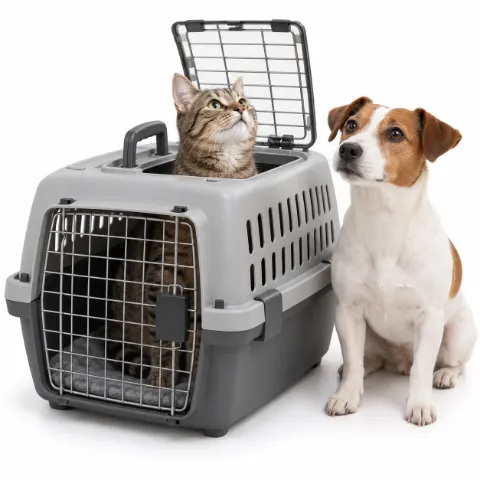
Amazon Basics 2-Door Top Load Hard-Sided Carrier, 58 cm
Front and top doors, so your cat can be lowered in
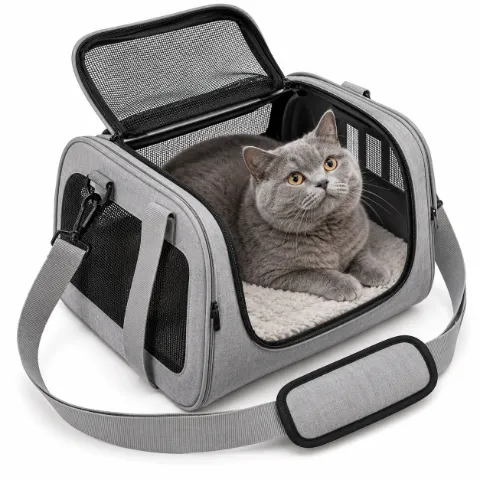
BELLA & PAL Cat Carrier, large
Padded strap, removable washable base and a zip that opens only from outside
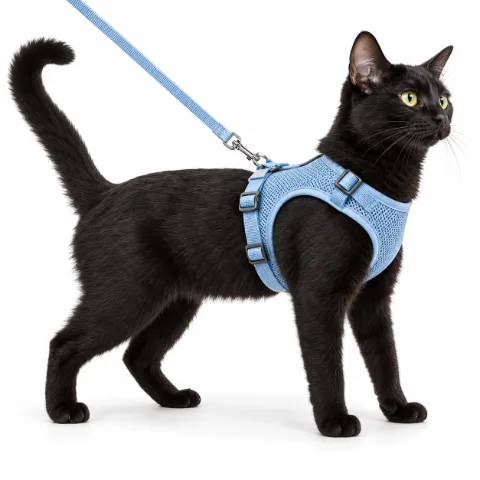
rabbitgoo Cat Harness and Leash Set
An overhead vest harness with a leash clip on the back; measure first
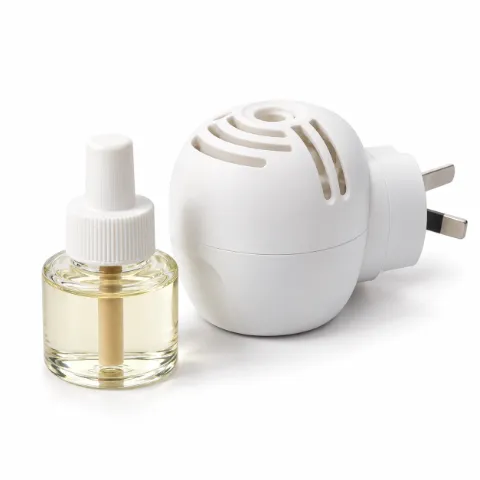
FELIWAY Classic diffuser refill, 48 ml
Refill only; it needs a diffuser
Pictures are illustrations, not the actual products.
Each one is covered in its full guide: best cat carriers, best cat harness, FELIWAY for cats and best cat backpack carriers.
How do I get a cat into a carrier today?
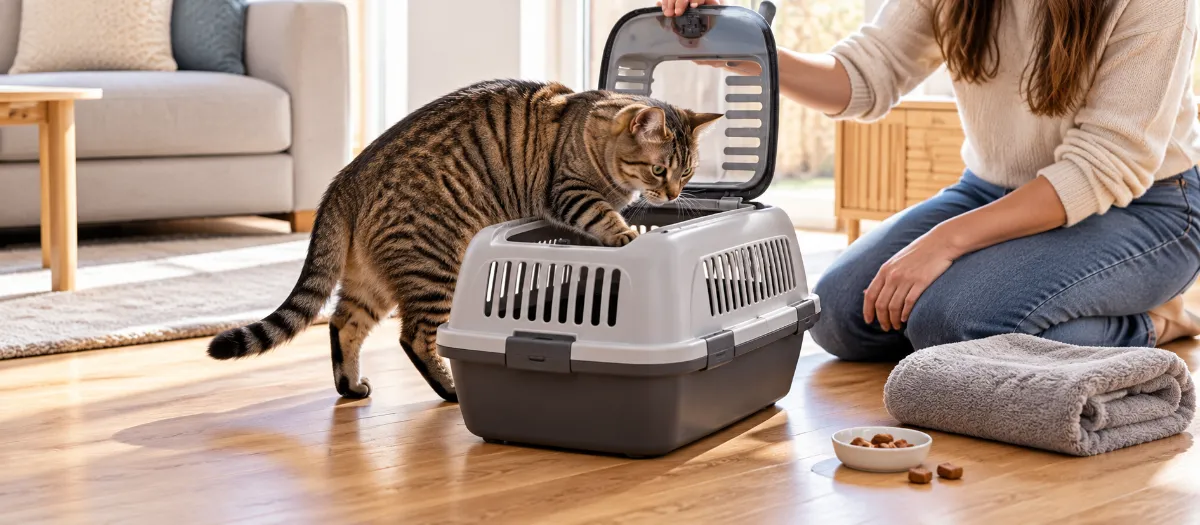
Close the doors to rooms with good hiding spots, keep your voice calm, and use a carrier that opens from the top if you have one. Lower your cat in back legs first and close the lid. If they struggle, wrap them in a towel and back them in. Never chase them.
Here is the step-by-step version, drawing on RSPCA Victoria, the UK charity PDSA and the AAFP and ISFM handling guidelines:
- Get the carrier out early. Put it in the room before you need it, not after your cat has spotted you looking for it.
- Close off the hiding spots. RSPCA Victoria suggests moving to a small room such as a bathroom where your cat can't hide, then picking up the carrier, speaking calmly and gently placing your cat inside (RSPCA Victoria).
- Use the top opening if there is one. For a top-opening carrier, PDSA says to lower your cat in bottom first (PDSA, December 2022). RSPCA Victoria says a top-loading carrier is worth considering if getting your cat in is a struggle.
- Front-opening carrier? Load them backwards. PDSA suggests putting the carrier where it can't move, such as against a wall, with a blanket inside, and guiding your cat in backwards. Some owners find it easier to stand the carrier on its end and lower the cat in the same way.
- Use a towel if they struggle. PDSA says to wrap your cat in a towel, back them in and leave the towel in the carrier. A wrapped cat is held snugly but not squashed.
- Close it gently, then cover part of it. A light towel over the carrier helps some cats feel hidden. Leave plenty of air flow.
Please don't scruff your cat or lift them by the scruff. The AAFP and ISFM feline-friendly handling guidelines say the panel doesn't condone lifting a cat or suspending their weight by the scruff (AAFP and ISFM, 2011). Don't force a cat through a small front door when a top opening is available, and don't yell or chase, which RSPCA Victoria also warns against. If it all goes wrong, stop, let everyone settle and try again in a few minutes.
How do I train my cat to like the carrier?
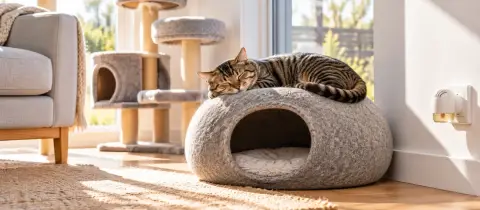
Leave the carrier out all the time as a normal bed, with your cat's own bedding inside, and link it to good things such as treats, meals and play. Go slowly and never force your cat in. Cats often come to see it as a safe spot rather than a sign of trouble.
RSPCA Victoria suggests keeping the carrier open in the house for several days before an appointment, feeding your cat in it regularly, and using a cue phrase as they step in (RSPCA Victoria). A plan you can follow in small steps, going at your cat's pace:
- Make it part of the furniture. Take the lid off or tie the door open, put it somewhere your cat already likes to sit, and add a towel or blanket that smells like them. Cats Protection also advises leaving the carrier out at all times, not just before appointments (Cats Protection, March 2022).
- Add rewards. Drop treats near it, then at the door, then inside. Feed a meal or play with a toy near and inside it.
- Let them choose. If they step in, praise quietly. If they don't, don't push. Go back to the last step they were relaxed with.
- Close the door for a moment. Open it again before they worry, reward, and build up slowly.
- Lift and carry. Pick the carrier up for a few seconds, walk across the room, put it down and reward.
- Short practice trips. A few minutes to the end of the street, then home to a treat, so the carrier doesn't only mean the vet.
Cats vary, so there's no standard timeline. Some are happy in days, others take a good while. If your cat is hissing, hiding or refusing food around the carrier, slow down. Our cat enrichment guide has ideas for easy, reward-based play you can use around the carrier.
What kind of carrier makes vet trips easier?
A sturdy, stable carrier that opens from the top as well as the front is easiest. A removable top half is ideal, because a vet can lift it off and examine your cat in the base without tipping them out. Soft carriers can work for calm cats and short trips.
The AAFP and ISFM guidelines say carriers should be sturdy, secure, stable, easy to carry and quiet. They add that a removable top is useful for fearful cats, as well as sick, painful or less mobile cats, because staff can lift the top off and examine the cat in the bottom tray rather than grabbing them or tipping the carrier (AAFP and ISFM, 2011).
International Cat Care recommends a solid plastic carrier with a secure door, ventilation slats and a removable top half, so your vet can examine your cat more easily (International Cat Care, updated 26 September 2025).
Our pick for the vet is the Amazon Basics 2-Door Top Load Hard-Sided Carrier, because it has a front door and a top door; whether the top lifts off completely isn't clear from the listing, so check if that matters to you. The BELLA & PAL soft carrier suits calm cats and short trips but can't be opened from the top by a vet. See our best cat carriers guide for the full comparison.
Never use a cardboard box or a harness alone for travel in a car. A harness helps with outdoor walks, not with car safety, and we cover it in our cat harness guide. For longer outings on foot, see our cat backpack carrier guide.
How do I keep my cat calm in the car?
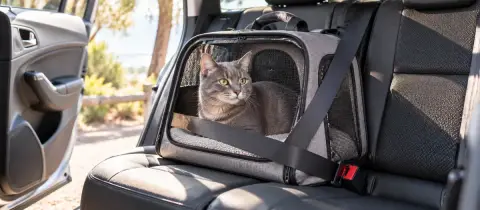
Put the carrier on a back seat and secure it with the seat belt, so it can't slide or tip. Keep the car quiet and at a moderate temperature, drive smoothly, and cover part of the carrier if your cat settles better unseen. Never leave a cat in a parked car. Rules for pets in cars vary by state; our dog car restraint guide explains where to check.
PDSA says to secure the carrier on a back side seat, not the middle seat, sitting flat (with a towel to level it if needed), with the seat belt passed over the top and tightened (PDSA, December 2022). Cats Protection suggests draping a sheet or towel over the carrier with enough ventilation, keeping noise low, driving smoothly, avoiding the hottest part of the day and keeping the car temperature moderate (Cats Protection, March 2022).
Some practical points:
- Never loose in the car. A loose cat can get under the pedals or bolt when a door opens.
- Do a few short practice drives. Go around the block, then straight home, so the car isn't always followed by the clinic.
- Never leave your cat in a parked car, even briefly, with the windows down, or in shade. RSPCA Australia says never to leave a pet in a car, that parking in the shade or leaving the windows open doesn't really help, and that an animal can die in a hot car in as little as six minutes (RSPCA Australia, 20 January 2021). RSPCA South Australia says that when it's 21 degrees outside, it can reach 43 degrees inside a car (RSPCA South Australia, 7 December 2018). On warm days, our keep your cat cool in summer guide has more.
- Car-sick cats. Drooling, vomiting or yowling from the first few minutes can have more than one cause. Mention it at your next vet visit rather than guessing.
- Rules for pets in cars vary by state. Our dog car restraint laws guide explains how they differ for dogs, and it's worth checking your own state's rules for cats.
What helps on vet day?
Bring your cat's own bedding, keep them in the carrier until you reach the consulting room, and ask about quieter appointment times or a cat-only waiting area. A clinic with Cat Friendly Clinic accreditation is worth looking for. A FELIWAY spray on bedding is optional, and the evidence is mixed.
Cats Protection's tips include putting unwashed bedding in the carrier, covering the carrier, asking when the practice is usually quietest, and looking for a clinic with a separate waiting area and ISFM Cat Friendly Clinic accreditation (Cats Protection, March 2022). The AAFP and ISFM guidelines say towels help reduce visual stimulation, and that covering a carrier can prevent arousal during transport (AAFP and ISFM, 2011). A towel over the carrier in the waiting room can help for the same reason.
Some more ideas:
- Tell the clinic your cat is nervous when you book, so they can plan the exam.
- Let them use the top opening. If your carrier has a removable top, say so at the start.
- Pheromone sprays are optional. Cats Protection suggests spraying a blanket or towel with a product such as FELIWAY at least 15 minutes beforehand. The evidence is mixed: a 2010 JAVMA review (Frank, Beauchamp and Palestrini) found the evidence for the feline facial pheromone insufficient for calming cats during catheterisation and not supportive for hospitalised cats (PubMed), while a 2023 Veterinary Evidence knowledge summary rated the evidence as moderate that it may reduce signs of short-term stress at the clinic, but not on its own (Veterinary Evidence, 6 December 2023). Treat it as a small support tool, not a fix. Our FELIWAY for cats guide has the detail.
- Ask about medication for very fearful cats. If every visit is a struggle, ask your vet whether anything suits your cat. Only a vet can prescribe it, and it should be a tool alongside the handling and carrier work above.
- Australian plug warning. When we checked Amazon Australia on 22 Oct 2026, some imported FELIWAY diffusers were made for overseas sockets. Buy the Australian version (sold by vets and pet shops), never use a plug adapter with a pheromone diffuser, and follow the maker's safety instructions. The FELIWAY Classic refill we link needs an existing diffuser.
If the vet sends you home with tablets, our guide on how to give a cat a pill covers food, the towel wrap and a water chaser.
What if my cat hides or fights the carrier every time?
Slow down and change the approach: practise the carrier training steps, use a top-loading carrier, and try the towel method or a two-person method, with one person holding the towel and another guiding the carrier. Some vets do home visits, so ask. Check for a medical cause if the behaviour is new.
A two-person method keeps it calm: one person keeps the carrier steady against a wall or on its end while the other lowers or backs the cat in, with a towel if needed. Stay quiet, avoid eye contact and stop if either of you is getting stressed. Never grab by the scruff or punish a cat for hiding. The AAFP and ISFM handling guidelines recommend going slowly, using a calm voice, avoiding direct eye contact and letting the cat keep a chosen position (AAFP and ISFM, 2011).
Some vets will come to your home, which skips the carrier and the car altogether. It's worth asking your clinic whether they do house calls, or whether they can recommend someone who does.
If the hiding or fighting is new, see the vet box below: a sudden behaviour change can have a medical cause.
Moving house or a long trip with a cat
For a move or longer trip, keep your cat in a secured carrier on a back seat, with a light towel over it, and plan stops around the hottest part of the day. Never leave your cat in the car. At the new home, a quiet room with their familiar things is a calm place to start.
Start the training steps well before moving day, and apply the car points above on the road. On arrival, keep doors and windows shut until your cat has settled, and let them come out of the carrier on their own. If a trip involves flying, the listing for any carrier may say whether it fits under an airline seat; always check with your airline. Our airline approved pet carriers guide covers the cabin and hold rules.
How we chose
We searched Amazon Australia for cat carriers, harnesses and FELIWAY products, then shortlisted products that met all of these checks:
- Well rated: a strong average rating with plenty of buyer reviews.
- No red flags: no pattern of poor reviews, safety complaints or listing problems.
- Available on Amazon Australia when we checked.
- Right for the job: a carrier with a top opening where possible, a harness that is made for cats, and a pheromone product made for Australian sockets.
- Honest about limits: every pick has clear cons, and we only repeat the brand's claims as "the listing says".
These are researched picks, not products we've personally tested. We compared the specifications shown on each Amazon Australia listing on 22 Oct 2026. We didn't accept payment from any brand, and no brand saw this page before it was published.
Left out this time: imported FELIWAY diffuser kits made for overseas sockets, a carrier that wasn't available when we checked, bubble-window backpacks (clear plastic domes can let in a lot of sun), and products with too little information on their listings.
Our picks in detail
1. Amazon Basics 2-Door Top Load Hard-Sided Carrier, 58 cm: best top-loading hard carrier
A hard-sided carrier with both a front door and a top door, so a reluctant cat can be lowered in. The listing gives a pet weight range of about 5.5 to 9 kg and a size of 58 x 38 x 33 cm.
- Pros: top and front doors; a top door lets you lower a reluctant cat in; spring latches; ventilation on three sides
- Cons: it's a bulky hard shell; the top half doesn't clearly lift off completely (check the listing); the about 5.5 to 9 kg range may not suit very small kittens or very large cats
- Best for: cats who dislike being pushed through a small door, and vet trips by car
- Skip it if: you want something soft and shoulder-carried, or your cat is over 9 kg
2. BELLA & PAL Cat Carrier, large: best soft carrier
A soft-sided carrier measuring 50 x 31 x 31 cm, with a self-locking zipper that the listing says opens only from outside. The listing says it is not airline approved because of its size.
- Pros: padded strap and handle; washable base; zip that opens only from outside; inner leash to clip to a harness
- Cons: a soft carrier gives less protection than a hard shell; no removable top half for the vet; not airline approved, according to the listing
- Best for: calm cats and short trips, and people who want a lighter carrier
- Skip it if: your cat panics, or you need a carrier a vet can open from the top
3. rabbitgoo Cat Harness and Leash Set: best harness for cats who slip out
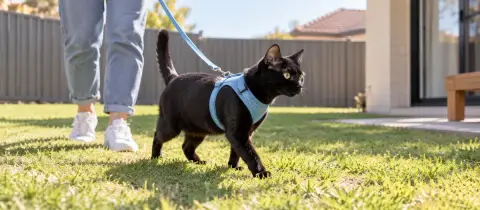
An overhead-style vest harness in air mesh with a leash clip on the back. A tip on the listing says the cat's head circumference should be at least 10 inches or they may slip out, so measure first. It's a walking harness, not a car restraint; see our cat harness guide.
- Pros: a vest style that spreads pressure across the chest; leash included; the listing gives sizing measurements
- Cons: sizing is fiddly, so measure carefully; some cats freeze when first wearing a harness; not a car restraint
- Best for: cats you want to carry or walk safely outdoors, with supervision
- Skip it if: you want something to restrain a cat in the car, or your cat's head is smaller than the listed measurement
4. FELIWAY Classic diffuser refill, 48 ml: best for owners with an Australian FELIWAY diffuser
A refill for the FELIWAY diffuser. The listing says it's a synthetic copy of the cat facial pheromone, is odourless and lasts up to 30 days. Refill only, so you need a diffuser.
- Pros: a simple routine for the home; no spraying needed
- Cons: refill only; the evidence is mixed; it won't fix a cat who is frightened of the carrier
- Best for: owners who already have an Australian FELIWAY diffuser and want to support a quiet area
- Skip it if: you don't have a diffuser, or your cat has a sudden behaviour change, which needs a vet check first
Our guides for cat travel
- Best cat carriers for vet trips and car travel
- Best cat harness for walking and carrying with a lead
- Best cat backpack carriers for longer outings on foot
- FELIWAY for cats for what the evidence says and what to buy
When to see your vet
See a vet straight away if your cat:
- shows signs of overheating, especially after time in a carrier or car. RSPCA Australia lists relentless panting, drooling, agitation or restlessness, very red or pale gums, vomiting, lethargy and weakness
- is straining in the litter tray with little or no urine, which is an emergency in male cats, according to the University of Illinois veterinary college
- hasn't eaten for 24 hours, seems lethargic, or has collapsed
- has been hurt in a struggle: a limp, a bite or scratch wound, or pain when touched
Book a vet check if your cat is spraying urine, going outside the tray, hiding, over-grooming or being aggressive. These can have medical causes, so see your vet before relying on calming products. International Cat Care says a cat that starts soiling indoors will likely need a vet examination to rule out medical causes. Car sickness, a cat who dreads every vet visit, or a very fearful cat are all worth raising at the next visit.
Frequently asked questions
How do you get an unwilling cat into a carrier?
Use the carrier's top opening if it has one, lower your cat in back legs first and close the lid. If they resist, wrap them in a towel and back them in. Stay calm and avoid chasing or scruffing. For next time, see the training steps above.
What's the easiest way to get a cat into a carrier?
A top-loading carrier. Your cat doesn't have to be pushed through a small door, so there's less to resist. Make it familiar first with bedding and treats, and a calm, quiet room helps too. A towel can help if your cat wriggles. The step list near the top of this page has the full method.
How do I get my cat to the vet without a carrier?
Please use a carrier. A loose cat in a car is dangerous for everyone, and a cat in your arms can bolt. A box with no secure lid isn't safe either, and a harness alone isn't enough in a car. A secure carrier belted onto the back seat is the safe choice.
Should I cover my cat's carrier?
It can help. The AAFP and ISFM guidelines say covering a carrier can prevent arousal during transport, and Cats Protection suggests a large sheet or towel with enough ventilation. Watch your cat, and uncover the carrier if they seem more distressed or the car gets warm.
Why does my cat meow in the car?
It may be fear, an unfamiliar movement or motion sickness, and it isn't always possible to tell which. A covered, belted carrier, a quiet car and short practice drives can help. If your cat also drools or vomits, mention it to your vet.
Can I give my cat something to calm them for the vet?
Only a vet can prescribe anything for a very fearful cat, so ask them. Over-the-counter options are limited, and the evidence for FELIWAY is mixed (see the vet-day section). Don't use human medicines or essential oils, which can be dangerous for cats.
Related guides
- Airline approved pet carriers
- How to give a cat a pill
- Cat restraint bags and wraps
- Best cat carriers
- Best cat harness
- Best cat backpack carriers
- Collapsible pet carriers
- Pet carriers with wheels
- FELIWAY for cats: does it work?
- Cat enrichment ideas
- How to keep your cat cool in summer
- All our cat guides
Sources
- AAFP and ISFM, AAFP and ISFM Feline-Friendly Handling Guidelines, Journal of Feline Medicine and Surgery, 2011 (https://pmc.ncbi.nlm.nih.gov/articles/PMC11107994)
- RSPCA Victoria, Getting your cat into a carrier (https://rspcavic.org/learn/getting-your-cat-into-a-carrier/)
- PDSA, How to get your cat in a carrier, December 2022 (https://www.pdsa.org.uk/pet-help-and-advice/pet-health-hub/other-veterinary-advice/how-to-get-your-cat-in-a-carrier)
- Cats Protection, How to make vet visits less stressful for your cat, 17 March 2022 (https://cats.org.uk/cats-blog/how-to-make-vet-visits-less-stressful-for-your-cat)
- RSPCA Australia, Keeping your pet safe during heat, 20 January 2021 (https://rspca.org.au/blog/2021/keeping-your-pet-safe-during-heat)
- International Cat Care, Travelling with your cat, updated 26 September 2025 (https://icatcare.org/articles/travelling-with-your-cat)
- RSPCA South Australia, Don't leave your pets in the car, 7 December 2018 (https://www.rspcasa.org.au/?p=35421)
- Veterinary Evidence, Effectiveness of F3 feline facial pheromone analogue for acute stress reduction within clinical veterinary practice (Crump), 6 December 2023 (https://veterinaryevidence.org/index.php/ve/article/view/669)
- Frank, Beauchamp and Palestrini, Systematic review of the use of pheromones for treatment of undesirable behavior in cats and dogs, JAVMA, 2010, PubMed (https://pubmed.ncbi.nlm.nih.gov/20550445/)
- International Cat Care, Soiling indoors, updated 26 September 2025 (https://icatcare.org/articles/soiling-indoors)
- University of Illinois College of Veterinary Medicine, Blocked cats: an emergency for male cats (https://vetmed.illinois.edu/pet-health-columns/blocked-cats-an-emergency-for-male-cats/)
This guide provides general information and isn't a substitute for veterinary advice. If you're concerned about your cat's travel or vet visits, speak with your vet.