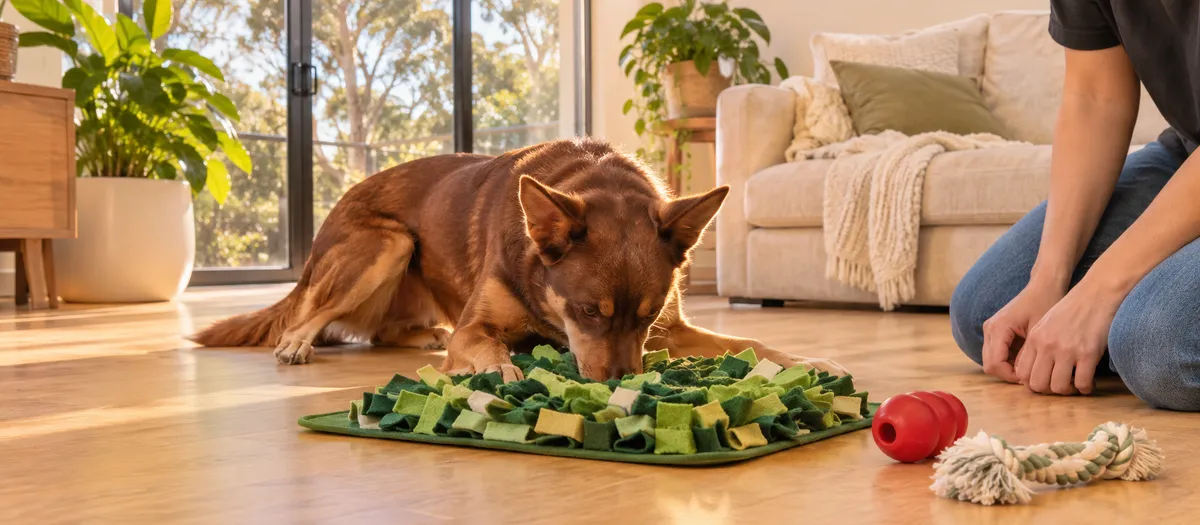
You come home to a chewed cushion, a dug-up garden bed, or a neighbour asking about the barking. It's easy to think you've got a "naughty" dog. Often, though, it's a dog who doesn't have enough to do. Boredom isn't the only possible cause, but it's a common one, and it's one of the easiest to work on.
Quick answer: Dog enrichment means giving your dog things to do that use their nose, brain and body. Build a little into each day: sniffy walks, a snuffle mat or food puzzle while you're home, a frozen KONG, or a short training game. A few short sessions a day is a good start, then adjust to how your dog responds.
This guide covers what enrichment means, 15 easy ideas, ideas for workdays, rainy days, hot days and puppies, how to spot possible boredom, and the enrichment toys that can help.
Quick picks
| Pick | Product | Why |
|---|---|---|
| Sniffing and slower meals | SCHITEC Snuffle Mat | Fleece mat for hiding kibble; supervised use, then put it away. |
| Calm licking time | LickiMat Classic Buddy | Textured mat for soft food; supervise and pick it up once it's licked clean. |
| Brain work at mealtimes | StarMark Bob-A-Lot | Adjustable difficulty, so you can start easy and make it harder. |
| Stuff and freeze | KONG Classic | Choose the size for your dog's weight; KONG advises supervision. |
| Puppy stuffing toy | KONG Puppy | Softer puppy rubber to stuff with food; choose the size by weight and supervise. |
| Slower eating | Outward Hound Fun Feeder Slo Bowl | A ridged bowl for dogs who gulp; pick a shallow one for flat-faced breeds. |
More detail on each is in Dog enrichment toys and gear that can help below. These are tools within a routine; they don't treat separation anxiety.
What is dog enrichment?
Dog enrichment means giving your dog things to do that use their nose, brain and body, such as sniffing walks, food puzzles, training games and chewing. It isn't about buying toys. Much of the best enrichment is free: a slower, sniffier walk, a training game, or hiding part of their dinner.
RSPCA Australia describes enrichment as essential for the physical and mental health of all dogs. It notes that enrichment can help reduce stress and anxiety and help prevent problems like excessive barking (RSPCA Australia). It also notes that exposing dogs to new scents, for example with a snuffle mat, has been linked with more engagement, fewer stress-related behaviours and more time spent resting (RSPCA Knowledgebase).
A balanced routine usually mixes several kinds:
| Type | What it looks like | Easy examples |
|---|---|---|
| Nose and senses | Sniffing, new smells, sounds and surfaces | Sniffy walks, scatter feeding, a snuffle mat, a walk somewhere new |
| Food | Working for part of a meal | Puzzle feeders, a frozen KONG, a lick mat (supervised) |
| Brain | Solving problems and learning | 5-minute training sessions, the cup game, a muffin tin puzzle |
| Chewing | A safe outlet for a natural behaviour | A tough rubber chew toy of the right size |
| Body | Moving in ways that suit your dog's age and health | Walks, play, fetch or running where it's safe, swimming for dogs who enjoy it |
| Social | Time with people, and with other dogs if they enjoy it | Cuddles, training together, calm play with friendly dogs, outings to new places |
Every dog needs a different mix. A young Kelpie may need lots of physical activity, while an older dog may get more from gentle sniffing and short brain games.
A breed example: Cavoodles
Intelligent, social or high energy dogs often need plenty of mental stimulation as well as exercise, and Cavoodles are a good example. Greencross Vets describes them as people orientated dogs who generally need 30 to 60 minutes of exercise a day. It also says they need plenty of stimulation to prevent boredom, and notes that their love of company may predispose them to separation anxiety (Greencross Vets). So for a Cavoodle who spends time home alone, brain work matters as much as the walk.
15 dog enrichment activities you can start today
Easy ideas that cost little: a slow sniffy walk, scattering part of breakfast in the grass, a snuffle mat, a frozen KONG, hiding treats for "find it", and five-minute training games. Use part of your dog's normal daily food, so the extra activity doesn't add extra weight.
- Sniffy walk. Let your dog set a slower pace and sniff as much as they like. In tick areas, check for ticks after walks.
- Scatter feeding. Toss part of breakfast across the grass and let your dog hunt for it.
- Snuffle mat. Hide kibble in the fleece strips while you're home, then put the mat away.
- Find it. Hide treats around one room and say "find it". Start easy, then make it harder.
- Muffin tin game. Treats in the cups of a muffin tin, with tennis balls on top for your dog to nudge off.
- Towel roll-up. Sprinkle kibble along an old towel, roll it up loosely and let your dog unroll it.
- Cardboard box dig. Fill a box with scrunched paper and a few treats. Remove tape and staples, and supervise.
- The cup game. Hide a treat under one of three plastic cups and let your dog find it.
- Hide and seek. Hide in another room and call your dog once. It's sneaky recall practice.
- Teach a new trick. Try "spin" or "touch" in 5-minute sessions, rewarding small steps.
- Frozen KONG. Stuff it with part of a meal and freeze it. KONG advises supervision.
- Lick mat. Spread on wet food or plain yoghurt, supervise, and pick it up once it's licked clean.
- Ice block treat. Freeze a few treats in water in a container for a cool snack on a hot day.
- Rotate toys. Keep 3 or 4 out and swap them every few days so they feel new.
- Somewhere new. A different park or street gives your dog a whole new set of smells.
Want gear for some of these? Jump to dog enrichment toys and gear.
Signs your dog may be bored
A bored dog tends to make its own fun, and you usually won't like its choices. Common clues include:
- Chewing furniture, shoes or skirting boards
- Digging holes in the backyard
- Barking, whining or howling more than usual
- Restlessness or trouble settling, or raiding the bin
One sign on its own doesn't mean your dog is bored. Chewing is normal for puppies, some breeds love to dig, and barking has lots of causes. What matters is the pattern, and whether it eases once your dog has had more to do. For the full list and how to read it, see is my dog bored? Signs and how to tell. If chewing is the problem you came for, start with how to stop a dog chewing.
Greencross Vets notes that dogs without enough exercise and environmental enrichment are more likely to develop destructive habits, such as chewing furniture (Greencross Vets).
Bored or anxious?
Boredom and separation-related anxiety can sometimes look similar. If your dog becomes distressed mainly when you're away, or when they see signs you're about to leave, it may be more than boredom. Signs can include persistent barking or howling, damage around doors or windows, pacing, drooling, or toileting inside.
That doesn't mean your dog definitely has anxiety, and some dogs have a bit of both. If the behaviour is persistent or severe, it's worth talking to your vet or a qualified behaviour professional. That guide goes into more detail, including how filming your dog can help. Noise fears are a different problem again: if it mostly happens in storms, see our guide for a dog scared of storms or fireworks.
Enrichment is a tool within a routine. It doesn't treat separation anxiety.
Enrichment ideas for every situation
When you're at work
For a full routine, see how to keep your dog busy while you're at work.
- Make the morning walk sniffy. Give your dog time to sniff and explore rather than turning every walk into a fast march. The RSPCA encourages owners to give their dog the chance to sniff.
- Leave something good as you go. A frozen KONG of the right size can make leaving feel more positive, once you've watched how your dog uses it at home (KONG advises supervision). Lick mats and snuffle mats are best given while you're still home, then put away.
- Rotate toys. Keep 3 or 4 out and swap them every few days. The RSPCA notes that dogs given the same toys every day are likely to get bored of them. A dog toy box makes the swap easy.
- Ditch the bowl sometimes. Scatter part of breakfast in the grass, or use a snuffle mat while you get ready.
- Break up long days. A neighbour, friend or dog walker at lunchtime can make a big difference.
- Going away for days? See your dog care options compared.
Indoors and rainy days
For twelve step by step games, see 12 rainy day games for dogs.
- Hide treats around one room and say "find it".
- Teach one new trick in 5-minute sessions, like "spin" or "touch".
- Make a DIY puzzle: treats rolled up in an old towel, or a cardboard box stuffed with paper and a few treats. Supervise, and take it away if your dog starts eating the cardboard.
- Practise easy skills like "sit", "drop" and "wait" around the house. Short sessions count.
- Recordable buttons are another low-cost training game; see our dog talking buttons guide for what they can and can't do.
Hot days
- Walk in the cooler parts of the day, early morning or after sunset, and avoid hot surfaces. If the footpath or sand feels uncomfortably hot on your hand, choose a cooler route, such as grass or shade, or keep your dog inside. More tips in how to keep your dog cool in summer.
- Swap the walk for indoor games for dogs on very hot days.
- Freeze treats in an ice block, a lick mat or a KONG for a cool snack.
- Add water play: a shallow clam-shell pool in the shade, with supervision.
- Know the signs of heatstroke and what to do. See our dog cooling mats and heat safety guide, and do cooling mats work? for what they can and can't do.
Backyard dogs
A backyard is great, but it's the same space every day. Add variety by hiding a few treats before you leave, rotating toys, and still getting out for walks so your dog meets new smells and sights. Make sure there's shade and water all day as the sun moves.
Puppies
- Keep sessions short. Young puppies tire quickly and need lots of sleep.
- Use soft, puppy safe chew toys, especially while teething.
- Start easy with a snuffle mat or a simple puzzle, so your puppy succeeds early and wants to keep playing.
For filling ideas, see our frozen KONG and lick mat recipes.
High-energy dogs
Working breeds like Kelpies and Border Collies, and many young dogs, often need more than a walk. Mix exercise with sniffing, training games and food puzzles, and build in rest too. Learning to switch off and settle is a skill, so reward calm moments as well as busy ones.
Older dogs
Older dogs may get more from gentle sniffing and easy scent games than from long walks or fetch. Keep games low impact, skip jumping and slippery floors, and talk to your vet if your dog seems stiff, sore or unsettled at night.
Food safety
Food is one of the easiest ways to enrich your dog's day, but some human foods are dangerous to dogs. Never use anything with xylitol (often in sugar-free peanut butter, sometimes listed as "birch sugar"), chocolate, grapes, raisins, sultanas, onion, garlic or macadamia nuts. These can be toxic to dogs. See the full list of foods to avoid. Count any fillings as part of your dog's daily food. If your dog eats something that might be toxic, call your vet or the Animal Poisons Helpline (1300 869 738, 24/7) straight away, even if they seem fine.
Is it working?
Results vary from dog to dog, so watch for small changes over the following weeks rather than expecting a quick fix. Signs the routine may be helping include:
- Your dog settles and rests more easily after a game or a walk
- Less chewing, digging or barking out of boredom
- Your dog looks forward to the games and gets better at them
If nothing changes, or things get worse, look again at the signs in when it might be more than boredom.
Dog enrichment toys and gear that can help
You don't need to spend much, and no product will fix boredom on its own. Think of gear as a tool within a good routine. One or two well chosen items used regularly usually beat a basket of toys your dog ignores. Each guide below compares options sold in Australia, or browse all our dog product picks.
| What your dog needs | Toy type | Supervision | Our guide |
|---|---|---|---|
| Sniffing and slower meals | Snuffle mat | Supervised, then put away | Best snuffle mats |
| Calm licking time | Lick mat | Supervised, not a chew toy | Best lick mats |
| Brain work at mealtimes | KONG-style and treat dispensing toys | KONG advises supervision; plastic puzzles are for supervised play | Best treat dispensing toys |
| A safe chewing outlet | Tough rubber chew toy | Watch new toys, replace damaged ones | Best toys for heavy chewers |
| Gulps meals too fast | Slow feeder bowl | At mealtimes | Best slow feeder bowls |
Snuffle mat
A fabric mat with fleece strips where you hide kibble or treats for your dog to sniff out. It can help with sniffing and slowing down fast eaters, and suits most dogs, including beginners. It's for supervised use: some dogs chew the strips, so put it away afterwards.
Our top pick: the SCHITEC Snuffle Mat for small and medium dogs. Compare all snuffle mats, including a larger mat for big dogs.
Lick mat
A textured rubber or silicone mat you spread with soft food like yoghurt or wet food. Licking helps many dogs settle, and frozen mats make a good hot-day treat. It suits calmer moments, bath time and grooming. Lick mats aren't chew toys, so supervise your dog and pick the mat up when it's licked clean.
Our top pick: the LickiMat Classic Buddy. Compare all lick mats.
Puzzle toys and treat dispensing toys
Toys your dog nudges, rolls or flips to get food out. They give a brain workout and can turn a meal into a game, and they suit food motivated and clever dogs. Start easy, because a puzzle that's too hard can frustrate your dog. Many are plastic, so they're for supervised play.
Our pick for adjustable difficulty: the StarMark Bob-A-Lot, so you can start easy and make it harder. Compare treat toys and puzzles, see puzzle toys by difficulty level, or find the right type of interactive dog toy.
KONG-style toys
Tough rubber toys you stuff with food and freeze for a longer-lasting challenge. They suit most dogs, as long as you pick the right size for your dog's weight. KONG advises supervision, and you should replace any toy that's damaged.
Our top pick: the KONG Classic, or the KONG Puppy for puppies. Amazon may open these listings on the Small size, so choose the size for your dog's weight from the options on the listing. See all our KONG picks. Which one and what size: see our KONG dog toys guide.
Tough chew toys
Durable rubber toys for dogs who love to chew. They give strong chewers a safe outlet and suit power chewers and teething puppies (in softer puppy rubber). Avoid chews that are too hard. Veterinary dentists use a simple thumbnail test: if you can't make a dent in a chew with your fingernail, it's likely too hard and may crack teeth. Cornell's canine health centre also warns against antlers, hooves and real bones (Cornell Riney Canine Health Center), and hard nylon bones fail the thumbnail test too.
Our top pick: the KONG Extreme for power chewers. Compare tough chew toys.
Slow feeder bowl
A bowl with ridges or a maze, so meals take longer. It can help dogs who gulp their food. Start with an easy pattern, and choose a shallow one for flat-faced breeds. It slows eating but won't replace other enrichment.
Our top pick: the Outward Hound Fun Feeder Slo Bowl. Compare slow feeder bowls.
Our picks are research based, not products we've personally tested. We compare the specifications and features on each Amazon Australia listing. Availability and prices can change.
When it might be more than boredom
When to see your vet
Some behaviour changes look like boredom but have a medical or other cause. It's worth seeing your vet if you notice:
- A sudden change in behaviour, especially in an adult or older dog
- Constant licking or chewing of paws or skin
- Eating non-food items like rocks or fabric
- Pacing, panting or restlessness at night in an older dog
- Severe distress when left alone, such as drooling, howling or scratching at doors and windows
For ongoing problem behaviour, a qualified reward based trainer or a veterinary behaviourist can help. Avoid anyone who suggests punishment, shock collars or prong collars.
Frequently asked questions
Why is enrichment important for dogs?
It gives dogs a chance to do what comes naturally, like sniffing, chewing, exploring and solving problems. RSPCA Australia describes enrichment as essential for the physical and mental health of all dogs, and links it with less stress. It's part of a healthy routine alongside exercise and rest, not a treatment for anxiety.
How much enrichment does my dog need each day?
There's no set amount. A few short sessions of brain work a day, on top of normal exercise, is a good place to start, then adjust to your dog. High-energy working breeds like Border Collies and Kelpies often need more, and older dogs may prefer shorter, gentler sessions.
What are good enrichment toys for dogs?
Good enrichment toys get your dog sniffing, licking, chewing or thinking for their food. A snuffle mat, a lick mat, a KONG-style toy you can stuff and freeze, and a tough rubber chew cover most dogs. Supervise new toys, and see the table above for which of our guides fits your dog.
Can I make DIY dog enrichment toys?
Yes. RSPCA Australia suggests a muffin tin with treats under tennis balls, a homemade snuffle mat from fleece or old T-shirts, treats frozen in an ice cube tray, and treasure hunts in the yard. Use part of your dog's daily food, choose safe materials, and supervise in case your dog chews or swallows pieces (RSPCA Knowledgebase).
Can a big backyard keep my dog entertained?
Usually not on its own. Once your dog has explored the yard, there's little new to discover. Walks, new places and short games give the variety most dogs need.
Is a snuffle mat or a lick mat better?
Neither is better. They do different jobs. A snuffle mat is more active and works the nose, while a lick mat is calmer and suits settling time. Many owners use both.
How much exercise does a Cavoodle need?
Greencross Vets suggests 30 to 60 minutes a day for most Cavoodles. Mix walks and play with brain games, and adjust for age and health. Everyday amounts by age and breed are in how much exercise a dog needs.
Can enrichment make my dog put on weight?
It can if the food is extra. Use part of your dog's normal daily food in toys and mats, and choose lower-fat fillings. The RSPCA warns that relying too much on food enrichment can lead to overfeeding.
What can I put inside a KONG?
Softened kibble, your dog's usual wet food, plain Greek yoghurt or cooked mashed pumpkin are easy starting points. Pack it loosely at first, then freeze it once your dog gets the hang of it. Our frozen KONG and lick mat recipes have more ideas.
Related guides
- How much exercise does a dog need?
- How to stop a dog chewing furniture and everything else
- Best dog agility equipment
- Is my dog bored? Signs and how to tell
- How to keep your dog busy while you're at work
- 12 rainy day games for dogs
- Frozen KONG and lick mat recipes
Sources
- RSPCA Australia: The importance of enrichment for dogs
- RSPCA Knowledgebase: Why is enrichment important for dogs?
- RSPCA Knowledgebase: How can I create low-cost DIY enrichment for my cat or dog?
- Greencross Vets: Cavoodle owner's guide
- Cornell Riney Canine Health Center: Risks of a fractured tooth
- Animal Poisons Helpline (Australia)
This guide provides general information and isn't a substitute for veterinary advice. If you're concerned about your dog's behaviour, health or safety, speak with your vet.