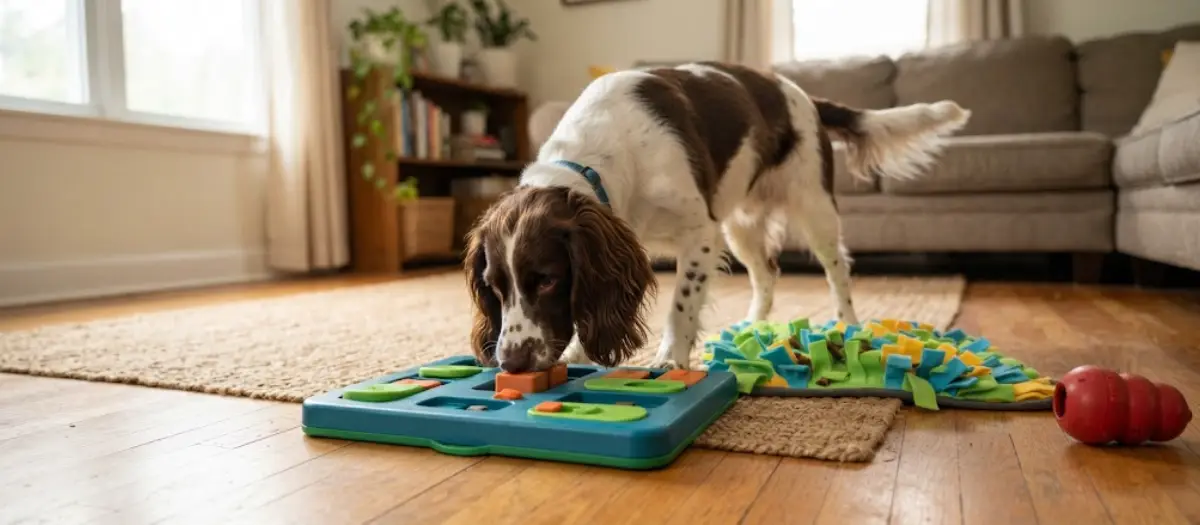
Quick answer: Interactive dog toys make your dog sniff, paw, lick, chew or chase to get a reward. Match the type to the dog: a snuffle mat for beginners, a puzzle board for thinkers, a stuffed rubber toy for chewers, a lick mat for calm time, a launcher for ball-mad dogs. Start easy and supervise.
Walk into a pet shop and "interactive" can mean almost anything with a treat hole. This guide sorts the main types by what they ask your dog to do, so you can pick one that fits instead of buying a basket of toys that sit in the corner. For activities that cost nothing, see our dog enrichment ideas. Here we focus on choosing toy types, with a link to a full buying guide for each.
What makes a dog toy interactive?
An interactive dog toy needs your dog to do something to get a payoff, usually food or a thrown ball. They nudge, paw, lick, sniff or chase, instead of just chewing or carrying. Many are feeding toys, so they work your dog's brain at mealtime.
RSPCA Australia groups puzzle feeders and food-filled toys under feeding enrichment, and says dogs are less likely to get bored with chewing or feeding activities (RSPCA Knowledgebase, updated 5 May 2023). It also recommends interactive and puzzle toys for mental stimulation (RSPCA Australia, 8 November 2023).
Two cautions come from the same RSPCA pages. Leaning too heavily on food enrichment can lead to overfeeding, and enrichment toys can be a hazard if a dog swallows them. Both come up again below.
Types of interactive dog toys
Each type works a different part of your dog. Nose work, paw and problem solving, licking, chewing and chasing all tire a dog in different ways, so it helps to know which one you are buying for.
Puzzle boards and sliding puzzles
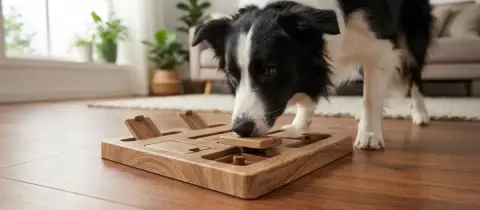
These are boards with lids, sliders or bone-shaped pieces over hidden treats. They work problem solving and paws, and come in levels from easy to hard. Start at level 1, because a puzzle that is too hard can end in a bored or frustrated dog. Pieces that lift out need supervision with chewers. See best dog puzzle toys.
Treat dispensing toys and KONGs
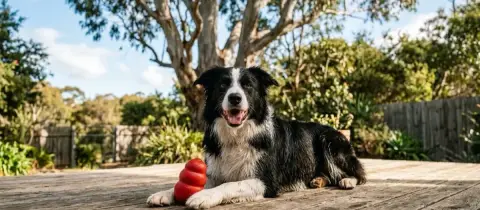
You fill a rubber toy or a wobbling dispenser with part of a meal, and your dog works it out. These suit most dogs when the size is right, and a stuffed KONG can be frozen for a longer challenge. KONG advises supervision. Our best treat dispensing toys guide has the size guide and includes the Nina Ottosson Dog Brick.
Snuffle mats
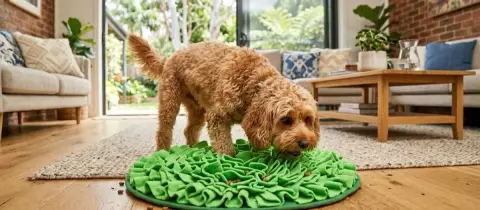
A fleece mat where you hide kibble in the strips. It works the nose and slows a fast eater, and it is a gentle place to start. Some dogs chew the strips, so use it while you are watching and put it away after. See best snuffle mats.
Lick mats
A textured mat you spread with soft food. Licking is slow and calm, so these suit settling time, grooming or a bath. A lick mat is not a chew toy, so pick it up once it is clean. See best lick mats, and our frozen KONG and lick mat recipes for safe fillings and the list of foods to avoid.
Slow feeder bowls
Not a toy as such, but a ridged or maze bowl turns a gulped meal into a slower one. It is the lightest option here and suits dogs who eat fast. See best slow feeder bowls.
Ball launchers and fetch
A hand-held launcher throws a ball farther and saves your back and your hands from slobber. It works chasing and running, so it suits ball-mad dogs. The ball must be too big to fit completely in your dog's mouth, and a fetch ball is not a chew. See best dog ball launcher, and read the heat and joint notes in the safety section below.
Tough chew toys
Durable rubber toys give a strong chewer a safe outlet and are the right choice when puzzles with loose pieces would not last. Pick the size for your dog's weight and replace anything damaged. See best toys for heavy chewers, or puppy teething toys for young dogs.
Automatic and self-playing toys
Battery or app-driven toys that roll, flick or launch on their own are everywhere online. We haven't recommended any yet. The automatic ball launchers we checked on Amazon Australia had listing problems, such as wrong ball sizes, or reliability and safety concerns, so we left them out for now. A dog playing alone with a machine also misses the part that matters most, which is you.
Which interactive toy suits your dog?
Pick by what your dog is like today, not by the toy that looks cleverest. A chewer needs something tough, a sniffer needs a mat, and a thinker needs a puzzle. If you are unsure, start with the gentlest option in the row and move up once your dog is succeeding.
| Dog | Try first | Why |
|---|---|---|
| Puppy | Snuffle mat or a puppy KONG | Easy wins, soft and short sessions. See puppy teething toys |
| Senior dog | Snuffle mat or lick mat | Low impact, gentle on joints |
| Strong chewer | Tough rubber chew or stuffed KONG | Puzzles with loose pieces may not last. See heavy chewer toys |
| Food-motivated thinker | Puzzle board, level 1 first | Uses problem solving. See puzzle toys |
| Ball-mad dog | Hand launcher with a correctly sized ball | Saves your arm. See ball launchers |
| Gulps meals | Slow feeder bowl or snuffle mat | Slows eating |
| Wound up and needs to settle | Lick mat | Calm, slow licking |
Dogs differ, so watch how yours responds. A toy that gets ignored today may click later, and a favourite can lose its shine, so having two or three types to rotate helps.
How do I introduce an interactive toy?
Start with the easiest version, let your dog win, and then make it harder in small steps. Use part of the day's normal food, stay close for the first few sessions, and stop while your dog is still keen. If they give up or get frustrated, go back a step.
SPCA New Zealand advises watching your dog for the first few minutes, and trying something different if they become frustrated or uninterested (SPCA New Zealand). It also suggests keeping a few puzzle toys and swapping them between meals.
A simple routine:
- Make it easy. Leave puzzle pieces raised, fill a snuffle mat loosely, or put a few treats in the open end of a toy.
- Let your dog succeed. Praise quietly, and don't help unless they're stuck.
- Raise the challenge slowly. One step at a time, once the easy version takes only a moment.
- Count the food. Treats from puzzles count toward the day's food. Use part of a meal or small treats, and see our dog training treats for picks. RSPCA Australia warns that relying too heavily on feeding enrichment can lead to overfeeding (RSPCA Australia, 8 November 2023).
- Rotate. RSPCA Australia says the same toys day in and day out are unlikely to help because dogs get bored. Keep a few out and swap them over.
Are interactive dog toys safe?
They are safe when the size suits your dog and you use them as the brand intends, which usually means supervised play. Take a puzzle away once the treats are found, and before your dog starts chewing it. Puzzles with removable pieces need extra care with chewers.
The rest of the checklist:
- Choose the size for your dog and follow the brand's guidance on the packaging or listing.
- Supervise puzzle toys and launchers. Brands label plastic puzzles, lick mats and snuffle mats for supervised use, so we don't suggest leaving them with your dog while you're at work.
- Watch for swallowing. RSPCA Australia notes enrichment toys may be hazardous if dogs swallow them. Replace anything cracked, chewed through or missing pieces.
- Balls must be too big to swallow. A ball should be too big to fit completely in your dog's mouth. If you are between sizes, go up. Never throw sticks.
- Fetch toys are not chews. Tennis-style and launcher balls are for fetch, then put away.
- Keep fetch short in the heat. RSPCA Australia says to avoid exercise in extreme heat, walk early or late, and avoid hot pavement and sand (RSPCA Australia, 20 January 2021). See burnt dog paws and keeping your dog cool in summer. A launcher makes long throws easy, so keep sessions short with rests, and avoid hard repetitive fetch for very young puppies or dogs with joint problems. If your dog has joint issues, ask your vet what suits them.
Can interactive toys help a bored or anxious dog?
They can help a bored dog as one part of a routine that also includes walks, sniffing, training and rest. They don't treat separation anxiety. If your dog is distressed mainly when you leave, see your vet or a qualified behaviour professional, and use toys as support only.
RSPCA Australia lists unexpected toileting, destructiveness, excessive barking, digging, pacing and trying to escape among the signs of separation anxiety, and advises discussing concerns with your vet, who may refer you to a behavioural specialist who uses humane, reward-based training (RSPCA Australia, 17 August 2021). It suggests a stuffed KONG-type toy as one step within a wider training plan, which fits how we see these toys: a tool, not a cure.
Our is my dog bored? guide helps you tell the two apart by looking at the pattern. If your days are long, keeping your dog busy while you're at work covers routines, and rainy day games has ideas that need no gear.
When to get help
See your vet if your dog:
- shows a sudden change in behaviour, especially an adult or older dog
- destroys things or tries to escape and seems distressed, particularly when left alone
- has swallowed a piece of a toy, or is vomiting, gagging, retching or not eating after play
- seems stiff, sore or limping after fetch
A qualified, reward-based behaviour professional can help with ongoing problem behaviour. Avoid anyone who suggests punishment.
Heat emergency: if your dog collapses, staggers, vomits or pants hard after play on a hot day, move them into shade or air conditioning and cool them with cool (not ice-cold) tap water while you call your vet or nearest emergency vet. Go straight there, even if your dog seems better. RSPCA Australia lists relentless panting, drooling, agitation, very red or pale gums, vomiting, lethargy and weakness as heatstroke signs (RSPCA Australia, 20 January 2021). See our summer guide.
Frequently asked questions
What are the best interactive toys for large dogs?
Large dogs usually do well with a tough rubber toy in a large size, a big snuffle mat, or a level 2 or 3 puzzle once they have mastered an easy one. Check the weight range on the listing. For strong chewers, start with our heavy chewer guide.
What are the best interactive toys for small dogs?
Small dogs suit small-size rubber toys, snuffle mats and compact puzzles. One puzzle we cover, the LUKITO slider, is listed for small breeds and suits small to medium dogs. See best dog puzzle toys. Make sure any toy is small enough to handle but too big to swallow.
What are the best interactive toys for puppies?
Soft, puppy-safe options: a snuffle mat, a puppy KONG, or a simple slider puzzle with no loose pieces, with you close by. Keep sessions short, because puppies tire quickly. Our best KONG and treat toys guide covers puppy sizes, best dog puzzle toys covers puppies, and puppy teething toys covers chews.
How long should a dog play with a puzzle toy?
Until the treats are found, usually a few minutes, then pick it up. Stop sooner if your dog loses interest or starts chewing the toy, and finish while they are still winning. Our best dog puzzle toys guide shows how to teach a puzzle step by step and when to move up a level.
Are automatic ball launchers good for dogs?
We haven't found one we can recommend yet. The ones we checked on Amazon Australia didn't pass our checks, for the reasons given above. If you are tempted, match the ball to your dog's mouth, teach your dog to stand back, and stay in the room. Our ball launcher guide has a checklist.
Can I leave my dog alone with an interactive toy?
We don't suggest it. Brands label plastic puzzles, lick mats and snuffle mats for supervised use, and KONG advises supervision. If you are heading out, give the toy while you are still home, take it away when it's done, and see keeping your dog busy at work.
Do interactive toys tire a dog out?
They can help. Sniffing and problem solving use real mental effort, and many dogs settle and rest afterwards. They don't replace walks, though. Mix them with exercise, training and rest, and watch how your dog responds rather than expecting a set result. A snuffle mat before a quiet evening is a good example.
Related guides
- Best squeaky dog toys
- Best herding balls for dogs
- Best dog puzzle toys
- Best dog ball launcher
- Best KONG and treat dispensing toys
- Best snuffle mats
- Best lick mats
- Best toys for heavy chewers
- Dog enrichment ideas
- Is my dog bored? Signs and how to tell
- All our dog guides
Sources
- RSPCA Australia Knowledgebase, Why is enrichment important for dogs? updated 5 May 2023 (https://kb.rspca.org.au/knowledge-base/why-is-enrichment-important-for-dogs/)
- RSPCA Australia, The importance of enrichment for dogs, 8 November 2023 (https://rspca.org.au/latest-news/blog/the-importance-of-enrichment-for-dogs/)
- RSPCA Australia, Keeping your pet safe during heat, 20 January 2021 (https://rspca.org.au/blog/2021/keeping-your-pet-safe-during-heat)
- RSPCA Australia, Is your dog anxious when you're not home? 17 August 2021 (https://www.rspca.org.au/latest-news/blog/your-dog-anxious-when-youre-not-home/)
- SPCA New Zealand, Food enrichment for dogs: tips for making food fun (https://spca.nz/advice-and-welfare/article/food-enrichment-for-dogs-tips-for-making-food-fun)
This guide provides general information and isn't a substitute for veterinary advice. If you're concerned about your dog's behaviour or play, speak with your vet.