Best dog talking buttons: recordable sets compared, and what the research actually shows
By Anish PuriUpdated 15 Nov 202610 min readResearched, not tested by us
Research guide. WhiskerFinds may earn a commission from links, at no extra cost to you.
Quick answer: The best dog talking buttons for most people are the 4-colour voice recording set (SVY212): four buttons, 30 seconds each, 2 AAA batteries per button. Four is plenty, because the AKC says to start with one word. Research shows dogs can respond to button words, but not that they "talk".
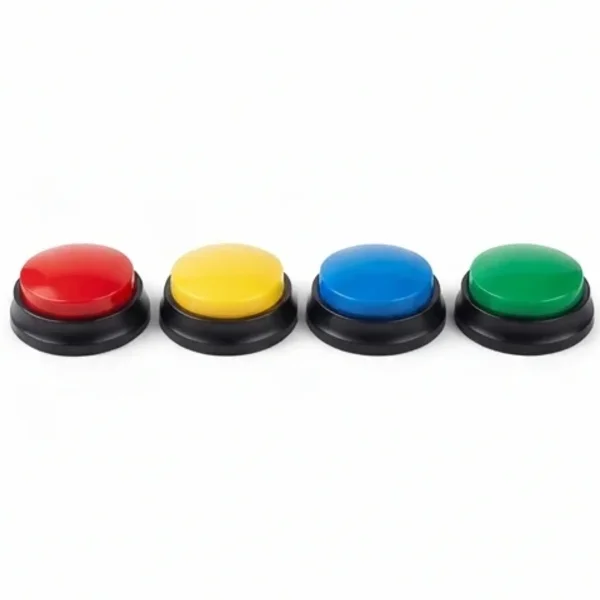
Illustration, not the actual product
Our top pick4-colour voice recording buttons (SVY212)
This guide compares three recordable sets on Amazon Australia by number of buttons, recording time, size in centimetres and power. It also covers a first-two-weeks teaching plan from the AKC, what two 2024 studies did and didn't find, and what to do if a dog chews a battery. If you mainly want your dog to signal for the toilet, our dog potty bells guide may suit better.
Quick picks
Our top pickBest overall
4-colour voice recording buttons (SVY212)
Four buttons, 30-second recording, a good size for starting with one or two words
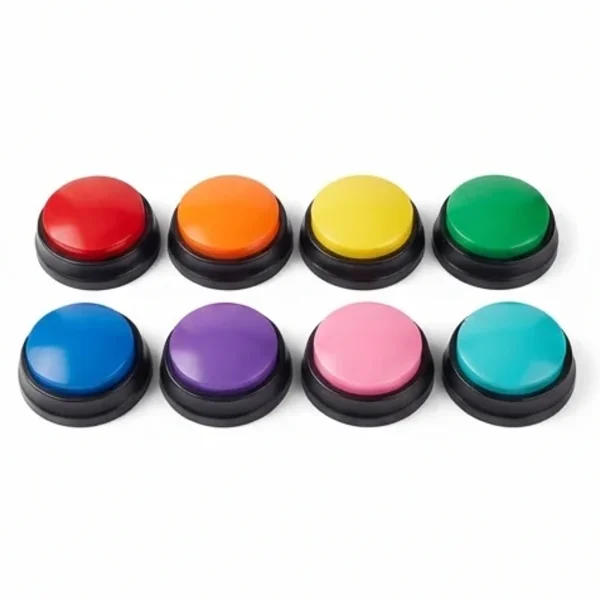
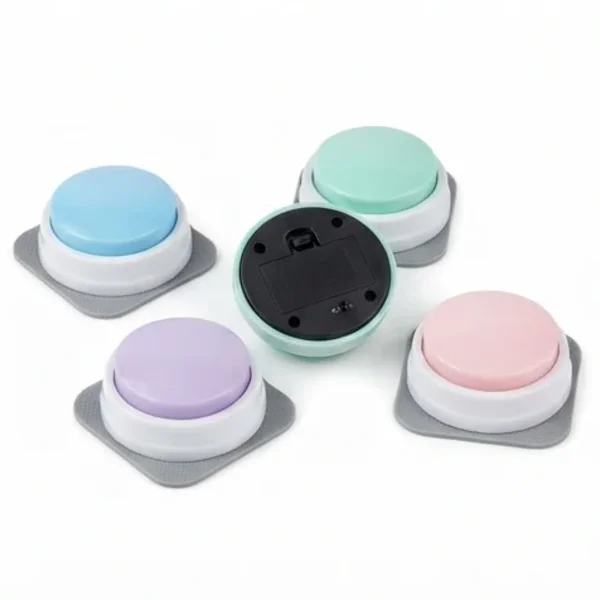
Pictures are illustrations, not the actual products.
What are dog talking buttons, and do they work?
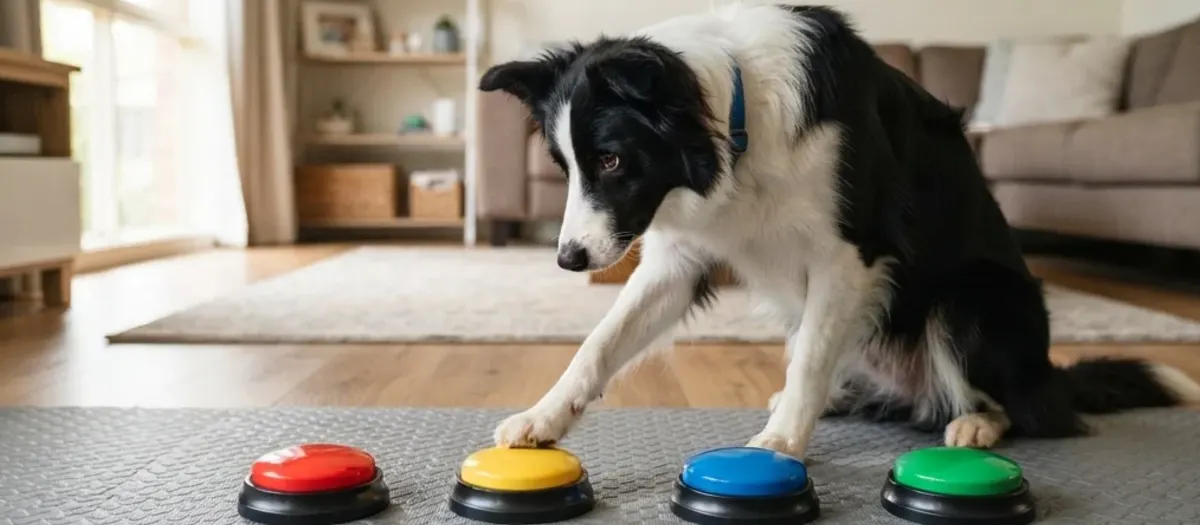
Dog talking buttons are paw-sized buzzers that each play a short recording of your voice, such as "outside" or "play". Dogs can learn to press them, and a 2024 study found dogs responded to some button words. No source shows that dogs understand them as language.
The AKC puts it plainly: there is no scientific proof that button-pressing dogs are talking, and the researcher behind the studies neither recommends nor discourages them (AKC, "Can Dogs Talk With Buttons?", updated 23 March 2026, page read 15 November 2026). What a button does give you is a consistent sound that goes with one activity. Think of it as a training game, not a translator.
What did the 2024 studies actually show?
Two 2024 studies from the University of California San Diego looked at dogs and soundboard buttons. The first found dogs responded to some button words. The second found dogs pressed two-button combinations more often than chance. Neither study shows that dogs understand word meanings, and both are early work.
Swipe sideways to see every column
Dogs and buttons: what each study found
What it didn't show
PLOS ONE, August 2024 (Bastos and colleagues)
Researchers visited 30 dogs at home, and 29 owners ran the trials themselves under remote guidance. Dogs responded appropriately to "play" and "outside", whether the word was spoken by the owner or played by a button, and whether the owner or a stranger pressed it.
Only a few words were tested. Rossano said the team was "just scratching the surface", and the article does not say dogs understand the words as language.
Scientific Reports, December 2024 (Bastos, Houghton, Naranjo and Rossano)
152 dogs over 21 months, with over 260,000 presses, about 195,000 of them by dogs. Two-button combinations such as "outside" with "potty" happened more often than chance. Dogs didn't just copy owners: they pressed "I love you" far less than owners did.
The write-up doesn't claim dogs know what the words mean. The presses were logged by owners in an app, and a co-author works for CleverPet while two others consulted for it, although the analysis is described as independent.
Sources: UC San Diego Today, 28 August 2024 and 9 December 2024 (both page read 15 November 2026). Read these as "dogs can learn to press a button and to respond to a recorded word in some situations", not as proof of conversation. The two studies also say nothing about which brand of button to buy.
Our picks in detail
1. 4-colour voice recording buttons (SVY212): best starter set
Four round buttons in rose, orange, blue and red, each about 8.8 x 8.8 x 4.1 cm, with a set weight of 290 g. The listing says you hold the REC button until you hear a beep, release it, and hear two beeps when the recording ends. It says each button records up to 30 seconds and takes 2 AAA batteries, not included. Housing is ABS with a non-slip base, according to the listing.
Four buttons suit the way the AKC suggests teaching: one word first, then more once it is understood. The listing says the set is not recommended for children under 12 years. We haven't printed the listing's other claims about clear sound and durability.
Pros: a sensible number of buttons for starting out; 30-second recording; replaceable batteries; non-slip base according to the listing
Cons: batteries aren't included; no pad, mat or stickers, so the buttons can slide on smooth floors; the record button's position isn't described in the listing
Best for: starting with one or two words, as trainers advise
Skip it if: you want a mat or stickers included
2. 8-colour voice recording buttons (SVY211): best for growing a vocabulary
Eight buttons in eight colours, each 8.8 x 8.8 x 4.1 cm, with a set weight of about 0.65 kg. Each records up to 30 seconds and takes 2 AAA batteries, not included. The listing says the recording button is on the underside, "to prevent accidental touching", which can help if your dog likes to paw at things.
The listing's table has a "battery average life" field that reads 30 seconds, which is clearly a data entry mistake, so we've ignored it. Eight buttons at once is more than the AKC's teaching advice suggests, so this set suits a dog who already uses a few words.
Pros: room to add words without buying a second set; record button on the underside; 30-second recording
Cons: eight buttons is a lot for a beginner; batteries aren't included, and 16 AAA cells are needed to fill the set; no pads or mat listed
Best for: a dog who already presses a few buttons and is ready for more words
Skip it if: you're starting out, because one or two buttons is a gentler beginning
3. 4-piece recordable buttons with anti-slip pads and on/off switch: best for buttons that stay put
Four buttons, each about 8.8 x 8.8 x 4.2 cm and made of ABS plastic, plus four anti-slip pads. The listing gives the pad size as 16 x 16 cm. You flick the on/off switch on the back to ON, hold the small record button on the back until you hear a beep, then let go. It records up to 30 seconds and takes 2 AAA batteries per button, not included.
The listing says the pads keep the buttons stable and less likely to move, and it calls the buttons water resistant (the maker's word). The title mentions cats and the listing's product details say it's for dogs, with a small-breed recommendation. The listing says the buttons are for indoor use.
Pros: pads give each button a grip on hard floors; an on/off switch on the back; four buttons suits a first set
Cons: batteries aren't included; the listing gives no set weight; fewer words than an eight-button set
Best for: tiles, floorboards and any dog who nudges buttons around
Skip it if: you want more than four words soon
Dog talking buttons compared
Specs from each Amazon Australia listing, checked on 15 Nov 2026. Brand claims are the listings' own, so we say "the listing says". All three sets are battery powered with replaceable AAA cells, not rechargeable.
Swipe sideways to see every column
Pick
Buttons
Recording
Size (cm)
Power
Set weight
Extras
4-colour (SVY212)
4
Up to 30 seconds
8.8 x 8.8 x 4.1
2 AAA per button, not included
290 g
None listed; listing says non-slip base
8-colour (SVY211)
8
Up to 30 seconds
8.8 x 8.8 x 4.1
2 AAA per button, not included
0.65 kg
Record button on the underside
4-piece with pads
4
Up to 30 seconds
8.8 x 8.8 x 4.2
2 AAA per button, not included
Not stated
4 anti-slip pads (16 x 16 cm), on/off switch on the back
The listing for the 4-colour set gives the housing as ABS plastic with a non-slip base, and the pads listing gives ABS as the material too. The 4-colour listing adds a note that it is not recommended for children under 12 years. We haven't printed any battery life, because none of the listings gives a usable figure.
How do you teach a dog to use talking buttons?
Start with one button and one word your dog already loves. Press it yourself just before the activity, say the word, then do the thing. When your dog presses it, praise and give them what the button says straight away. Add a second button only once the first is understood, and don't rush.
That is the AKC's method (AKC, "How to Teach Your Dog to 'Talk' Using Buttons", updated 7 December 2021, page read 15 November 2026). It also says to put the button in a central spot on the route to the activity, so the "outside" button goes by the door your dog uses. The AKC gives no set timeframe, and neither do we. Dogs vary widely.
Keep to words you can always follow through on. A "walk" button you can't answer at 11 pm teaches frustration, so start with something you can give every time.
Below is our own layout of the AKC steps for the first two weeks. It is a plan, not a promise: move on when your dog is ready, not when the calendar says so.
Swipe sideways to see every column
When
What you do
What you reward
What to avoid
Days 1 to 3
Record one word. Place the button on the path to the door or toy cupboard.
Any interest in the button, with calm praise
Pressing it over and over, or recording more than one word
Days 4 to 7
Press the button, say the word, then go out or play right away
The activity itself, plus praise
Using the word at random times, or for things you won't do
Week 2
Let your dog choose: wait to see if they press it. If not, press it for them and carry on.
When your dog presses, give what the button says at once
Ignoring a press, or answering with something else
Once one word is solid
Add a second button, in its own spot
Same again for the new word
Adding three or four buttons at once
Are recordable buttons safe? Batteries and chewing
The buttons are made to be pressed, not chewed, and each one runs on two AAA batteries. If your dog chews a button and a battery is punctured or swallowed, treat it as an emergency. Don't make your dog vomit. Call your vet or the Animal Poisons Helpline on 1300 869 738 (24 hours).
Pet Poison Helpline says a chewed battery can leak and cause corrosive injury to the mouth and tissues. Coin (disc) and lithium cells can cause burns in the oesophagus or intestines, and mouth ulcers may not show for hours. Signs can include drooling, mouth pain and pawing at the mouth (Pet Poison Helpline, "Batteries Are Toxic To Pets", undated, page read 15 November 2026). These sets use AAA cells rather than coin cells, but some other recordable products do use coin cells, so check any button before you buy.
Keep the buttons out of reach of a puppy who chews everything, check the battery covers are closed, and put the buttons away when your dog is unsupervised and might chew them. For more on chewing, see our guide to stopping a dog chewing.
Choose by situation
Swipe sideways to see every column
Your situation
What to look for
Our pick
First time, one or two words
A small set so you don't overdo it
4-colour (SVY212)
Dog who has mastered a few words
Room to add more buttons
8-colour (SVY211)
Buttons slide on tiles or floorboards
Anti-slip pads under each button
4-piece with pads
Dog who may paw the record button by accident
A record button on the underside or the back
8-colour or 4-piece with pads
Want a layout mat or stickers
A mat is sold separately, or print and cut your own layout
None of these sets includes one
Dog who chews small objects
Skip buttons, or keep them put away when unsupervised
We searched Amazon Australia for recordable dog buttons and shortlisted sets that met all of these checks:
Well rated: a strong average rating with plenty of buyer reviews.
No red flags: no pattern of poor reviews, safety complaints or listing problems.
Available on Amazon Australia when we checked.
Recording time, size and power stated in the listing, so we could compare them in centimetres and AAA cells.
A clear way to record and re-record, because you will change words as your dog learns.
Teaching steps from the AKC and research from UC San Diego to match to what the sets can and can't do.
These are researched picks, not products we've personally tried. We compared the specifications and features on each Amazon Australia listing, checked on 15 Nov 2026. We didn't accept payment from any brand.
Left out this time: one 8-piece set with a mat and stickers, because we couldn't confirm it was available when we checked, and one set that fell short of our rating check.
Where else can you buy talking buttons?
Recordable dog buttons are also sold in some pet shops and online pet supply stores. Seeing one in person lets you check the size against the table above. If you want a layout mat, a rubber or foam mat from a pet shop or home store works, or you can print and cut your own.
When to see a vet
Buttons are a training game, not a treatment. They don't treat anxiety, separation anxiety or boredom. If your dog seems distressed when left alone, is pacing, vocalising a lot, or suddenly changes in behaviour, a vet can work out whether pain, illness or anxiety is behind it. Our separation anxiety guide explains the signs.
If a button or battery may have been chewed or swallowed: treat it as an emergency. Don't try to make your dog vomit. Call your vet straight away, or the Animal Poisons Helpline on 1300 869 738 (24/7). Drooling, pawing at the mouth or mouth pain can be more consistent with a leaking battery.
Frequently asked questions
How many buttons should I start with?
Start with one. The AKC says to teach one word first and add more buttons once your dog understands it. A four-button set is fine to own, but only put out as many buttons as your dog is ready for. Eight buttons on day one is more than the AKC's advice suggests.
Which word should I record first?
Choose a concrete word for something your dog already loves, such as "outside" or "play". The AKC suggests words like these and says not to start with "food" or "treat", because praise, cuddles and play work better than food rewards for button training. Record it in a calm, consistent voice.
How long does it take a dog to learn talking buttons?
There's no set time. The AKC says dogs vary widely and not to rush. Some dogs press quickly, and others never take to it. Move to a second word only once your dog reliably presses the first, and don't judge your dog against videos online.
Can cats use talking buttons?
Some people try it, and one listing here mentions cats in its title. We didn't find research on cats using recordable buttons, so we can't say it works. The sets we picked are described as dog buttons, and the 2024 studies were on dogs. Our interactive cat toys guide has options with a stronger track record.
Should I use treats to teach the buttons?
The AKC suggests avoiding food rewards at first and using praise, cuddles and play. Give what the button says, such as going outside, as the reward. If you do use treats later, count them within the 10% treat limit and see our dog training treats guide.
Do I need a mat for the buttons?
Not strictly, but a mat or pads keep buttons from sliding, and a consistent spot helps, as the AKC suggests putting each button on the route to its activity. The pads set includes four 16 x 16 cm pads. None of the three sets includes a mat, so buy one separately or print a layout.
Are talking buttons better than a potty bell?
They do different jobs. The AKC's bell-training article lists three ways for a dog to ask to go out: hanging bells, a doorbell with receivers around the home, and recordable buttons (AKC, page read 15 November 2026). A bell is simpler and does one thing. Buttons can carry more words, but they take more teaching. See our dog potty bells guide.
Does it matter if I use my own voice or a stranger's?
Less than you might expect. In the 2024 PLOS ONE study, dogs responded to "play" and "outside" whether the owner or a stranger pressed the button, and whether the word was spoken or played. Most owners record their own voice, which keeps the cue the same as what the dog hears every day, but the study suggests the consistent word is what counts.
Product details from each linked Amazon Australia listing, checked on 15 Nov 2026.
This guide provides general information and isn't a substitute for veterinary advice. If you're concerned about your dog's behaviour or training, speak with your vet.