Quick answer: Dog eating cat food? A small amount usually won't harm your dog, but cat food is richer than dog food and isn't recommended. Regular raids can upset your dog's stomach or add weight, and a big feed of fatty food can trigger pancreatitis. Feed your cat on set meals, somewhere your dog can't reach.
Most dogs with a cat in the house will try the cat's bowl at some point. This guide covers why it's a problem, which dogs need extra care, what to do after a big raid and how to set up feeding so it stops. If you're still settling a dog and cat into the same home, start with our guide on how to introduce a dog to a cat.
Quick picks
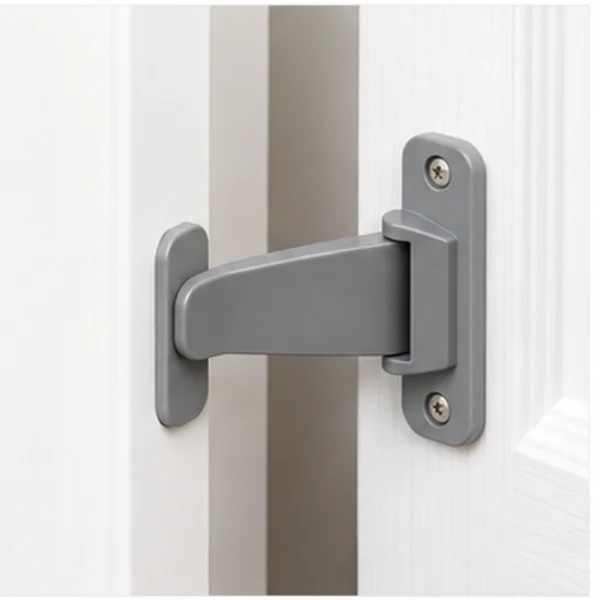
Door Buddy Door Latch Plus Door Stop
Holds a door open at a cat-width gap, from 0 to 15 cm, with no drilling.
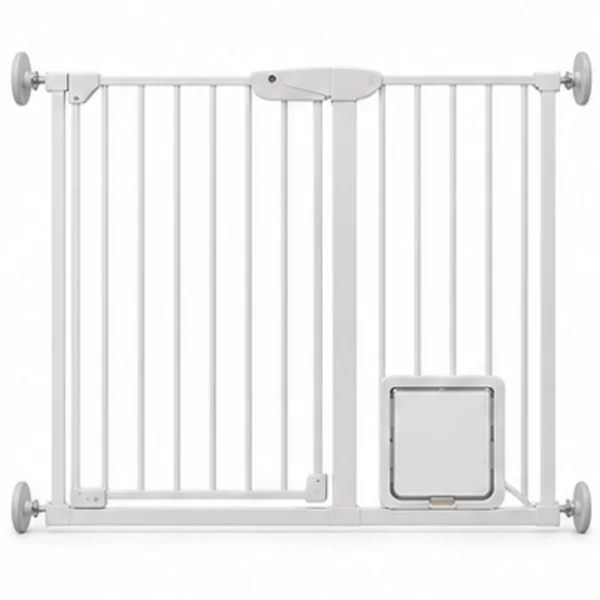
Carlson Extra Wide Walk Through Pet Gate with Small Pet Door
A gate with a cat door, so your cat gets through and a bigger dog can't.
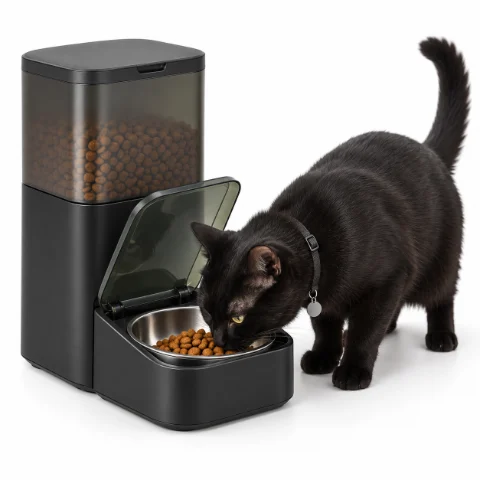
PETLIBRO RFID feeder with collar tag
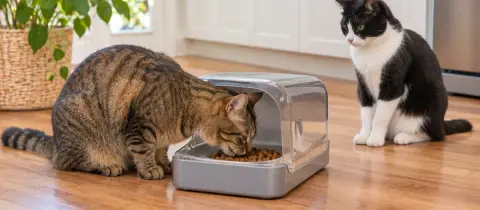
Opens only for your cat's tag, so the dog can't reach the food.
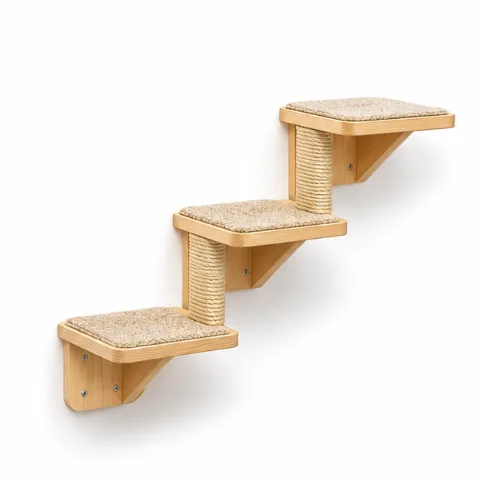
COOLEX 3-in-1 Cat Climbing Wall Steps with Hemp Rope
Wall steps give your cat a high spot most small dogs can't reach.
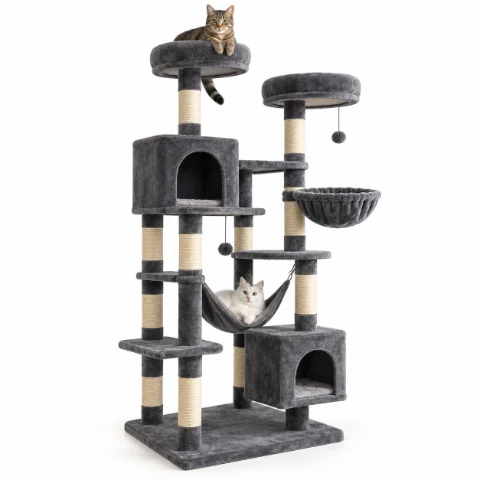
Feandrea 206 cm Cat Tree
A tall cat tree is a high perch that most small dogs can't climb to.
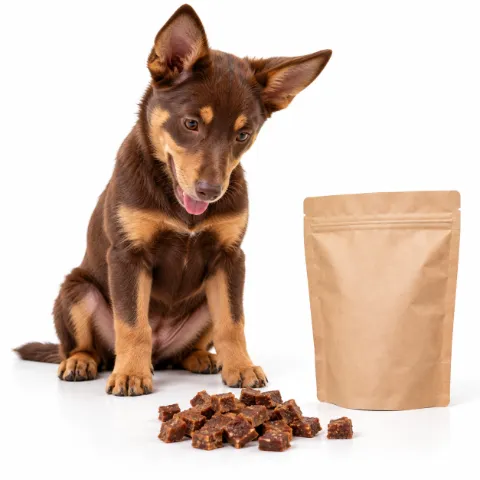
SavourLife Dog Training Treats, Australian Kangaroo, 165 g
Small, soft rewards for teaching your dog to turn away from the cat's bowl.
Carlson Extra Wide Walk Through Pet Gate with Small Pet Door
A gate with a built-in cat door, so your cat can get through and a larger dog can't.
PETLIBRO RFID feeder with collar tag
Opens only for your cat's tag, so the dog can't get at the meal.
COOLEX 3-in-1 Cat Climbing Wall Steps with Hemp Rope
Wall-mounted steps give your cat a high place to eat that most small dogs can't reach.
Feandrea 206 cm Cat Tree
A tall cat tree gives your cat a high spot away from a small dog.
SavourLife Dog Training Treats, Australian Kangaroo, 165 g
Small, soft rewards that are easy to count towards the day's food, for teaching "leave it".
Pictures are illustrations, not the actual products.
More detail on the door latch is in Useful gear for a cat-only feeding room below, and the rest are the "You may also like" cards at the end of the row. Management does the work here; no gate, shelf or feeder beats every dog.
Is cat food bad for dogs?
Cat food isn't toxic to dogs, but it's too rich to be a regular meal. PetMD says a small amount won't harm most dogs, yet feeding it isn't recommended. Eating a lot can cause an upset stomach or pancreatitis, and long-term eating can lead to weight gain.
The richness comes from what cats need. PetMD, a vet-written site, gives the AAFCO minimums for adult food, and cat food has to start from a higher base (PetMD, "Can Dogs Eat Cat Food?", updated 5 February 2025, page read 23 November 2026).
| Nutrient | Adult dog minimum | Adult cat minimum | What it means for your dog |
|---|---|---|---|
| Protein | 18% | 26% | Cat food starts from a higher protein base than dog food. |
| Fat | 5.5% | 9% | More fat per mouthful, which is the pancreatitis concern. |
| Taurine | None listed | 0.1% (dry), 0.2% (canned) | A cat requirement. There's no set minimum for adult dog food, so it doesn't make cat food a better meal for your dog. |
| Arachidonic acid | None listed | 0.02% | Another cat requirement, with no set minimum for adult dog food. |
These are minimums, so a real cat food can sit well above them. PetMD points out that dogs are omnivores and cats are obligate carnivores, which is why the two foods are built differently.
Fatty food is also the reason we warn about Christmas ham on our can dogs eat ham guide.
Why do dogs love cat food?
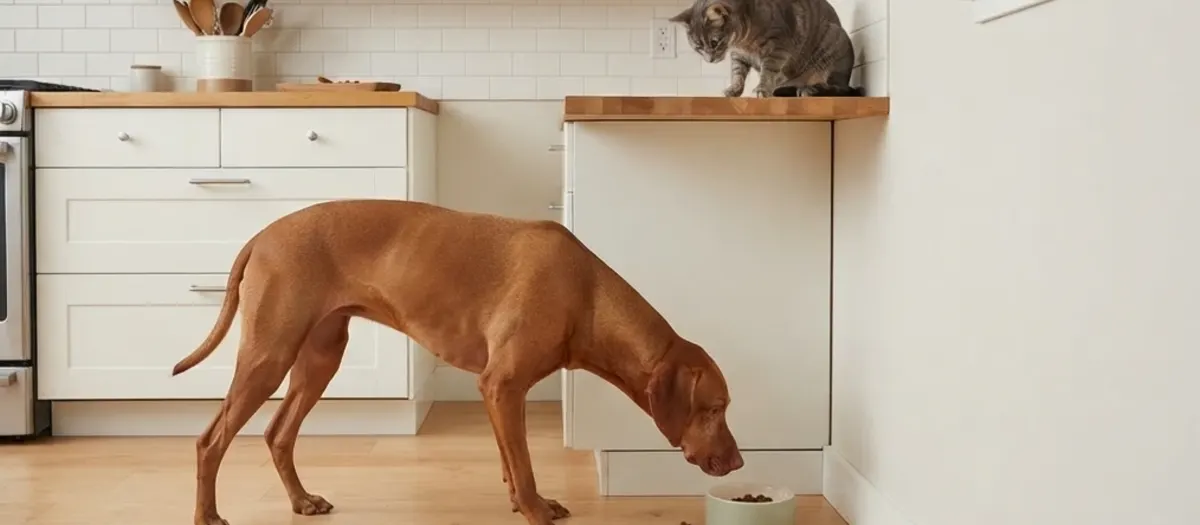
Cat food is meaty, fatty and strongly scented, and it often sits in a bowl at nose height all day. Dogs are opportunists, so an open buffet is hard to resist. It's usually habit and opportunity, not a sign that your dog's own food is wrong.
If your adult dog has suddenly become much hungrier than usual, mention it to your vet. Many dogs also raid the litter tray, which brings different risks: see dog eating cat poop.
Which dogs are most at risk?
Dogs that already need careful feeding are at higher risk. PetMD names dogs on a low-fat or moderate-protein diet, and dogs with a history of pancreatitis, high blood fats, kidney disease, liver disease or a sensitive stomach. If yours is on that list, treat any cat food access as something to fix, not shrug off.
PetMD also says how much is too much depends on the type of food, your dog's size and your dog's diet and health. That's why we don't give a "safe amount" in grams. A small dog that eats a whole bowl of rich wet food is a different situation from a large dog that licks a few biscuits.
Puppies are a separate case. They need a complete food made for growing dogs, so see our best puppy food guide rather than topping up from the cat's bowl.
What should I do if my dog ate a lot of cat food?
Watch your dog closely and call your vet if they seem unwell or you're worried. PetMD says to phone the vet if your dog seems sick, and to keep watching if they seem fine. Have your dog's weight, what they ate, roughly how much and when ready.
Over the following days, look for repeated vomiting, diarrhoea, a hunched back, a sore tummy, less interest in food or unusual tiredness. These can be more consistent with pancreatitis or other tummy trouble, but only a vet can say. The American Kennel Club says a dog showing several of these signs should see a vet as soon as possible, and that fatty food is one of the most common triggers (AKC, "Pancreatitis in Dogs", updated 20 October 2026, page read 23 November 2026). Our pancreatitis guide covers the signs and what a vet may do.
Don't try to make your dog vomit at home unless a vet tells you to. For loose stools on their own, our dog diarrhoea guide covers home care and when to call.
If the cat's food or treats may have held something toxic, such as onion, garlic or xylitol, call the Animal Poisons Helpline on 1300 869 738 (24/7) or your vet straight away. Our toxic foods list has the full list.
How do I stop my dog eating the cat's food?
Take away the free access. Put the cat on set mealtimes, feed the cat somewhere your dog can't get to, and teach your dog "leave it" as a back-up. Management does the work, and training only supports it. Never punish your dog for sniffing around the bowl.
- Stop free-feeding. Offer the cat's meal, then pick up whatever is left when your cat walks away. A bowl that's always down is an all-day invitation. If your cat is a kitten, a senior or has a health condition, ask your vet before changing how they're fed.
- Separate the animals at meals. PetMD suggests a crate or playpen for your dog while the cat eats, if the cat has set mealtimes. The RSPCA also says to feed cats and dogs in separate areas (RSPCA Australia knowledge base, updated 30 July 2024, page read 23 November 2026).
- Move the cat's food out of the dog's reach. The next section covers where.
- Clean up crumbs and licked bowls. A scent trail keeps the interest alive.
- Teach "leave it". Reward your dog for turning away from food and coming to you. Our training treats guide has small, soft rewards that are easy to count towards the day's food. The FAQ below has the steps.
The RSPCA says pairs that never become best friends can still live together, with separate feeding areas, and not to leave them alone together until you're certain they tolerate each other (RSPCA Australia knowledge base, updated 4 March 2024, page read 23 November 2026). Our introduction guide covers the rest.
Where should the cat's bowl go in a house with a dog?
Somewhere the cat can get to easily and the dog can't: up high, in a cat-only room with a gap only the cat fits through, or behind a gate with a cat door. The RSPCA says to move the cat's food, water and tray into a cat-only area early (RSPCA Australia knowledge base, updated 4 March 2024).
No setup beats every dog. A cat door, gap or shelf is a way to make raiding harder, not a guarantee. Use this table to match the fix to your home.
| Your setup | Best option | Why it works | What beats it |
|---|---|---|---|
| Small dog | A high shelf or a tall cat tree. See cat wall shelves and cat trees. | Most small dogs can't jump or climb to the bowl. | A jumper, or a dog that can climb on furniture first. |
| Large dog | A gap-held door to a cat-only room, or a gate with a cat door. | The dog is bigger than the gap or door. | A dog that shoves hard at the door, or one that fits the cat door. |
| Older cat who can't jump | A low bowl in a cat-only room behind a held-open door, plus a raised cat bowl if your cat finds a tilt easier. | No climbing is asked of your cat. | A slim dog that fits the gap. Narrow the gap, or use a gate with a cat door instead. |
| Renter | A no-drill door holder (see the gear below), or a pressure-fit gate. | Nothing is cut into the door or wall. | A door the holder can't stick to, so check your lease and door first. |
| Determined dog, tech option | A microchip cat feeder. | It opens only for your cat's chip or tag. | A dog that can knock or carry the feeder away, or a cat that won't learn it. |
Our interior cat door guide covers no-gate options such as flaps and cut-in doors, and our dog gate guide covers gates in general. For senior cats and litter trays, see litter boxes for senior cats. If a dog is also raiding the tray, our dog-proof litter box guide compares boxes by entry height.
Useful gear for a cat-only feeding room
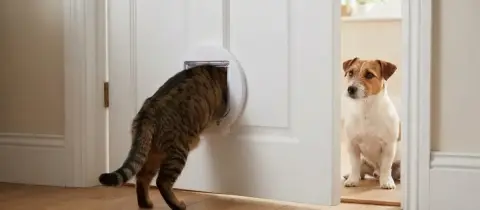
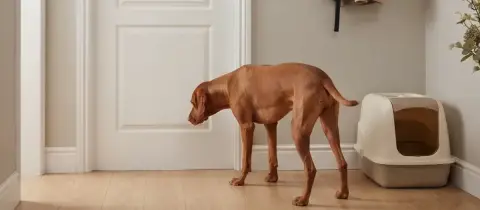
A door held open at a cat-width gap is a simple way to turn a laundry or spare room into a cat-only feeding spot. It only suits a dog that is clearly bigger than the gap.
- Door Buddy Door Latch Plus Door Stop: an adjustable strap and foam door stop that holds a door open at a gap from 0 to 15 cm (0 to 6 in). The listing says it sticks on with 3M adhesive, works on bifold, sliding, pocket and double doors, and shouldn't be installed on plasterboard. The listing also claims it holds dogs up to 54 kg (120 lb), and says to discourage large, persistent dogs from pushing on the door. Set the gap so your cat fits and your dog doesn't, and check that a small dog can't squeeze through. Our interior cat door guide has other no-cut options.
- Not ready for a latch? Read our guides to gates with a cat door, microchip cat feeders, cat wall shelves and raised cat bowls. Pet shops also sell gates and feeders if you'd like to see one in person.
When to see a vet
Call your vet if your dog seems unwell after eating cat food, or you're worried about how much they ate. Only a vet can say what's behind the signs.
- Repeated vomiting or diarrhoea
- A hunched back, or a sore or swollen tummy
- Not interested in food, or unusually tired
- Signs that keep coming back over several days
- A dog with pancreatitis, kidney or liver disease, or a sensitive stomach who has eaten cat food
If the cat food or treats may have held something toxic, call the Animal Poisons Helpline on 1300 869 738 (24/7) or your vet straight away. See our toxic foods list. The American Kennel Club lists the signs of pancreatitis.
Frequently asked questions
Can puppies eat cat food?
No. Puppies need a complete food made for growing dogs, and cat food is richer than dog food. If your puppy has raided the cat's bowl, watch for tummy upset and ring your vet if you're worried. Our best puppy food guide covers choosing one by breed size.
Can I give my dog cat food if I run out of dog food?
PetMD says a small amount won't harm most dogs, but it isn't recommended. If you're short, a bag of dog food from the shops or a vet clinic is a safer plan. Check with your vet first if your dog has pancreatitis, kidney or liver disease or a sensitive stomach.
Can cats eat dog food?
Not as their regular food. PetMD's table lists taurine and arachidonic acid as cat requirements, and dog food isn't built to provide them. A stolen mouthful is unlikely to matter, but your cat's meals should be a complete cat food. See our wet cat food and dry cat food guides.
Is it OK to free-feed my cat when there's a dog in the house?
It makes things harder. Food that's always down is always available to your dog too. Set mealtimes work better, with the bowl in a place your dog can't reach. If free-feeding suits your cat, put the bowl up high or in a cat-only room, and ask your vet if your cat has a health condition.
Can I feed my dog and cat at the same time in the same room?
It's easier to keep them apart. The RSPCA says to feed cats and dogs in separate areas. Meals in the same room invite a dog to wander over and a cat to feel pressured. Shut your dog in another room or use a gate while your cat eats.
How do I teach my dog to "leave it" around the cat's bowl?
Start away from the cat's bowl. Hold a treat in a closed hand, wait for your dog to look away, then reward from your other hand. Move on to food on the floor under your hand, then a covered or empty bowl. Practise often, keep it calm and never punish.
Is a microchip cat feeder worth it to keep the dog out?
It can be, if gaps, shelves and doors don't suit your home. A microchip feeder opens only for your cat's chip or tag, so the dog can't reach the food. Your cat has to learn it, and it's not a fix for every dog. Our microchip cat feeder guide compares options.
Why does my dog also go for the litter tray?
Dogs are scavengers, and cat poo can smell like cat food to them. It can also carry bacteria and parasites, so it's worth stopping. See our full guide on dogs eating cat poop, and for boxes that make raiding harder, our dog-proof litter box guide.
Related guides
- How to introduce a dog to a cat
- Dog eating cat poop: why it happens and how to stop it
- Dog-proof litter boxes
- Pet gates with a cat door
- Interior cat doors
- Microchip cat feeders
- Can dogs eat ham?
- Frozen KONG recipes (full toxic foods list)
- Best puppy food
- All our dog guides
Sources
- PetMD, Can Dogs Eat Cat Food?, Jennifer Coates, DVM, updated 5 February 2025, page read 23 November 2026.
- American Kennel Club, Pancreatitis in Dogs, updated 20 October 2026, page read 23 November 2026.
- RSPCA Australia Knowledgebase, How should I introduce my new cat or kitten to the family dog?, updated 30 July 2024, page read 23 November 2026.
- RSPCA Australia Knowledgebase, How should I introduce my new dog or puppy to the family cat?, updated 4 March 2024, page read 23 November 2026.
This guide provides general information and isn't a substitute for veterinary advice. If you're concerned about your dog's diet or what they've eaten, speak with your vet.