Quick answer: If you're wondering why your cat is crazy at night, the main reason is that cats are naturally most active at dusk and dawn, and a cat that sleeps all day has energy to burn after dark. Move play and meals into the afternoon and evening, keep the routine steady, and see your vet if the behaviour is new or your cat is older.
Being pounced on at 4am is tiring, and it's a common complaint from cat owners. This guide explains what's behind the night-time zoomies, how to shift your cat's day so you can sleep, and when the problem is medical. For more daytime ideas, see our cat enrichment guide.
Why is my cat so crazy at night?
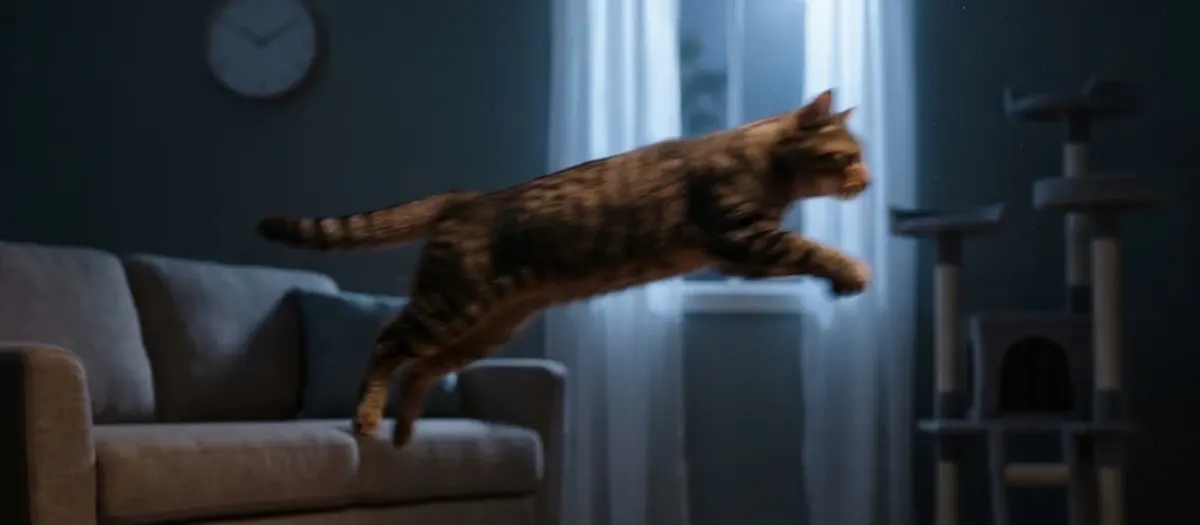
Cats aren't truly nocturnal. They're crepuscular, meaning most active around dusk and dawn, like their wild relatives, which is when small prey is about. Add a long, quiet day alone, and that natural peak can turn into a wild, noisy lap of the house just as you want to sleep.
RSPCA Australia says cats left alone during the day often sleep, then wake up full of beans when their people get home. It also says night activity can be social play or attention-seeking, especially in a single cat whose owners work all day (RSPCA Australia Knowledgebase, updated 20 April 2022, page read 15 November 2026). Cats Protection adds that early waking is usually normal too, because many cats are easily roused by the first sunrise (Cats Protection).
Why does my cat wake me up at 4am?
The usual reasons are hunger, a learned routine and a wish for company. If waking you has ever led to food, a pat or a chat, your cat has learned that it works. This isn't spite. Cats repeat what pays off.
VCA Animal Hospitals says any attention, even getting up to see what your cat wants, rewards night calling, and suggests a feeder timed for around 5am for cats that wake early for food (VCA Animal Hospitals, edited 9 July 2019). A cat that wakes at the same time every morning has simply learned when breakfast is likely. We cover the fix in the routine below. A sudden change in waking time, or a cat that is always hungry and losing weight, is a reason to call the vet instead (see the vet box).
Is it zoomies, boredom or something else?
Look at what your cat actually does, because racing and play attacks, calling for food or company, and yowling or wandering in the dark point in different directions. The table pairs each pattern with what it may be more consistent with and a sensible first step. It isn't a diagnosis; a vet can work out what is going on.
| What you see | It may be more consistent with | First step |
|---|---|---|
| Racing around, pouncing on feet or toes, play attacks | Pent-up energy, play, predatory instinct | Play in the evening that ends with a catch |
| Meowing at the door or bowl, walking on you around the same time each day | Hunger, learned routine | Bedtime snack, timed breakfast |
| Following you, calling when you leave the room | Wanting company | More daytime attention, enrichment, perhaps a compatible second cat |
| Loud yowling in the dark, wandering, seeming confused | Possible medical or age-related problem | Vet visit first |
| Restless, drinking more, hungry but losing weight | Possible medical problem | Vet visit first |
| Sudden change in a cat who was sleeping through | Pain, illness or stress | Vet visit first |
Why are kittens and young cats so active at night?
Kittens and young cats have the most energy and the least interest in sleeping through. Cats Protection says kittens and young cats are especially active at dawn and dusk, and RSPCA Australia says they usually sleep more through the night as they mature. Results vary from cat to cat, so a steady routine helps in the meantime.
Age changes the likely cause, as this table shows:
| Age | Common reasons | What helps |
|---|---|---|
| Kitten | Lots of energy, play, learning routines | Several short play sessions, a bedtime meal, safe toys (see our kitten proofing checklist) |
| Young adult | Energy, boredom, single cat alone all day | Play twice in the evening, climbing, puzzle feeders |
| Bored indoor adult | Sleeping all day, little to do | More daytime enrichment, rotating toys |
| Cat about 10 or older | Medical causes come first | Vet check before changing anything |
How do I stop my cat waking me up?
Shift your cat's day so the busy time happens before you sleep. Play in the afternoon and early evening, feed a small meal close to bedtime, then keep the routine the same every day. RSPCA Australia suggests this, and says to gradually shift the schedule, since cats learn routines quickly.
Here is a night-by-night routine to follow. Move any step that doesn't suit your household, but keep the order.
| Time | What to do | Why |
|---|---|---|
| Afternoon | A short play session if you're home | Uses energy earlier |
| About 6pm | Play, then dinner | Play then eat mimics hunt then meal |
| About 9pm | Second play, slower toward the end, finishing with a catch and a treat | Winds the hunt down |
| Bedtime | A small snack or a puzzle feeder | RSPCA suggests a meal near bedtime |
| Overnight | Nothing. Ignore calling if your cat is well | Avoids rewarding the waking |
| Wake time | A timed breakfast, then shifted later by 15 minutes every few days | Moves the wake-up gradually |
Start the timed breakfast at the time your cat already wakes you, so the first change is painless. If calling starts again after a shift, hold at that time for a few more days before moving on.
A few extra tips:
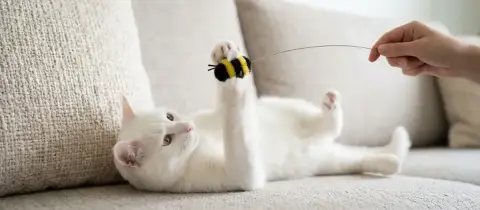
- Play with a purpose. Wand toys let your cat stalk, chase and catch. Our cat wand toys guide explains how to choose one. Finish with a catch and a treat, and avoid laser-only play. Put wands away afterwards, and never leave string or ribbon out: RSPCA Australia warns that string toys and small objects can be swallowed and cause a fatal obstruction.
- Rotate toys. RSPCA Australia suggests keeping about 10 and bringing out only a few at a time.
- Make food a hunt. Scatter feeding or puzzle feeders give your cat something to do. See our puzzle feeders for wet food guide.
- Add climbing and watching. Perches, scratching posts and a window view help. See our cat trees and window hammock guides.
Should I ignore my cat at night?
Often, yes, if your cat is healthy and the calling is for attention. Any response, including a sleepy word or a quick pat, pays the behaviour, so don't get up, talk or feed. It often seems to get worse for a few nights before it eases, because your cat is testing whether it still works. Results vary.
Ignoring is wrong in some cases. Cats Protection says don't scold a cat for waking you, because it may be unwell. So don't ignore a senior cat, a sudden change, or a cat that seems in pain or distressed. See your vet first. Never punish, shout or squirt your cat, and never use scents or essential oils. Punishment doesn't teach a cat what to do instead.
If you can't ignore it, let your cat sleep outside the bedroom, provided it has a litter tray, water, a bed, scratching, climbing and a few toys there.
Can an automatic feeder help?
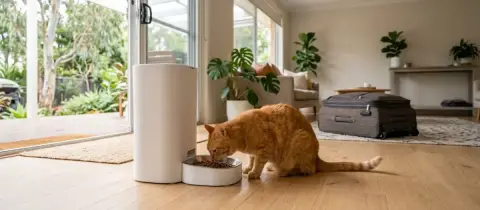
Yes, as one tool within the routine. A timed feeder can give breakfast at your cat's wake time without you getting up, which for most early wakers means somewhere around 5am. RSPCA Australia says your cat needs to learn during the day that the feeder, not you, is where food comes from, so run it for daytime meals first.
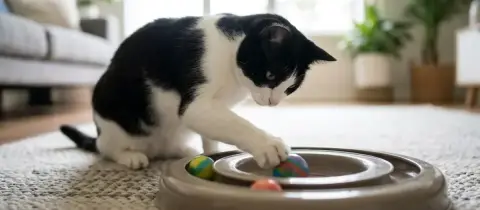
A feeder won't fix boredom, loneliness or a medical problem, so it works best alongside the play and meal routine. Our automatic cat feeders guide compares options, and our interactive cat toys guide covers motion toys for the evening.
When is night activity a medical problem?
Night activity can be medical when it is new, changes a lot, or starts in an older cat. Cornell says signs of cognitive problems become noticeable at 10 years or older, that night-time yowling is relatively common in cats with an overactive thyroid, and that it can also happen with high blood pressure. A vet can work out the cause.
Cornell lists other signs that can overlap: disorientation, a changed sleep and wake pattern, sudden loud calling in the middle of the night and litter accidents (Cornell Feline Health Center). It says arthritis, dental pain, kidney disease and brain disease can cause overlapping signs and need ruling out first, and that high blood pressure can detach the retina and cause blindness, which may leave a cat anxious and confused.
An overactive thyroid mostly affects middle-aged and older cats. Cornell lists weight loss with a bigger appetite, more thirst and urination, vomiting, diarrhoea, hyperactivity and an unkempt coat. Signs can be subtle at first. Vets diagnose it with an exam and a blood test (Cornell Feline Health Center). If changes at home don't help, RSPCA Australia says to see your vet, and that medication is only considered in rare, severe cases.
Useful guides
Gear supports the routine; it doesn't replace it. These guides compare what's out there:
- Automatic cat feeders, for a timed breakfast
- Cat wand toys, for evening play that ends with a catch
- Interactive cat toys, for motion and track toys
- Cat puzzle feeders for wet food, for a bedtime snack
- Cat trees, for climbing and perching
- Cat window hammocks, for daytime bird watching
- Cat enrichment ideas, for the whole picture
When to see a vet
Book a vet visit if your cat's night-time behaviour comes with any of these:
- a cat about 10 or older who starts yowling at night
- weight loss with a big appetite
- drinking or urinating more than usual
- disorientation, wandering, staring at walls or seeming lost
- a sudden change in a cat of any age
- litter accidents, or crying in or near the tray
- no change after a few weeks of a steady routine
Straining in the tray with little or no wee, repeated vomiting or collapse needs a vet straight away, day or night. If your cat may have chewed a lily or another toxic plant, call your vet now and the Animal Poisons Helpline on 1300 869 738 (24/7). See our lilies guide.
Frequently asked questions
Why does my cat run around frantically at night, like a maniac?
Those bursts are usually play and hunting energy, and they peak around dusk and dawn. A cat with a quiet day behind it has plenty to burn. If the racing is new, comes with yowling, or your cat is older, mention it to your vet.
Why does my cat purposely wake me up at night?
It's learned attention, not spite. Cats don't plan revenge; they repeat whatever has worked before, and a 4am wake-up that once earned breakfast or a cuddle is worth trying again. Stop paying it: breakfast on a timer, play before bed, no response in the night. If the waking is new or your cat is older, see your vet first.
Should I feed my cat when it wakes me up?
Better not. Feeding on demand teaches your cat that waking you works, so it will keep trying. Give a small meal at bedtime, as RSPCA Australia suggests, then nothing until breakfast arrives at a set time. If you can't hold out, wait until your cat is quiet before you feed, so silence is what gets rewarded.
Can I lock my cat out of the bedroom at night?
Yes, if your cat has what it needs in its own space: a litter tray, water, a bed, something to scratch and climb, and a few toys. Expect some protest at the door for the first few nights. Don't shut a senior, unwell or anxious cat away without asking your vet first.
Will my kitten grow out of being crazy at night?
Often, yes. Kittens have the most energy and tend to settle as they mature, though every cat is different. In the meantime, give several short play sessions ending with a catch, a small meal at bedtime, and put wand and string toys away before you go to bed. A new kitten that cries at night is often unsettled; a warm bed, a tray nearby and a steady routine help. Book a vet check if the crying doesn't ease or your kitten seems unwell.
Does getting a second cat help?
It can. RSPCA Australia says having more than one cat that gets along well can increase activity and stimulation. It isn't a quick fix, and a poor match adds stress. Our guide to introducing a kitten to an older cat explains how.
Should I let my cat outside at night to burn energy?
No. Cats Protection recommends keeping cats in overnight, because road injuries and fights are more likely then. Safe daytime outdoor time, such as an enclosure, can help. See our catio ideas and cat curfew rules guides for local rules.
How long does it take for a cat to stop waking me up?
There's no set timeline, and results vary. The pace is set by the method: shifting breakfast from 4am to 6am by 15 minutes every few days takes eight steps, so allow the better part of a month even when it goes smoothly, and hold at any step where your cat starts calling again. A cat that is older, or whose waking is new, needs a vet check rather than patience.
Related guides
- Why won't my cat use the cat tree?
- Best tall cat trees
- Cat enrichment ideas for bored indoor cats
- Best cat wand toys
- Best automatic cat feeders
- Best interactive cat toys
- Best cat trees
- How to introduce a kitten to an older cat
- Catio ideas: types, sizes and how to set one up
- Kitten proofing your home
Sources
- RSPCA Australia Knowledgebase: My cat is very active at night and keeps waking me up, updated 20 April 2022, read 15 November 2026
- VCA Animal Hospitals: Cat behavior problems, nocturnal activity, edited 9 July 2019, read 15 November 2026
- Cats Protection: Cats at night, read 15 November 2026
- Cornell Feline Health Center: Cognitive dysfunction, read 15 November 2026
- Cornell Feline Health Center: Hyperthyroidism in cats, read 15 November 2026
This guide provides general information and isn't a substitute for veterinary advice. If you're concerned about your cat's sleep, behaviour or health, speak with your vet.