Golden Retriever Dog Food: Picks for Puppies, Adults and Seniors
By Anish PuriUpdated 27 Nov 202615 min readResearched, not tested by us
Research guide. WhiskerFinds may earn a commission from links, at no extra cost to you.
Quick answer: The best golden retriever dog food is a complete large-breed food that matches your dog's age: a large-breed puppy food while your dog is growing, then an adult or senior formula you can keep at a lean weight. Our top pick for adults is Optimum Adult Large Breed, with picks for puppies, budget and seniors below.
Illustration, not the actual product
Our top pickOptimum Adult Large Breed, Chicken, Vegetables and Rice 15 kg
Goldens are big, hungry and quick to gain weight, so the bag matters. This guide compares four foods on Amazon Australia by bag size in kilograms, life stage and size as each listing states them, then covers puppy growth, weight and grain free. For breed basics, see our golden retriever guide.
Quick picks
Our top pickBest overall
Optimum Adult Large Breed, Chicken, Vegetables and Rice 15 kg
A large-breed adult kibble in a 15 kg bag, made in Australia per the maker's table
Pictures are illustrations, not the actual products.
What should you feed a golden retriever?
Feed a complete and balanced food made for your dog's life stage and size, in an amount that keeps your dog lean. For most goldens that means a large-breed puppy food, then an adult food, then a senior food if your vet agrees. The brand matters less than the life stage, the fit and the measured portions.
A golden's adult weight is usually about 25 to 34 kg (55 to 75 pounds), according to VCA Animal Hospitals, "Golden Retriever", page read 27 November 2026. Whatever you choose, change foods over about a week and follow the pack's guide for your dog's ideal weight, then adjust with your vet.
Golden retriever dog food compared
Details come from each Amazon Australia listing, checked on 27 Nov 2026. Where a listing has no maker's age range in years, the table says so.
Swipe sideways to see every column
Food
Bag
Life stage per listing
Size per listing
Grains
Optimum Large Breed
15 kg
Adult, 1 to 7 years (maker's range table)
Large
Rice named in the title
Supercoat Large Breed
18 kg
Adult (no age range in years)
Large breed (title)
Wholegrain wheat, barley, sorghum and corn listed
Royal Canin Maxi Puppy
4 kg
2 to 15 months
Adult weight 26 to 44 kg
Maize listed first
Optimum Senior
13.7 kg
7+ years
All breeds (title)
Sorghum listed as a special ingredient
Our picks in detail
1. Optimum Adult Large Breed, Chicken, Vegetables and Rice 15 kg: best overall
A large-breed adult kibble in a 15 kg bag. The listing gives the size as large and the recipe as chicken, vegetables and rice. Its maker's range table shows 1 to 7 years for the adult recipes and ticks complete and balanced, no artificial colours or flavours, and made in Australia across the range. The listing says a zinc and omega 6 blend supports skin and coat, and a blend of antioxidants supports natural defences. Those are the maker's claims.
We made it the top pick as the best mix of a clear life-stage window, the right size and a bag that lasts a single golden a while, not as a claim that it beats every other food.
Pros: large-breed adult recipe; 15 kg bag; made in Australia per the maker's table; zinc and omega 6 for skin and coat per the listing
Cons: chicken based, with one recipe on this listing; no reseal detail on the listing, so plan an airtight container; no ingredient list shown on the listing
Best for: adult goldens from 1 to 7 years whose owners want a large-breed kibble in a big bag
Skip it if: your golden is a puppy or a senior, or needs to avoid chicken
2. Purina Supercoat Adult Large Breed Chicken 18 kg: best budget large-breed bag
The biggest bag here, written for adult large dogs. The listing says it's for adult health and maintenance in large breeds, with a protein to fat ratio to help maintain lean body mass, glucosamine, and added calcium. It also says there are no added artificial colours or flavours, and that you should switch foods over 7 to 10 days with fresh water always available. Those are the maker's claims.
The ingredient list is grouped: meat and meat by-products (chicken, beef) and poultry by-products, then wholegrain wheat, barley, sorghum and corn. You can't see how much of each, so it isn't suited to a dog with a known food allergy.
Pros: 18 kg for big appetites or two large dogs; large-breed adult recipe; no added artificial colours or flavours per the listing
Cons: grouped ingredient list; 18 kg is heavy to lift and store; the listing gives no age range in years
Best for: goldens with big appetites on a budget, and homes with two large dogs
Skip it if: your dog needs to avoid wheat, chicken or beef, or you want named single ingredients
3. Royal Canin Maxi Puppy 4 kg: best for golden puppies
A large-breed puppy food. The listing says it suits puppies aged 2 to 15 months with an expected adult weight of 26 to 44 kg, with moderate energy for a long growth period. It lists a protein it calls L.I.P. and prebiotics (FOS) that the maker says support digestion. The ingredients begin with maize, poultry meal and corn gluten feed, and include taurine and chondroitin sulfate.
Check the pack for a line saying the food is formulated for growth of large-breed puppies, as VCA advises. Don't add calcium or other supplements to it. A golden's adult weight sits at the lower end of this food's range, so a smaller female may finish under 26 kg. Ask your vet to track growth.
Pros: made for large-breed puppies; moderate energy for a long growth period per the maker; ingredient list on the listing
Cons: a 4 kg bag empties fast as a golden pup grows; maize is the first ingredient; poultry based
Best for: golden puppies from 2 to 15 months
Skip it if: your puppy's expected adult weight is under 26 kg, or your puppy needs to avoid poultry or maize
4. Optimum Senior All Breeds, Chicken, Vegetables and Rice 13.7 kg: best for seniors 7+
A senior recipe for goldens moving off adult food. The listing gives the age as 7 and over and lists hip and joint support as a use, saying chicken is a natural source of glucosamine. The maker's range table ticks complete and balanced, no artificial colours or flavours, and made in Australia. The listing also says whole grains and beet pulp provide fibre.
VCA treats a golden as a senior from about 8 years, so ask your vet when to switch.
Pros: made for dogs 7 and over; made in Australia per the maker's table; fibre from whole grains and beet pulp per the listing
Cons: an all-breeds recipe, not a large-breed one; chicken based
Best for: goldens aged 7 and over that are healthy and moving off adult food
Skip it if: your senior has kidney, heart or joint disease under vet care, because your vet may want a specific diet
When should a golden retriever puppy switch to adult food?
Switch when your vet says your puppy has finished growing, which can be well after the first birthday. The Royal Canin Maxi Puppy listing runs to 15 months, but VCA says large breeds can take up to two years to reach adult weight, so ask your vet to check your puppy's growth rather than going by the calendar.
VCA says large-breed puppies should grow steadily, because growing too fast can stress developing bones and joints. It suggests choosing a food whose label says it is formulated for growth of puppies including large dogs. It also warns that too much calcium is harmful in a growing puppy, which is why extra calcium isn't added on top of a complete food (VCA Animal Hospitals, "Nutritional Requirements of Large and Giant Breed Puppies", page read 27 November 2026).
Other points from the same page: weigh portions on a gram scale instead of using a cup, split the day's food into several small meals, and watch body condition and stools. Change foods gradually. Tufts describes a week-long plan that starts at about 10% new food, and says some pets need four to six weeks. If a stool turns loose but your dog is well, stay at the last ratio that worked for a day or two (Tufts Cummings School, Petfoodology, "How do I switch my pet's food?", page read 27 November 2026). Our puppy food guide has more picks.
How do you keep a golden retriever at a healthy weight?
Weigh the food, count the treats and check your dog's shape every few weeks. VCA says weight management plays a major role in a golden's joint and metabolic health, and the RSPCA Knowledgebase says obesity is common in Australian dogs and can make osteoarthritis worse.
From above: you should see a waist between the ribs and the back legs.
By touch: you should feel the ribs under a light layer of fat, with no thick cover.
From the side: the belly should tuck up, not sag.
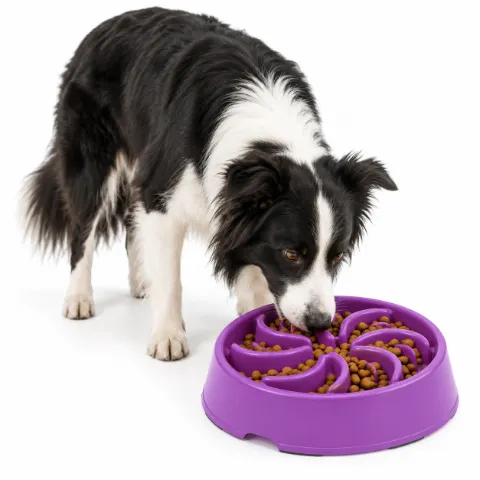
A golden's thick coat can hide extra weight, so use your hands. If the ribs are hard to feel, ask your vet about a body condition score and a plan. Our weight control dog food guide covers foods to raise with your vet, and a slow feeder bowl can slow a dog that gulps dinner.
Is grain free food safe for golden retrievers?
Most goldens don't need grain free food, and it's worth talking through with your vet first. The US FDA has investigated reports of heart disease (dilated cardiomyopathy, or DCM) in dogs on some grain free diets. Golden retrievers are listed first in its breed chart, though it says a cause hasn't been proven and notes possible reporting bias.
We searched Amazon Australia for large-breed dog foods and shortlisted foods that met all of these checks:
Well rated: a strong average rating with plenty of buyer reviews.
No red flags: no pattern of poor reviews, safety complaints or listing problems.
Available on Amazon Australia when we checked.
Right size and life stage: a large-breed or large-puppy recipe, with the life stage stated on the listing or its maker's table.
Listing facts kept honest: maker claims are attributed to the maker, and we ignored listing fields that contradicted the product's own title or text.
No medical claims: we didn't pick any food for what it says it treats, prevents or cures.
These are researched picks, not products we've tested. We compared the specifications and features on each Amazon Australia listing, checked on 27 Nov 2026, after a private check of buyer feedback, and we didn't accept payment from any brand.
Left out this time: breed formulas that didn't pass our Amazon Australia check this time, grain free foods (see above), tiny freeze-dried and raw packs that don't suit a 30 kg dog, and medium-breed formulas. Prescription and veterinary diets are never picks here: your vet may prescribe one if your dog needs it.
Where else can you buy golden retriever food?
Royal Canin also makes a Golden Retriever formula for adults and puppies, and Hill's makes large-breed recipes. Both are sold through vet clinics and pet shops, which can also help match a recipe to your dog. Optimum and Supercoat are also found in supermarkets. Our Royal Canin dog food guide covers that brand's range, and our dry dog food guide compares kibble for dogs of all sizes.
When to see a vet
Book a vet visit if your golden's ribs are hard to feel or its weight is creeping up, if itchy skin, ear infections or hot spots keep coming back, or if a puppy is lame or growing unevenly. Tiring quickly, coughing, and vomiting or diarrhoea lasting more than a day also need a check. Don't change food to treat a skin or tummy problem before talking to your vet. Our itchy skin guide, hot spots guide and diarrhoea guide have more.
Go to a vet or emergency clinic straight away for a swollen, tight belly, retching with nothing coming up, restlessness or drooling after eating, which can be bloat and is an emergency, or for fainting or collapse. If your dog may have eaten something toxic, call the Animal Poisons Helpline on 1300 869 738 (24/7). Our KONG recipes guide has the full list of foods dogs shouldn't eat.
Frequently asked questions
How much should I feed my golden retriever?
Follow the pack's feeding guide for your dog's ideal weight, then adjust with your vet. The right amount depends on the food's energy, your dog's age, activity and whether it's desexed. Weigh the food on a gram scale, count treats in the day's total and check your dog's body shape every few weeks.
Is Royal Canin Golden Retriever worth it compared with a general large-breed food?
It may suit owners who want a breed-shaped kibble, but we haven't found an independent source showing it beats a good complete large-breed food. Its calorie and kibble claims are the maker's. It's sold through vet clinics and pet shops, and your vet can help you decide. See our Royal Canin guide.
Should I feed my golden wet or dry food?
Either can work if it's complete and balanced for your dog's life stage. Dry food is easier to store and measure, which helps with weight. Wet food has more moisture and can tempt a fussy eater. If you mix them, count both in the day's total. Our wet dog food guide compares options.
How many meals a day should a golden retriever have?
RSPCA Australia says healthy adult dogs can be fed once or twice a day, and VCA says most puppies do best on several small meals. VCA's bloat page lists one large meal a day and eating fast among risk factors, so splitting meals and slowing down fast eaters is a sensible habit. Ask your vet what suits your dog.
Can changing food help a golden retriever's itchy skin?
It might, but a vet needs to work out the cause first. Itchy skin and hot spots can come from fleas, allergies, ear or skin infections and other causes, and a food change on its own can delay the right treatment. If your vet suspects a food reaction, they can plan a proper diet trial.
Do adult goldens need a large-breed adult food?
Not always, but it's a handy way to match a bag to a 25 to 34 kg dog. VCA's large-breed advice focuses on puppy growth, so for adults the bigger points are a complete and balanced food, a lean weight and your vet's advice. Our dry dog food guide covers kibble for all sizes.
Which foods are unsafe for golden retrievers?
Several common foods are toxic to dogs, including onion, garlic, chocolate, grapes and raisins. Cooked bones are also unsafe. Keep treats to a small share of the day's food. Our KONG recipes guide has the full toxic foods list, and our dog treats guide explains the 10% treat rule.
Product details from each linked Amazon Australia listing, checked on 27 Nov 2026.
This guide provides general information and isn't a substitute for veterinary advice. If you're concerned about your dog's diet or health, speak with your vet.