Quick answer: High rise syndrome in cats is the set of injuries cats can suffer after falling from a window, balcony or other height. Most falls are accidents, and even a low floor is risky. Take any cat that falls to a vet straight away, even if it seems fine, and secure every opening.
Most cat owners know an open window is a risk, but fewer know how many different ways a cat can get out of one. This guide explains why falls happen, what vets see afterwards, what to do in the first hour, and how to secure each type of window and balcony. For a wider room-by-room check, see our kitten proofing checklist.
What is high-rise syndrome in cats?
High-rise syndrome is the name vets use for the injuries cats can suffer when they fall from a height, usually a window or balcony. The Animal Medical Center in New York describes it as a set of injuries that tend to appear together, and says it can happen whenever a window or balcony door is left open.
Why do cats fall from balconies and windows?
Most falls are accidents, not jumps. The ASPCA says cats don't generally leap from dangerous heights on purpose. A bird or other animal can grab their full attention, and the ASPCA says window ledges and brick surfaces can be hard to grip. The Cat Protection Society of NSW adds that a fright can cause a slip too.
That second point matters for balconies. Cat Protection NSW notes that cats are good at balancing on railings, but a cat that has walked a rail many times can still be caught out by a sudden fright or a bird. Cat Protection NSW sums it up as "it only takes one slip".
Can a cat get hurt falling from a low floor?
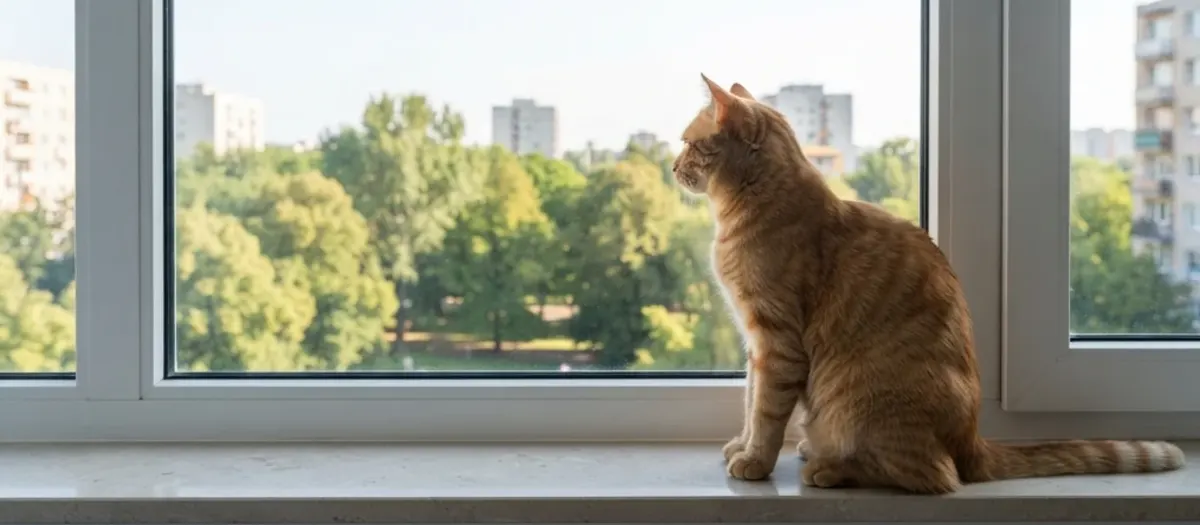
Yes. The ASPCA says cats in one- or two-storey homes are still at risk, because a shorter fall leaves less time to correct their posture, and a cat that lands with splayed feet can suffer severe head and pelvis injuries. The Cat Protection Society of NSW's balcony factsheet makes the same point about lower floors, noting that a cat may treat a second or third floor balcony as a way outside.
We don't give a "safe height", because none of the sources we read supports one. Treat every window above ground level as a fall risk, and every fall as a reason to see a vet.
What injuries do cats get from falls?
Vets see chest and lung injuries, head and facial injuries, broken limbs and abdominal injuries. The ASPCA lists shattered jaws, punctured lungs and broken limbs and pelvises, and says falls can be fatal. Some internal injuries aren't obvious at first, so a cat that walks away may still be badly hurt.
The Animal Medical Center says the sooner a cat is checked and treated, the better the chance of a full recovery. Cat Protection NSW says vets also see cats hurt after years of balcony access, so a long record of "no problems" isn't protection.
What should I do if my cat falls?
Find your cat straight away, keep things calm and quiet, and get to a vet or emergency clinic, even if your cat seems fine. The Animal Medical Center and the ASPCA both say to go right away, and the Center warns that serious injuries aren't always visible. Phone ahead so the clinic can prepare for you.
Here are the steps in order:
- Find your cat. Search nearby straight away, including under cars and in garden beds. Move quietly and speak softly, as a frightened cat may hide or bolt.
- Keep your cat still and contained. A carrier or a towel works. Handle your cat as little as you can.
- Phone the vet or an emergency clinic on the way and tell them what happened.
- Don't give any human medicine. Some human pain medicines are dangerous for cats, so only give what a vet prescribes.
- Go even if your cat seems normal. The Animal Medical Center and Cat Protection NSW say injuries, including internal ones, may not be obvious at first.
How do I cat-proof each window and opening?
Fit a strong screen, limit how far each window opens, and net balconies from floor to roof. The right fix depends on how the window opens, so use the table below. None of it makes an open window fall-proof, so keep windows closed when you're unsure and watch your cat around any gap.
Three points from the sources shape every fix:
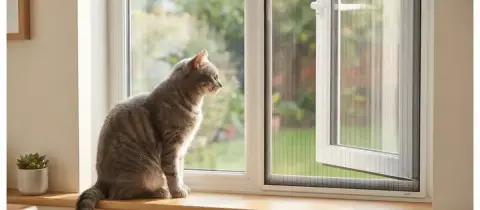
- Screens must be snug. The ASPCA says to fit snug, sturdy screens and to make sure adjustable screens are tightly wedged into their frames. Fly screens aren't built to hold a cat, and none of the listings we checked says otherwise. Our adjustable window screen guide and pet-proof fly screen guide cover your options.
- Child-safety gaps aren't enough. The ASPCA says not to rely on childproof window guards, because cats can slip through them. NSW's child-safety rule for strata buildings limits openings to under 12.5 cm (NSW Government), a gap made for a child, not a cat. We explain the difference in our window restrictor guide.
- No source gives a safe gap for cats. Set the smallest opening that gives you airflow, and keep a screen in place.
Opening by opening
| Opening | How a cat gets out | What helps | Our guide |
|---|---|---|---|
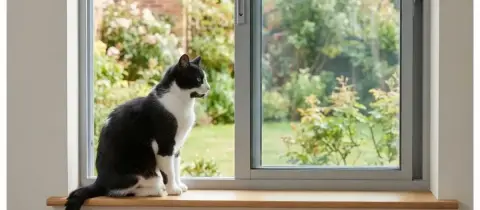
| Horizontal sliding window | The window slides open, or the cat pushes a loose sliding fly screen | A track lock to fix the gap, plus a strong screen | Restrictors, fly screens |
| Vertical sash (older homes) | Opened from below, so the gap sits at the bottom | An expandable screen wedged in, plus a restrictor | Adjustable screens, restrictors |
| Awning (winder, opens outward) | A gap at the bottom of the sash, with the screen inside | Keep the screen fitted, and add a cable restrictor | Fly screens, restrictors |
| Casement (side-hung, opens outward) | A wide gap when open | A cable restrictor plus a screen | Restrictors, fly screens |
| Louvre (common in Queensland) | Gaps between the blades, with the screen often loose or missing | Keep the screen fitted, or add a magnetic screen over the frame | Adjustable screens |
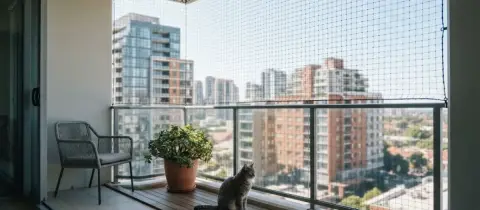
| Balcony and balcony door | An open door, or climbing the railing | Keep the door shut and net the whole balcony, floor to roof | Balcony netting |
| Doorway to a room with an open window | The cat slips into the room | A zip-up pet screen door on the doorway | Fly screens |
None of these makes an open window or balcony fall-proof. Supervise your cat, and keep windows closed when you're unsure.
Balconies need their own plan
Net the balcony from floor to roof, as Cat Protection NSW suggests. It says nets should be UV and chew resistant, and that you should sit out with your cat several times before leaving them alone, to check the space is escape-proof. If your cat can't get back inside easily, leave fresh water and a litter tray out there.
The Animal Medical Center adds three habits: keep balcony doors shut, don't feed birds from the balcony because they can draw cats to the edge, and consider a screened outdoor enclosure for play. Our catio ideas and window catio guides cover those. If you grow plants on the balcony, Cat Protection NSW recommends heavy pots, and every plant should be cat-safe. True lilies and daylilies can cause kidney failure in cats, even from pollen or vase water, so keep them out of the house (lilies guide). Our cat-safe indoor plants guide lists safer choices.
Useful guides
Product choice lives on our buying guides. These compare what's out there by opening type:
- Cat netting for balconies, for floor-to-roof balcony enclosures
- Window restrictors for cats, for limiting how far a window opens
- Pet-proof fly screen, for tougher mesh and room-door screens
- Adjustable window screens, for windows that have no screen
- Window catio, for fresh air without an open window
When to see a vet
See a vet straight away after any fall from a window, balcony or roof, even if your cat seems fine. The Animal Medical Center and the ASPCA both say to get a cat that has fallen to a vet straight away, and the Animal Medical Center and Cat Protection NSW say injuries may not be obvious at first. Phone ahead, and get to the clinic or an emergency vet.
These signs are more consistent with a serious injury and mean go now:
- trouble breathing, or breathing with the mouth open
- bleeding from the nose or mouth
- a jaw that doesn't line up
- not using a leg, or dragging a limb
- pale gums
- hiding and not eating
Never give human pain medicine, as some is dangerous for cats. Ask a vet before giving anything.
Frequently asked questions
Can cats survive a fall from a balcony?
Many do. The Animal Medical Center reports about 90% survived in a 1980s study of 132 cats it treated, and the ASPCA gives the same figure for cats that get immediate proper care. Many were seriously injured, though, and falls can be fatal. These are old or general figures, not a promise, so go straight to a vet.
Do cats always land on their feet?
No. Cat Protection NSW says the old saying is simply not true. Cats can twist in the air, but the ASPCA says a short fall leaves less time to correct posture, and a splayed landing can cause severe head and pelvis injuries. Treat every fall as an emergency.
My cat fell but seems fine. Does it still need a vet?
Yes. The Animal Medical Center says serious injuries may not be obvious, Cat Protection NSW says internal injuries can be hidden at first, and the ASPCA says to take a cat that has fallen to a vet straight away. A vet can check the chest, jaw, limbs and abdomen. Phone ahead and go the same day, even if your cat is eating and walking normally.
Why would a cat jump off a balcony?
Usually it doesn't mean to. The ASPCA says cats don't deliberately jump from dangerous heights. Falls happen when a cat locks on to a bird or other animal, or loses its grip on a ledge, and Cat Protection NSW adds that a fright can cause a slip. Net the balcony so a lunge can't become a fall.
Is it safe to let my cat on an unnetted balcony if I'm out there too?
Not reliably. Cat Protection NSW says it only takes one slip, and a fright or a bird can cause it in a second. Netting the balcony floor to roof is the safer option. A cat harness is only a short, supervised choice, and it doesn't replace netting.
Are ground-floor windows a risk?
Falls are less of a worry, but escape is. A cat that slips out of a ground-floor window can roam, meet traffic or other animals, or get lost. Check your local rules on keeping cats in, which we cover in our cat curfew rules guide.
Can my cat fall through a flyscreen?
It can happen. Fly screens aren't built to hold a cat's weight, and they can tear or pop out of the frame when a cat leans on them. Check each screen is snug and undamaged. Our pet-proof fly screen guide has the full answer.
Related guides
- Cat netting for balconies
- Window restrictors for cats
- Pet-proof fly screen
- Adjustable window screens
- Cat-safe indoor plants
- Window catio picks
- Catio ideas: types, sizes and how to set one up
- Kitten proofing your home
- Cat curfew rules in Australia
- Best cat harness and leash
Sources
- The Animal Medical Center, High Rise Syndrome in Cats, updated 17 June 2024, page read 23 November 2026
- ASPCA, High-Rise Syndrome: Lifesaving Tips for Cat Parents, 6 July 2023, page read 23 November 2026
- Cat Protection Society of NSW, Factsheet: Balcony Safety, page read 23 November 2026
- NSW Government, Window, deck, and balcony safety in a rental property, page read 23 November 2026
This guide provides general information and isn't a substitute for veterinary advice. If you're concerned about your cat after a fall, speak with your vet.