Dog hair dryers: force dryers, brush dryers and when a towel is enough
By Anish PuriUpdated 21 Nov 202615 min readResearched, not tested by us
Research guide. WhiskerFinds may earn a commission from links, at no extra cost to you.
Quick answer: For a dog hair dryer, our top pick is the 2800 W stepless pet grooming dryer, whose listing gives a 30 to 55°C range. Can you use a human hair dryer? Vets and trainers mostly advise against it, because dog dryers move air rather than heat. Many short coats only need a good towel.
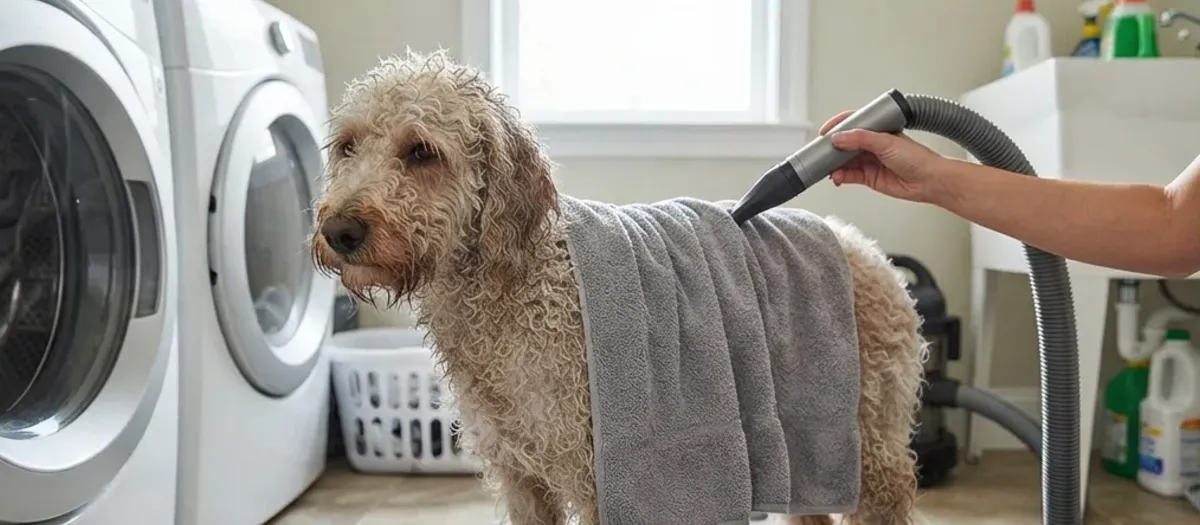
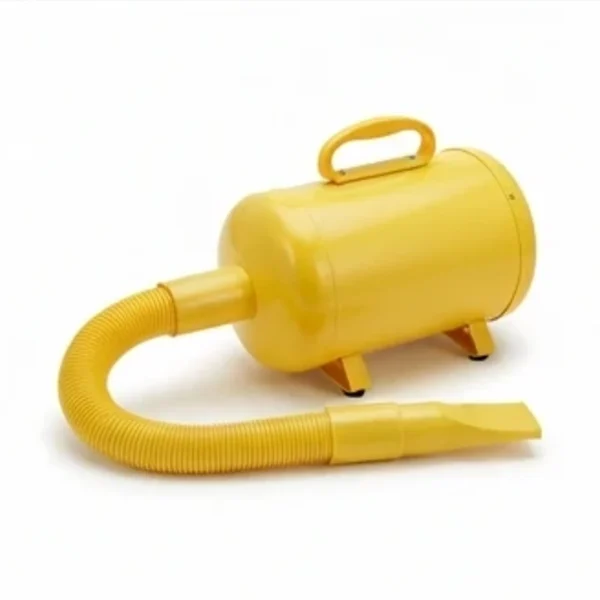
Illustration, not the actual product
Our top pick2800 W stepless speed pet grooming dryer, yellow
A dryer is a tool for thick, long or double coats that stay damp for hours, and it can do harm if it's used badly. This guide compares five dryers on Amazon Australia by power, heat range and the noise each listing claims, then shows when a towel is enough and how to dry your dog without burns or stress. Towels and robes have their own dog towel guide, and drying between the toes is part of our guide to trimming your dog's paw fur.
The range is thin. Most listings name no brand or a small one, and only two give both an airflow and a temperature range. We've said what's missing in each pick.
Quick picks
Our top pickBest overall
2800 W stepless speed pet grooming dryer, yellow
Lowest stated top heat, 55°C, and a stepless dial so you can start gently
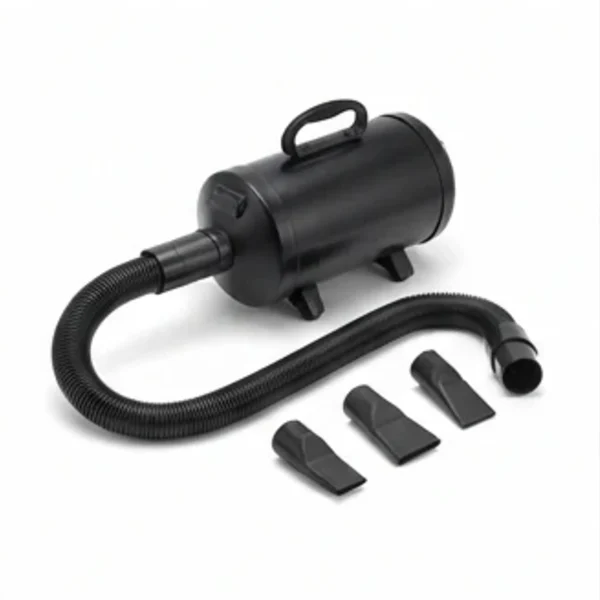
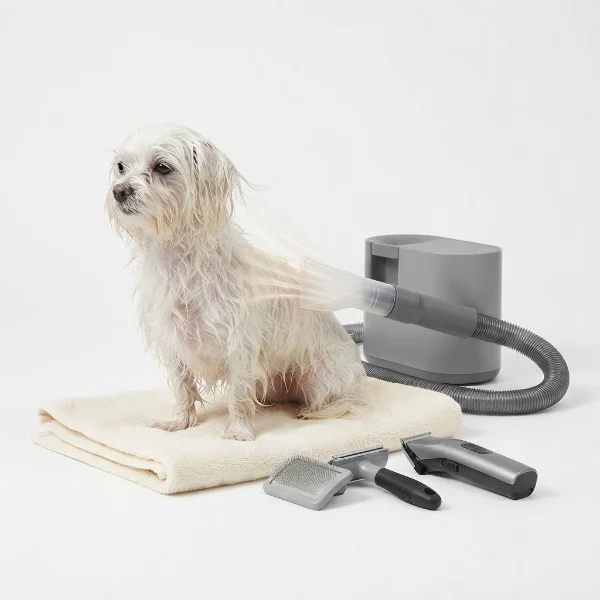
Pictures are illustrations, not the actual products.
Can you use a human hair dryer on a dog?
Mostly, vets and trainers say no. The AKC advises against a human dryer, because a dog dryer dries by airflow and heat can burn skin. Vetstreet says a human dryer is workable only on its lowest setting, kept moving, and our advice is to use a dog dryer instead.
If you ever have to, use the lowest heat, hold it at a distance, keep it moving and check the air on your own hand. Vetstreet's Dr Marty Becker points out that your dog can't tell you it's getting too hot. A human dryer also pushes far less air than a dog blower, so it takes longer on a thick coat, which means more time near heat.
Dog hair dryers compared
Details from each Amazon Australia listing, checked on 20 Nov 2026. Every noise figure is the listing's own claim, not a measurement. "Not stated" means the listing doesn't say.
Swipe sideways to see every column
Dryer
Type
Power
Heat range
Airflow
Hose
Noise claim
Plug and voltage
2800 W stepless (1)
Force dryer
2800 W
30 to 55°C, stepless
25 to 65 m/s
2.5 m
Under 78 dB
Not stated
2800 W blower (2)
Force dryer
2800 W
Dial, range not stated
Not stated
Flexible, length not stated
50 to 70 dB
Not stated
oneisall 8 in 1 (3)
Combined vacuum and dryer
Not stated
7 settings, 35 to 65°C
3 speeds, no figure
Not stated
Under 60 dB
Not stated, corded
Trigrand (4)
Force dryer
3000 W
35 to 70°C
15 to 65 m/s
2.5 m
65 dB or less
Not stated
PARSMARDO (5)
Brush dryer
Not stated
Low, medium, high, no °C
3 airflow settings
None, handheld
Under 80 dB
Not stated
The PARSMARDO's title says two heat settings while its bullet points say three, so check the listing before you order.
Our picks in detail
1. 2800 W stepless speed pet grooming dryer: best overall
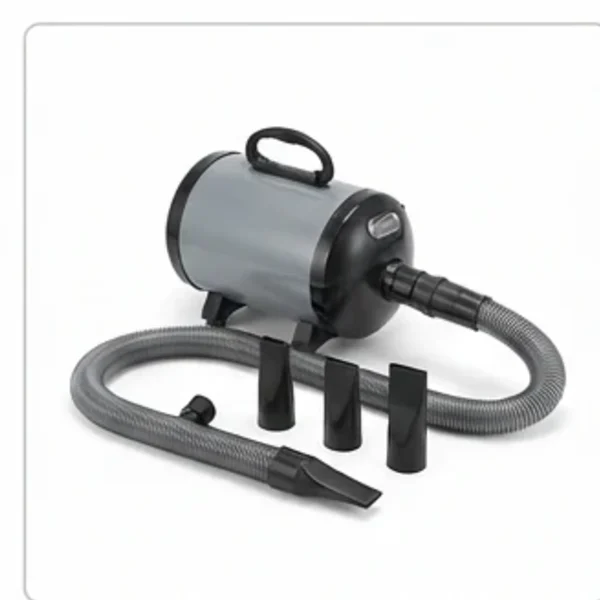
A 2800 W blower with a dial that adjusts airflow and temperature smoothly, so you can start very gently. The listing says 30 to 55°C, which is the lowest top temperature of the dryers that state one, and 25 to 65 m/s airflow. It says a 2.5 m hose, four nozzles, three noise-reducing covers with a noise claim of under 78 dB, and a 12-month warranty. The package weighs 4.6 kg. The listing's details give no brand.
Pros: lowest maximum heat of the range; stepless dial; long hose; warranty
Cons: no brand in the listing's details; heavier than pick 2; plug and voltage not stated, so check before you order
Best for: a nervous dog, or a thick coat where you want gentle heat
Skip it if: you want the highest wattage (pick 4) or a handheld machine
2. 2800 W professional dog blower dryer with 4 nozzles: best for adjustable speed in a lighter force dryer
A force dryer with dial control of speed and heat, four nozzles and a flexible hose. The listing says a washable filter, an insulated handle and a noise claim it words as "50-70 dB quieter", which we read as 50 to 70 dB. It weighs 3.2 kg, lighter than pick 1.
Pros: lighter at 3.2 kg; adjustable speed and heat; washable filter
Cons: the listing gives no temperature range or airflow figure, so start on the lowest heat; no brand named; plug and voltage not stated
Best for: a second-choice force dryer when you want a lighter machine
Skip it if: you want a stated temperature range (pick 1)
3. oneisall 8 in 1 grooming vacuum and dryer: best all-in-one
One unit that dries, vacuums and clips. The listing says seven heat settings from 35 to 65°C (95 to 149°F), three flow speeds and three nozzles (round, narrow and diffuser), plus a pin brush and shed brush for vacuuming, and clippers that work alone or on the hose. It claims under 60 dB, is corded and weighs 4.83 kg.
It's a combined grooming unit, not a force dryer. The listing doesn't give an airflow figure, so expect it to be slower on a thick double coat than the force dryers. The top setting is hot, so stay low. The vacuum side is covered in our grooming vacuum guide.
Pros: dryer, vacuum and clippers in one; seven heat steps; three nozzles
Cons: no airflow figure; slower on thick coats; top setting is hot; plug and voltage not stated
Best for: a home groomer who wants one machine, with a medium coat
Skip it if: your dog has a dense double coat that needs a high-velocity blaster
4. Trigrand 3000 W dog hair dryer blaster: best for most power
The highest wattage here, though its listed top airspeed, 65 m/s, is the same as pick 1's. The listing says 3000 W, a wind speed of 15 to 65 m/s, 35 to 70°C, a maximum noise of 65 dB or less, a 2.5 m hose with a clip fitting and four nozzles. The package weighs 4.22 kg. The listing says adults 18 and over only.
The listing doesn't state the plug type or voltage, and it has the highest top temperature in the range, so stay well below it. Check the listing shows an Australian plug before you order, and never run it through a travel adaptor.
Pros: most power; wide airflow range; lighter than pick 1
Cons: highest top heat, 70°C; plug and voltage not stated, and the model number ends in "de", so check it isn't a European-plug version; adults only
Best for: a big double coat, used on a low heat
Skip it if: you want a low maximum heat (pick 1)
5. PARSMARDO 2 in 1 pet hair dryer brush: best for small dogs with short coats
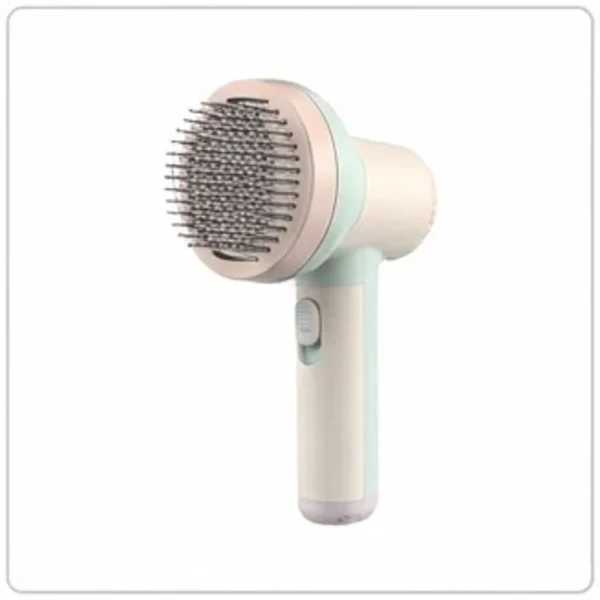
A handheld dryer with a slicker-style brush head. The listing says low, medium and high heat with no temperatures given, three airflow settings, auto shut-off when it gets too hot, a noise claim of under 80 dB, a removable filter, a replaceable brush head and a weight of 572 g. It says it suits small and medium dogs and cats with short straight hair.
It isn't built for big, thick or long coats. Use gentle strokes and keep the pins off the skin.
Pros: light and handheld; auto shut-off per the listing; replaceable brush head
Cons: no temperature figures; not for thick or long coats; title and bullets disagree on heat settings
Best for: a small dog with a short, straight coat
Skip it if: your dog has a thick, curly or long coat
Add-on: a dryer stand
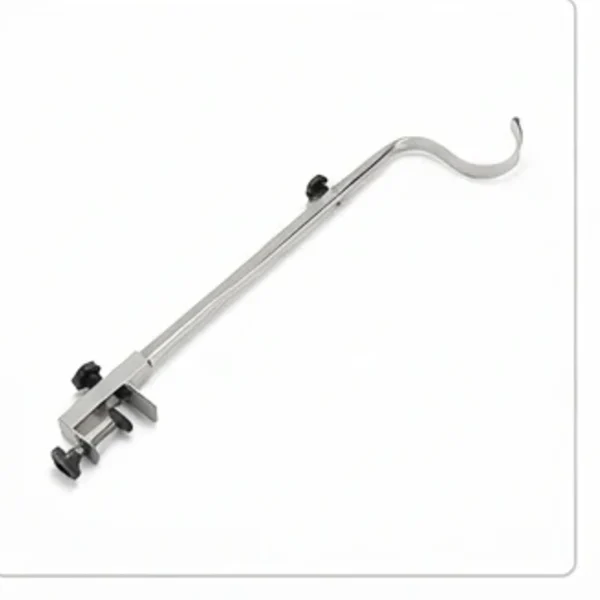
Stainless steel grooming dryer stand with clamp
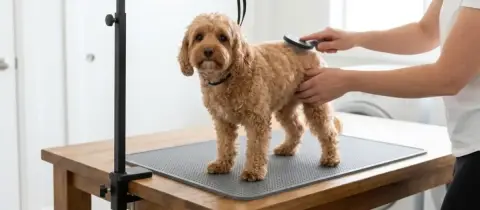
A gooseneck arm that clamps to a table and holds a handheld dryer in any position, so you have both hands free. The listing says it clamps to tables 0.6 to 3 cm thick, weighs 540 g and is a stand only. The listing says it is for handheld dryers, so use it only with one, and only while you stay with your dog. See our grooming table guide for a safe table setup.
Force dryer, brush dryer or towel: which does your dog need?
A towel is enough for many short single coats. A force dryer suits thick, long, curly and double coats, and a brush dryer suits a small dog with a short, straight coat. This table is our reading of the AKC and Vetstreet points and the listings, not a measured result.
Swipe sideways to see every column
Coat and dog
Towel and air dry
Brush dryer
Force dryer
Short single coat (beagle, staffy)
Usually enough on a warm day
Optional
Not needed
Small fluffy dog (Maltese, Pomeranian)
Press with a towel first
Not ideal; pick 5's listing says short straight hair
A low, gentle setting
Long silky coat
Not alone
Slow and fiddly
Yes, brush as you dry
Double coat (Husky, Golden Retriever)
Starts the job
No, the listing says short hair
Yes, it reaches the undercoat
Curly or doodle coat
No
No
Yes, then comb to the skin
Flat-faced or older dog
Yes, in shade
Optional
Only on cool, with breaks
The AKC says to press a towel into the coat rather than rub, because rubbing can tangle the fur, and to towel thick or double coats first and finish with a dryer. Vetstreet adds that forced air reaches the undercoat of double coats such as Collies and Samoyeds and helps stop them matting.
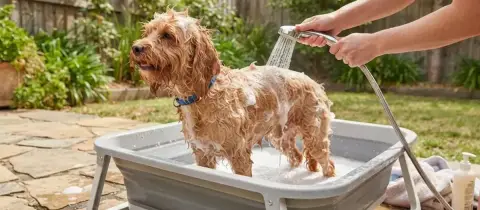
A dryer earns its place when the coat stays wet to the skin for hours. Damp thick fur is harder to dry and can tangle. Our guide to washing your dog covers how often a bath is needed by coat. For the bath itself, see our dog bath tub guide.
How hot should a dog dryer be?
As low as works, and often cool. The AKC says dog dryers work by airflow, not heat. Vetstreet's advice is the lowest heat available, with the air kept moving so heat can't build on one spot. PetMD's groomers and trainers start on a low setting with no heat, or on cool.
The hand test is the simplest check. Run your hand through the coat in the airflow, and if it feels too hot for you, it's too hot for your dog (PetMD, quoting its groomers). The ranges in the listings give you a ceiling to compare, not a target.
Dryer
Listed top heat
2800 W stepless (1)
55°C
oneisall 8 in 1 (3)
65°C
Trigrand (4)
70°C
2800 W blower (2), PARSMARDO (5)
Not stated
If you don't need a hot setting, favour the dryer with the lowest top heat and stay on its low end.
How to use a dog hair dryer safely
Start low and cool, keep the nozzle moving and away from the face, and stay with your dog the whole time. Use this checklist each time:
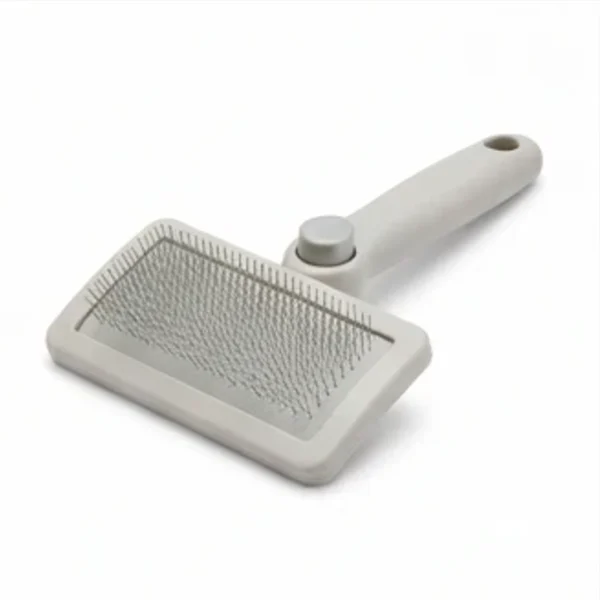
Brush out knots first. PetMD's groomers say to comb and brush before the bath, because mats make drying harder. Our dematting comb guide and slicker brush guide cover the tools. Tight mats go to a groomer or vet.
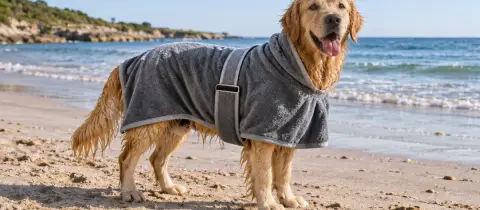
Towel first. Press, don't rub (AKC).
Lowest heat or cool air first, pointed downward, in a small room such as the bathroom (PetMD).
Keep the nozzle off the face, eyes and ears. The AKC says to keep the dryer away from the face and ears. PetMD's groomers cover the eyes and ears, and say never to push cotton into the ear canal.
Keep it moving and keep checking the coat with your hand, down to the skin.
Stay with your dog. Never leave a running dryer unattended.
No crate or cage drying.
No crate or cage drying: the heatstroke risk
Some dogs find it stressful to be shut in with a dryer (AKC). In our view a closed crate also gives warm air nowhere to go.
Let your dog meet it switched off, then on at a distance on the lowest setting, with treats. Move closer only while your dog stays relaxed. If your dog freezes, tries to escape or bites, stop and ask your vet for advice (Purdue University Canine Welfare Science).
Put the dryer on the floor, off, and give a treat when your dog sniffs it.
Switch it on in another room, then in the same room, pointed away.
Feed treats one at a time while it runs, as PetMD's trainers suggest, and let your dog move away.
Aim at a leg first, never the head, then work up the body.
Keep sessions short and finish while your dog is still calm.
For dogs that struggle with loud noise in general, our dog ear muffs guide covers hearing protection. Our grooming vacuum guide uses the same introduction for kits with a motor.
What should Australian buyers check on the plug and voltage?
For a 2800 W or 3000 W machine, check the listing shows an Australian plug before you order. None of the five listings states a plug or voltage in its text, so look at the product images and the details on the page, and ask the seller through Amazon if it's unclear.
Never run a dryer of this power through a travel adaptor. We left out one blaster because its listing says it ships with a UK plug.
Where else can you buy a dog dryer?
Pet shops and grooming supply shops sell force dryers, and grooming salons and vet clinics can tell you which type suits your dog's coat. You can also ask a groomer to dry your dog after a wash if the coat is a lot of work. Wherever you buy, check the plug and the heat range.
Choose by situation
Swipe sideways to see every column
Your situation
What to look for
Our pick
Nervous dog
Stepless speed, lowest top heat
2800 W stepless (1)
Big double coat
Strong airflow, brush as you dry
Trigrand (4), or the stepless (1)
Small dog with a short coat
A light brush dryer, low heat
PARSMARDO (5)
One machine for everything
Dryer, vacuum and clippers together
oneisall 8 in 1 (3)
Humid summer
Low heat, short sessions, a cool room
2800 W stepless (1), kept on cool
Lighter force dryer
Dial control, washable filter
2800 W blower (2)
How we chose
We searched Amazon Australia for dog dryers, blowers and brush dryers, then shortlisted those that met all of these checks:
Well rated: a strong average rating with plenty of buyer reviews.
No red flags: no pattern of poor reviews, safety complaints or listing problems.
Available on Amazon Australia when we checked.
Dog-specific dryer: made for pets, not a human hair dryer.
Power and heat range stated on the listing where it was given, with the lowest top heat favoured for the top pick.
Plug and voltage checked where the listing gave them, and any listing that ships with a UK plug left out.
Where a listing is unbranded or missing a detail, we say so in the cons. These are researched picks, not products we've personally tested. We compared the specifications and features on each Amazon Australia listing, checked on 20 Nov 2026, and we didn't accept payment from any brand.
Left out this time: a 220 V blaster whose listing ships with a UK plug, a pink near-copy of pick 2, a dryer stand with a thin listing, and vacuum kits with no dryer, which are on our grooming vacuum guide.
When to see a vet
Go to a vet or emergency clinic straight away if your dog shows heatstroke signs after drying or on a warm day: constant heavy panting that gets worse, drooling, restlessness, very red or pale gums, vomiting, wobbling or collapse. RSPCA Australia says to contact your vet immediately. Our summer cooling guide has the full list of signs and what to do on the way.
Book a vet visit if the skin looks red, sore or burnt after drying, if your dog shakes its head or scratches its ears afterwards, or if damp patches keep forming or smell. These can have many causes, and a vet can work out which.
Frequently asked questions
Can a dog dryer hurt my dog's ears?
It can, if the airflow is aimed at them. The AKC says to keep the dryer away from the face and ears. PetMD's groomers say to cover or shade the ears and eyes and not to push cotton into the ear canal. Dry around the head with a towel instead. Our ear cleaner guide covers ear care.
Do I need to dry a double-coated dog all the way to the skin?
Aim for a coat that's dry through, not just on top. The AKC says thick coats are hard to dry with a towel alone, and Vetstreet says forced air reaches the undercoat, which mats easily. Check with your hand down to the skin, and ask a groomer if you're unsure.
Is it okay to let my dog air dry?
For a short single coat on a mild day, yes, in a shaded, draught-free spot. That's our suggestion, not a source's rule. Don't leave a damp dog in the cold or put one out in strong sun on a hot day. Thick coats can stay damp for hours, which is when a dryer helps. See our dog towel guide.
Can I use a dog dryer on a puppy?
None of our sources gives a puppy age or setting. Ask your vet or groomer first. Our suggestion is a towel and a warm room for a young puppy, and a first introduction with the dryer switched off and treats before it's ever turned on.
What's the difference between a force dryer and a stand dryer?
In our reading, a force dryer is a motor with a hose and nozzles that you hold and aim at the coat. A stand dryer sits on a stand and blows by itself. A stand still needs you with your dog all the time, and the clamp arm in our add-on is for handheld dryers only.
Why is my dog scared of the dryer?
Dryers are loud, and the air feels strange on a wet coat. Vetstreet suggests showing your dog the dryer switched off, then on at a distance, with treats, and PetMD's trainers feed treats one at a time while it runs. If your dog freezes, tries to escape or bites, stop and ask your vet or a trainer for help.
How far should I hold the dryer from my dog?
Sources differ, so treat any distance as a starting point. Vetstreet suggests keeping the nozzle a few inches from the fur with the air always moving, while PetMD's trainers start with the dryer on low with no heat, pointed down, and let the dog move away from it. Test the air on your hand, and back off if your dog flinches.
Is it safe to dry my dog in a crate?
No. The AKC advises against crate dryers, because some dogs find being shut in with a dryer stressful. In our view heat can also build up in a closed space. Never leave a running dryer unattended, and never leave your dog shut in a crate or cage with one blowing.
Product details from each linked Amazon Australia listing, checked on 20 Nov 2026.
This guide provides general information and isn't a substitute for veterinary advice. If you're concerned about your dog's coat, skin or heat tolerance, speak with your vet.