Quick answer: A dog drinking a lot of water is one drinking more than 100 ml per kg of weight a day, while most dogs drink about 20 to 70 ml per kg (roughly 400 ml to 1.4 litres for a 20 kg dog). Heat, exercise and dry food raise it. A sudden, lasting increase, especially with more weeing, needs a vet.
Every dog drinks a bit differently, so "a lot" is hard to judge by eye. This guide gives you a litres-by-weight table, a simple way to measure at home, the everyday reasons for extra thirst, and the patterns that are worth a vet visit. If you're sorting out bowls and fountains, we link our product guides near the end.
How much water should a dog drink a day?
Veterinary textbooks give normal intake for dogs as about 20 to 70 ml per kg of body weight a day, and drinking more than 100 ml per kg a day counts as definitely increased (Davies Veterinary Specialists). Here is what that means in litres for common sizes.
| Dog's weight | Usual daily range | Drinking a lot (over 100 ml per kg) |
|---|---|---|
| 5 kg | 100 to 350 ml | More than 500 ml |
| 10 kg | 200 to 700 ml | More than 1 litre |
| 20 kg | 400 ml to 1.4 litres | More than 2 litres |
| 30 kg | 600 ml to 2.1 litres | More than 3 litres |
| 40 kg | 800 ml to 2.8 litres | More than 4 litres |
These are guides, not targets. The same fact sheet notes that food moisture, activity and panting all change how much a dog drinks, and that some dogs drink clearly more than usual without passing 100 ml per kg. Dogs on wet food drink less from the bowl, because the food already holds water. So the most useful number is often your own dog's normal, compared with today.
Your dog's weight matters too, so weigh them if you're not sure. Most clinics will weigh your dog at the front desk if you ask.
How do you measure how much water your dog drinks?
Fill a measuring jug, pour a known amount into the bowl, and measure what's left after 24 hours. Subtract the leftover from what you put in. Repeat for two or three days, because one day can mislead. Walkerville Vet describes the same idea: mark the level, then top up to the mark with a jug (Walkerville Vet).
A few things make the numbers more honest:
- Measure the starting amount with a jug rather than guessing, and use the same bowl each day.
- Count every water source. Pools, puddles, the garden tap, a bathroom floor and other pets' bowls all add up. Give other pets their own water in another room for the test.
- Allow for spills and evaporation. Outside bowls lose water to the sun, and messy drinkers splash.
- Write down the weather, exercise and food for each day. A hot day with a long walk will look different from a quiet day.
- Take your notes to the vet. A clear record helps them decide what to check first.
Measuring doesn't mean limiting. Keep fresh water out the whole time, and don't hold anything back to make the numbers easier.
What are the everyday reasons a dog drinks a lot of water?
Many dogs drink more for ordinary reasons: hot weather, extra exercise, a switch from wet to dry food, or suckling puppies. Salty food or treats can add to it, and some medicines can too. Looking at the context, and at whether it settles, tells you more than a single day does.
Common everyday patterns include:
- Hot weather and exercise. Dogs lose water by panting, so thirst goes up on warm days and after play. Our guide to keeping your dog cool in summer covers heat and heatstroke.
- Food changes. Walkerville Vet lists a switch from wet to dry food among the benign causes (Walkerville Vet). PetMD, in an article by a veterinarian, says canned food holds more water and that high-sodium meals and treats can make dogs thirstier (PetMD).
- Medicines. Corticosteroids such as prednisone can increase thirst and urination, and PetMD says these effects often settle in the first week or two (PetMD). Diuretics are on Walkerville Vet's list too. Don't stop a medicine yourself. Ask your vet.
- Nursing mums. Walkerville Vet lists suckling puppies among the appropriate reasons for drinking more (Walkerville Vet).
If the extra drinking carries on once the weather, food or medicine explanation is gone, it's worth a check.
When can extra thirst mean a health problem?
Extra thirst that lasts, or comes on suddenly, can be linked to conditions such as kidney disease, diabetes, Cushing's disease, liver disease or a womb infection called pyometra. It isn't a diagnosis on its own, and only a vet can tell what's behind it. The sensible step is a check, not guesswork.
Davies Veterinary Specialists lists kidney damage or infection, liver failure, diabetes mellitus, pyometra and overactive adrenal glands among the causes of increased drinking, and says it is an important sign that deserves investigation (Davies Veterinary Specialists). Walkerville Vet asks owners to bring in any dog who starts drinking more, even if the dog doesn't seem unwell, because early detection is vital for some diseases (Walkerville Vet).
Patterns that are more consistent with a health problem:
- More drinking and more weeing, or toilet accidents in a house-trained dog.
- A change that lasts for more than a few days without a clear cause.
- Other changes alongside, such as weight loss, tiredness, vomiting, diarrhoea or not eating.
- An undesexed female who is unwell and drinking more. Walkerville Vet notes pyometra affects undesexed females, and Davies lists it as a cause of increased drinking. Pyometra can become serious quickly, so phone your vet that day.
Vets usually start with blood and urine tests (Davies Veterinary Specialists). Please don't cut back your dog's water to try to fix it. PetMD says never to deprive a dog of water unless your vet specifically directs it, because restriction can lead to dehydration and other problems (PetMD).
Why is my dog drinking so much water at night?
Night-time drinking can have the same everyday causes as daytime drinking, such as salty treats, a warm room or too little water during the day. It can also be one of the patterns above. PetMD lists dehydration, cognitive changes in older dogs, boredom or stress, and medical causes (PetMD).
Think about the day before. Was it hot? Did your dog have salty treats or a longer walk? Was water out all day, including while they were crated or shut in a room? If the night drinking comes with more weeing, accidents or wake-ups, include that in your notes for the vet. A dog who leaks urine overnight may need dog nappies while your vet finds the cause.
Why is my old dog drinking a lot of water?
Older dogs can drink more for everyday reasons, but they are also more likely to have a health condition behind it. PetMD notes that senior dogs may drink more or less than usual because of cognitive dysfunction or other medical issues (PetMD).
That's why older dogs, and dogs with a known health condition, should be checked sooner rather than later. A change in drinking can also come with more toilet accidents, weight loss or a smaller appetite, so mention anything you've noticed. Don't put it down to age alone. Walkerville Vet says early detection is vital for some diseases (Walkerville Vet).
Is my puppy drinking too much water?
Puppies often drink more for their size, because they play hard and their kidneys don't concentrate urine as well as an adult's. PetMD says higher activity, and any vomiting or diarrhoea, add to the water they lose (PetMD). Most of that is normal puppy life, not a problem.
A puppy who drinks, plays and wees regularly is usually fine. It's worth a call to your vet if the drinking seems excessive, or comes with vomiting, diarrhoea, tiredness or a poor appetite. Don't take water away to help with house training. Instead, offer water at regular times, take your puppy out after drinking, and ask your vet for a plan if toilet accidents are a worry.
How can you help your dog drink enough?
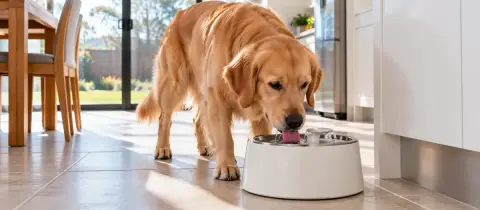
Refresh your dog's water every day and wash the bowl, because the US FDA advises washing pet food bowls and scoops with soap and hot water after each use (US FDA, content current as of 23 May 2024). In hot weather, put out more than one bowl in the shade, in case one gets knocked over.
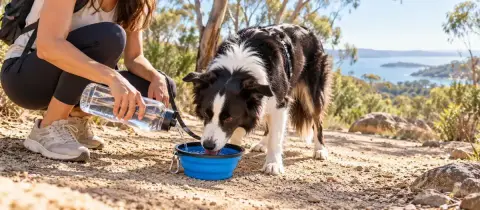
The RSPCA suggests ice cubes to keep the water cold (RSPCA Australia). Take water and a bowl on walks and car trips too. Some tips on gear:
- A fountain can encourage some dogs to drink. Clean any fountain thoroughly at least once a week, and change filters as the maker suggests. Keep a normal water bowl out as well. See our dog water fountain guide.
- Bowls and travel bowls. A heavy bowl is harder to tip, and a collapsible one is handy on walks. See our dog water bowl guide.
- Gravity dispensers. The water sits still, so empty, wash and refill them often, not only when the bottle runs out.
Do feeders and food containers change how much a dog drinks?
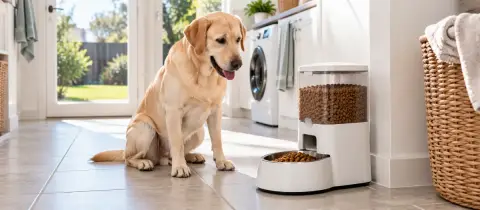
Not directly, but a steady routine makes a change in drinking easier to spot. Automatic feeders help with a late lunch or a long workday, not with days away: a dog still needs fresh water, toilet breaks, company and someone to notice if they're unwell. Gravity feeders top up as the dog eats, so they suit only dogs who don't overeat, while timed feeders make it easier to stick to the amount on the food's feeding guide, which RSPCA Australia points to along with your vet (RSPCA Australia, 2017). See our automatic dog feeder guide.
To keep dry food fresh, the US FDA advises storing it in its original bag, folded down, in a cool, dry place below about 27°C, so the best use of a container is to put the whole bag inside it (US FDA, content current as of 23 May 2024). See our dog food container guide, and for time away see leaving your dog when you go on holiday and keeping your dog busy while you're at work.
When to see a vet
See your vet if your dog suddenly starts drinking much more or much less than usual, is drinking more and weeing more or having accidents inside, or the change comes with vomiting, diarrhoea, not eating, weight loss or lethargy. Older dogs and dogs with health conditions should be checked sooner.
Go to a vet straight away if your dog seems very unwell or collapses, or shows heatstroke signs on a hot day. Increased thirst can be a sign of conditions such as kidney disease, diabetes or hormone problems, so don't restrict water to fix it (Walkerville Vet; Davies Veterinary Specialists).
Frequently asked questions
Why is my dog drinking so much water all of a sudden?
A sudden change can have an everyday cause, such as hot weather, more exercise, salty food or a new medicine. If it carries on for more than a few days without a clear reason, or comes with other changes, see your vet. Measuring for a few days gives them useful facts.
Why is my dog drinking a lot of water and peeing a lot?
Drinking more and weeing more together can be more consistent with a health condition, such as kidney disease, diabetes or hormone problems. It can also follow a medicine like prednisone. Either way, see your vet, and keep water available while you wait for the appointment.
Should I limit my dog's water?
No, not unless your vet tells you to. PetMD advises never to deprive a dog of water without veterinary direction, because it can lead to dehydration (PetMD). If the drinking worries you, measure it and book a check instead. Keep the bowl full while you wait for the appointment.
How much water should a dog drink in 24 hours?
Most dogs drink about 20 to 70 ml per kg of body weight in 24 hours, and more than 100 ml per kg is considered definitely increased. A 20 kg dog usually drinks 400 ml to 1.4 litres. See the table above for other sizes.
Do dogs drink more in summer?
Yes, often. Dogs lose heat by panting, so they usually drink more on hot days and after exercise. Put out more than one bowl in the shade and add ice cubes. If your dog seems unwell in the heat, see our summer cooling guide and go to a vet.
Is it normal for an old dog to drink more water?
It can be an everyday cause, but older dogs are more likely to have a health condition behind it, so it's worth a check. Mention any weight loss, accidents or appetite changes. Read more in the older dog section above.
Can dry food make a dog drink more?
It can. Dogs on wet food drink less from the bowl because the food already contains water, so a switch to dry food can mean more bowl drinking. Salty treats can add to it. Compare your measuring notes from before and after a food change.
Related guides
- How often to wash dog bowls
- Automatic dog water bowls
- Dog Rocks and lawn burn
- Best dog water fountains
- Best automatic dog feeders
- Best dog food containers
- Best dog water bowls
- How to keep your dog cool in summer
- Keeping your dog busy while you're at work
- Dog care guides
Sources
- Davies Veterinary Specialists: Polydipsia in dogs and cats (increased drinking) fact sheet
- Walkerville Vet: Help! My dog is drinking a lot (posted 17 September 2017, updated 6 June 2021)
- PetMD: Why is my dog drinking a lot of water? (updated 28 July 2023)
- RSPCA Australia: 4 ways to keep your dog cool this summer (7 December 2022)
- RSPCA Australia: 4 ways to avoid obesity in your dog (11 October 2017)
- US FDA: Tips for safe handling of pet food and treats (content current as of 23 May 2024)
This guide provides general information and isn't a substitute for veterinary advice. If you're concerned about your dog's drinking or health, speak with your vet.