Quick answer: Yes, dogs can eat apples. Plain, fresh slices are a safe crunchy treat for most dogs. Take out the core, stem and seeds first, because the core can choke a dog or block the gut and the seeds contain a little cyanide. Keep portions small, and count apple as a treat.
Apples are easy to find, easy to slice and most dogs love the crunch. This guide covers which parts are safe, how many slices suit your dog's size, and which apple products to skip. It sits alongside our other fruit guides, including what fruits dogs can eat and whether dogs can eat mango.
Can dogs eat apples?
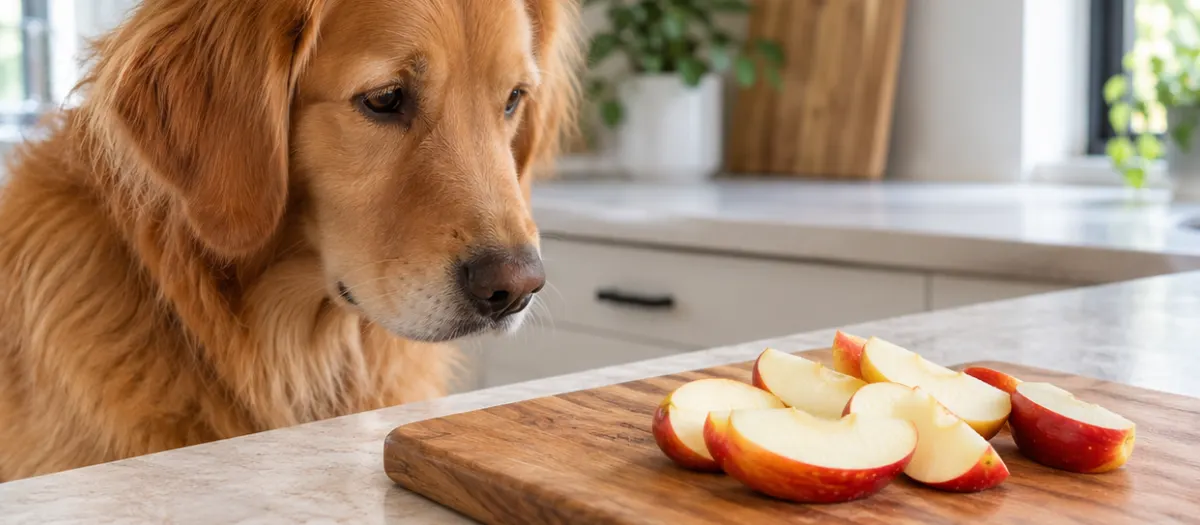
Yes. Fresh apple is a safe treat for most dogs in small amounts. Wash it, cut it into slices or small cubes, and remove the core, stem and seeds. Serve it plain, with nothing added. Treat it as an extra, not a meal.
PetMD says dogs can safely eat apples once the core, seeds and stem are removed, and recommends starting with a small amount and watching for digestive upset (PetMD, updated 25 September 2025). The American Kennel Club (AKC) calls apples a safe, nutritious treat in moderation, with fibre and vitamins A and C (AKC, updated 2 June 2026).
Are apple seeds poisonous to dogs?
Apple seeds contain a small amount of cyanide, so remove them. A single seed or two is unlikely to cause trouble, because a dog would need to eat a large number to be poisoned. Taking them out is simply the safest habit, and it costs you nothing.
PetMD says the seeds hold trace cyanide and that removing them is the safest choice (PetMD, updated 25 September 2025). The AKC says the same: a little cyanide, harmful in large doses (AKC, updated 2 June 2026). If your dog crunches through a whole core, don't panic. Note roughly how much was eaten and call your vet or the Animal Poisons Helpline (1300 869 738, 24/7) for advice.
Can dogs eat apple cores?
No. The core is tough, and so is the stem. Both can choke a dog, and swallowed pieces may contribute to a blockage in the gut. Cut the core out and bin it somewhere your dog can't reach, such as a lidded bin (our Christmas food guide covers bins).
PetMD says cores are a choking hazard and can contribute to intestinal blockage (PetMD, updated 25 September 2025). The AKC advises watching for digestive trouble or a blockage if a dog eats the core or seeds (AKC, updated 2 June 2026). Small dogs are at greater risk of getting a whole core stuck, so be extra careful if you have one.
Can dogs eat apple skin?
Yes, for most dogs. Apple skin is safe and holds a lot of the fibre. Dogs with sensitive tummies may do better with peeled apple, so if your dog gets loose poos with skin on, peel it. Bits of skin can also catch between teeth.
PetMD says the skin is safe for most dogs and adds fibre, and that dogs with sensitive stomachs may tolerate peeled apple better (PetMD, updated 25 September 2025). The AKC notes the peel holds much of the fibre, while peeling makes apples easier to digest (AKC, updated 2 June 2026). Wash the apple first.
How much apple can a dog have?
A few slices is plenty. Treats, including fruit, should stay at about 10% of your dog's daily calories, and apple has natural sugar. Use the table below as a guide, give less to overweight dogs, and ask your vet if your dog has a health condition.
PetMD gives the serving sizes below, using pieces about 2.5 cm wide and 0.6 cm thick, and says treats should be no more than 10% of daily calories (PetMD, updated 25 September 2025). The AKC says a slice or two is enough to satisfy a dog, and that a whole apple is likely too much because of the sugar (AKC, updated 2 June 2026).
| Dog size | Weight | Pieces a day (PetMD) |
|---|---|---|
| Extra small | 1 to 4.5 kg (2 to 10 lb) | 1 to 2 |
| Small | 5 to 9 kg (11 to 20 lb) | 2 to 3 |
| Medium | 10 to 23 kg (21 to 50 lb) | 3 to 4 |
| Large | 23 to 41 kg (51 to 90 lb) | 4 to 5 |
| Extra large | Over 41 kg (91 lb and up) | 5 to 6 |
Can puppies eat apples?
Yes, in small amounts. Start with one small cube or thin slice, with the core and seeds removed, and watch for vomiting or diarrhoea. Puppies have sensitive tummies, so keep pieces smaller than you would for an adult, and check with your vet if your puppy is on a special diet.
The AKC says puppies can eat apples in small amounts, starting with a small slice or cube and watching for allergic reactions or digestive problems (AKC, updated 2 June 2026). PetMD doesn't cover puppies specifically. Supervise closely, as a puppy can swallow a piece whole. For proper chew options, see our puppy teething toys guide.
Can dogs eat applesauce, dried apple or apple pie?
Plain, unsweetened applesauce is fine in small amounts. Dried apple is a smaller-portion treat, because drying concentrates the sugar. Apple pie, apple juice and anything with added sugar, spices or sweeteners such as xylitol should be skipped. Check labels on every apple product.
The AKC says plain applesauce is safe if it's unsweetened, and warns against apple pie because of the added sugar and nutmeg (AKC, updated 2 June 2026). PetMD says to avoid applesauce with added sugar, spices, preservatives or xylitol, and to avoid shop-bought dried apple with added sugar or preservatives (PetMD, updated 25 September 2025). Neither page covers apple juice, so a safe rule is to offer water and fresh fruit instead. Raisins and sultanas in any apple cake or crumble are toxic, so see our toxic foods list.
Which dogs should skip apples?
Dogs with diabetes or other conditions that need strict diet management should have apple only with their vet's approval. Dogs with pancreatitis, weight problems or a prescription diet should also ask first. For dogs with digestive problems, introduce apple slowly and in tiny pieces.
PetMD says dogs with diabetes, or other conditions needing strict diet management, should have apples only with veterinary approval, and that starting with a small amount and introducing apples gradually helps reduce the risk of digestive upset (PetMD, updated 25 September 2025). Each apple has roughly 19 grams of sugar, the AKC says, which is why a whole apple is too much (AKC, updated 2 June 2026).
How to serve apples to your dog
Keep it plain and simple. Wash the apple, cut around the core, and slice or cube the flesh to suit your dog's size.
- Fresh slices: the easiest option. One piece at a time.
- Frozen slices or cubes: a cool treat for warm days. Give one at a time, let it soften for a minute and watch your dog eat it. Our keeping your dog cool in summer guide covers heat safety.
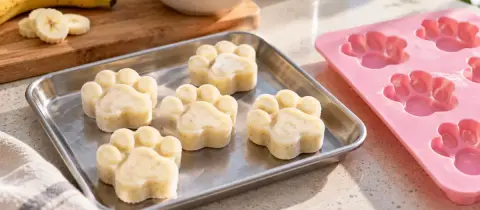
- Mashed in a toy: spoon plain, unsweetened applesauce into a KONG or lick mat and freeze. See our frozen KONG and lick mat recipes.
- Count it: apple counts toward the day's treats, so trim other treats on apple days.
Start with one or two pieces the first time, and watch for loose stools or tummy upset.
Apple serving choices by situation
| Situation | What to do |
|---|---|
| Healthy adult dog | A few fresh slices, core and seeds removed |
| Small dog | Tiny cubes, to avoid choking |
| Puppy | One small cube first, then watch their tummy |
| Sensitive tummy | Peel the apple and go slowly |
| Diabetes or pancreatitis | Ask your vet before offering any |
| Dog ate a core or seeds | Note how much, then call your vet or the Animal Poisons Helpline |
| Applesauce | Plain and unsweetened, a spoonful |
| Apple pie, juice, sweetened products | Skip them |
When to see a vet
Call your vet now if your dog has swallowed a whole core or a lot of seeds, or seems to be choking. Don't wait for symptoms.
- Vomiting or retching, especially more than once
- Straining to poo, or no poo at all
- A swollen, hard or sore belly, or a hunched posture
- Loss of appetite, lethargy or drooling
- Coughing, gagging or pawing at the mouth, which can mean something is stuck in the throat
If your dog has eaten something toxic such as grapes, raisins or xylitol, call your vet or the Animal Poisons Helpline (1300 869 738, 24/7) straight away. See our toxic foods list.
Frequently asked questions
Can dogs have apples every day?
A small amount can be fine, but it's better not to make it a habit. PetMD's serving sizes are given as a daily amount, within its rule that treats should be no more than about 10% of daily calories. Apple has natural sugar, so for most dogs a few slices a few times a week is plenty.
Is apple good for dogs?
In small amounts it's a healthy treat. The AKC says apples provide fibre, vitamins A and C, potassium and antioxidants. It's also sugary, so it doesn't replace a complete, balanced diet. Think of it as a crunchy extra rather than a supplement.
Can dogs eat green apples?
Green apples can be served the same way as red ones: washed, cored and seeded, in small pieces. Neither source we read separates apple varieties, so the same safety rules apply. They can be more tart, so some dogs won't like them. Start small.
How many apple seeds are toxic to a dog?
Sources don't give a precise number. PetMD says a dog would need to eat a large number of seeds to be poisoned, as they hold only trace cyanide. If your dog eats a few seeds, it's usually not an emergency, but if they eat a lot, call your vet or the Animal Poisons Helpline.
What should I do if my dog ate an apple core?
Work out how much was eaten, and whether the core and stem went too. A whole core can choke a dog or contribute to a blockage, as PetMD and the AKC describe. Call your vet for advice, and watch for vomiting, straining, a sore belly or going off food. Don't try to make your dog sick at home.
Can dogs eat applesauce?
Yes, if it's plain and unsweetened, in small amounts. Avoid versions with added sugar, spices, preservatives or xylitol, which is toxic to dogs. Freezing a spoonful in an ice cube tray makes an easy treat, as the AKC suggests. Always check the label first.
Are any fruits toxic to dogs?
Yes. Grapes, raisins and sultanas are the fruits dogs must never eat, as they can cause kidney failure. Apple is one of the safer fruits once the core and seeds are gone. Our what fruits can dogs eat guide lists safe and unsafe fruits, and the toxic foods list covers everything else.
Related guides
- Can dogs eat bananas?
- What fruits can dogs eat?
- Can dogs eat mango?
- Can dogs eat strawberries?
- Can dogs eat cherries?
- Can dogs eat watermelon?
- Can dogs eat pineapple?
- Can dogs eat cucumber?
- Can dogs eat sweet potato?
- Can dogs eat ham? Christmas food and bins
- Frozen KONG and lick mat recipes
- Best frozen dog treats
- All our dog guides
Sources
- American Kennel Club, Can dogs eat apples? updated 2 June 2026, page read 6 November 2026 (https://www.akc.org/expert-advice/nutrition/can-dogs-eat-apples/)
- PetMD, Can Dogs Eat Apples? Benefits and Risks, updated 25 September 2025, page read 6 November 2026 (https://www.petmd.com/dog/nutrition/can-dogs-eat-apples)
This guide provides general information and isn't a substitute for veterinary advice. If you're concerned about your dog's diet or health, speak with your vet.